What Is PIM for Manufacturing?
PIM for manufacturing centralizes technical product data, specifications, CAD files, compliance documents, and compatibility matrices, into one system for distribution to B2B portals, reseller networks, and ecommerce sites. Unlike retail-focused tools, product information management for manufacturers prioritizes deep attribute hierarchies, ERP integration, and role-based catalogs where engineers see technical specs while customers see approved marketing copy. PIM software for manufacturing ingests data from ERP systems like SAP or Odoo, enriches it with compliance certifications and repair manuals, and syndicates to distributors with customer-specific pricing. Manufacturing product data management solves the chaos of spreadsheets by creating a single source of truth for complex, multi-level product data across the product lifecycle.
How PIM Differs from ERP and PLM Systems
An ERP manages transactions: inventory levels, purchase orders, financials, and basic product identifiers like SKU and cost. PIM for manufacturing manages enrichment: technical specifications, CAD files, compliance documents, and channel-specific content that ERPs cannot handle. The ERP answers “how many units do we have and what did we pay?” The product information management for manufacturers answers “what are its specifications and which compliance standards does it meet?” Neither replaces the other. PIM integration with ERP for manufacturers ensures data flows both ways so inventory updates in the ERP enrich product records in the PIM.
A PLM (Product Lifecycle Management) system manages product design, engineering, and development before launch. PLM answers “how do we design and manufacture this product?” PIM software for manufacturing answers “how do we describe and sell this product across channels after launch?” PLM serves engineers during development. B2B PIM for manufacturing companies serves marketing, sales, and distribution teams after production. As products move from development to market, data flows from PLM to PIM. Integration between them streamlines the handoff.

Why Standard Data Tools Fall Short for Manufacturers
Spreadsheets cannot handle complex product hierarchies. A single industrial motor might have nested specifications: voltage ranges with sub-attributes, compatibility matrices linking to dozens of replacement parts, and multiple compliance certifications. PIM for complex product catalogs manages these relationships natively. Spreadsheets flatten everything into rows and columns, losing connections between components. Manufacturing product data management requires a database that understands that part A is compatible with parts B, C, and D but not part E. Spreadsheets have no concept of compatibility.
ERPs store transactional data, not rich product content. Your ERP knows the cost and quantity of a pump but cannot manage its CAD drawings, installation manuals, or warranty documents. The product data management manufacturing industry requires linking technical assets to product records. ERPs also lack channel syndication. They cannot push product data to Amazon, distributor portals, and ecommerce sites in channel-specific formats. PIM for multichannel manufacturing distribution fills this gap. Standard tools force manufacturers to choose between spreadsheets (flexible but chaotic) and ERPs (structured but limited). A manufacturing PIM combines the structure of an ERP with the enrichment capabilities spreadsheets lack.
Key Challenges PIM Solves in Manufacturing
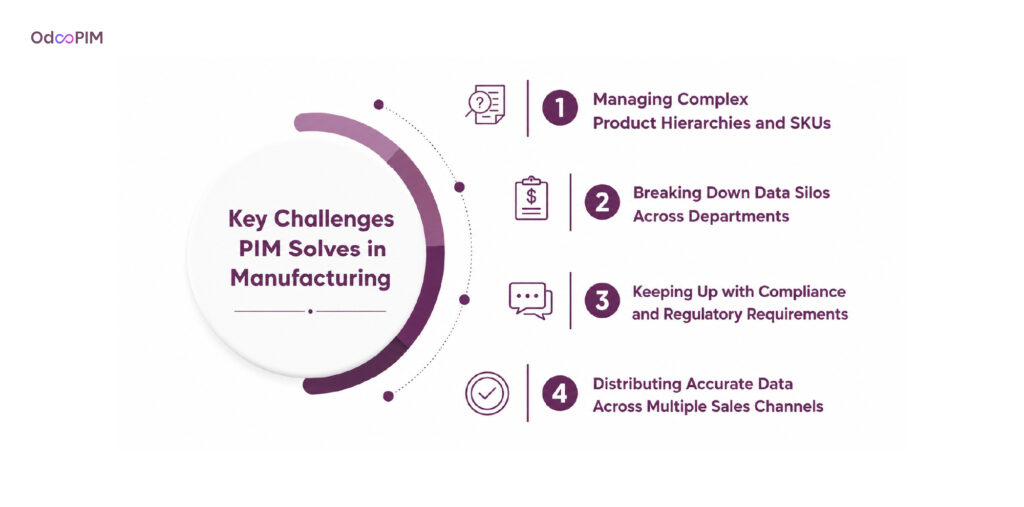
Managing Complex Product Hierarchies and SKUs
A single industrial product can have dozens of variants, each with unique specifications, compatibility rules, and replacement parts. Spreadsheets flatten these relationships into rows and columns, losing the connections between components. PIM for complex product catalogs maintains nested attribute hierarchies where a motor’s voltage specification includes sub-attributes for min, max, and nominal ranges. The system also tracks compatibility matrices, linking each product to compatible accessories and replacement parts.
SKU proliferation makes management even harder. A pump available in three sizes, four materials, and two voltage configurations creates 24 distinct SKUs. PIM for manufacturing handles variant generation automatically from a master product record. Add a new material option, and the system creates every size-material combination instantly. Manufacturing product data management without a PIM means manually creating each variant and praying nothing gets missed.
Breaking Down Data Silos Across Departments
Engineering maintains specifications in the ERP. Marketing keeps descriptions in spreadsheets. Sales manages pricing in separate files. Product information management for manufacturers centralizes everything into one system that every department uses. Engineering updates a spec in the PIM. Marketing sees that change immediately. Sales adjusts pricing based on the new spec. Centralized product data manufacturing eliminates the “which version is current” debates that waste hours weekly.
Departmental silos also create duplicate work. Marketing enriches a product. Engineering enriches the same product independently. B2B PIM for manufacturing companies ensures one enrichment feeds all departments. Role-based permissions let engineering edit technical fields while marketing handles descriptions. Neither steps on the other’s work. PIM integration with ERP for manufacturers pulls transactional data from the ERP into the same interface. Inventory, cost, and basic identifiers live alongside enriched content.
The intricacies of digital commerce are prompting organizations to enhance how they create, maintain and publish product information to downstream channels
– Helen Grimster & Jason Daigler, Gartner, Market Guide for Product Information Management Solutions
Keeping Up with Compliance and Regulatory Requirements
Manufacturers face a web of compliance standards: RoHS, REACH, ISO, UL, CE, and industry-specific regulations. Each standard requires specific data fields, documentation, and certification tracking. PIM system for industrial products stores compliance attributes per product and enforces validation rules. A product missing required CE documentation cannot syndicate to EU channels. The system blocks incomplete compliance data before it causes fines or delisting.
A new version of RoHS adds restricted substances. Product data management manufacturing industry with a PIM lets you add new compliance fields once and apply them across affected products. Audit trails track who certified which product and when. PIM software for manufacturing also manages supplier compliance data. Your suppliers provide material declarations. The PIM validates them against your requirements and flags non-compliant components. Without this automation, compliance becomes a full-time manual audit job. With a PIM, it runs in the background.
Distributing Accurate Data Across Multiple Sales Channels
Manufacturers sell through distributors, direct ecommerce, marketplaces, and internal sales portals. Each channel needs different data formats and different product assortments. PIM for multichannel manufacturing distribution stores one master record and transforms it for each destination. Distributor A sees technical specs with their pricing, distributor B sees marketing copy with different pricing and your ecommerce site sees customer-friendly descriptions, all from the same source.
Before pushing to Amazon Business, the PIM checks that every product has a GTIN and requires safety certifications. Before pushing to a distributor portal, it checks that customer-specific pricing is applied. PIM integration with ERP for manufacturers ensures inventory levels from your ERP flow to channels simultaneously. A warehouse updates stock. All channels reflect the change within minutes. Product information management for manufacturers with strong syndication turns channel distribution from a manual headache into an automated process.
Learn about Manufacturing PIM Software.

Core Benefits of Using a PIM System in Manufacturing
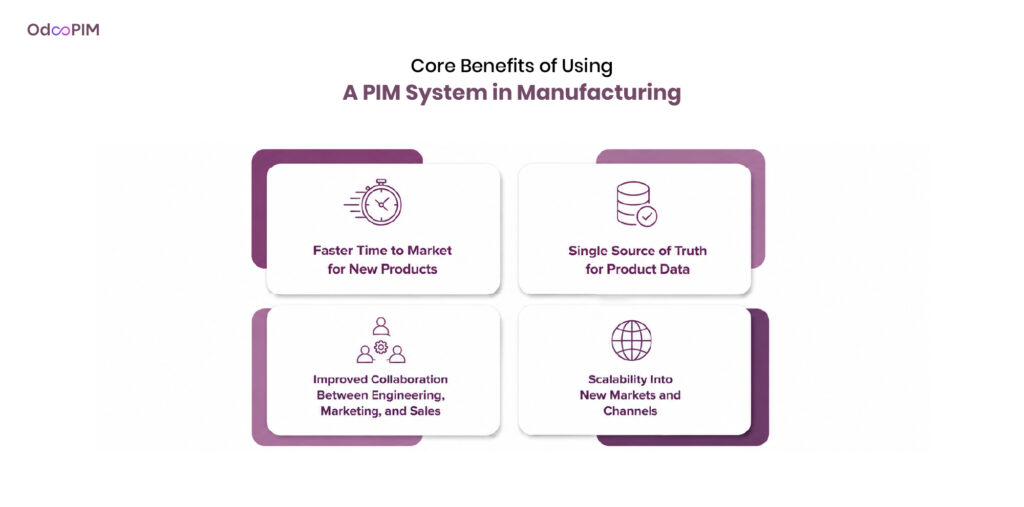
Faster Time to Market for New Products
A new product launch in manufacturing requires coordinating engineering specs, compliance docs, marketing copy, and channel distribution. Without a PIM, this process takes weeks of email chains and spreadsheet handoffs. PIM for manufacturing collapses this timeline by centralizing every task in one system. Engineering uploads specs. Marketing adds descriptions. Legal approves compliance. All in parallel, not sequence. Product information management for manufacturers reduces launch time from weeks to days.
The speed advantage multiplies with complex products. A configurable industrial pump with dozens of options might take a month to prepare for market manually. PIM software for manufacturing handles variant generation automatically. Add a new material option, and the system creates every size-material combination instantly. Approval workflows route each variant to the right reviewers. Syndication pushes all variants to channels simultaneously.
Single Source of Truth for Product Data
Engineering maintains one spreadsheet, marketing maintains another and sales maintains a third. A product update requires touching all three, and they never match. Centralized product data manufacturing with a PIM eliminates this chaos. One system holds every product attribute, document, and image. Every department uses the same source. The PIM system for industrial products becomes the authoritative version that everyone trusts.
A wrong specification in a distributor portal triggers returns. A missing compliance document causes delisting. Manufacturing product data management with a PIM ensures that every channel receives the same accurate data because all data comes from one place. No more “I thought you updated that.” No more “which spreadsheet is current?” PIM integration with ERP for manufacturers pulls inventory and pricing from your ERP into the same source. Your team works from one interface. Your channels receive one version of truth.
Improved Collaboration Between Engineering, Marketing, and Sales
Engineering and marketing rarely speak the same language. Engineers care about voltage tolerances and marketers care about benefits and features. B2B PIM for manufacturing companies gives each team their own view of the same product. Engineers see technical fields and CAD files, marketers see description fields and SEO metadata and sales sees pricing and customer-specific notes.
Workflow automation routes tasks between teams. Engineering completes a spec sheet, the system notifies marketing to write descriptions. Once marketing finishes, then sales gets notified to set channel pricing. Product information management for manufacturers tracks completion status and deadlines. A stalled task escalates automatically. PIM for complex product catalogs also handles approval chains. A junior engineer proposes a spec change. A senior engineer reviews and approves. The system logs every decision. Collaboration becomes structured, not chaotic. Your team stops fighting over who owns what and starts launching products.
Scalability Into New Markets and Channels
Adding a new sales channel means configuring new data formats, new validation rules, and new distribution feeds. Without a PIM, this takes weeks of manual setup. PIM for multichannel manufacturing distribution reduces new channel onboarding to days. Define the channel’s requirements once, map your master fields to the channel’s schema, set validation rules and the system handles the rest. Add a new distributor portal? Same process. Add Amazon Business? Same process. PIM software for manufacturing scales with your growth.
Geographic expansion follows the same pattern. Entering the EU market requires metric measurements, local compliance labels, and translated content. Product data management manufacturing industry with a PIM handles localization through regional overlays. One master product record. French overlay for France. German overlay for Germany. The system serves the correct version to each region’s channels automatically. PIM system for industrial products turns market expansion from a data migration project into a configuration change. Your catalog can double.

How PIM Integrates With Your Existing Manufacturing Tech Stack
PIM and ERP Integration
Your ERP holds inventory levels, cost data, and basic product identifiers. Your PIM holds enriched descriptions, technical specs, and channel content. PIM integration with ERP for manufacturers connects these systems so data flows both ways automatically. When your ERP updates inventory, the PIM receives that change and syndicates it to the channels. When your PIM enriches a product, basic identifiers like SKU and price sync back to the ERP. PIM for manufacturing without ERP integration forces double entry and guarantees data drift.
Odoo users get native integration because the PIM and ERP share the same database. For SAP or Microsoft Dynamics, look for pre-built connectors or open APIs. Test the integration with your actual data volume before committing. A broken connector creates more work than no connector. Manufacturing product data management relies on clean ERP-PIM handoffs. Inventory updates should flow instantly. New products created in the ERP should appear in the PIM automatically.
PIM and PLM Integration
PLM (Product Lifecycle Management) manages product design, engineering, and development before launch. PLM answers “how do we design and manufacture this product?” Product information management for manufacturers answers “how do we describe and sell this product after launch?” Integration between them streamlines the handoff from development to marketing. When a product reaches the “released” stage in PLM, its core specifications and CAD files should flow automatically into the PIM.
The integration also works in reverse. Customer feedback from the PIM, returns due to confusing specs, requests for missing documentation, can feed back into PLM for future revisions. PIM for complex product catalogs benefits from PLM integration because technical data originates in PLM. Engineers design there. Marketers are enriched there. The PIM becomes the bridge between development and sales. PIM system for industrial products without PLM integration forces your team to manually export from PLM and import into PIM. That manual step introduces delays and errors.
Connecting PIM to E-commerce and Distributor Portals
Manufacturers sell through multiple channels: direct ecommerce, distributor portals, marketplaces like Amazon Business, and internal sales portals. PIM for multichannel manufacturing distribution connects to each destination through pre-built connectors or APIs. Your ecommerce platform receives customer-friendly descriptions and images. Distributor portals receive technical specs with channel-specific pricing. Amazon Business receives GTINs and compliance certifications. Each channel gets what it needs, transformed automatically from your master PIM data.
Channel connectivity also includes validation. Before pushing to a distributor portal, the PIM checks that customer-specific pricing is applied. Before pushing to Amazon, it checks that every product has a GTIN and requires safety labels. B2B PIM for manufacturing companies maintains channel-specific mapping rules. Define once and apply automatically. Centralized product data manufacturing with strong channel connectivity eliminates manual reformatting and copy-paste errors. A price change in your ERP flows through the PIM to the channels within minutes.
Who Needs PIM in Manufacturing?
Industrial Equipment Manufacturers
Companies that build heavy machinery, pumps, motors, or industrial tools face massive product complexity. Each product has dozens of specifications, compatibility rules with other components, and a stack of compliance certifications. PIM for manufacturing helps these businesses manage nested attribute hierarchies where a motor’s voltage rating includes min, max, and nominal sub-values. PIM system for industrial products also tracks which replacement parts work with which equipment generations, preventing costly ordering errors.
Industrial equipment manufacturers also sell through multiple channels: direct sales, distributor networks, and increasingly ecommerce. Product information management for manufacturers ensures that a technical spec sheet created by engineering reaches every channel in the correct format. Distributors see technical data. Ecommerce customers see simplified descriptions. Internal sales teams see both. PIM for complex product catalogs turns chaos into structure. Without it, engineers waste hours answering the same questions: “which part works with which machine?”
Spare Parts and Components Suppliers
Suppliers of bearings, fasteners, electronic components, or hydraulic parts manage thousands of SKUs with subtle variations. A single bearing might differ by inner diameter, outer diameter, width, material, and seal type. Manufacturing product data management with a PIM handles variant generation automatically from a master template. Add a new material option, and the system creates every size-material combination instantly. Centralized product data manufacturing ensures that a customer searching for a specific bearing specification finds exactly what they need.
Parts suppliers also face intense pressure from customers who need accurate compatibility data. A wrong part number shuts down a production line. PIM software for manufacturing maintains compatibility matrices linking each part to the equipment it fits. Validation rules block incomplete compatibility data before syndication. PIM integration with ERP for manufacturers keeps inventory levels synced so customers see real-time availability. Without a PIM, parts suppliers drown in SKU proliferation. With a PIM, they turn complexity into competitive advantage.
B2B Manufacturers Selling Across Distributors
Manufacturers who sell through distributor networks need to provide different data to each partner. Distributor A gets different pricing than Distributor B. Distributor C sells only a subset of your product line. B2B PIM for manufacturing companies creates role-based catalogs. Each distributor logs into a portal and sees only their approved products with their specific pricing tiers. The same master product record serves multiple partners with different views. PIM for multichannel manufacturing distribution automates this segmentation.
Distributor data requirements also vary. Some need CSV feeds. Others require API connections. Many want branded PDF catalogs. The product data management manufacturing industry with a PIM handles each partner’s preferred format automatically. Define the mapping once. The system generates the correct feed on schedule. Product information management for manufacturers also tracks which distributors have received which product updates. A spec change triggers automatic notification to every affected partner. Without this automation, manufacturers spend weeks manually updating distributor spreadsheets. With a PIM, it runs in the background while your team focuses on growth.
How to Choose the Right PIM Software for Your Manufacturing Business
Key Features to Look For
Your PIM must handle attribute hierarchies where specifications have sub-specifications. A motor’s voltage rating includes min, max, and nominal values. A bearing’s dimensions include inner diameter, outer diameter, and width. PIM for complex product catalogs supports nested attributes without forcing workarounds. Also demand ERP integration. PIM integration with ERP for manufacturers ensures inventory and pricing flow automatically. Test the connector with your ERP before buying.
Compatibility management is another non-negotiable feature. Your PIM must track which parts work with which equipment and flag incompatible combinations. The PIM system for industrial products should also offer role-based catalogs. Engineers see technical specs, sales sees marketing copy and distributors see customer-specific pricing. B2B PIM for manufacturing companies includes approval workflows for compliance-sensitive fields. Validation rules block incomplete products from syndication. Missing CAD file? Blocked. Missing compliance cert? Blocked. These features separate manufacturing PIMs from retail-focused tools.
On-Premise vs Cloud-Based PIM
Cloud-based PIM (SaaS) means the vendor hosts everything. You pay a subscription and access the software via browser. PIM software for manufacturing in the cloud eliminates server maintenance, security patches, and upgrade planning. Most manufacturers choose cloud for lower IT overhead. The trade-off is data residency. Your product specifications and compliance documents live on vendor infrastructure. Some regulated industries require on-premise deployment where you install the software on your own servers.
On-premise gives you full control over data, customization, and upgrade timing. Open-source options like Akeneo Community Edition or Pimcore allow this. Manufacturing product data management on-premise requires your team to handle hosting, security, backups, and troubleshooting. A bug appears at 2 AM before a product launch? Your engineers fix it, not the vendor. Centralized product data manufacturing deployment choice depends on your team’s capacity and compliance requirements. Cloud for speed and low maintenance. On-premise for control and data sovereignty.
Questions to Ask Before Buying
Ask each vendor: “How does your PIM handle nested attribute hierarchies?” A retail-focused PIM will struggle with voltage ranges and compatibility matrices. Product information management for manufacturers must demonstrate complex data modeling with your product examples. Second question: “What pre-built connectors do you offer for my ERP and channels?” PIM for multichannel manufacturing distribution needs native connections to SAP, Microsoft Dynamics, or Odoo, plus distributor portals and ecommerce platforms.
Third question: “How do your approval workflows handle compliance review?” PIM for manufacturing should route products to legal or engineering for signoff before syndication. Ask for a live demo of a compliance-heavy product. Fourth question: “What does implementation typically cost and how long does it take?” Product data management manufacturing industry implementations mostly run four to six months. Add 50% to vendor estimates. Fifth question: “Can you provide references from manufacturers in my specific sub-industry?” A PIM that works for automotive parts might fail for industrial pumps. Talk to peers. Test with your data. Verify before committing.

Frequently Asked Questions
1. What is PIM in manufacturing?
PIM for manufacturing centralizes technical product data, specifications, CAD files, compliance documents, and compatibility matrices, into one system for distribution to B2B portals, reseller networks, and ecommerce sites. Unlike retail-focused tools, product information management for manufacturers prioritizes attribute hierarchies, ERP integration, and role-based catalogs where engineers see technical specs while customers see approved marketing copy. PIM software for manufacturing ingests data from ERP systems like SAP or Odoo, enriches it with compliance certifications, and syndicates to distributors with customer-specific pricing. Manufacturing product data management solves the chaos of spreadsheets by creating a single source of truth for complex, multi-level product data.
2. How does PIM help reduce time to market?
A new product launch requires coordinating engineering specs, compliance docs, marketing copy, and channel distribution. The PIM system for industrial products collapses this timeline from weeks to days by centralizing every task in one system. Engineering uploads specs, marketing adds descriptions and legal approves compliance. All in parallel, not sequence. Centralized product data manufacturing with a PIM handles variant generation automatically, adds a new material option, and the system creates every size-material combination instantly. Approval workflows route each variant to the right reviewers. Syndication pushes the variants to every channel simultaneously.
3. Is PIM different from ERP?
An ERP manages transactions: inventory levels, purchase orders, financials, and basic product identifiers like SKU and cost. B2B PIM for manufacturing companies manages enrichment: technical specifications, CAD files, compliance documents, and channel-specific content that ERPs cannot handle. The ERP answers “how many units do we have and what did we pay?” The PIM answers “what are its specifications and which compliance standards does it meet?” PIM integration with ERP for manufacturers ensures data flows both ways so inventory updates in the ERP enrich product records in the PIM. Neither replaces the other. You need both.