
What Is Ecommerce Performance Analytics?
Definition and scope
Ecommerce performance analytics is the practice of collecting, measuring, and analyzing data from your online store to understand how well your business is performing and where improvements are needed. High performance ecommerce depends on tracking key metrics like conversion rate, average order value, and cart abandonment, but true performance measurement goes beyond surface-level numbers. Ecommerce performance analytics covers everything from website speed and user behavior to product data quality and channel syndication effectiveness. Ecommerce performance marketing relies on analytics to optimize campaigns, but product data quality is often the hidden variable that determines whether those campaigns convert. Performance ecommerce businesses measure what matters, and what matters starts with product data completeness.
Analytics vs. reporting
Reporting tells you what happened, the conversion rate dropped from 3% to 2.5% last month, and cart abandonment increased by 8% during the same period. Ecommerce performance analytics tells you why it happened and what to do about it, connecting the dots between product data gaps, channel inconsistencies, and declining conversion rates. High performance ecommerce requires both reporting and analytics, because reporting without analysis is just data collection, and analysis without reporting is guesswork. Ecommerce performance teams use analytics to diagnose root causes, not just track symptoms, ensuring that every metric has an actionable insight attached to it. Ecommerce website performance optimization starts with identifying which product data issues are driving your metric declines.
Learn about PIM Software for eCommerce

Why product data is a hidden variable
Most ecommerce performance analytics tools measure shopper behavior, ad performance, and site speed, but they do not measure product data quality, the completeness of your descriptions, the consistency of your attributes, or the accuracy of your channel syndication. High performance ecommerce requires understanding that a low conversion rate often traces back to missing product dimensions, incomplete variant attributes, or inconsistent pricing across channels, not just poor ad targeting or slow page load times. Ecommerce performance metrics like return rate and time to publish are directly influenced by product data quality, yet most analytics dashboards ignore this connection entirely. Performance ecommerce leaders build analytics stacks that include product data completeness scores alongside traditional ecommerce metrics, because product data is the invisible variable that determines whether your performance marketing actually converts.
Learn about Best PIM Software for Ecommerce Site
10 Core Ecommerce Performance Metrics
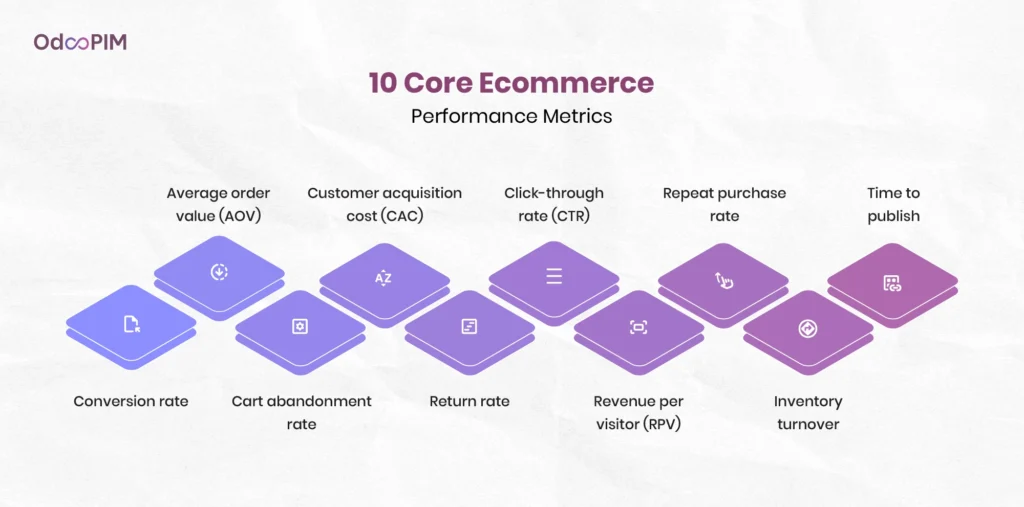
1. Conversion rate
Conversion rate measures the percentage of website visitors who complete a purchase, and it is the most critical ecommerce performance metric because it directly reflects how well your product data, user experience, and marketing align. A conversion rate below 2% typically indicates product data gaps, missing dimensions, incomplete variant information, or inconsistent pricing across channels that confuse shoppers and prevent purchases. High performance ecommerce businesses maintain conversion rates above 3% by ensuring every product has complete attributes, high-quality images, and accurate pricing before syndication. Ecommerce performance analytics should track conversion rate by product category, because electronics might convert differently than apparel, revealing category-specific data quality issues. Performance ecommerce leaders know that conversion rate optimization starts with product data completeness, not just A/B testing button colors.
2. Average order value (AOV)
Average order value measures the average amount customers spend per transaction, and it is a key ecommerce performance metric because increasing AOV is often more cost-effective than acquiring new customers. High performance ecommerce businesses drive AOV through cross-sell and upsell recommendations that depend on accurate product relationships, compatibility data, and bundle suggestions, all of which require clean, structured product data. Ecommerce performance marketing campaigns that promote complementary products fail when product relationships are missing or inconsistent across channels. Ecommerce website performance optimization includes ensuring that product recommendation algorithms have complete attribute data to make relevant suggestions. Performance ecommerce teams track AOV by product category and channel, because inconsistent product data across channels can lead to different AOVs that reveal syndication gaps.
3. Cart abandonment rate
Cart abandonment rate measures the percentage of shoppers who add items to their cart but do not complete the purchase, and it is a critical ecommerce performance metric because abandoned carts represent lost revenue that could be recovered. High performance ecommerce businesses maintain cart abandonment rates below 70% by ensuring that product data, pricing, availability, shipping dimensions, is accurate and consistent across the entire shopping journey. Ecommerce performance analytics often shows that abandoned carts spike when product dimensions are missing or variant information is incomplete, because shoppers cannot confirm that the product fits their needs. Ecommerce performance optimization includes ensuring that shipping costs, delivery dates, and product specifications are visible and accurate at the cart stage. Performance ecommerce leaders use cart abandonment data to identify which products or categories have the highest abandonment rates, then audit those products for data completeness gaps.
Learn about Ecommerce Catalog Management
4. Customer acquisition cost (CAC)
Customer acquisition cost measures the total marketing and sales spend required to acquire a new customer, and it is a critical ecommerce performance metric because high CAC destroys profitability even when conversion rates are strong. High performance ecommerce businesses reduce CAC by improving organic conversion rates through better product data, because complete descriptions and accurate attributes drive higher organic rankings and reduce reliance on paid advertising. Ecommerce performance marketing campaigns are wasted when product data inconsistencies cause listing rejections or poor conversion rates, increasing CAC without corresponding revenue growth. Ecommerce website performance optimization includes ensuring that product data completeness scores correlate with lower CAC, because complete products convert at higher rates and reduce the cost of customer acquisition. Performance ecommerce teams track CAC by channel and product category to identify where product data gaps are driving up acquisition costs.

5. Return rate
Return rate measures the percentage of orders that are returned by customers, and it is a critical ecommerce performance metric because returns erode profitability and indicate product data quality issues. High performance ecommerce businesses maintain return rates below 10% by ensuring that product descriptions, dimensions, images, and specifications are complete and accurate before customers purchase. Ecommerce performance analytics shows that return rates spike when product dimensions are missing, variant information is incomplete, or images do not accurately represent the product. Performance ecommerce leaders use return rate data to identify which categories have the highest return rates, then audit those products for data completeness gaps. Ecommerce performance optimization includes adding product dimensions, material information, and size guides to reduce customer expectation mismatches and prevent returns.
6. Click-through rate (CTR)
Click-through rate measures the percentage of shoppers who click on your product listing after seeing it in search results or ads, and it is a critical ecommerce performance metric because low CTR indicates poor listing quality or relevance. High performance ecommerce businesses maintain CTRs above 5% by ensuring product titles include primary keywords, images are high-quality, and pricing is competitive, all of which depend on complete product data. Ecommerce performance marketing campaigns fail when product data inconsistencies cause listing rejections or suppress organic visibility, reducing CTR across channels. Ecommerce website performance optimization includes ensuring that product data completeness scores correlate with higher CTR, because complete products with optimized titles and images attract more clicks. Performance ecommerce teams track CTR by product category to identify which groups have listing quality issues that suppress organic traffic.
7. Revenue per visitor (RPV)
Revenue per visitor measures the average revenue generated per website visitor, combining conversion rate and average order value into a single metric that reflects overall monetization efficiency. High performance ecommerce businesses maintain RPV above $2 by ensuring that product data completeness drives both higher conversion rates and higher average order values. Ecommerce performance analytics shows that RPV increases when product data is complete because shoppers find what they need faster, add complementary products to their cart, and complete purchases with confidence. Performance ecommerce leaders use RPV to measure the combined impact of product data quality on both conversion and upsell effectiveness. Ecommerce performance optimization includes tracking RPV by product category and channel to identify where incomplete product data is costing revenue.
8. Repeat purchase rate
Repeat purchase rate measures the percentage of customers who make more than one purchase, and it is a critical ecommerce performance metric because repeat customers are more profitable and less expensive to acquire than new customers. High performance ecommerce businesses maintain repeat purchase rates above 25% by ensuring that product data accuracy drives customer satisfaction and trust. Ecommerce performance analytics shows that repeat purchase rates drop when customers receive incorrect products due to inconsistent SKUs or missing variant attributes. Performance ecommerce leaders use repeat purchase rate to measure the long-term impact of product data quality on customer loyalty and lifetime value. Ecommerce performance optimization includes auditing product data for consistency across channels, because customers who see different information on your website versus Amazon are less likely to return.
Learn about Amazon PIM software.
9. Inventory turnover
Inventory turnover measures how quickly your inventory sells and is replaced, and it is a critical ecommerce performance metric because high turnover indicates strong demand and efficient operations. High performance ecommerce businesses maintain healthy inventory turnover by ensuring product data accuracy drives discoverability and conversion. Ecommerce performance analytics shows that slow-moving inventory often has incomplete product data, missing dimensions, poor descriptions, or inconsistent attributes that prevent shoppers from finding and buying those products. Performance ecommerce leaders use inventory turnover data to identify which products have data quality issues that are suppressing sales and causing slow turnover. Ecommerce performance optimization includes prioritizing product data enrichment for slow-moving SKUs to improve their discoverability and conversion rates.
10. Time to publish
Time to publish measures how long it takes from product data creation to live listing across all sales channels, and it is a critical ecommerce performance metric because faster time-to-market captures revenue sooner and reduces opportunity cost. High performance ecommerce businesses maintain time-to-publish under 48 hours by automating product data enrichment, validation, and syndication through PIM workflows. Ecommerce performance analytics shows that time-to-publish increases when product data is managed in spreadsheets because manual processes introduce delays and errors. Performance ecommerce leaders use time-to-publish to measure the efficiency of their product data workflows, identifying bottlenecks where manual steps slow down channel syndication. Ecommerce performance optimization includes tracking time-to-publish by category and channel to identify where manual processes are delaying revenue.
Learn about eCommerce AI Agents
Despite strong e-commerce growth, 76% of global retail sales will still occur offline in 2028 — which is why Forrester emphasizes that retailers must invest in omnichannel strategies delivering a seamless experience across both online and offline channels.
Why Most Ecommerce Analytics Tools Miss the Root Cause
They measure behavior, not data quality
Ecommerce performance analytics tools like Google Analytics, Adobe Analytics, and Hotjar focus on user behavior, clicks, scrolls, page views, and conversions, but they do not measure product data completeness, attribute consistency, or channel syndication accuracy. High performance ecommerce requires understanding that a 10% drop in conversion rate often traces back to missing product dimensions or inconsistent variant attributes, not poor user experience or ad targeting. Ecommerce performance teams who rely solely on behavioral analytics will optimize button colors and checkout flows while ignoring the product data gaps that are actually driving metric declines. Performance ecommerce leaders connect behavioral analytics with product data quality scores to diagnose root causes, not just surface-level symptoms. Ecommerce website performance improvements must include product data quality as a core metric, because bad data makes every other optimization less effective.
Channel fragmentation compounds the blind spot
Ecommerce performance analytics tools measure each channel separately, website analytics, Amazon dashboards, Google Shopping reports, social commerce insights, but none of them see the complete picture of product data quality across channels. High performance ecommerce requires unified analytics that track product data completeness scores across every channel, because inconsistent product data across channels drives metric variations that behavioral analytics cannot explain. Ecommerce performance teams who manage analytics separately for each channel miss the root cause when one channel outperforms another because its product data is more complete. Performance ecommerce leaders aggregate performance data by product, not by channel, to identify where product data gaps are driving channel-specific underperformance. Ecommerce performance marketing campaigns are wasted when channel-specific product data gaps prevent them from converting, and fragmented analytics tools will not tell you why.
The data completeness gap
Ecommerce performance analytics dashboards show conversion rates, AOV, and cart abandonment, but they do not show whether your product descriptions are complete, your dimensions are accurate, or your variant attributes are consistent across channels. High performance ecommerce businesses track product data completeness scores alongside traditional performance metrics, creating a direct link between data quality and business outcomes. Ecommerce performance metrics like return rate and time to publish are directly influenced by product data completeness, yet most analytics dashboards completely ignore this connection. Performance ecommerce leaders build analytics stacks that include product data completeness as a core KPI, ensuring that every performance metric has a corresponding data quality metric to explain its movement. Ecommerce website performance optimization requires understanding that a low conversion rate on a specific category is likely driven by incomplete product attributes, and the analytics dashboard must show that connection.
Learn about Product Data for Ecommerce

How a PIM Transforms Ecommerce Performance Analytics
Centralized product data as a single source of truth
A PIM centralizes every product attribute, descriptions, dimensions, images, variants, channel mappings, into one master database, creating a single source of truth that every analytics tool can reference. Ecommerce performance analytics with PIM centralization means that product data completeness scores, attribute consistency metrics, and channel syndication accuracy become trackable KPIs alongside conversion rates and AOV. High performance ecommerce businesses use PIM data to power their analytics dashboards, ensuring that every performance metric has a corresponding data quality metric to explain its movement. Ecommerce performance teams can finally see when a conversion rate drop is driven by missing product dimensions in a specific category, because the PIM provides that visibility. Performance ecommerce leaders use PIM data to diagnose root causes, not just track symptoms.
Completeness scoring and validation rules
A PIM assigns a completeness score to every product based on how many required attributes are populated and whether those values meet quality standards, and it enforces validation rules that block incomplete products from syndication. Ecommerce performance analytics with PIM completeness scoring means that conversion rates, return rates, and time-to-publish can be correlated with completeness scores, revealing exactly which data gaps are hurting performance. High performance ecommerce businesses set completeness thresholds and track performance improvements as scores increase, because complete products convert at higher rates and generate fewer returns. Performance ecommerce leaders use completeness scores to prioritize enrichment work, fixing the products with the lowest scores first to drive the biggest performance gains. Ecommerce performance optimization becomes data-driven when every product has a completeness score that can be correlated with revenue.
Channel-ready product syndication
A PIM syndicates enriched, validated product data to every sales channel automatically, ensuring that product data is consistent and complete across your website, Amazon, Google Shopping, and retailer portals. Ecommerce performance analytics with PIM syndication means that channel performance differences can be traced back to data quality gaps in specific channels, because the PIM tracks what was sent to each destination. High performance ecommerce businesses use PIM syndication data to monitor which channels received complete product feeds and which channels have partial data, enabling proactive optimization before metrics decline. Performance ecommerce leaders track performance by channel and by product to identify where syndication gaps are driving underperformance. Ecommerce performance marketing campaigns convert better when every channel has complete, consistent product data, and PIM syndication ensures that consistency.
Faster product launches with workflow automation
A PIM with workflow automation routes product enrichment tasks to the right teams, tracks approval status, and syndicates approved products to channels automatically, reducing time-to-publish from weeks to days. Ecommerce performance analytics with PIM workflow automation means that time-to-publish becomes a trackable KPI that can be monitored and improved over time. High performance ecommerce businesses use PIM automation to launch products faster, capturing revenue sooner and improving time-to-publish metrics. Ecommerce performance teams can track how many products were launched each month, how long each took, and which bottlenecks caused delays, enabling continuous process improvement. Performance ecommerce leaders know that faster time-to-market is a competitive advantage, and PIM workflow automation makes it achievable at scale.
Learn about ecommerce PIM Software
Case Studies
Case Study 1: Data-Driven Apparel Brand Boosts Conversion Rate by 32% by Uncovering Product Data Gaps
Challenge
An apparel brand generating $4.2 million in annual revenue tracked all the standard ecommerce performance metrics, conversion rate at 2.1%, AOV at $89, and cart abandonment at 72%. The brand invested heavily in ecommerce performance marketing, spending $45,000 monthly across Meta and Google Ads. Yet ecommerce website performance remained flat for six months. The analytics dashboards showed green lights everywhere, ROAS at 3.8X, CTR improving, traffic growing. But revenue was stagnant. The brand’s ecommerce performance analytics tools were measuring behavior but missing the root cause: product data quality.
Solution
The brand implemented OdooPIM to centralize product data and track completeness scores alongside traditional ecommerce performance metrics. The PIM revealed that 40% of products had incomplete dimensions, 25% were missing size charts, and 15% had inconsistent variant attributes across channels. The team correlated completeness scores with conversion rates and discovered that products with 90%+ completeness converted at 3.1%, while products below 70% completeness converted at just 1.4%. High performance ecommerce required fixing the data gaps first. The brand prioritized enrichment for low-scoring products, added size charts, filled missing dimensions, and standardized variant attributes across all channels.
Results
- Ecommerce performance conversion rate increased from 2.1% to 2.8% within 90 days
- Products with enriched data saw 32% higher conversion rates
- Cart abandonment dropped from 72% to 63% due to accurate shipping calculations
- Return rate decreased by 18% as customers received what they expected
- Ecommerce website performance improvements drove an additional $420,000 in annual revenue
- The brand now tracks product completeness as a core ecommerce performance metric alongside conversion rate and AOV
- Performance ecommerce culture shifted from “fix the ads” to “fix the product data”
Case Study 2: Home Goods Retailer Eliminates Channel Discrepancies and Scales to $15M with Unified Analytics
Challenge
A home goods retailer selling across their website, Amazon, and Wayfair generated $8.2 million annually. The brand tracked ecommerce performance separately per channel, website analytics, Amazon dashboards, Wayfair reports. Ecommerce performance analytics showed wildly different conversion rates across channels: website at 2.8%, Amazon at 9.2%, Wayfair at 4.1%. The marketing team assumed Amazon outperformed due to marketplace traffic quality. But the real problem was invisible in channel-specific dashboards: product data completeness varied across channels. Website listings had complete dimensions and descriptions, but Amazon listings were missing size charts, and Wayfair listings lacked material specifications. Ecommerce website performance appeared strong, but channel fragmentation masked the data quality issue.
Solution
The retailer deployed OdooPIM to create a single source of truth for all product data and syndicate complete, consistent data to every channel. Ecommerce performance analytics was unified across channels, with product completeness scores tracked alongside conversion rates per channel. The PIM revealed that Amazon products with size charts converted at 11.2%, while those without converted at just 6.8%. Wayfair products with material specifications converted at 5.2% versus 3.1% without. The brand enriched products with complete dimensions, size charts, material specs, and high-res images before syndicating to every channel. Ecommerce performance marketing campaigns were optimized based on unified data, not channel-specific guesses.
Results
- Ecommerce performance conversion rate on Amazon increased from 9.2% to 11.8%
- Wayfair conversion rate improved from 4.1% to 6.2%
- Total annual revenue grew from $8.2 million to $10.8 million within eight months
- Channel-specific ecommerce performance metrics now tracked against data completeness scores
- The brand scaled to $15 million within 18 months without adding data team headcount
- High performance ecommerce became achievable because product data quality was treated as a core ecommerce performance metric
- The unified analytics stack with PIM integration now shows which data gaps are holding back each channel
Learn about ecommerce inventory management software

Building a High-Performance Ecommerce Analytics Stack
Analytics layer
The analytics layer includes your core reporting tools, Google Analytics, Adobe Analytics, or custom dashboards, that track ecommerce performance metrics like conversion rate, AOV, cart abandonment, and CAC. High performance ecommerce requires that your analytics layer receives product data quality scores from your PIM, enabling correlation between data completeness and performance outcomes. Ecommerce performance dashboards must include product data completeness alongside traditional metrics, because without that connection, you cannot diagnose root causes. Performance ecommerce leaders ensure their analytics layer provides visibility into both what is happening (conversion rates) and why (product data gaps). Ecommerce website performance optimization depends on an analytics layer that can identify which categories or products have data quality issues that are suppressing performance.
Product data layer
The product data layer is your PIM, which centralizes, enriches, and validates product data before it reaches your analytics tools, ensuring that every performance metric has a corresponding data quality metric. Ecommerce performance analytics with a strong product data layer means that completeness scores, attribute consistency metrics, and syndication accuracy are tracked alongside conversion rates. High performance ecommerce businesses use their PIM to power their analytics dashboards, ensuring that every performance metric can be traced back to a product data root cause. Ecommerce performance teams use the product data layer to identify which products or categories have data gaps that are driving performance declines. Performance ecommerce leaders prioritize investment in the product data layer because it enables the analytics layer to diagnose root causes, not just track symptoms.
Channel layer
The channel layer includes your sales channels, website, Amazon, Google Shopping, retailer portals, that receive product data from your PIM and generate performance data that flows back to your analytics layer. Ecommerce performance analytics with a connected channel layer means that channel-specific performance differences can be traced back to data quality gaps in specific channels, because the PIM tracks what was sent to each destination. High performance ecommerce businesses use their channel layer to monitor which channels received complete product feeds and which channels have partial data, enabling proactive optimization before metrics decline. Performance ecommerce leaders track performance by channel and by product to identify where syndication gaps are driving underperformance. Ecommerce performance marketing campaigns convert better when every channel has complete, consistent product data, and the channel layer ensures that visibility.
Feedback loop
The feedback loop connects analytics back to the PIM, so when performance metrics decline, your team can identify the product data gaps driving the decline and prioritize enrichment work to fix them. Ecommerce performance analytics with a closed feedback loop means that every conversion rate drop triggers a product data audit, ensuring that root causes are addressed before they become systemic problems. High performance ecommerce businesses use performance data to prioritize enrichment work, fixing the products with the lowest completeness scores first to drive the biggest performance gains. Performance ecommerce leaders create a continuous improvement cycle where performance data feeds into product data enrichment priorities, and enriched product data drives better performance. Ecommerce website performance optimization becomes a continuous process when analytics and PIM are connected through a feedback loop that ensures data gaps are identified and fixed proactively.
Learn about ecommerce order management
Ecommerce Performance Analytics Checklist
- Conversion rate tracked by product category and channel
- Product data completeness scores tracked for all SKUs
- Attribute consistency metrics tracked across variants
- Return rate tracked by category and correlated with data completeness
- Time-to-publish tracked and monitored for all new products
- Channel performance compared against PIM syndication data
- Product data gaps identified and prioritized by performance impact
- Feedback loop established between analytics and PIM
- Dashboards include data quality metrics alongside performance metrics
- Regular audits conducted to identify data gaps and prioritize fixes
FAQ
1. What are ecommerce performance analytics?
Ecommerce performance analytics is the practice of collecting, measuring, and analyzing data from your online store to understand how well your business is performing and where improvements are needed. High performance ecommerce depends on tracking key metrics like conversion rate and average order value, but true performance measurement goes beyond surface-level numbers to identify root causes. Ecommerce performance analytics covers everything from website speed and user behavior to product data quality and channel syndication effectiveness. Ecommerce performance marketing relies on analytics to optimize campaigns, but product data quality is often the hidden variable that determines whether those campaigns convert. Performance ecommerce businesses measure what matters, and what matters starts with product data completeness.
2. What is the most important ecommerce performance metric?
The most important ecommerce performance metric is conversion rate because it reflects how well your product data, user experience, and marketing align to drive purchases. High performance ecommerce businesses maintain conversion rates above 3% by ensuring every product has complete attributes, high-quality images, and accurate pricing before syndication. Ecommerce performance teams know that conversion rate below 2% typically indicates product data gaps, missing dimensions, incomplete variant information, or inconsistent pricing across channels. Ecommerce website performance optimization starts with ensuring product data completeness drives conversion, because no amount of traffic or marketing spend can compensate for products that do not convert. Performance ecommerce leaders track conversion rate by product category to reveal where data quality issues are costing revenue.
3. How does a PIM improve ecommerce analytics?
A PIM improves ecommerce performance analytics by providing centralized product data completeness scores, attribute consistency metrics, and syndication accuracy data that can be correlated with performance metrics like conversion rate and return rate. High performance ecommerce businesses use PIM data to power their analytics dashboards, ensuring that every performance metric has a corresponding data quality metric to explain its movement. Ecommerce performance teams can finally see when a conversion rate drop is driven by missing product dimensions in a specific category, because the PIM provides that visibility. Ecommerce performance marketing campaigns convert better when product data completeness scores are high, and PIM data enables that optimization. Performance ecommerce leaders use PIM data to diagnose root causes, not just track symptoms.
4. What is the difference between ecommerce analytics and ecommerce reporting?
Reporting tells you what happened, conversion rate dropped from 3% to 2.5% last month, and cart abandonment increased by 8%. Ecommerce performance analytics tells you why it happened and what to do about it, connecting the dots between product data gaps, channel inconsistencies, and declining conversion rates. High performance ecommerce requires both reporting and analytics, because reporting without analysis is just data collection, and analysis without reporting is guesswork. Ecommerce performance teams use analytics to diagnose root causes, not just track symptoms, ensuring that every metric has an actionable insight attached to it. Performance ecommerce leaders know that analytics is what turns data into decisions.
5. Which ecommerce analytics tools work best with a PIM?
Ecommerce performance analytics tools that work best with a PIM are those that can ingest product data quality scores from your PIM alongside traditional performance metrics like conversion rate and AOV. High performance ecommerce businesses use Google Analytics, Adobe Analytics, or custom dashboards that are integrated with their PIM through APIs to display completeness scores, attribute consistency, and syndication accuracy on the same dashboards as performance metrics. Ecommerce performance teams use tools that allow them to segment performance by product data completeness scores, revealing exactly which data gaps are hurting revenue. Ecommerce website performance optimization depends on analytics tools that show you not just what is happening, but why. Performance ecommerce leaders choose analytics tools that can integrate with their PIM because that integration is what turns data into actionable insights.