What is a SaaS PIM?
How SaaS PIM Works
A SaaS PIM delivers product information management through a cloud-hosted platform accessed via browser, eliminating the need for local installation, server provisioning, or infrastructure maintenance. Your team logs into a secure online environment where every product attribute, digital asset, and technical specification lives in a centralized repository governed by your business rules. The PIM SaaS vendor handles uptime, security patches, data backups, and performance optimization while your organization focuses solely on enriching and syndicating product content. Updates roll out automatically across the platform without IT intervention or scheduled downtime windows. This SaaS PIM model transforms product data management from a software installation project into an operational capability available the moment you configure your account.
SaaS PIM vs. On-Premise PIM
The SaaS PIM solutions versus on-premise debate centers on where responsibility for infrastructure, maintenance, and upgrades resides. On-premise PIM software demands internal servers, dedicated IT staff for maintenance, and manual upgrade cycles that consume organizational resources beyond the initial license fee. A PIM SaaS platform shifts that burden to the vendor, freeing internal teams to focus on product data quality rather than database tuning and security patching. On-premise deployments offer customization access to the underlying codebase, while SaaS delivers faster time to value through pre-configured environments. The PIM solution choice between these models hinges on whether your organization values infrastructure control or operational agility more heavily. Cloud delivery accelerates deployment from months to days while eliminating the capital expenditure spike of on-premise procurement.
SaaS PIM vs. Open-Source PIM
Open-source PIM software provides access to source code and the freedom to modify it, appealing to organizations with deep development resources and unique customization requirements. The hidden cost of open-source emerges in the engineering hours consumed by installation, configuration, maintenance, and ongoing security patching that a SaaS PIM handles as part of the subscription. Open-source platforms demand that your team become PIM infrastructure experts in addition to product data stewards, dividing focus across two distinct disciplines. A PIM SaaS solution delivers the same core functionality, centralized product data, enrichment workflows, channel syndication, without the operational overhead of managing the application stack. The best PIM software choice depends on whether your competitive advantage comes from customizing PIM code or from the speed and quality of your product data reaching channels.

Key Benefits of SaaS PIM
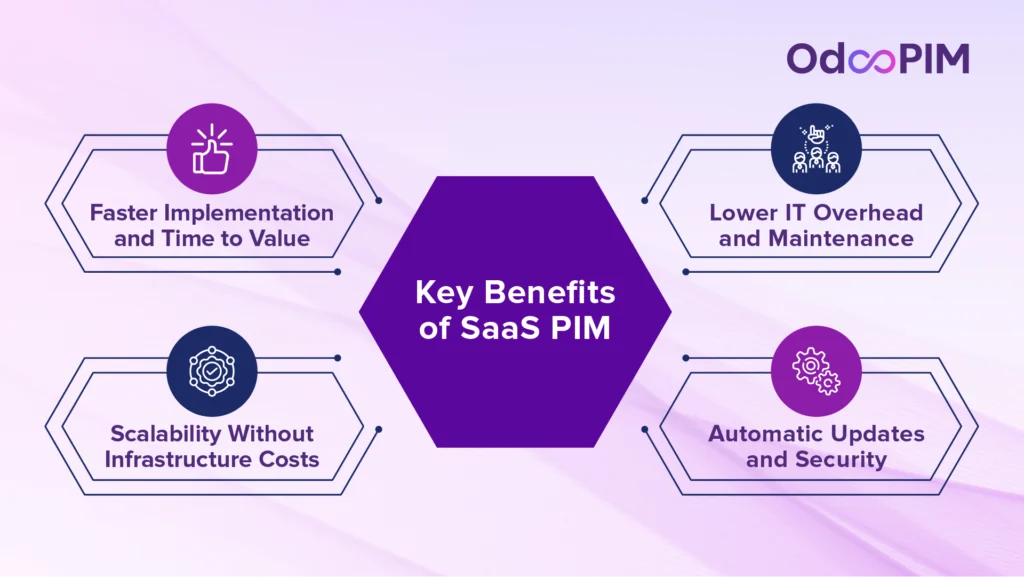
1. Faster Implementation and Time to Value
SaaS PIM solutions eliminate the infrastructure provisioning, software installation, and environment configuration phases that stretch on-premise deployments across multiple quarters. Your team begins importing product data, defining attributes, and configuring enrichment workflows within days of signing a subscription agreement. This compressed timeline means the PIM SaaS model starts delivering cleaner product data to channels while an on-premise alternative would still be in server setup. Pre-built connectors, templated data models, and guided onboarding accelerate the path from raw product information to enriched, syndicated content. The PIM solution starts generating measurable business value before traditional software would finish its first installation milestone.
2. Lower IT Overhead and Maintenance
A SaaS PIM removes database administration, server maintenance, security patching, and backup management from your team’s responsibilities. The vendor operates the application stack, monitors performance, and applies updates without consuming internal IT hours or requiring scheduled maintenance windows. This reduced overhead makes PIM SaaS particularly attractive for mid-market manufacturers and distributors who lack dedicated PIM infrastructure specialists. Internal resources shift from managing software to managing product data quality, which impacts revenue and customer experience. The best PIM software for lean IT organizations delivers enterprise-grade product data management without enterprise-grade operational burden.
3. Scalability Without Infrastructure Costs
Scaling a SaaS PIM to accommodate catalog growth, additional users, or new channel connections requires no hardware procurement, database expansion, or infrastructure planning. The cloud architecture allocates resources dynamically as your product data volume increases, absorbing catalog expansion without performance degradation or capital expenditure. This elasticity makes SaaS PIM solutions ideal for organizations planning aggressive SKU growth or channel expansion where infrastructure forecasting becomes impractical. Adding fifty thousand SKUs or onboarding ten new users happens through subscription adjustments rather than server capacity projects. The PIM solution scales with business ambition rather than constraining it to available infrastructure.
4. Automatic Updates and Security
PIM SaaS platforms deliver continuous updates that enhance functionality, patch vulnerabilities, and improve performance without user intervention or upgrade projects. Security compliance stays current as the vendor applies patches, manages certifications, and monitors threats across their customer base with resources no single organization could dedicate. This automatic update model means your SaaS PIM improves over time without the version-lock that plagues on-premise installations where upgrades become multi-year initiatives. Your team always operates on the latest PIM software capabilities without the disruption of traditional upgrade cycles. The vendor’s security posture becomes your security posture, backed by dedicated teams monitoring the threat landscape continuously.
SaaS PIM vs. On-Premise PIM: Key Differences
1. Deployment and Setup
SaaS PIM solutions deploy through account provisioning on a cloud tenant, making the platform ready for data import and workflow configuration within hours. On-premise PIM software requires hardware procurement, operating system configuration, database setup, application installation, and network security adjustments before the first product attribute enters the system. This deployment gap means SaaS begins delivering value while on-premise projects remain mired in infrastructure preparation. The cloud model eliminates geographic constraints, allowing distributed teams to access the same PIM solution simultaneously without VPN configurations or remote desktop setups. Deployment speed translates into competitive advantage when product data quality determines channel performance.
2. Cost Structure
A PIM SaaS subscription bundles infrastructure, maintenance, updates, and support into predictable operational expenditure with no upfront capital outlay. On-premise PIM software demands substantial initial investment in licenses, hardware, and implementation services, followed by ongoing costs for maintenance contracts, IT staffing, and periodic upgrade projects. The cloud model converts what would be a major capital request into a recurring operational line item that scales with actual usage. Total cost of ownership for SaaS PIM solutions mostly runs lower over a five-year horizon when factoring the hidden infrastructure and personnel expenses on-premise deployments generate. Predictable subscription pricing simplifies budgeting and eliminates the surprise capital requests that aging on-premise infrastructure inevitably produces.
3. Control and Customization
On-premise PIM software grants unfettered access to the underlying codebase, database, and server configuration for organizations requiring customization beyond what standard APIs allow. SaaS PIM solutions trade this unlimited customization potential for operational simplicity, offering extensive configuration options and robust APIs while abstracting the application stack itself. The PIM solution choice hinges on whether your differentiation comes from unique PIM functionality or from the quality and speed of product data reaching customers. Most organizations discover that modern PIM SaaS platforms provide sufficient extensibility through APIs and configuration without the burden of managing custom code. The customization question shifts from “can we modify anything” to “can we achieve our business outcomes with available capabilities.”
4. Data Security and Compliance
SaaS PIM vendors invest in security certifications, dedicated monitoring teams, and compliance frameworks that surpass what most individual organizations can resource internally. On-premise PIM software keeps data within your controlled environment, appealing to organizations in heavily regulated industries with strict data sovereignty requirements. Cloud PIM SaaS platforms undergo regular third-party audits, maintain SOC 2 compliance, and encrypt data both in transit and at rest as standard practice. The security question facing SaaS PIM solutions evaluators has shifted from “is the cloud secure” to “does this vendor’s security posture exceed our internal capabilities.” For most manufacturers and distributors, the answer increasingly favors vendor-managed security.

What to Look for in a SaaS PIM Solution
ERP and System Integration
A SaaS PIM must connect smoothly to your ERP, ecommerce platform, and other business systems where product data originates or flows. Native integration with your ERP stack eliminates the middleware tax that adds cost, latency, and failure points to data synchronization between systems. The best PIM software treats integration as a core capability, offering pre-built connectors and robust APIs that make data exchange a configuration exercise rather than a custom development project. Real-time synchronization ensures pricing changes, inventory updates, and product modifications flow from the ERP through the PIM solution to customer-facing channels without manual intervention. Integration depth determines whether your PIM SaaS functions as a connected hub or an isolated data island.
Channel Syndication Capabilities
The PIM solution must push enriched product content to every sales channel automatically, formatting attributes, assets, and descriptions to meet each platform’s specific requirements. Strong syndication capabilities transform your SaaS PIM from a data storage tool into a channel acceleration engine that publishes consistent product information everywhere buyers shop. Channel-specific formatting rules, validation against platform requirements, and automated feed generation prevent the manual rework that consumes team hours in organizations without syndication. The best PIM software makes adding a new sales channel a configuration task rather than a data transformation project. Syndication separates SaaS PIM solutions that actively drive revenue from those that merely organize data.
Multi-User Access and Workflow Management
A SaaS PIM supports distributed teams where engineering, marketing, sales, and compliance stakeholders each contribute specific product information through governed workflows. Role-based permissions ensure technical specifications come from engineering while marketing enriches descriptions without either team overwriting the other’s contributions. Workflow automation routes content through approval chains before enriched product data reaches customer-facing channels, preventing embarrassing errors from publication. The PIM solution tracks every change, maintaining audit trails that support compliance requirements and team accountability. Effective multi-user management distinguishes PIM SaaS platforms designed for enterprise collaboration from those built for single-department usage.
Scalability for Large Catalogs
The best PIM software handles hundreds of thousands of SKUs with complex product hierarchies, variant structures, and technical attributes without performance degradation. Catalog complexity, nested product families, configurable components, regional variations, stresses SaaS PIM solutions in ways that simple SKU counts do not, demanding sophisticated data modeling capabilities. Bulk editing, attribute inheritance across product families, and efficient search across massive catalogs separate enterprise-ready PIM SaaS from lightweight alternatives. The platform must maintain responsiveness as data volume grows, ensuring enrichment workflows stay efficient regardless of catalog scale. Scalability means the PIM solution grows with your business rather than becoming the constraint that limits product expansion.
learn about PIM vs DAM
SaaS PIM for B2B Manufacturers and Distributors
Managing Complex Product Catalogs in the Cloud
B2B product catalogs contain technical specifications, engineering drawings, compliance certifications, material compositions, and dimensional variants that consumer-focused PIM software struggles to model effectively. A SaaS PIM designed for industrial complexity handles attributes like torque ratings, pressure tolerances, and electrical specifications alongside standard marketing content in a single governed environment. Complex product relationships, assemblies, spare parts, compatible components, require data modeling capabilities beyond simple flat catalogs. The best PIM software for manufacturers understands that a single industrial valve might carry fifty technical attributes, fifteen compliance documents, and customer-specific pricing tiers. Cloud delivery makes this sophisticated data management accessible without the infrastructure burden of on-premise industrial PIM deployments.
ERP-Native vs. ERP-Integrated SaaS PIM
An ERP-native PIM SaaS operates within the same platform ecosystem as your ERP, eliminating integration latency and data synchronization failures between product data management and business operations. ERP-integrated SaaS PIM solutions connect through APIs and middleware, providing flexibility to choose best-in-class PIM functionality at the cost of maintaining an additional vendor relationship and integration layer. The native approach synchronizes inventory levels, pricing updates, and product changes in real time because both systems share the same data foundation. The integrated approach allows selecting PIM software optimized for product data management even when your ERP’s native capabilities fall short. The best PIM software decision for manufacturers hinges on whether integration smoothness or functional depth matters more for your operations.
How OdooPIM Delivers SaaS PIM on Odoo
OdooPIM operates natively within the Odoo ecosystem as a SaaS PIM solution, connecting product data management to Odoo ERP, sales, inventory, and ecommerce without middleware or third-party integration layers. This native architecture means product attributes, inventory counts, pricing tiers, and customer data flow smoothly between the PIM software and every Odoo business application in real time. The cloud delivery model eliminates infrastructure management while providing the tight ERP integration that manufacturers and distributors require for accurate product data across channels. OdooPIM enforces enrichment completeness standards before syndicating product content, preventing incomplete listings from reaching marketplaces and distributor portals. The best PIM software for Odoo users transforms product data management from a fragmented spreadsheet exercise into a governed, channel-ready capability built into their operational core.

Case Studies
Case Study 1: Industrial Valve Manufacturer Replaces Spreadsheets with SaaS PIM and Cuts Listing Errors to Near Zero
Challenge
A mid-sized industrial valve manufacturer managed product data for twelve thousand SKUs entirely through disconnected spreadsheets shared across engineering, marketing, and sales teams. Each department maintained its own version of product specifications, creating constant conflicts where the website displayed different pressure ratings than distributor catalogs and Amazon listings. Engineering updated technical specifications in a PLM system that never synchronized with the marketing spreadsheets used to populate channel listings. A major distributor flagged that fifty-seven product listings on their portal contained outdated compliance certifications, threatening the manufacturer’s authorized supplier status. The company needed PIM software that could centralize product truth without requiring an IT infrastructure project they lacked resources to support.
Solution
The manufacturer selected a SaaS PIM solution specifically to eliminate infrastructure demands while governing complex industrial product data. The cloud PIM SaaS platform deployed within a week, allowing the team to immediately begin importing product attributes, technical specifications, and compliance documentation into a single governed repository. Engineering connected their PLM system to the PIM solution through APIs, ensuring specification changes flowed into the central product record automatically rather than through emailed spreadsheet attachments. Marketing enriched descriptions and digital assets within the same platform, building on engineering-validated technical data instead of duplicating it in separate files. Channel syndication pushed consistent product content to the website, three distributor portals, and Amazon Business simultaneously from the governed master records. Workflow automation routed compliance document updates through approval chains before publication, preventing the outdated certification problem that had threatened distributor relationships.
Results
- Listing errors caused by specification mismatches dropped to near zero within the first quarter of SaaS PIM adoption
- Distributor compliance violations eliminated as certification updates propagated automatically across partner portals
- New product launch time reduced from four weeks of manual spreadsheet coordination to same-day enrichment and syndication
- Engineering and marketing now work from identical product data for the first time in company history
- The best PIM software decision delivered measurable ROI within six months through reduced returns and eliminated rework
- Channel expansion capability built into operations, with new marketplace onboarding now a configuration task rather than a data reconstruction project
Case Study 2: Electrical Components Distributor Adopts ERP-Native SaaS PIM and Scales Channel Operations Without Adding Headcount
Challenge
An electrical components distributor running on Odoo ERP managed product data for eight thousand SKUs through a combination of Odoo fields and external spreadsheets. Their catalog included complex technical attributes, voltage ratings, amperage specifications, compliance certifications, that standard Odoo product fields could not structure effectively. The team manually formatted product data for their B2B portal, Amazon Business, and two industry-specific marketplaces, consuming twenty hours weekly on spreadsheet manipulation alone. Rapid SKU growth from acquired product lines threatened to overwhelm the manual processes entirely. Leadership needed a PIM solution that could handle industrial product complexity while integrating natively with their existing Odoo investment.
Solution
The distributor implemented OdooPIM as a native SaaS PIM within their existing Odoo ecosystem, eliminating the need for middleware or third-party integration layers. Because the PIM software operated inside the same platform as their ERP, inventory levels, pricing tiers, and customer data synchronized in real time without API configuration or data mapping projects. The team modeled complex product hierarchies, technical attribute sets, and compliance documentation requirements within the PIM SaaS platform, structuring data that standard Odoo fields could not accommodate. Channel syndication automated the formatting and delivery of enriched product content to the B2B portal, Amazon Business, and both marketplace platforms from a single governed repository. Enrichment workflows ensured technical specifications received engineering approval before marketing descriptions joined the master record, creating a governed process that eliminated the spreadsheet chaos.
Results
- Weekly product data management time reduced from twenty hours to three hours as syndication automated channel-specific formatting
- Product data consistency achieved across B2B portal, Amazon Business, and two industry marketplaces from a single PIM solution
- New product line acquisitions now integrate into the catalog in days rather than weeks of manual data restructuring
- Customer return rate decreased by twenty-two percent as accurate technical specifications reached every channel simultaneously
- The SaaS PIM solutions investment paid for itself within eight months through operational efficiency gains and reduced listing errors
- The best PIM software choice for their Odoo environment delivered native integration that third-party alternatives could not match without costly middleware
Is SaaS PIM Right for Your Business?
When SaaS PIM Makes Sense
SaaS PIM solutions fit organizations that prioritize speed to value, operational agility, and reduced IT burden over the unlimited customization potential of on-premise deployments. Your team lacks dedicated PIM infrastructure specialists and prefers channeling internal resources toward product data enrichment rather than software maintenance. Cloud delivery aligns with businesses planning rapid catalog growth or channel expansion where infrastructure forecasting becomes a constraint rather than an enabler. The subscription cost model matches organizations that prefer operational expenditure over capital outlay for software procurement. Choose PIM SaaS when product data quality matters more to your competitive position than the ability to customize PIM source code.
When On-Premise May Still Apply
On-premise PIM software remains relevant for organizations operating under strict data sovereignty regulations that mandate physical control over data storage and processing infrastructure. Heavily customized legacy systems with proprietary integrations may justify the continued investment in maintaining on-premise deployments. The best PIM software choice tilts toward on-premise when unique business processes demand code-level customization that even the most configurable SaaS PIM solutions cannot accommodate through APIs and settings. Organizations with substantial existing data center investments and specialized IT teams may extract more value from on-premise deployments. These cases grow increasingly rare as PIM SaaS platforms mature and compliance frameworks evolve to address regulated industry requirements.
Where to Start
Begin your SaaS PIM journey by auditing your current product data quality and identifying the specific gaps costing you channel performance and buyer confidence. Select a PIM solution that integrates natively with your ERP system to ensure product data synchronization happens in real time from day one. Start with a focused implementation covering your highest-revenue product lines and critical sales channels before expanding to the full catalog. This phased approach delivers measurable results while building organizational confidence in the PIM SaaS platform. The path to best PIM software adoption begins not with evaluating every vendor feature but with understanding the product data problems you need to solve.
This response is AI-generated and for reference purposes only.

FAQs
1. What is a SaaS PIM?
A SaaS PIM is cloud-hosted product information management software that centralizes every product attribute, digital asset, and technical specification into a governed repository accessible through any browser. Unlike traditional PIM software requiring on-site servers, a PIM SaaS platform delivers product data management as a subscription where the vendor handles infrastructure, security patches, and automatic updates. Your team logs in, enriches content, manages workflows, and syndicates consistent information to every sales channel without touching a server. This PIM solution transforms product data management from an IT installation project into an operational capability available immediately after account configuration. The best PIM software delivered as SaaS eliminates hardware procurement and maintenance burdens entirely.
2. What is the difference between SaaS PIM and on-premise PIM?
The difference between SaaS PIM solutions and on-premise deployments centers on who owns infrastructure responsibility and how quickly value materializes. On-premise PIM software demands internal servers, dedicated IT staff, manual upgrade cycles, and substantial capital expenditure before the first product attribute enters the system. A PIM SaaS platform shifts infrastructure, maintenance, and security to the vendor, freeing internal teams to focus on data quality rather than database administration. Cloud delivery deploys in days while on-premise projects stretch across months consumed by hardware provisioning and software installation. Total cost of ownership for SaaS PIM mostly runs lower over five years when factoring hidden infrastructure and personnel costs. The best PIM software choice hinges on whether you value operational agility or unlimited code-level customization more.
3. Is SaaS PIM suitable for B2B manufacturers and distributors?
SaaS PIM solutions are architecturally suited for B2B manufacturers and distributors managing complex catalogs with technical specifications, compliance documents, and customer-specific pricing tiers. Industrial product data complexity, torque ratings, material compositions, dimensional variants, demands sophisticated data modeling that modern PIM SaaS platforms handle without the infrastructure burden of on-premise deployments. The cloud model supports distributed teams where engineering, marketing, and sales contribute product information through governed workflows accessible from any location. A PIM solution built for B2B connects natively to ERP systems, ensuring real-time synchronization of inventory, pricing, and product changes across channels. The best PIM software for manufacturers combines cloud agility with the deep product data governance industrial catalogs require.
4. How does a SaaS PIM integrate with an ERP system?
A SaaS PIM integrates with ERP systems through standardized APIs, pre-built connectors, or native platform architecture that synchronizes data without middleware complexity. The PIM software pulls product identifiers, inventory levels, pricing tiers, and customer data from the ERP while pushing enriched content back for order management and fulfillment workflows. Native integration within the same platform ecosystem eliminates synchronization latency, ensuring pricing updates and inventory changes flow between the PIM solution and ERP in real time. Middleware-based integration provides flexibility to connect a best-in-class SaaS PIM to legacy or third-party ERP systems through configured data mappings. The integration quality determines whether your PIM SaaS functions as a connected operational hub or an isolated data island requiring manual data transfer.
5. What should I look for when choosing a SaaS PIM solution?
Evaluate SaaS PIM solutions first on ERP integration depth, since product data synchronization with business systems determines whether the platform delivers operational value or creates another silo. Channel syndication capabilities must push enriched content to every marketplace, distributor portal, and storefront with automatic formatting that respects platform-specific requirements. The best PIM software handles your catalog complexity today while scaling seamlessly as SKU counts grow and product hierarchies deepen. Multi-user workflow management with role-based permissions ensures engineering, marketing, and sales contribute to governed content without overwriting each other’s work. Your PIM solution vendor should demonstrate security certifications, uptime commitments, and a product roadmap that aligns with your channel expansion plans.