What Is a PIM System?
A PIM system centralizes and governs every piece of structured product information, SKU identifiers, technical specifications, marketing descriptions, pricing tiers, compliance certifications, and category relationships, in a single repository. The platform provides enrichment workflows where teams collaborate on product content before syndicating consistent, channel-ready information to ecommerce sites, marketplaces, distributor portals, and print catalogs. A PIM enforces data quality standards that prevent incomplete or inaccurate product records from reaching customer-facing channels. The system handles complex product hierarchies, variant structures, and the attribute relationships that define B2B catalogs. The PIM vs DAM distinction starts here: PIM governs the textual and technical product truth that answers what a product is and why a customer should purchase it.
What Is a DAM System?
A DAM system centralizes unstructured rich media files, product photographs, marketing videos, brand logos, creative assets, and technical drawings, in a searchable, governed library. The platform provides metadata tagging, version control, and access permissions that ensure teams find and use only current, approved assets rather than outdated files scattered across shared drives. A DAM transforms creative asset management from folder-based chaos into a structured library where assets carry usage rights, expiration dates, and relationship links to campaigns or products. Understanding the difference between PIM and DAM means recognizing that DAM answers what a product looks like rather than what it is. The system serves creative teams, brand managers, and marketing departments who need governed access to visual content across every campaign and channel.
Learn about PDM Tools

PIM vs DAM: The Key Differences
What Each System Manages
The fundamental PIM vs DAM distinction separates structured product data from unstructured rich media. A PIM manages product attributes with defined formats and validation rules, dimensions in millimeters, voltage ratings in specific ranges, marketing descriptions in controlled vocabularies. A DAM manages creative files without inherent structure, JPEG images, MP4 videos, PSD design files, PDF brochures, each requiring metadata overlay to become discoverable. The difference between PIM and DAM data types means PIM enforces attribute completeness standards while DAM enforces metadata tagging consistency. PIM DAM software converges these capabilities where platforms handle structured product data and the unstructured assets that visualize products. This distinction shapes every operational decision about which system your organization needs first.
Who Uses Each System
PIM users include product managers, ecommerce teams, technical writers, and channel marketing specialists who create and govern the commercial product information that drives purchase decisions. DAM users encompass creative teams, photographers, brand managers, and campaign marketers who produce and distribute the visual content that supports brand identity. The PIM vs DAM vs CMS user landscape extends to content editors and web managers who publish marketing pages distinct from product detail pages. Engineering teams contribute technical specifications to PIM while creative teams contribute brand imagery to DAM. PIM and DAM integration connects these user communities so product managers can access approved imagery while creative teams understand which assets support which products.
Where Each Fits in the Product Journey
PIM operates at the product level, governing the information that customers use to evaluate, compare, and validate purchase decisions across every channel. DAM operates at the asset level, governing the visual content that appears across product pages, marketing campaigns, social media, and brand communications. The PIM vs DAM placement in the content supply chain means PIM feeds the product detail page while DAM feeds every visual touchpoint including product pages. PIM DAM software integration ensures that the product journey presents consistent information and imagery rather than mismatched text and visuals. Understanding where each system fits prevents the organizational mistake of expecting one platform to solve both product data and creative asset challenges.
Side-by-Side Comparison Table
| Dimension | PIM | DAM |
| Manages | Structured product data | Unstructured rich media files |
| Content types | Attributes, specs, descriptions | Images, videos, creative files |
| Primary users | Product, ecommerce, technical teams | Creative, brand, marketing teams |
| Governance | Attribute completeness, data quality | Metadata tagging, version control |
| Output | Product detail pages, catalogs | Visual content across touchpoints |

Do You Need a PIM or a DAM First?
When PIM Comes First
Organizations struggling with inconsistent product specifications, missing attributes, and channel listing errors need a PIM before a DAM because product data accuracy drives purchase decisions more directly than visual content. B2B manufacturers and distributors managing complex technical catalogs discover that the PIM vs DAM priority clearly favors PIM because engineering specifications and compliance data determine whether customers can purchase at all. The difference between PIM and DAM deployment sequence matters because enriching product data delivers immediate channel performance improvements while visual content enhances already-accurate listings. Companies with rapidly growing SKU counts or multi-channel expansion plans need PIM governance before the product data chaos becomes customer-visible. PIM first, DAM second defines the logical deployment sequence when product information accuracy represents the primary operational bottleneck.
When DAM Comes First
Brand-driven organizations where visual identity and creative content drive competitive differentiation benefit from DAM deployment before PIM. Consumer brands managing extensive photo shoots, video production, and campaign creative across global markets need governed asset management to prevent the brand inconsistency that scattered shared drives cause. The PIM vs DAM priority tilts toward DAM when creative teams waste more time searching for assets than product teams waste correcting listing errors. Organizations with relatively simple product data but complex creative operations, fashion, beauty, luxury goods, find DAM delivers faster operational relief than PIM. Understanding your specific PIM vs DAM vs CMS needs prevents deploying the wrong platform first simply because industry trends favor one approach.
When You Need Both
Most mid-market and enterprise organizations eventually require both PIM DAM software capabilities because product data and visual content must work together to drive modern commerce. Companies launching products across multiple channels discover that PIM without DAM creates product pages with accurate specifications but inconsistent imagery. DAM without PIM produces beautiful visual content attached to product records with incomplete or conflicting technical information. The PIM and DAM integration question becomes not whether you need both but how tightly they should connect. Growing businesses should select platforms with native or tightly integrated PIM vs DAM capabilities to avoid the costly integration projects that connecting separate systems demands.
Learn about product data management.
How PIM and DAM Work Together
Linking Assets to Product Records
PIM and DAM integration establishes direct relationships between product records and their approved visual assets, ensuring that product detail pages always display current, correct imagery. When a product manager updates a SKU in the PIM, the linked DAM assets automatically reflect the approved product photography without manual file searches. Asset-to-product links enable automated syndication where the right images travel with product data to every channel simultaneously. The PIM DAM software connection eliminates the common failure where marketing updates product imagery in the DAM but the ecommerce platform still displays outdated photos. This integration transforms the manual coordination between product and creative teams into an automated relationship governed by the platform.
Syndicating Data and Assets to Channels
Integrated PIM vs DAM syndication pushes both product information and approved visual assets to every sales channel in a single automated workflow. Channel-specific formatting rules ensure Amazon receives product images at required resolutions while distributor portals pull technical drawings alongside specifications. The syndication layer eliminates the manual process of downloading assets from the DAM and uploading them separately to each channel’s product listings. PIM DAM software integration ensures that when a product image updates, that change propagates to every marketplace and storefront automatically. This unified syndication transforms multi-channel product presentation from a manual coordination exercise into an automated capability.
Learn about Product Data Management Best Practices

PIM vs DAM vs CMS vs MDM
PIM vs CMS
A CMS manages web pages, blog content, landing pages, and the editorial content that surrounds product detail pages within a broader digital experience. The PIM vs DAM vs CMS distinction separates product information management from web content management, with PIM feeding product-specific content to the CMS for page assembly. A CMS handles the customer experience layer, navigation, promotional content, brand storytelling, while PIM supplies the structured product data that populates product pages. Organizations often confuse PIM and CMS capabilities, attempting to manage product data within a CMS that lacks enrichment workflows and channel syndication. The PIM DAM software ecosystem works alongside CMS platforms, with each system governing its specific content domain.
Learn more about PIM vs CMS
PIM vs MDM
The PIM vs DAM vs MDM landscape distinguishes product information management from master data management, where MDM governs multiple data domains, customers, suppliers, locations, assets, while PIM focuses specifically on product data. MDM provides enterprise-wide data governance across domains, ensuring consistent customer records across CRM and ERP systems while PIM governs product records across commerce channels. The difference between PIM and DAM and MDM matters because organizations often purchase MDM platforms expecting PIM functionality they do not deliver. MDM handles the core identifiers and relationships that define business entities; PIM handles the enriched product content that drives customer purchase decisions. Most organizations need PIM capabilities regardless of whether MDM exists in their technology landscape.
DAM vs CMS
A DAM governs creative assets and their metadata while a CMS governs web pages and their publishing workflows. The PIM vs DAM vs CMS distinction clarifies that DAM serves as the media supply chain for the CMS, providing approved images and videos that populate web pages. A CMS without DAM integration forces content editors to search shared drives for assets, creating the version control problems that DAM solves. PIM DAM software integration with CMS platforms creates a complete content supply chain where product data and assets flow through governed processes to customer-facing experiences. Understanding these distinctions prevents the costly mistake of attempting to manage all content types within a single platform designed for one specific purpose.
Learn about Product Data Management Platform
Case Studies
Case Study 1: Industrial Lighting Manufacturer Integrates PIM and DAM, Eliminates Asset Chaos Across Seven Channels
Challenge
A Midlands-based industrial lighting manufacturer with four thousand SKUs managed product specifications in Odoo ERP while storing product images, installation videos, and technical drawings across three separate shared drives. Marketing spent fifteen hours weekly searching for current product imagery because the shared drives contained multiple versions of each asset without clear approval status. The PIM vs DAM disconnect meant product pages on their B2B website, Amazon UK, and five distributor portals frequently displayed outdated images alongside accurate technical specifications. A major electrical wholesaler complained that the manufacturer’s online product images showed discontinued models while the specifications described current versions. The company needed both governed product data and governed digital assets but lacked clarity on the difference between PIM and DAM and how these systems should work together.
Solution
The manufacturer implemented OdooPIM, which provided both PIM DAM software capabilities within their existing Odoo environment, eliminating the need for separate systems. Product attributes, technical specifications, and compliance certifications were centralized in the PIM while all product imagery, installation videos, CAD files, and technical drawings were governed within the same platform. The native PIM and DAM integration meant asset-to-product links operated on shared data, eliminating the synchronization failures that plague disconnected systems. When marketing approved new product photography, those images linked directly to the correct product records and syndicated automatically to the website, Amazon UK, and all five distributor portals. Engineering CAD file updates propagated to every channel simultaneously because assets and product data existed in one governed environment.
Results
- Marketing team time spent searching for product imagery reduced from fifteen hours weekly to near zero as governed PIM DAM software replaced shared-drive chaos.
- The electrical wholesaler complaint was resolved immediately as product pages now displayed current imagery matched to accurate specifications through PIM and DAM integration.
- New product launch time was reduced from four weeks to six days because product data and approved assets syndicated together automatically to seven channels.
- Asset version control issues eliminated as the PIM vs DAM solution ensured only approved, current imagery reached customer-facing channels.
- The manufacturer identified unified PIM vs DAM vs MDM capabilities as the critical factor behind their improved channel consistency, noting that separate systems would have required costly middleware.
Learn about PIM dam solution
Case Study 2: Consumer Electronics Brand Deploys DAM First, Then Integrates PIM to Fix Product Data Inconsistency
Challenge
A consumer electronics brand selling audio equipment invested first in a DAM system to govern their extensive library of product photography, lifestyle imagery, and video content. While the DAM successfully organized creative assets, the PIM vs DAM gap emerged as product information remained trapped in marketing spreadsheets disconnected from the governed asset library. Product pages displayed beautiful, approved imagery but carried inconsistent technical specifications because different channel managers wrote descriptions independently. The difference between PIM and DAM became painfully clear when a new product launch generated returns because Amazon listed outdated driver specifications alongside the correct product images. The brand needed PIM to govern product data while maintaining their DAM investment for creative asset management.
Solution
The brand implemented a PIM platform and established PIM and DAM integration through APIs connecting the two systems, allowing product records in the PIM to reference approved asset IDs in the DAM. Product managers now governed technical specifications, compatibility data, and marketing descriptions in the PIM while creative teams maintained imagery and video content in the DAM. The PIM DAM software integration ensured that when engineering updated a driver specification in the PIM, that change syndicated to channels while linked DAM assets remained current. Channel syndication pulled product data from the PIM and approved imagery from the DAM simultaneously, presenting unified product truth across their website, Amazon, and retail partner platforms.
Results
- Product return rate attributed to specification mismatches dropped significantly as PIM and DAM integration ensured accurate technical data accompanied approved product imagery.
- New product launches now synchronize product data and visual assets across channels simultaneously, eliminating the specification lag that caused the costly return incident.
- Creative and product teams maintain autonomy within their respective PIM DAM software platforms while the integration layer ensures consistency across customer touchpoints.
- The PIM vs DAM vs CMS architecture now feeds consistent product content to their content management system for rich editorial experiences alongside accurate product pages.
- The brand recognized that understanding the PIM vs DAM vs MDM landscape meant knowing which system governed which content type, with integration ensuring neither product data nor visual assets drifted independently.
Learn about headless commerce
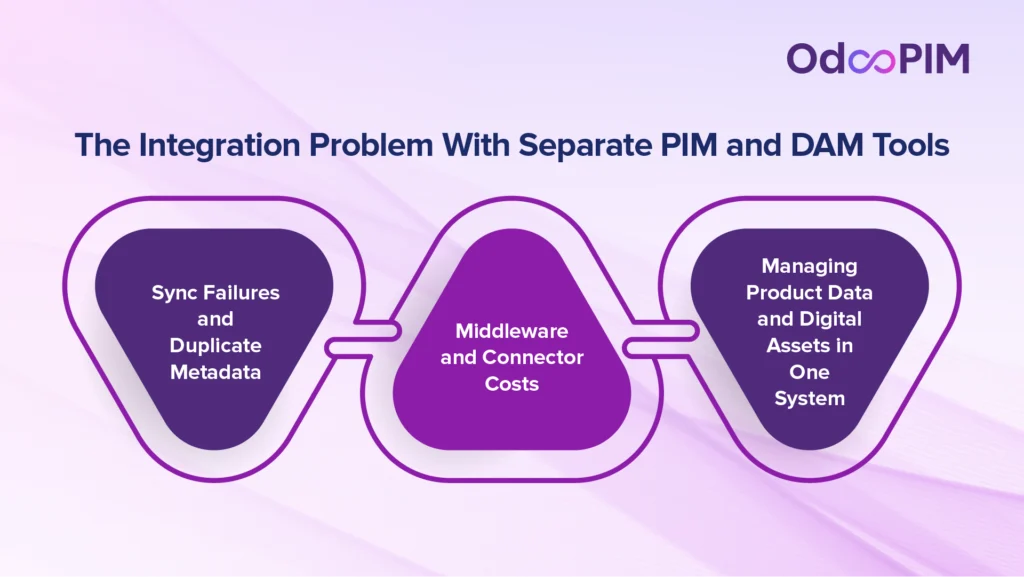
The Integration Problem With Separate PIM and DAM Tools
Sync Failures and Duplicate Metadata
Disconnected PIM and DAM platforms inevitably develop synchronization failures where product records reference assets that have been archived, updated, or replaced in the DAM without corresponding updates. Teams duplicate metadata across systems, entering product names and identifiers in the PIM and DAM separately, creating the inconsistencies where asset tags contradict product attributes. The difference between PIM and DAM becomes an operational liability when the integration layer fails silently, leaving channels displaying outdated imagery alongside current product specifications. Separate PIM DAM software platforms require constant metadata reconciliation that consumes team hours and still allows errors to reach customer-facing channels. These synchronization failures compound as product catalogs grow and asset libraries expand, making manual cross-referencing mathematically impossible.
Middleware and Connector Costs
Connecting separate PIM and DAM platforms requires middleware that introduces licensing fees, integration development costs, and ongoing maintenance burdens. Each PIM and DAM integration connector must be maintained through platform version updates, adding recurring operational costs beyond the initial implementation investment. The middleware layer creates failure points where asset-to-product links break silently, requiring troubleshooting resources to identify and resolve synchronization gaps. Organizations evaluating PIM vs DAM vs CMS total cost of ownership must account for the integration tax that separate platforms impose. These hidden costs often make tightly integrated PIM DAM software more economical than best-of-breed separate solutions once the fully loaded operational expense enters the calculation.
Managing Product Data and Digital Assets in One System
OdooPIM resolves the PIM vs DAM integration challenge by providing governed product information management and digital asset management within a unified Odoo environment. Product records and their associated images, videos, and technical documents exist in the same platform, eliminating the middleware that separate PIM and DAM deployments demand. The native architecture ensures that asset-to-product links never break because they operate on shared data rather than synchronized copies across disconnected systems. This unified approach eliminates the difference between PIM and DAM integration costs while providing the governed product data and asset management that B2B manufacturers, distributors, and wholesalers require. OdooPIM transforms the PIM DAM software decision from an integration architecture challenge into a single-platform capability that connects product truth and visual content automatically.

FAQ
1. What is the difference between PIM and DAM?
The fundamental PIM vs DAM distinction separates structured product data from unstructured rich media assets within the commerce technology stack. A PIM governs product attributes, technical specifications, marketing descriptions, and category relationships that answer what a product is and why customers should purchase it. A DAM governs creative files, photographs, videos, logos, brand assets, that answer what a product looks like across every customer touchpoint. The difference between PIM and DAM extends to users, with product and ecommerce teams managing PIM content while creative and brand teams own DAM assets. Understanding this PIM vs DAM vs MDM landscape prevents organizations from expecting one platform to solve product data governance and creative asset management challenges.
2. Can a PIM replace a DAM?
A PIM cannot effectively replace a DAM because these systems govern fundamentally different content types with distinct metadata structures, user workflows, and syndication requirements. PIM platforms handle structured product data with defined attributes and validation rules, while DAM systems manage creative files requiring metadata tagging, version control, and format conversion capabilities. The difference between PIM and DAM functionality means PIM lacks the image processing, video transcoding, and creative workflow features that DAM users require daily. Organizations attempting to use PIM for asset management discover that product images become disorganized without the specialized metadata and search capabilities DAM provides. The PIM DAM software convergence trend sees platforms adding capabilities in both directions, but purpose-built systems still deliver superior depth within their respective domains.
3. Do I need both PIM and DAM?
Most mid-market and enterprise organizations need both PIM and DAM integration because product data accuracy and visual content quality together drive purchase decisions across every channel. A PIM without DAM creates product pages with accurate specifications but inconsistent, outdated, or missing product imagery that undermines conversion. DAM without PIM produces beautiful visual content attached to product records that may carry incomplete, conflicting, or inaccurate technical information. The PIM vs DAM question shifts from either-or to how tightly these systems should connect within your technology stack. Growing businesses should evaluate PIM DAM software options that provide native integration or unified capabilities to avoid the costly middleware projects that connecting separate platforms demands.
4. What is PIM vs DAM vs CMS?
The PIM vs DAM vs CMS landscape distinguishes three content management domains that serve different purposes within the digital experience stack. A PIM governs structured product information feeding product detail pages, a DAM governs rich media assets supporting all visual touchpoints, and a CMS governs web pages, blog content, and editorial experiences surrounding product content. Understanding the difference between PIM and DAM and CMS prevents organizations from attempting to manage product data within a content management system that lacks enrichment workflows and channel syndication. The PIM vs DAM vs MDM comparison adds master data management, which governs multiple data domains across the enterprise while PIM focuses specifically on product information. These systems work together in a mature commerce architecture, with each platform governing its specific content domain and integrating with the others.
5. How do PIM and DAM integrate?
PIM and DAM integration establishes direct links between product records and their approved visual assets, ensuring that product detail pages always display current, correct imagery alongside accurate specifications. The integration typically connects through APIs that allow the PIM to reference DAM asset IDs, enabling automated syndication where the right images travel with product data to every channel. Middleware-dependent integration introduces synchronization risks where asset-to-product links can break silently when either platform updates. Native PIM DAM software integration eliminates these failure points by managing product data and digital assets within a shared data model that requires no connector maintenance. The integration architecture decision directly impacts whether your product pages consistently present unified product truth or drift apart as disconnected systems age.