What Is a Product Data Management Platform?
A product data management platform centralizes every piece of product information, descriptions, specifications, images, pricing, inventory, into one system, replacing scattered spreadsheets and siloed databases. Unlike basic product data management software that only stores data, a best product data management platform enriches content, enforces quality rules, and syndicates to every sales channel automatically. Product information management platform solutions like Odoo product data management platform handle complex attribute hierarchies, role-based workflows, and real-time updates across ecommerce sites, marketplaces, and retail partners. The right PIM platform for ecommerce turns product data from a maintenance headache into a competitive asset, ensuring customers see accurate, consistent information wherever they shop.
Why Businesses Need a Dedicated Product Data Management Platform
The Problem With Managing Product Data in Spreadsheets
Spreadsheets feel comfortable because everyone knows Excel. But they fail silently at scale. A merged cell breaks formulas. Two people editing the same file creates version conflicts. No audit trail exists, so you never know who changed what or when. Product data management software solves these basic collaboration problems that spreadsheets cannot. Cloud-based product data management platforms offer concurrent editing, version history, and rollback capabilities that spreadsheets lack.
A wrong dimension typed into a spreadsheet reaches your website, causing returns. A missing image field means incomplete listings. Centralized product data platform tools prevent these mistakes through validation rules and required fields. Spreadsheets have no concept of data types or mandatory attributes. Your team spends hours manually checking for errors that a product information management platform would catch automatically. For any catalog above 500 products, spreadsheets become a liability, not a tool.
Why Ecommerce Platforms Are Not Built for Product Data Management
Shopify, Magento, and WooCommerce prioritize storefront functionality, not data governance. Their backends work for entering products one at a time but crumble under bulk operations or complex attribute hierarchies. PIM platform for ecommerce fills this gap by handling what store platforms cannot: advanced data modeling, channel syndication, and workflow automation. A product catalog management platform lets you update five hundred products simultaneously without clicking through variation screens.
Ecommerce platforms also lack PIM platform vs ERP integration. Your store might connect to your ERP, but without a dedicated product data platform for retailers, you still maintain separate data silos. Descriptions live in the store. Specs live in the ERP. Images live in a DAM. A best product data management platform sits between these systems, centralizing enrichment and pushing consistent data everywhere. Odoo product data management platform exemplifies this for Odoo users. Your ecommerce platform becomes a publishing endpoint, not a data management system.

Core Features of a Product Data Management Platform
1. Centralized Product Repository: Single Source of Truth
A centralized product data platform stores every product attribute, image, and specification in one database, eliminating duplicate files and version conflicts. Your team stops asking “which spreadsheet is current?” because only one version exists. Product information management platform tools enforce this single source through access controls, edit logging, and real-time synchronization. When operations update inventory in the ERP, the PIM reflects that change instantly. No more reconciling mismatched numbers across departments.
2. Data Ingestion From ERPs, Suppliers, and Legacy Systems
The best product data management platform pulls product information from multiple sources automatically. Your ERP provides inventory and pricing. Supplier feeds add specifications. Legacy spreadsheets contribute historical enrichment. Odoo product data management platform simplifies this by sharing the same database as your ERP, eliminating middleware. For other ERPs, look for pre-built connectors or open APIs. The platform should map incoming data to your standard attribute model, normalizing sizes, units, and categories during ingestion.
3. Product Data Enrichment and Attribute Management
Enrichment turns data into complete product stories. Add SEO descriptions, lifestyle images, technical specs, and channel-specific copy. Product catalog management platform features include attribute families, dropdown values, and bulk editing tools that spreadsheets cannot match. Your team enriches once, not per channel. AI-assisted enrichment generates draft descriptions and fills missing attributes automatically. Human review catches tone issues. The combination cuts enrichment time by 70%. Marketing writes strategy.
4. Automated Data Validation and Quality Controls
Validation rules block incomplete or incorrect data before it reaches your catalog. Prices must be numbers. Images must meet resolution standards. Required fields cannot stay empty. Cloud-based product data management platforms flag errors immediately, shifting quality control from reactive cleanup to proactive prevention. Conditional validation adds another layer. If a product category is “Electronics,” voltage and wattage become required. If “Apparel,” size and fabric are mandatory. The platform rejects non-compliant products and tells your team what to fix.
5. Multichannel Syndication and Distribution
Syndication pushes your master product data to every sales channel automatically. Your website, Amazon, Google Shopping, and retail partners all receive correctly formatted feeds. PIM platform for ecommerce handles channel-specific transformations, bullet points for Amazon, long descriptions for your site, structured data for comparison engines. A single price update in your PIM propagates everywhere within minutes. No manual exports. No copy-paste errors. No version drift between channels. Your customers see consistent information whether they shop on your site, a marketplace, or a retail partner portal.
6. Workflow Automation and Approval Processes
Workflows route enrichment tasks to the right people with deadlines and notifications. A junior editor writes a description; the system sends it to a senior reviewer for approval. Product data management software with workflow automation ensures no product launches without proper signoff. PIM platform vs ERP distinctions matter here, ERPs lack these content governance features. Approval chains can require multiple signoffs: marketing for descriptions, legal for compliance, operations for specifications. Status tracking shows exactly who is waiting on whom. No dropped tasks. No “I thought you approved that” conversations. Just clean, accountable data movement.
Learn about AI for PDM.

Types of Product Data Management Platforms
1. SaaS Cloud-Based PIM Platforms
SaaS PIM platforms run on the vendor’s servers. You pay a monthly or annual subscription and access the software through a web browser. Cloud-based product data management eliminates hosting, security, and upgrade responsibilities for your team. Vendors like Plytix, Sales Layer, and Salsify offer tiered pricing based on features, users, or product volume. The best product data management platform for most small to mid-size businesses falls into this category because of predictable costs and minimal IT overhead.
You cannot modify the underlying code or self-host. Data lives on vendor infrastructure, which matters for compliance-sensitive industries. PIM platform for ecommerce SaaS solutions handle maintenance automatically, no downtime for upgrades, no security patches to manage. Your team focuses on product data, not server administration. For teams without dedicated engineering resources, SaaS is usually the right choice. Just verify data export capabilities before committing.
2. Open-Source Product Data Management Platforms
Open-source PIM platforms provide full access to the source code. Akeneo Community Edition and Pimcore lead this category. You download the software for free, install it on your own servers, and customize anything. Product data management software with open-source licensing appeals to technical teams who want complete control over features, workflows, and hosting. No vendor lock-in. No surprise price hikes. Product information management platform open-source options offer unlimited customization potential.
Your team handles installation, server maintenance, security updates, backups, and troubleshooting. A bug appears at 2 AM before a product launch? Your engineers fix it, not the vendor. Centralized product data platform open-source works well for enterprises with dedicated developer headcount. For everyone else, the hidden labor costs exceed SaaS subscription fees. Calculate your hourly engineering rates before choosing this path. “Free” software rarely means zero cost.
3. Enterprise-Grade Product Data Platforms
Enterprise platforms like inRiver, Syndigo, and Contentserv target large organizations with complex requirements. These systems handle millions of SKUs, thousands of users, and dozens of channels simultaneously. Product data platform for retailers at enterprise scale includes advanced workflow automation, compliance tracking, supplier portals, and real-time syndication to global marketplaces. Product catalog management platform enterprise solutions also offer dedicated account management and custom SLAs.
Enterprise implementations start at $50,000 annually and often exceed $200,000 with services. Implementation timelines run six to twelve months with certified partners. The best product data management platform for enterprise buyers prioritizes scalability and governance over speed or low cost. If your catalog exceeds 50,000 SKUs or you sell to hundreds of retail partners, these platforms justify their price. For smaller operations, they represent overkill. Do not let an enterprise sales team convince you otherwise.
PIM Platforms Built Into Larger Business Ecosystems (Like Odoo)
Some PIM platforms are not standalone products but modules within larger business suites. Odoo product data management platform lives inside Odoo’s ERP ecosystem, sharing the same database as accounting, inventory, and sales. This native integration eliminates middleware, sync delays, and connector fees. PIM platform vs ERP becomes a false choice because both functions operate from one system. For businesses already running Odoo, this is the cleanest option available.
You cannot easily separate your PIM from Odoo if you decide to switch ERPs later. Product information management platforms embedded within a suite also tend to have fewer advanced features than best-of-breed alternatives. OdooPIM handles standard enrichment well but lacks the digital shelf analytics of Salsify or the deep B2B workflows of inRiver. Choose this model if you value integration simplicity over specialized features. Choose standalone if you need best-in-class capabilities for complex manufacturing or global retail.
Learn about PDM System.
PIM makes a single, trusted source of product information available for multichannel commerce and data exchange.
– Gartner Market Guide for Product Information Management Solutions
Product Data Management Platform vs Other Systems: Key Differences
Product Data Management Platform vs ERP
An ERP manages transactions: inventory levels, purchase orders, financials, and basic product identifiers like SKU and cost. A product data management platform manages enrichment: descriptions, images, SEO metadata, and channel-specific content. PIM platform vs ERP comparison shows ERPs lack workflow automation for content approval and cannot syndicate to Amazon or Google Shopping. Both are essential. The best setups integrate them tightly. Odoo product data management platform eliminates this distinction by combining both in one database.
Product Data Management Platform vs CMS
A CMS (like WordPress or Shopify) manages front-end presentation, web pages, blog posts, and site navigation. A product information management platform manages back-end product data that feeds into those pages. The CMS displays what the PIM provides. Product catalog management platform tools handle bulk enrichment, attribute governance, and channel syndication that CMSs cannot. Think of CMS as your store window. Think of PIM as your warehouse. You need both, but they serve completely different jobs.
Product Data Management Platform vs MDM
MDM (Master Data Management) manages all critical business data across an organization: customers, suppliers, employees, locations, and products. Product data management software focuses exclusively on product information. MDM is broader but shallower for product use cases. The best product data management platform for product teams offers deeper enrichment features, channel syndication, and attribute modeling than general-purpose MDM. Choose MDM for enterprise-wide data governance across multiple domains. Choose PIM for product-specific enrichment and distribution.
Product Data Management Platform vs DAM
A DAM (Digital Asset Management) stores raw media files: images, videos, PDFs, and 3D models. A centralized product data platform stores product attributes and links to those media files. The PIM knows which image belongs to which product variant. The DAM stores the actual file. Cloud-based product data management platforms often include basic DAM features. For enterprises with massive media libraries, a dedicated DAM feeding into your PIM is the right architecture. The two systems complement each other. Neither replaces the other.
Product Data Management Platform vs PLM
PLM (Product Lifecycle Management) manages product design, engineering, and development before launch. A product data platform for retailers manages product information after launch, enrichment, distribution, and channel optimization. PLM answers “how do we design and manufacture this?” PIM answers “how do we describe and sell this?” Product catalog management platform tools handle specifications that PLM creates, but the workflows differ. PLM serves engineers. PIM serves marketers. As products move from development to market, data flows from PLM to PIM. Integration between them streamlines the handoff.
Learn about MDM Implementation
How a Product Data Management Platform Supports Multichannel Commerce
Syndicating Product Data to Ecommerce Platforms
A product data management platform connects directly to your ecommerce platform via API or pre-built connector. Shopify, Magento, WooCommerce, and BigCommerce receive real-time product updates, descriptions, images, pricing, inventory, without manual CSV uploads. PIM platform for ecommerce pushes changes instantly, so a price correction in your PIM reflects on your website within seconds, not days. The alternative is exporting spreadsheets, reformatting, and uploading manually, a process that breaks at scale and consumes hours your team could spend on strategy. Cloud-based product data management platforms handle two-way sync: orders flow back for analytics, and inventory changes update your store automatically.
Distributing to Marketplaces Like Amazon, eBay, and Walmart
Marketplaces demand specific data formats. Amazon needs bullet points, GTINs, and white-background images. Walmart requires different category taxonomies. eBay expects condition codes. A product information management platform stores one master record and transforms it for each marketplace automatically, define mapping rules once, and the system applies them to every product. Product catalog management platform tools also validate data before syndication, blocking incomplete listings that would be suppressed or penalized by marketplace algorithms. Your team fixes issues in the PIM, not across five different seller dashboards. Seasonal pricing updates happen with one click, not five separate uploads.
Feeding Retailer Portals and B2B Partner Channels
Retail partners like Target and Home Depot require product feeds in specific formats, some accept CSV, others require APIs, and many maintain branded portals. Product data management software automates this complexity: configure each partner’s requirements once, and the PIM generates the correct file on schedule. Odoo product data management platform users can automate feeds from their ERP-connected PIM. B2B channels need customized catalogs with partner-specific pricing and product selection. A product data platform for retailers with B2B features creates partner-specific views automatically, Distributor A sees tier 1 pricing, Distributor B sees tier 2, both pulled from your master catalog without manual duplication.
Managing Localized Product Data for Global Markets
Selling globally means translating descriptions, converting measurements (metric vs imperial), and complying with local regulations. A centralized product data platform stores one master record with localized overlays, French customers see French descriptions, US customers see imperial units, EU customers see metric. The best product data management platform for global commerce applies these localization rules automatically during syndication. Localization also includes regulatory compliance: food products need region-specific allergen statements, electronics need different certifications (FCC for US, CE for Europe). The platform enforces that each regional variant has required compliance fields before publishing. One master record. Infinite regional outputs.
Learn about PIM database
Benefits of Using a Product Data Management Platform
Faster Product Launches and Time to Market
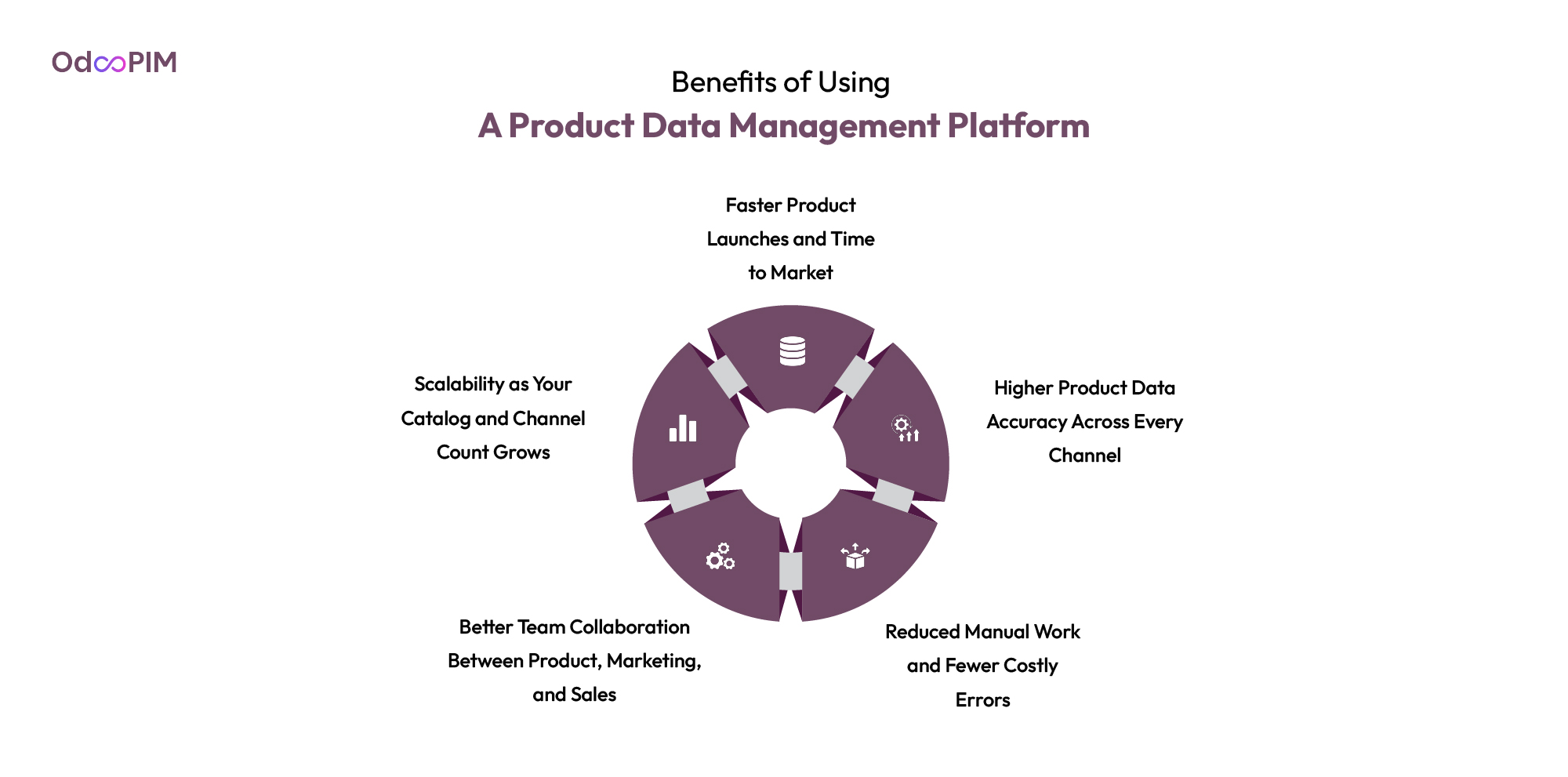
A product data management platform collapses launch timelines by eliminating manual data entry across multiple systems. Your team enriches product information once in the centralized product data platform, then syndicates to every channel simultaneously. What took two weeks of spreadsheet wrangling now takes two days. PIM platform for ecommerce users report cutting new product setup time by 70% because bulk editing, templates, and automated attribute assignment replace repetitive clicking. Seasonal collections benefit most. Your team stops chasing launch deadlines. The platform handles distribution speed.
Higher Product Data Accuracy Across Every Channel
Errors multiply with every channel you add. A wrong dimension on your website goes unnoticed; that same error on Amazon triggers returns and chargebacks. Product information management platform tools apply validation rules at entry, not after damage spreads. The system flags missing images, mismatched prices, and incomplete attributes before publishing. Cloud-based product data management means one correction fixes every destination simultaneously. Update a spec once in the product catalog management platform, and your website, Amazon, Google Shopping, and retailer portals reflect the change within minutes. Accuracy becomes automatic, not aspirational.
Reduced Manual Work and Fewer Costly Errors
Manual product data entry creates two problems: it consumes hours, and it introduces errors. A product data platform for retailers eliminates both. Your team stops copying descriptions between spreadsheets, reformatting images for different channels, and double-checking prices across systems. Odoo product data management platform users benefit from native ERP integration, inventory and pricing flow automatically without manual reconciliation. The cost savings add up quickly. A team of three spending fifteen hours weekly on product data costs roughly $22,000 annually in labor. A PIM subscription that cuts that time by 80% pays for itself in months.
Better Team Collaboration Between Product, Marketing, and Sales
Without a centralized product data platform, product managers, marketers, and sales reps maintain separate spreadsheets. No one knows which version is current. A product information management platform brings everyone into one system with role-based permissions. Product managers edit specifications. Marketers write descriptions. Sales teams set channel pricing. Workflow automation routes tasks between teams with approval chains and status tracking. No more “I thought you did that” conversations. Just clean, accountable collaboration from one master record.
Scalability as Your Catalog and Channel Count Grows
Spreadsheets work at 500 products. They crack at 5,000. Ecommerce platform backends handle entry but choke on complex attribute hierarchies. A product data management platform scales linearly with your business. Add 10,000 products? The same workflows apply. Add five new sales channels? Configure mapping rules once, and syndication scales automatically. Cloud-based product data management means no server upgrades or performance degradation as your catalog grows. The best product data management platform turns scaling from a crisis into a routine operation. Your catalog can double without doubling your team. That is the scalability promise only a dedicated PIM delivers.
How to Choose the Right Product Data Management Platform
Step 1: Define Your Product Data Challenges and Goals
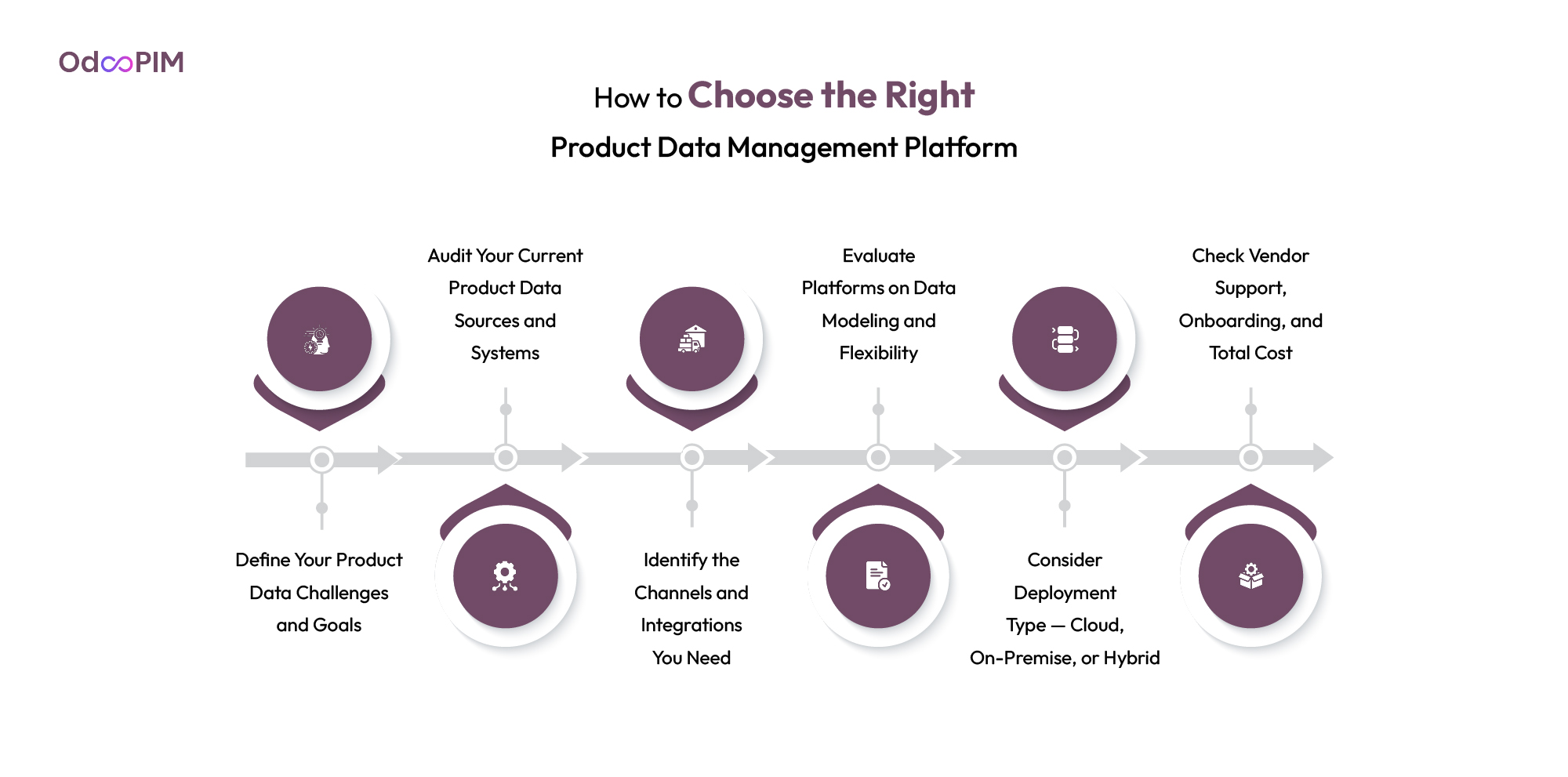
Does your team waste hours manually updating spreadsheets? Do customers complain about inconsistent information across channels? Are product launches delayed because data is incomplete? Product data management software solves specific problems. Write yours down before evaluating any vendor. Goals matter equally: reduce time-to-market by 50%, eliminate channel discrepancies, enable non-technical team members to update product data without breaking things. The best product data management platform for your business addresses your biggest frustrations. Share these goals with every vendor. The ones who listen carefully win.
Step 2: Audit Your Current Product Data Sources and Systems
List every place product data lives today. Your ERP holds inventory and pricing. Spreadsheets contain descriptions and SEO fields. Supplier feeds provide specifications. Images sit in a shared drive or DAM. A centralized product data platform must ingest from all these sources. Document data volume (SKU count, attributes per product, images per product) and update frequency. Also map your tech stack: which ecommerce platform, which ERP, which marketplace connections? PIM platform for ecommerce needs pre-built connectors to your specific systems. A platform requiring custom middleware for every integration will cost you months and thousands. Audit first. Choose second.
Step 3: Identify the Channels and Integrations You Need
List every destination for product data, your website, Amazon, eBay, Google Shopping and retailer portals (Target, Walmart, Home Depot). B2B partner feeds and print catalogs. Product data management platforms must syndicate to each channel in the correct format. Channel count impacts platform requirements. Five channels might work with mid-market tools. Twenty channels likely require enterprise-grade syndication engines. Cloud-based product data management platforms vary widely in connector quality. Test each critical integration before purchasing. A connector that breaks monthly creates more work than no connector at all. The best product data management platform maintains connectors actively, updating them when retailer APIs change.
Step 4: Evaluate Platforms on Data Modeling and Flexibility
Data modeling determines how your product catalog is structured. Flat attribute lists work for simple products. Nested hierarchies, variant matrices, and reference fields handle complex catalogs. Product information management platform candidates must support your data model, not force you to simplify. Test each platform with your most complicated product. If the PIM cannot represent voltage ranges, compatibility lists, or multi-level BOMs, move on. Flexibility also applies to attribute creation. Can your team add new fields without developer help? Product catalog management platform tools that require coding for every schema change will bottleneck your operations. Match platform flexibility to your catalog evolution speed.
Step 5: Consider Deployment Type — Cloud, On-Premise, or Hybrid
Cloud deployment means the vendor hosts everything. You pay a subscription and access via browser. Cloud-based product data management eliminates server maintenance, security patches, and upgrade planning. Most businesses choose cloud for lower IT overhead. The trade-off is data residency, your product information lives on vendor infrastructure. Compliance-sensitive industries may require on-premise deployment, where you install software on your own servers. Open-source options like Akeneo Community Edition allow this. Product data management software on-premise gives full control over data, customization, and upgrade timing. The trade-off is ownership of everything: hosting, security, backups, and troubleshooting. Choose based on your team’s capacity.
Step 6: Check Vendor Support, Onboarding, and Total Cost
Support quality varies enormously. Some vendors offer 24/7 chat with real humans. Others provide email-only support with 48-hour response times. The best product data management platform for your team includes support that matches your working hours and urgency levels. Ask about SLAs, escalation procedures, and customer references in your industry. Total cost of ownership extends beyond the license. Implementation fees often add 30-50% to first-year costs. Centralized product data platform vendors sometimes hide data migration, custom integration, and training fees until late in the sales cycle. Request a full cost breakdown including onboarding, per-user fees, data volume overages, API call limits, and premium support tiers. Get everything in writing before signing.
Top Product Data Management Platforms to Know in 2026
OdooPIM: Native Platform for Odoo Ecosystem Users
Odoo product data management platform shares the same database as your Odoo ERP, eliminating middleware, sync delays, and connector fees. For businesses already running Odoo, this is the cleanest product data management software available, your inventory, pricing, and product data live in one place, not two systems fighting for truth. The PIM module adds enrichment workflows, channel syndication, and approval chains without forcing your team to learn a second interface. PIM platform vs ERP becomes irrelevant because both functions operate from the same system. The trade-off is ecosystem lock-in and fewer advanced features than best-of-breed alternatives, but for Odoo users, the integration advantage outweighs those gaps.
Akeneo: Flexible Platform for Complex Product Hierarchies
Akeneo handles thousands of attributes, nested families, and variant relationships without slowing down. Product information management platform excels at complex catalogs where other systems choke, B2B manufacturers with multi-level specifications, configurable products, or compatibility matrices. The platform offers open-source Community Edition for technical teams and paid Enterprise tiers with advanced workflow automation. Best product data management platform for complex hierarchies is Akeneo, but the interface feels dense to newcomers, and enterprise pricing climbs fast. Implementation requires real commitment, but for genuinely complicated product data, no other product catalog management platform matches Akeneo’s flexibility.
Pimcore: Open-Source Platform With PIM, DAM, and CMS Combined
Pimcore bundles PIM, DAM, CDP, and CMS into one open-source centralized product data platform. Unlike product data management software vendors that sell separate modules, Pimcore gives you everything under one roof with no per-feature upcharges. Technical teams appreciate full code access and unlimited customization possibilities, you own the stack completely. The catch is that self-hosting requires serious engineering resources. Server maintenance, security updates, and troubleshooting all fall on your team. For enterprises with dedicated developers, Pimcore delivers unmatched control at a fraction of commercial license costs. For everyone else, cloud-based product data management from managed vendors is the safer choice.
Salsify: Platform Built for Digital Shelf and Analytics
Salsify tracks how your product content performs across retailer sites, something most product data platforms for retailers ignore. The platform shows which images drive clicks on Amazon, which descriptions convert on Walmart, and where competitors outrank you. That intelligence turns PIM platform for ecommerce from a cost center into a revenue driver. Best product data management platform for digital shelf optimization is Salsify, but the price matches the power. Annual commitments often reach six figures, and implementation runs six to nine months. For enterprise brands fighting for visibility across dozens of retail partners, Salsify’s analytics justify the investment. For smaller players, the features are overkill.
Inriver: Enterprise Platform for B2B and B2C Data Management
Inriver builds its entire architecture around one concept: feed once, publish everywhere. The platform’s syndication engine handles B2B portals, direct-to-consumer sites, marketplaces, and print catalogs from the same master record. Product information management platform also excels at role-based views, engineers see technical specs, sales sees marketing copy, customers see approved content. Where inRiver stumbles is self-service onboarding. Implementation almost always requires certified partners, adding 30-50% to first-year costs. A product catalog management platform for large distributors juggling dozens of channel requirements, inRiver’s syndication depth justifies the heavy setup. Just budget for professional services from day one.
Plytix: Affordable Platform for SMBs
Plytix charges one flat monthly fee regardless of user count. No per-seat surprises. No volume overage shocks. For product data management software buyers with lean teams, that pricing model alone beats every competitor. The platform focuses on getting products live quickly, clean interface, straightforward channel connections, minimal friction. Cloud-based product data management with Plytix means small teams can go from signup to first export in an afternoon. The trade-offs appear above 10,000 SKUs. Workflow automation and advanced syndication lag behind enterprise options. Still, Plytix is the smart starting point for most growing brands. You can always migrate to Akeneo alternatives later. Many businesses never need to.
What Makes OdooPIM a Strong Product Data Management Platform
Deep Integration With Odoo ERP, CRM, and Ecommerce Modules
Odoo product data management platform shares the same database as your Odoo ERP, CRM, and ecommerce modules. No middleware. No sync delays. No connector fees. When a warehouse worker updates inventory in the ERP, that change appears in your product listings instantly because there is only one source of truth. PIM platform vs ERP becomes a false choice when both functions live inside the same system. For businesses already running Odoo, switching to a standalone product information management platform means paying more for less reliability. The native architecture eliminates a category of integration headaches that plague other product data management software setups.
This integration also extends to Odoo’s ecommerce module. Product data flows from your PIM to your online store without third-party plugins or custom API work. PIM platform for ecommerce within Odoo means your store always reflects the latest enrichment, pricing, and inventory from your master catalog. Customer data from your CRM links to product interactions, giving you a complete view of what sells and who buys. The cost savings on integration labor alone often justify OdooPIM over standalone alternatives for existing Odoo users.
Centralized Product Data Management Without Switching Tools
Odoo users already manage inventory, accounting, sales, and CRM inside Odoo. Adding OdooPIM means your team never leaves the interface they already know. Centralized product data platform functionality appears as a natural extension of your existing product forms, not a separate application with a different login and workflow. Your team enriches descriptions, uploads images, and manages specifications alongside cost data and stock levels. Product catalog management platform features become part of your daily Odoo routine rather than a separate system to learn and maintain.
The alternative, using a standalone PIM alongside Odoo, requires building and maintaining middleware connections. Two systems mean two databases, two sync layers, and two points of failure. The best product data management platform for Odoo users is OdooPIM because no other solution offers this level of native centralization. Your team stops context-switching between applications. Data stops getting lost in translation between systems. Cloud-based product data management within Odoo means your product operation lives under one roof, from procurement to enrichment to distribution.
Built-In Workflow, Validation, and Syndication Capabilities
OdooPIM includes native workflow automation that routes product data tasks between teams. A junior merchandiser enriches a product, and the system automatically sends it to a senior editor for approval. Product information management platform with built-in workflows ensures no product launches without proper signoff. Validation rules block incomplete or incorrect data before syndication, missing GTIN? Required image absent? The system rejects publishing until fixes are made. Product data management software with native validation shifts quality control from reactive cleanup to proactive prevention.
Syndication pushes your enriched product data to sales channels automatically. OdooPIM connects natively to Odoo’s ecommerce module, plus external platforms like Shopify and Amazon via pre-built connectors. Product data platform for retailers using Odoo can manage websites, marketplaces, and wholesale feeds from one interface. Define channel mapping rules once. The system transforms your master data for each destination automatically. A single price update in OdooPIM propagates to your store, Amazon, Google Shopping, and retail partners within minutes. Product catalog management platform capabilities become automatic, not aspirational.

Frequently Asked Questions
1. What Is the Difference Between a PIM and a Product Data Management Platform?
PIM (Product Information Management) and product data management platform are interchangeable terms for the same category of software. Both centralize, enrich, and distribute product information across channels. Some vendors prefer “PIM,” others use “product data management software,” but the features overlap nearly completely. The distinction matters only when comparing against adjacent systems like ERP or DAM. PIM platform vs ERP is a meaningful comparison. Product information management platform vs product data management platform is marketing semantics. Focus on actual features, data modeling, syndication, workflow automation, not naming conventions.
2. What Is the Best Product Data Management Platform for Small Businesses?
Plytix leads for small businesses because of flat monthly pricing with no per-user fees. A five-person team pays the same as a solo founder. Cloud-based product data management with Plytix means self-service onboarding, direct Shopify connectors, and clean interfaces that non-technical users master in days. For Odoo users, Odoo product data management platform offers native ERP integration at competitive pricing. Best product data management platform for small catalogs under 5,000 SKUs rarely requires enterprise features. The trade-offs appear above 10,000 products or with complex variants. Start simple. Outgrow later. Most small businesses never need to upgrade beyond Plytix or OdooPIM.
3. Can a Product Data Management Platform Replace an ERP?
PIM platform vs ERP comparison shows they serve completely different functions. ERPs manage transactions: inventory levels, purchase orders, financials, and basic product identifiers. A product data management platform manages enrichment: descriptions, images, SEO metadata, and channel-specific content. ERP answers “how many do we have and what did we pay?” PIM answers “what are its specifications and why should someone buy it?” You need both systems. The best product data management platform integrates tightly with your ERP so data flows both ways. Neither replaces the other. They are partners, not competitors.
4. How Does OdooPIM Compare to Standalone Product Data Platforms?
Odoo product data management platform shares the same database as Odoo ERP, eliminating middleware and sync delays. Standalone platforms like Akeneo or Plytix require separate databases and integration layers. For existing Odoo users, OdooPIM offers lower total cost of ownership and faster implementation. The trade-off is feature depth. Standalone product information management platform options often provide more advanced syndication, digital shelf analytics, or B2B workflow automation. Centralized product data platform choice depends on your stack. Already on Odoo? Choose OdooPIM. Need best-in-class enrichment for complex manufacturing? Consider standalone. Neither is universally better.
5. How Long Does It Take to Implement a Product Data Management Platform?
Simple deployments with Plytix or Sales Layer take two to four weeks. Mid-market Akeneo implementations run two to three months. Product data platforms for retailers with complex requirements need four to six months. Enterprise platforms like inRiver or Salsify regularly hit six to nine months with certified partners. Product catalog management platform implementation time depends on data cleanliness, integration complexity, and workflow configuration. Your messiest spreadsheet determines the timeline. Clean data before migrating. Test with one product category first. Add 50% to vendor estimates. Rushing guarantees a broken system your team abandons.