What Are Ecommerce Catalog Management Services?
Ecommerce catalog management services are specialized offerings that centralize, cleanse, enrich, and syndicate product data across every sales channel, available as managed services, software platforms, or hybrid models combining both. Managed catalog management services provide outsourced product data operations handled by external specialists who assume ongoing maintenance responsibility. OdooPIM provides the software foundation for catalog management in ecommerce by centralizing product data within the Odoo ERP framework, enabling your team to govern enrichment and syndication without external dependency.
Core Deliverables
Product catalog management services deliver SKU creation and normalization, attribute mapping to channel-specific requirements, taxonomy and categorization structuring, product image editing, marketing copywriting, and automated channel syndication. These deliverables transform fragmented supplier data and internal spreadsheets into governed, channel-ready product records. OdooPIM handles these core ecommerce catalog management functions natively, automating attribute mapping and syndication from one governed source.
Who Uses Them
Brands scaling SKU counts beyond what manual processes can sustain use catalog management services to maintain data quality during growth. Distributors aggregating products from hundreds of suppliers depend on ecommerce product catalog management to normalize diverse incoming data formats. OdooPIM serves these organizations with a platform that connects natively to Odoo ERP, supplier data, and every sales channel.

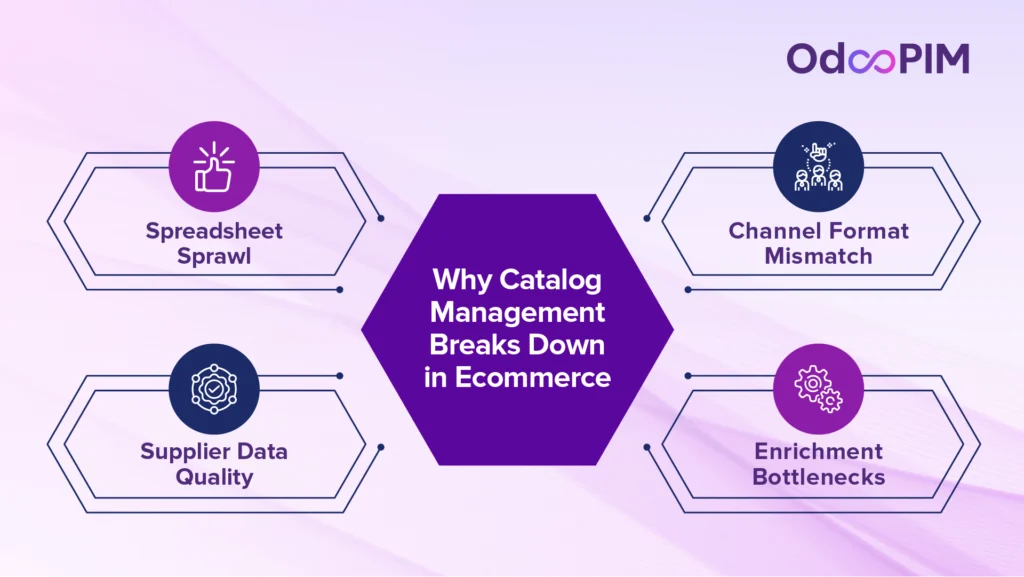
Why Catalog Management Breaks Down in Ecommerce
1. Spreadsheet Sprawl
Spreadsheet-based ecommerce catalog management creates version conflicts where marketing, purchasing, and sales teams each maintain separate product data files that inevitably drift apart. There is no audit trail tracking who changed which attribute, no validation preventing incomplete records from reaching channels. OdooPIM eliminates spreadsheet sprawl by centralizing ecommerce product catalog management in one governed platform with audit trails and validation rules.
2. Channel Format Mismatch
Amazon, Shopify, and Google Shopping each demand different attribute schemas, field requirements, and content policies that manual catalog management in ecommerce cannot reconcile efficiently. Teams waste hours reformatting the same product data for each channel, introducing inconsistencies that trigger listing rejections. OdooPIM automates channel-specific formatting for catalog management services, pushing governed product data to every platform in its required structure.
3. Supplier Data Quality
Distributors aggregating products from dozens or hundreds of suppliers face inconsistent inbound feeds where each manufacturer delivers specifications in their own format with varying completeness levels. Manual normalization of supplier data for ecommerce catalog management consumes team capacity that should focus on enrichment and channel optimization. OdooPIM automates supplier data ingestion and normalization as part of its product catalog management services capabilities.
4. Enrichment Bottlenecks
Product copy and imagery creation lag behind SKU onboarding because content teams cannot keep pace with catalog growth using manual ecommerce product catalog management processes. The enrichment gap leaves products live on channels with sparse descriptions and missing images that suppress conversion rates. OdooPIM accelerates enrichment through governed workflows and bulk editing that eliminates the catalog management in ecommerce bottleneck.
Learn about catalog management software
According to Gartner, poor data quality costs organizations an average of $12.9 million per year
– Gartner
What’s Included in a Catalog Management Service
| Service Component | What It Involves | Typical Turnaround | Who Owns It |
| Data collection and ingestion | Gathering product data from suppliers, ERPs, spreadsheets | Days to weeks | Service provider or platform |
| Cleansing and deduplication | Removing duplicates, standardizing formats, correcting errors | Days to weeks | Service provider or platform |
| Attribute enrichment | Populating missing specs, descriptions, and marketing content | Ongoing | Service provider or your team |
| Taxonomy and categorization | Structuring product hierarchies and category assignments | Initial project | Service provider or your team |
| Image and media processing | Editing, resizing, formatting product images per channel | Days per batch | Service provider |
| Channel syndication | Formatting and publishing product data to each channel | Automated or scheduled | Platform or service provider |
| Ongoing maintenance | Updating products, managing discontinuations, monitoring quality | Continuous | Your team or service provider |
Data Collection and Ingestion
Ecommerce catalog management services begin by gathering raw product data from ERP systems, supplier feeds, spreadsheets, and legacy databases into a centralized repository. Automated ingestion routines transform inconsistent source formats into standardized product records ready for enrichment. OdooPIM provides native data ingestion within the Odoo framework, pulling product information from integrated ERP modules.
Cleansing and Deduplication
Product catalog management services identify and resolve duplicate SKUs, standardize inconsistent attribute values, and correct formatting errors that accumulated during ungoverned data management. This cleansing phase establishes the clean data foundation that makes subsequent enrichment and syndication reliable. OdooPIM enforces data quality rules that prevent duplicates and inconsistencies during ecommerce catalog management rather than correcting them after publication.
Attribute Enrichment
Catalog management in ecommerce populates missing technical specifications, marketing descriptions, and channel-specific attributes that transform bare operational data into customer-ready product content. Enrichment workflows ensure every product record meets completeness standards before reaching sales channels. OdooPIM provides governed enrichment tools that automate attribute population while maintaining data quality standards for ecommerce product catalog management.
Taxonomy and Categorization
Ecommerce catalog management structures products into logical category hierarchies, assigns appropriate taxonomies, and establishes product relationships that power navigation and search. Proper categorization impacts discoverability and the customer browsing experience. OdooPIM manages complex taxonomies within the Odoo ecosystem, connecting catalog management services to ecommerce navigation.
Image and Media Processing
Product catalog management services handle image editing, resizing, background removal, and channel-specific formatting to ensure every product listing displays professional, compliant imagery. Media processing ensures Amazon, Shopify, and marketplace requirements are met without creative team bottlenecks. OdooPIM links digital assets directly to product records for automated ecommerce catalog management syndication.
Channel Syndication
Ecommerce product catalog management pushes enriched product data to every sales channel with automated formatting that respects each platform’s unique attribute requirements and content policies. Syndication eliminates the manual reformatting that consumes team hours and introduces listing errors. OdooPIM automates channel syndication as a core catalog management in ecommerce capability.
Ongoing Maintenance
Catalog management services include continuous product updates, discontinuation management, pricing changes, and quality monitoring that keep channel listings accurate as products evolve. Ongoing maintenance prevents the data drift that occurs when products change but channels do not reflect updates. OdooPIM synchronizes product changes in real time across channels because ecommerce catalog management operates on the same data as ERP.
Learn about best catalog management software

Managed Service vs. In-House PIM: Which Model Fits?
When Outsourcing Wins
Outsourced ecommerce catalog management services excel for one-time catalog migrations where internal teams lack the capacity for large-scale data cleansing and enrichment. Seasonal SKU surges justify external catalog management services when temporary volume spikes exceed internal team bandwidth. Organizations without product data teams find managed product catalog management services deliver faster time-to-market than building internal capabilities.
When In-House Wins
In-house ecommerce product catalog management suits businesses with frequent product updates, proprietary taxonomy requirements, and compliance documentation needing internal oversight. Organizations with established product data teams achieve lower long-term catalog management in ecommerce costs through internal platforms. Regulatory complexity and proprietary product knowledge make internal governance more reliable than external service providers.
The Hybrid Model
The hybrid approach to ecommerce catalog management pairs a service partner for initial catalog buildout and supplier onboarding with an in-house platform for ongoing governance. This model accelerates time-to-value while building internal capability for long-term product catalog management services ownership. OdooPIM supports hybrid catalog management in ecommerce by providing the platform layer that internal teams manage after initial service-led implementation.
| Model | Setup Speed | Cost Structure | Control | Scalability | Best Fit |
| Managed Service | Fast | Per-SKU or retainer | Low | Limited by provider | One-time projects, seasonal surges |
| In-House PIM | Slower | Upfront platform + internal team | High | Unlimited with right platform | Frequent updates, proprietary data |
| Hybrid | Moderate | Service + platform | Medium | High | Accelerated launch, ongoing control |
How Much Do Ecommerce Catalog Management Services Cost?
Ecommerce catalog management services pricing mostly ranges from £1-£10 per SKU for one-time enrichment projects and £1,000-£10,000 monthly for ongoing managed services, as of 2026 estimates. Hidden costs in product catalog management services include rework charges for specification changes, rush fees for accelerated timelines, and channel-specific reformatting billed as change requests. In-house ecommerce catalog management using a platform like OdooPIM converts variable service costs into predictable operational investment.
How to Evaluate a Catalog Management Provider
Evaluate ecommerce catalog management services providers against data quality SLAs specifying accuracy rates, completeness thresholds, and error correction turnaround times. Confirm data ownership terms before contracting, who owns the enriched product data when the agreement ends and in what format you receive it. OdooPIM eliminates provider dependency for product catalog management services by keeping your enriched data within your Odoo environment under your complete control.
Building Catalog Management In-House with a PIM
Core PIM capabilities for in-house ecommerce product catalog management include centralized product data repository, attribute governance, enrichment workflows, digital asset management, and channel syndication. Established platforms like Akeneo, Pimcore, Salsify, and Contentserv provide these catalog management in ecommerce foundations with varying integration architectures and deployment models. Platform selection determines whether your team manages product data governance or manages integration infrastructure.
Learn about online catalog management tools
Case Studies
Case Study 1: Industrial Parts Distributor Replaces Outsourced Catalog Management Services with OdooPIM and Gains Complete Data Control
Challenge
A Midlands-based industrial parts distributor with eighteen thousand SKUs had used outsourced ecommerce catalog management services for three years to handle product data enrichment and channel syndication. The external provider managed their website, Amazon Business, and eBay product listings, charging per-SKU fees that grew as the catalog expanded. Problems emerged when the distributor needed to update technical specifications across two thousand products, the catalog management services provider quoted six weeks and significant change request fees.
Solution
The distributor implemented OdooPIM within their existing Odoo ERP environment, building their own ecommerce catalog management capability that eliminated external dependency. Product data migration extracted enriched content from the previous provider and centralized it within OdooPIM, where the internal team now governs all attributes, specifications, and channel content. The internal team completed the two thousand product specification update in three days, work that the product catalog management services provider had quoted six weeks to deliver.
Results
Annual ecommerce catalog management services costs eliminated, with the OdooPIM investment recovering within eight months through saved service fees and change request charges. Supplier price changes now reach the channels in real time because OdooPIM shares data with Odoo ERP without synchronization delays. The operations director noted that bringing catalog management in ecommerce in-house with OdooPIM transformed product data from a recurring expense into an owned strategic asset.
Learn about b2b catalog management
Case Study 2: Consumer Electronics Brand Avoids Catalog Management Outsourcing Altogether by Deploying OdooPIM
Challenge
A consumer electronics brand with five thousand SKUs selling through their Shopify website, Amazon, and two retail marketplace partners evaluated outsourcing their ecommerce catalog management to a managed service provider. Rapid product launches were overwhelming the marketing team, who spent twenty hours weekly manually formatting product data for each channel. Leadership hesitated at the cost and the prospect of handing their product data to an external provider.
Solution
The brand deployed OdooPIM instead of outsourcing, selecting it specifically because native Odoo architecture provided the catalog management services automation they needed while keeping product data under internal control. Channel syndication now pushes correctly formatted product data to Shopify, Amazon, and both retail platforms simultaneously from one governed source. New product launches accelerated from two weeks of manual coordination to same-day syndication across channels.
Results
The brand avoided ongoing catalog management services fees, redirecting budget toward growing their internal product data capability. Weekly product data management hours reduced from twenty to four as OdooPIM automated the ecommerce catalog management workflows that previously consumed marketing team capacity. The marketing director credited OdooPIM with delivering the catalog management in ecommerce automation they needed without the cost and data ownership concerns of external service providers.
Learn about b2b catalog management.
How OdooPIM Supports Ecommerce Catalog Management
OdooPIM supports ecommerce catalog management through native Odoo architecture where product data, inventory, and pricing share one database without integration layers between PIM and ERP. Catalog updates propagate to storefront and stock levels immediately because ecommerce product catalog management operates on the same data foundation as business operations. OdooPIM fits mid-market ecommerce businesses running Odoo who need product catalog management services integrated with their operational systems.
Learn more about how OdooPIM centralizes your catalog management on our product page.

FAQ’s
1. What are ecommerce catalog management services?
Ecommerce catalog management services are specialized solutions that centralize, cleanse, enrich, and syndicate product data across sales channels, combining technology platforms with expert teams to transform fragmented product information into governed, channel-ready content. These product catalog management services handle SKU normalization, attribute mapping, taxonomy structuring, image optimization, and ongoing channel maintenance that manual spreadsheet processes cannot sustain. OdooPIM delivers the technology foundation for catalog management in ecommerce natively within the Odoo ERP framework, enabling your team to govern enrichment and syndication without external dependency.
2. What’s the difference between catalog management services and a PIM platform?
Catalog management services provide outsourced product data operations where an external team handles the work, while a PIM platform provides the software that your internal team uses to manage product data governance. Managed ecommerce catalog management services suit one-time catalog migrations and seasonal volume spikes, while a PIM platform suits businesses needing ongoing control over proprietary product data and frequent updates. OdooPIM bridges both models as a platform for ecommerce product catalog management that your team owns, eliminating recurring service fees while keeping enriched data within your Odoo environment.
3. How much do ecommerce catalog management services cost?
Ecommerce catalog management services pricing mostly ranges from £1-£10 per SKU for one-time enrichment projects and £1,000-£10,000 monthly for ongoing managed services, as of 2026 estimates. Hidden costs include rework charges for specification changes, rush fees for accelerated timelines, and channel-specific reformatting billed as change requests. OdooPIM converts variable catalog management in ecommerce service costs into predictable operational investment with native Odoo module pricing.
4. Who owns the product data if I outsource catalog management?
Data ownership terms vary across catalog management services providers, making it critical to confirm before contracting who retains enriched product data when the agreement ends and in what format you can export it. Some product catalog management services contracts grant the provider usage rights or make data extraction difficult, creating vendor lock-in that limits your future flexibility. OdooPIM ensures your enriched ecommerce product catalog management data stays within your Odoo environment under your complete ownership and control.
5. Can catalog management services work with Shopify, Magento, and Amazon at once?
Professional ecommerce catalog management services support multi-channel syndication to Shopify, Magento, Amazon, and other marketplaces simultaneously, formatting product data to each platform’s specific requirements. The complexity lies in maintaining consistency across channels when each platform demands different attribute schemas and content policies. OdooPIM automates multi-channel catalog management in ecommerce from one governed source, pushing correctly formatted product data to Shopify, Magento, Amazon, and every connected channel simultaneously.