What Is Ecommerce Product Management?
Product management vs ecommerce product management
Traditional product management focuses on product development, roadmap planning, and feature prioritization for software or physical goods. Ecommerce product management focuses on the lifecycle of product data, enrichment, standardization, distribution, and optimization across sales channels once the product exists. Product ecommerce managers ensure that product descriptions are complete, dimensions are accurate, images are high-quality, and variant attributes are consistent across your website, Amazon, and retailer portals. Ecommerce product marketing teams rely on accurate product data to create compelling campaigns, but they cannot market what they cannot accurately describe. Ecommerce management of product data is fundamentally different from traditional product management because you are managing information about products rather than the products themselves.
Who owns it in your organization
In most organizations, ecommerce product management ownership falls into a gray area, marketing owns descriptions, operations owns specifications, sales owns pricing, and no one owns data completeness. This fragmented ownership creates the silos that destroy product ecommerce consistency, because each department updates their piece of product data without coordinating with others. Ecommerce product solutions work best when a dedicated product data manager or master data manager owns product information completeness, with roles assigned to each department for their data domains. Ecommerce product management system ownership should include governance policies that define who can edit which fields, what validation rules apply, and what completeness thresholds must be met. E-commerce product management without ownership guarantees inconsistency, because teams who do not know they are responsible will not take accountability.
Learn about PIM Software for eCommerce: From Small Business to Enterprise
Despite strong e-commerce growth, 76% of global retail sales will still occur offline in 2028 — which is why Forrester emphasizes that retailers must invest in omnichannel strategies delivering a seamless experience across both online and offline channels.
Why Ecommerce Product Management Breaks Down
Data scattered across ERPs, spreadsheets, and inboxes
Ecommerce product management breaks down because product data lives in multiple disconnected systems, your ERP holds inventory and pricing, spreadsheets contain descriptions and SEO fields, supplier emails provide specifications, and images sit in a shared drive. Product ecommerce teams spend 40% of their time hunting for the correct data instead of enriching it, because the current version could be in any of five different places. Ecommerce management without centralization means that a product update requires updating five different files, and inevitably one of them gets missed. Ecommerce product solutions with centralization eliminate this chaos by pulling all product data into one master database that every department can access. Ecommerce product marketing teams cannot create compelling campaigns from scattered data, and operations cannot ensure accurate fulfillment from inconsistent specifications.
The cost of incomplete or inconsistent product data
Incomplete product data directly destroys product ecommerce performance, products missing dimensions drive 22% higher return rates, products missing variant attributes break search filters and cause 18% of shoppers to abandon their search, and products missing brand names get suppressed entirely. Ecommerce product management with incomplete data means your team spends 30% of their time fixing errors that should have been prevented, and each error that reaches customers costs you in returns, lost sales, and damaged trust. Ecommerce product solutions with validation rules prevent incomplete data from reaching customers, but most teams rely on manual checks that miss 40% of errors. Ecommerce product marketing campaigns fail when product data is incomplete, because ads that promise features the listing does not include create customer frustration and drive returns. Ecommerce product management systems without completeness scoring cannot show you which data gaps are costing you revenue.
Slow time-to-market from manual enrichment
Manual ecommerce product management creates bottlenecks that delay product launches by weeks or months, because each product requires manual data entry across multiple systems, manual quality checks, and manual channel-by-channel listing. Product ecommerce teams spend 60% of their time on manual data preparation instead of strategic optimization, and new product launches take 10-14 weeks when they could take 2-3 days. Ecommerce management without workflow automation means that product data sits in spreadsheets waiting for approval while competitors launch similar products and capture market share. Ecommerce product solutions with automated workflows route enrichment tasks, track approval status, and syndicate approved products to channels simultaneously. Ecommerce product marketing teams cannot wait months for product data that could be ready in days, and slow time-to-market impacts revenue capture and competitive positioning.
Learn about Best PIM Software for Ecommerce Site in 2026

Core Responsibilities of Ecommerce Product Management
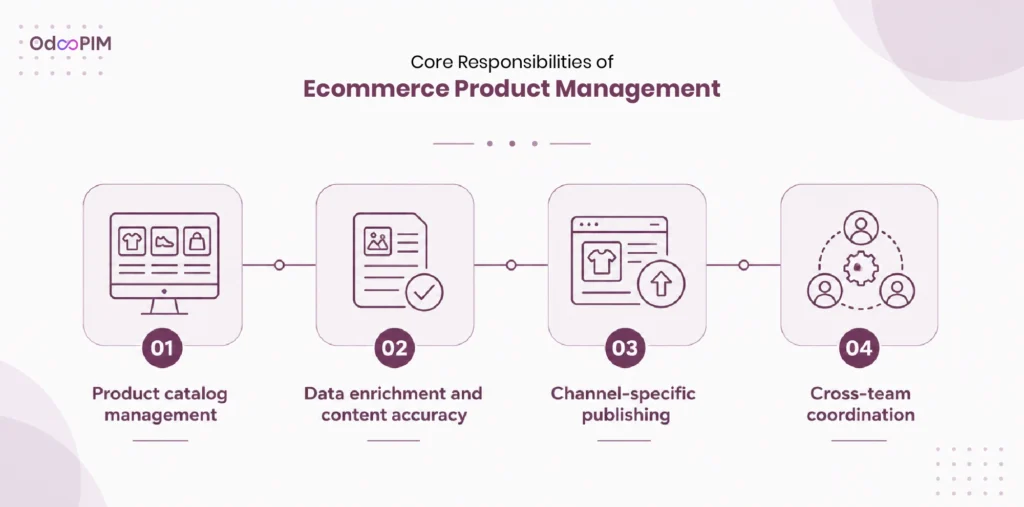
Product catalog management
Ecommerce product management catalog management includes creating product records, defining attribute families, standardizing attribute values, managing variant relationships, and ensuring every product has complete, accurate data before distribution. Product ecommerce catalog management with attribute templates ensures that every product in a category has the same required fields, so electronics products automatically have voltage and battery life fields while apparel products have size and fabric fields. Ecommerce product solutions with catalog management enable bulk editing across thousands of products, so a price update applies to every SKU in a category with one click. Ecommerce product management system catalog management also includes category mapping, browse node assignment, and product relationships for cross-sell and upsell recommendations. Ecommerce product marketing teams rely on catalog management to create campaigns that resonate, because they cannot optimize what they cannot trust.
Learn about Ecommerce Order Management System
Data enrichment and content accuracy
Ecommerce product management enrichment includes adding SEO descriptions, lifestyle images, comparison charts, and technical specifications that answer customer questions before they ask them. Product ecommerce data enrichment with AI-generated descriptions cuts manual writing time by 70%, but human review ensures tone and accuracy. Ecommerce management of content accuracy requires validation rules that block incomplete products from syndication, because missing GTINs or incorrect dimensions destroy customer trust. Ecommerce product solutions with enrichment workflows route tasks to the right teams, marketing writes descriptions, operations verifies specifications, legal approves compliance copy. Ecommerce product marketing teams cannot create compelling campaigns from incomplete descriptions, and accurate content is the foundation of every successful product experience.
Channel-specific publishing
Ecommerce product management channel publishing includes formatting product data for each sales channel, Amazon needs bullet points, your website needs long-form copy, Google Shopping needs structured feeds, and retailer portals need specific attribute mappings. Product ecommerce channel publishing with transformation rules ensures that a single master description becomes Amazon bullet points, website copy, and feed formats automatically. Ecommerce product solutions with channel-specific validation check each product against each channel’s requirements before syndication, so missing GTINs or incorrect image ratios are caught before they cause listing rejections. Ecommerce product management systems with automated syndication eliminates manual per-channel publishing, because your team sets mapping rules once and the system applies them consistently. Ecommerce product marketing campaigns depend on channel-ready content that matches each platform’s requirements, and automated syndication ensures consistency without manual effort.
Cross-team coordination
Ecommerce product management coordination includes aligning marketing, operations, sales, and compliance teams around a single product data workflow, because product data touches every department. Product ecommerce coordination with workflow automation routes tasks between teams, engineering completes specs, marketing writes descriptions, legal approved compliance, and sales sets channel pricing, all in one system with no email chains. Ecommerce management without cross-team coordination creates the silos that destroy product data consistency, because each department updates their piece without knowing what others are doing. Ecommerce product solutions with collaboration tools include commenting, task assignment, and notifications that keep teams aligned without constant meetings. Ecommerce product marketing teams need visibility into enrichment status to plan campaigns, and cross-team coordination gives them that visibility without chasing stakeholders.
Learn about eCommerce AI Agents
How PIM Solves Ecommerce Product Management Challenges
Single source of truth for all product data
A PIM centralizes every product attribute, descriptions, dimensions, images, variants, channel mappings, into one master database that every department and system accesses, eliminating spreadsheet chaos and version conflicts. Ecommerce product management with a PIM means your team stops asking “which file is current?” because only one version exists, and a product update in the PIM updates every channel automatically. Product ecommerce with centralization reduces reconciliation work by 80%, freeing your team for strategic work instead of fighting data chaos. Ecommerce product solutions with a single source of truth ensure that marketing, operations, and sales all work from the same data, eliminating the inconsistencies that destroy customer trust. Ecommerce product management system centralization is the foundation of every successful product management operation.
Structured enrichment workflows
A PIM with structured enrichment workflows routes tasks to the right teams, tracks approval status, and ensures completeness before syndication, replacing the email chains and spreadsheet handoffs that delay launches. Ecommerce product management with workflow automation means that a new product goes through engineering for specs, marketing for descriptions, legal for compliance, and sales for pricing, all in one system with no manual coordination. Product ecommerce enrichment workflows reduce time-to-market from weeks to days, because tasks are assigned automatically and bottlenecks are visible to every stakeholder. Ecommerce product solutions with validation rules ensure that products missing required attributes cannot move to the next workflow step, enforcing quality at every stage. Ecommerce product marketing teams get product data when they need it, not when someone finally remembers to email the spreadsheet.
Faster, error-free channel syndication
A PIM with automated syndication pushes enriched, validated product data to the sales channels simultaneously, eliminating the manual exports and per-channel formatting that introduce errors and delays. Ecommerce product management with syndication means that a product description updated in the PIM updates your website, Amazon, and retailer portals within minutes, not weeks. Product ecommerce with automated syndication ensures that every channel receives complete, consistent data with channel-specific transformations applied automatically. Ecommerce product solutions with validation rules check each product against each channel’s requirements before syndication, so missing GTINs or incorrect image ratios are caught before they cause listing rejections. Ecommerce product management system with automated syndication turns channel distribution from a manual bottleneck into a background process that scales with your catalog.
Learn about AI in B2B Ecommerce

Why Odoo-Native PIM Has an Ecommerce Advantage
No ERP-to-PIM data handoff
Odoo-native PIM shares the same database as Odoo ERP, so product data flows from your ERP to your PIM without middleware, connectors, or sync delays that introduce errors and inconsistencies. Ecommerce product management with Odoo-native PIM means a price change in your ERP updates your product catalog and syndicates to every channel instantly, because there is only one database, not two systems fighting for truth. Product ecommerce with no data handoff eliminates the integration headaches that plague standalone PIMs, because there is no middleware to maintain, no sync failures to debug, and no data drift to reconcile. Ecommerce product solutions with Odoo-native architecture ensure that inventory levels, pricing, and product specifications are always aligned across your operations and customer-facing channels. Ecommerce product marketing teams can trust that the data they see is current, because it comes from the same source your operations team uses.
Manage catalogs where your business already runs
Odoo-native PIM operates within the same interface where your team already manages accounting, inventory, sales, and CRM, so your product management workflow integrates smoothly with your daily operations. Ecommerce product management with Odoo-native PIM means your team does not need to learn a second system or context-switch between applications, because the PIM is built into the Odoo interface they already use. Product ecommerce with Odoo-native PIM reduces training time, adoption friction, and the errors that come from switching between disconnected systems. Ecommerce product solutions with Odoo-native architecture enable faster implementation, lower total cost of ownership, and easier scaling because there is no middleware to maintain and no custom integrations to build. Ecommerce product marketing teams can access product data in the same system where they manage campaigns, and operations teams can update specifications without switching applications, creating a unified workflow that drives efficiency and accuracy.
Learn about Agentic AI in Ecommerce
Choosing the Right Ecommerce Product Management Software
Key features to look for
Ecommerce product management software must include centralized product data storage, attribute templates per product category, validation rules and completeness scoring, workflow automation for enrichment and approval, and automated channel syndication with channel-specific formatting. Product ecommerce software should also include bulk editing capabilities for large catalogs, variant management for configurable products, and multi-language support for global expansion. Ecommerce product solutions with native ERP integration eliminate the integration headaches and middleware costs of standalone PIMs, while open APIs enable connections to your existing ecommerce, CMS, and marketplace tools. Ecommerce product management systems with flexible data modeling adapts to your catalog, not the other way around, so you can add new attributes and categories as your business grows. Ecommerce product marketing teams need software that ensures product data is complete, consistent, and channel-ready, because they cannot optimize what they cannot trust.
Questions to ask before selecting a tool
Ask each vendor: how does your software handle complex product variants with nested attributes and compatibility matrices? What pre-built connectors do you offer for my ERP, ecommerce platform, and marketplaces? Ecommerce product management software that requires custom middleware for every integration will cost you months and thousands, so native connectors matter. Product ecommerce tools should also demonstrate their workflow automation and validation rules with your actual product examples, because generic demos do not reveal whether the software can handle your specific data complexity. Ecommerce product solutions vendors should provide references from companies in your industry and catalog size, because a PIM that works for fashion might fail for industrial parts. Ecommerce product management system implementation timelines, costs, and ongoing support should be transparent, because hidden fees and delayed go-live dates will undermine your ROI. Ecommerce product marketing teams should be involved in the evaluation process, because they will use the software daily to create campaigns and need a tool that matches their workflow.
Learn about Product Experience in Ecommerce

Frequently Asked Questions
1. What is ecommerce product management?
Ecommerce product management is the discipline of overseeing your online product catalog from creation to distribution, encompassing data enrichment, attribute standardization, channel syndication, inventory synchronization, and ongoing optimization across sales channels. Product ecommerce management ensures that product descriptions are complete, dimensions are accurate, images are high-quality, and variant attributes are consistent across your website, Amazon, and retailer portals. Ecommerce product management system centralizes product data so marketing, operations, and sales teams work from the same source, eliminating the version conflicts and reconciliation work that plague spreadsheets. Ecommerce management without a centralized product data foundation means your team spends 40% of their time hunting for correct data instead of enriching it. Ecommerce product marketing teams rely on accurate product data to create compelling campaigns, but they cannot market what they cannot accurately describe.
2. What does an ecommerce product manager do?
An ecommerce product manager oversees the entire product data lifecycle, from supplier data ingestion to channel syndication, ensuring that every product has complete, accurate, and consistent information across all sales channels. E-commerce product management responsibilities include defining attribute standards, managing enrichment workflows, coordinating cross-functional teams, and optimizing product content for search and conversion. The product ecommerce manager also monitors completeness scores, validates channel-specific requirements, and ensures that products launch on time with accurate data. Ecommerce product solutions with workflow automation free product managers from manual data entry so they can focus on strategy and optimization. Ecommerce product marketing teams depend on product managers to provide complete, accurate data that drives campaign performance and customer trust.
3. How does PIM help with ecommerce product management?
A PIM centralizes every product attribute, descriptions, dimensions, images, variants, channel mappings, into one master database, eliminating the spreadsheet chaos and version conflicts that plague manual ecommerce product management. Product ecommerce with a PIM means your team stops asking “which file is current?” because only one version exists, and a product update in the PIM updates the channels automatically. Ecommerce product management system with validation rules ensures that incomplete products cannot syndicate, so missing GTINs or dimensions never reach customers. Ecommerce product solutions with workflow automation route enrichment tasks to the right teams, track approval status, and reduce time-to-market from weeks to days. Ecommerce product marketing teams get product data when they need it, not when someone finally remembers to email the spreadsheet, enabling faster campaign launches and better customer experiences.