What Is a Magento Product Feed?
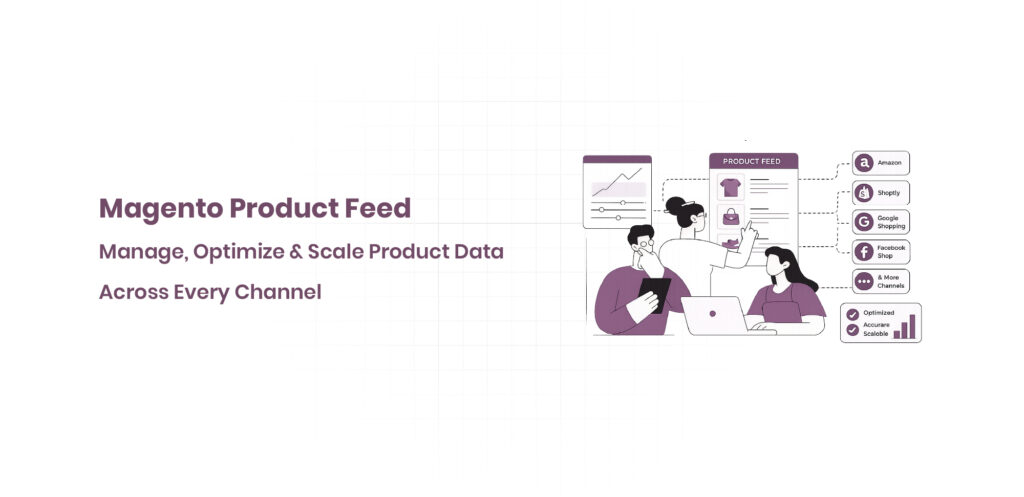
A Magento product feed is a structured file that automatically sends product information from your store to sales and advertising channels, helping merchants keep listings accurate and updated. In real-world ecommerce projects, a well-managed Magento product feed reduces manual work, improves catalog visibility, and increases conversion rates. Using a Magento 2 product feed, businesses can synchronize inventory, pricing, images, SKUs, descriptions, and availability across platforms. Many retailers rely on a Magento product feed extension or Magento data feed manager to automate updates and simplify Magento product export processes. A Magento Google Product Feed, Magento shopping feed, and product feed export Magento setup enable stores to distribute product data efficiently to marketplaces, comparison engines, affiliate networks, social commerce platforms, and advertising channels while maintaining consistency across every customer touchpoint.

How Product Feeds Work in Magento
A Magento product feed works by extracting product information from the Magento catalog and converting it into a structured format that external platforms can read and process. The feed automatically pulls details such as product titles, descriptions, SKUs, prices, images, inventory levels, and attributes, then maps them to channel-specific requirements. In many ecommerce implementations, businesses use a Magento product feed extension or Magento data feed manager to automate updates and ensure data accuracy. This process eliminates repetitive manual uploads, keeps listings synchronized across channels, and helps merchants maintain consistent product information while scaling catalog operations efficiently.
Learn about Magento integration.
Where Magento Product Feeds Are Used
A Magento product data feed is used across a wide range of sales, marketing, and distribution channels to ensure products reach customers wherever they shop. The most common use cases include Magento Google Product Feed submissions for Google Shopping campaigns, marketplace integrations, social commerce catalogs, affiliate networks, comparison-shopping engines, and retailer portals. Many growing brands also use a Magento shopping feed to distribute product data across multiple advertising platforms simultaneously. Real-world ecommerce businesses often rely on automated feed management because maintaining separate product datasets for every channel becomes difficult as product catalogs, regional stores, and customer touchpoints continue to expand.
Learn about SEO for Magento
What Data Goes Into a Magento Feed?
A Magento product feed contains all the information required for external platforms to display, rank, and sell products effectively. Typical feed data includes product names, descriptions, categories, prices, promotional pricing, SKUs, GTINs, inventory status, product URLs, image links, brand information, dimensions, and custom attributes. Depending on the destination channel, a Magento 2 product feed may also require specific fields such as Google Product Categories, shipping details, or marketplace-specific identifiers. Businesses that maintain complete and accurate feed data consistently achieve higher listing approval rates, better search visibility, and stronger campaign performance across ecommerce and advertising platforms.

How to Create a Product Feed in Magento 2
Creating a Magento product feed starts with exporting catalog data and mapping it to the requirements of the destination channel. Native Magento product export features can handle basic product data extraction, but growing stores often need a Magento product feed extension or Magento data feed manager to automate updates, schedule syncs, and customize feed attributes. A Magento 2 product feed solution makes it easier to generate channel-ready files without manual formatting. For advertising campaigns, a Magento Google Product Feed helps merchants publish products to Google Shopping with accurate pricing, availability, and images. Businesses selling through social platforms use a Magento shopping feed to create Facebook-compatible catalogs, while product feed export Magento tools ensure product information remains consistent across multiple marketplaces, reducing listing errors and improving campaign performance.
Learn about Magento Content Management
Native Magento Export: What It Can Do
Magento’s native export functionality allows merchants to perform basic Magento product export tasks by extracting catalog data into CSV files for external use. This capability is useful for small catalogs and simple data-sharing requirements, providing access to essential information such as product names, SKUs, prices, inventory levels, and categories. However, native export tools offer limited automation, attribute mapping, and channel-specific customization. As product catalogs grow and businesses expand into multiple sales channels, managing feeds manually becomes time-consuming and increases the risk of errors. This is why many organizations move beyond native exports and adopt more advanced feed management solutions.
Using a Product Feed Extension for Magento 2
A Magento product feed extension enhances feed management by automating data extraction, transformation, and distribution across multiple channels. Instead of manually creating and updating files, merchants can generate dynamic feeds that automatically reflect catalog changes in real time. A robust Magento 2 product feed solution typically includes attribute mapping, feed scheduling, custom filters, channel-specific templates, and error monitoring. Businesses with large product catalogs benefit significantly from these capabilities because they reduce manual effort while improving feed accuracy. In practice, feed extensions help ecommerce teams maintain consistent product information and support faster expansion into new marketplaces and advertising platforms.
To win, serve, and retain customers, sellers must provide content that’s unique to a buyer’s locale, need, occasion, persona, and channel at every step of the customer journey.
– Forrester
Generating a Google Shopping Feed From Magento
Creating a Magento Google Product Feed involves formatting product data according to Google Merchant Center requirements and ensuring all mandatory attributes are included. Product titles, descriptions, images, GTINs, pricing, availability, and category mappings must meet Google’s specifications for products to be approved. Many merchants use a Magento product feed solution to automate this process and reduce manual maintenance. Businesses that regularly optimize feed quality often achieve stronger visibility in Google Shopping results and better advertising performance. Accurate product data, enriched content, and automated synchronization play a major role in maintaining high approval rates and maximizing campaign effectiveness.
Learn about PIM Implementation.
Setting Up a Facebook Product Feed in Magento
A Magento shopping feed for Facebook enables businesses to synchronize product catalogs with Meta Commerce Manager and support dynamic advertising campaigns. The setup process involves exporting product information from Magento, mapping required attributes, and ensuring that inventory, pricing, images, and descriptions remain updated. Many retailers rely on a Magento product feed extension to automate feed generation and maintain consistency between their store and Facebook catalog. This integration allows businesses to create dynamic product ads, retarget website visitors, and showcase personalized product recommendations. Well-structured Facebook feeds improve campaign relevance, increase engagement, and help brands reach customers throughout the buying journey.
Learn about Best PIM Software.
Common Magento Product Feed Problems
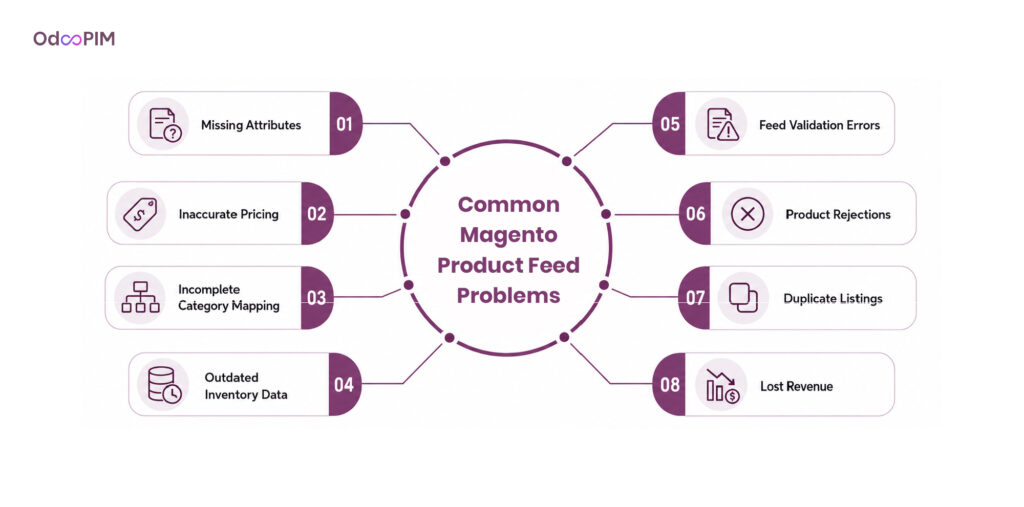
Many ecommerce teams struggle with Magento product feed issues caused by missing attributes, inaccurate pricing, incomplete category mapping, and outdated inventory data. From practical implementation experience, these problems often lead to product disapprovals, lower visibility, and lost revenue across marketplaces. A poorly configured Magento 2 product feed or outdated Magento product feed extension can create inconsistencies between channels, while weak Magento product export processes increase the risk of duplicate or incorrect listings. Businesses using a Magento Google Product Feed and Magento shopping feed frequently encounter feed validation errors that trigger product rejections. As catalogs expand across multiple stores and regions, a robust Magento data feed manager and automated product feed export Magento workflow become essential for maintaining accurate, scalable product data distribution.
1. Incomplete or Missing Product Attributes
Incomplete product attributes are one of the most common causes of Magento product feed performance issues because marketplaces and advertising platforms rely on accurate data to display products correctly. Missing values such as brand names, GTINs, product categories, dimensions, colors, or material specifications can reduce visibility and lead to listing disapproval. In large catalogs, attribute gaps often occur when product information is collected from multiple suppliers or entered manually. Businesses that implement structured data governance and validation processes within their Magento 2 product feed workflow consistently achieve better feed quality, higher approval rates, and improved customer experiences across sales channels.
2. Inconsistent Data Across Channels
Inconsistent product data across channels creates confusion for both customers and sales platforms, weakening the effectiveness of a Magento product feed strategy. A product may display one price on a marketplace, another on Google Shopping, and different specifications on the ecommerce store if data updates are not synchronized properly. These inconsistencies often result from disconnected systems, manual updates, and fragmented product management processes. Businesses that centralize product information and automate feed distribution through a Magento data feed manager significantly reduce discrepancies. Consistent product content strengthens brand trust, improves conversion rates, and ensures customers receive the same information regardless of where they shop.
3. Feed Errors That Get Products Rejected
Feed errors occur when a Magento Google Product Feed or marketplace feed fails to meet platform requirements, causing products to be rejected or limited in visibility. Common issues include invalid GTINs, missing mandatory attributes, image violations, pricing mismatches, unavailable inventory, and incorrect category mapping. Even small data inaccuracies can prevent products from appearing in search results and advertising campaigns. Ecommerce teams that regularly audit their Magento product feed, validate attribute completeness, and automate compliance checks experience fewer rejections and stronger campaign performance. Proactive feed monitoring helps protect revenue opportunities and ensures products remain eligible for promotion.
4. Scaling Feeds Across Multiple Stores
Scaling a Magento product feed across multiple stores becomes increasingly complex as businesses expand into new regions, languages, currencies, and sales channels. Each store may require unique pricing structures, localized content, tax rules, product assortments, and marketplace-specific attributes. Managing these variations manually often leads to operational bottlenecks and data inconsistencies. Successful ecommerce brands use automated feed management systems, centralized product data, and standardized workflows to support growth efficiently. A scalable Magento 2 product feed strategy enables businesses to distribute accurate product information across multiple storefronts while maintaining consistency, reducing administrative effort, and supporting long-term expansion.
Why Product Data Quality Drives Feed Performance
High-performing campaigns depend on accurate Magento product feed data because every marketplace and advertising platform evaluates product information before displaying listings. Poor titles, missing attributes, inconsistent pricing, and incomplete descriptions in a Magento Google Product Feed or Magento shopping feed reduce visibility, increase ad costs, and lower conversion rates. Channel-ready data includes standardized attributes, optimized product content, clean taxonomy mapping, high-quality images, and real-time inventory updates within every Magento 2 product feed. As catalogs grow, native Magento product export capabilities become difficult to manage at scale, prompting businesses to adopt a Magento product feed extension or Magento data feed manager that improves governance, automation, and product feed export Magento accuracy across multiple sales channels.
How Poor Product Data Hurts Ad Campaigns
Poor product data directly reduces the effectiveness of advertising campaigns because platforms such as Google Shopping and Meta rely on accurate information to match products with customer searches. An incomplete Magento product feed containing weak titles, missing attributes, low-quality images, or incorrect pricing often leads to lower visibility, reduced click-through rates, and higher advertising costs. In many ecommerce audits, feed quality issues are responsible for underperforming campaigns despite healthy ad budgets. When customers encounter inaccurate or inconsistent product information, trust declines and conversions suffer. High-quality product data improves relevance, increases engagement, and helps advertising platforms deliver better results from the same marketing investment.
What Channel-Ready Product Data Looks Like
Channel-ready product data is complete, standardized, enriched, and optimized for the specific requirements of each sales and marketing platform. A high-performing Magento product feed includes accurate product titles, detailed descriptions, structured attributes, high-resolution images, correct category assignments, pricing information, inventory status, and platform-specific identifiers. Successful ecommerce businesses go beyond basic product information by tailoring content for Google Shopping, marketplaces, social commerce channels, and partner networks. This approach improves product discoverability and customer engagement. When every field is validated and optimized before distribution, businesses achieve higher approval rates, stronger search visibility, and better overall performance across multiple channels.
Why Magento Alone Can’t Manage Feed Quality at Scale
Magento provides strong ecommerce capabilities, but managing feed quality at scale requires more than storing product information inside the commerce platform. As catalogs grow to thousands of SKUs and products are distributed through multiple channels, maintaining a consistent Magento product feed becomes increasingly difficult. Different marketplaces demand unique attributes, content formats, and compliance requirements that are challenging to manage manually. Data enrichment, validation, governance, localization, and channel-specific optimization often exceed the capabilities of standard catalog management workflows. This is why growing organizations adopt dedicated feed management tools or PIM solutions to ensure product data remains accurate, scalable, and ready for every destination.
Learn about magento product recommendation
How a PIM Solves Magento Product Feed Challenges
A PIM strengthens Magento product feed performance by creating a single source of truth for product information before data reaches sales channels. Instead of managing content inside multiple systems, teams centralize, enrich, validate, and standardize product attributes, improving the quality of every Magento 2 product feed. Leading brands use PIM platforms to map attributes to the unique requirements of a Magento Google Product Feed, Magento shopping feed, marketplaces, and advertising networks, reducing approval issues and data inconsistencies. Combined with a Magento product feed extension or Magento data feed manager, PIM-driven Magento product export processes deliver accurate, channel-ready content, while automated product feed export Magento workflows support growth across multiple stores, regions, and customer touchpoints.
Centralizing and Enriching Product Data First
Centralizing and enriching product data is the foundation of a successful Magento product feed strategy because feed quality depends on the accuracy and completeness of the underlying information. A PIM consolidates product data from suppliers, ERP systems, spreadsheets, and ecommerce platforms into a single source of truth, eliminating duplication and inconsistencies. Teams can enrich records with detailed descriptions, technical specifications, images, marketing content, and standardized attributes before distribution. This process improves data quality across the entire catalog and ensures every Magento 2 product feed contains complete, reliable information. As a result, businesses achieve better listing performance, stronger customer experiences, and fewer feed-related issues.
Mapping Attributes to Channel-Specific Feed Requirements
Mapping attributes to channel-specific requirements ensures that every Magento product feed contains the exact information needed by each marketplace, advertising platform, or distributor. Different channels often require unique data structures, mandatory fields, category taxonomies, and attribute formats. A PIM simplifies this complexity by allowing businesses to map a single product record to multiple channel templates without duplicating work. For example, attributes used in a Magento Google Product Feed may differ from those required by Facebook, Amazon, or a B2B partner portal. Effective attribute mapping improves feed compliance, reduces product rejections, and enables faster expansion into new sales channels.
Pushing Optimized Feeds From PIM to Magento and Beyond
A PIM enables businesses to distribute optimized product information across Magento and every connected channel from a centralized platform. Once product data has been validated, enriched, and mapped, the system automatically generates channel-ready feeds and synchronizes updates wherever products are sold. This approach strengthens Magento product feed management by ensuring that pricing, inventory, descriptions, images, and attributes remain consistent across ecommerce stores, marketplaces, advertising networks, and partner ecosystems. Many growing retailers use this model to support thousands of products across multiple regions without increasing manual workload. Automated feed distribution improves efficiency, accelerates product launches, and supports scalable commerce growth.
Learn about magento product export

CASE STUDIES:
Case Study 1: Fashion Retailer Reduced Product Feed Errors by 85% With PIM-Driven Magento Feed Management
Challenge
A fast-growing fashion retailer operating across Google Shopping, Meta, and multiple online marketplaces struggled with inconsistent product data in its Magento product feed. Product attributes were managed across spreadsheets and disconnected systems, leading to missing sizes, inaccurate colors, and incomplete descriptions. The company experienced frequent rejections in its Magento Google Product Feed, resulting in reduced product visibility and wasted advertising spend.
Solution
The retailer implemented a PIM platform integrated with Magento to centralize product information and automate feed creation. Product attributes were standardized, enriched, and mapped to the requirements of each sales channel. Automated validation rules ensured every Magento 2 product feed met marketplace specifications before publication.
Results
- 85% reduction in feed-related errors
- 60% faster product onboarding
- 35% increase in approved Google Shopping listings
- Improved consistency across all sales channels
- Higher conversion rates due to richer product content
Case Study 2: Electronics Distributor Scaled Multi-Channel Product Syndication Across 12 Marketplaces
Challenge
An electronics distributor managing over 50,000 SKUs relied on manual Magento product export processes to supply data to marketplaces, dealer portals, and comparison-shopping engines. Different channels required unique product attributes, causing significant delays and inconsistencies. Managing multiple versions of the same Magento shopping feed became increasingly difficult as the business expanded internationally.
Solution
The company deployed a PIM connected to Magento and its ERP system. Product data was centralized, enriched, and automatically mapped to channel-specific requirements. Using automated workflows and feed templates, the business generated optimized feeds for Google Shopping, Amazon, distributors, and regional marketplaces from a single source of truth.
Results
- Reduced feed management effort by 70%
- Cut new product launch times from days to hours
- Improved product data accuracy across all channels
- Increased marketplace listing coverage by 40%
- Successfully scaled operations across 12 sales channels without increasing headcount.
How OdooPIM Streamlines Your Magento Product Feed
A PIM strengthens Magento product feed performance by creating a single source of truth for product information before data reaches sales channels. Instead of managing content inside multiple systems, teams centralize, enrich, validate, and standardize product attributes, improving the quality of every Magento 2 product feed. Leading brands use PIM platforms to map attributes to the unique requirements of a Magento Google Product Feed, Magento shopping feed, marketplaces, and advertising networks, reducing approval issues and data inconsistencies. Combined with a Magento product feed extension or Magento data feed manager, PIM-driven Magento product export processes deliver accurate, channel-ready content, while automated product feed export Magento workflows support growth across multiple stores, regions, and customer touchpoints.
Managing All Product Data in One Place
Managing all product data in one place simplifies Magento product feed operations by eliminating the fragmentation that often exists across spreadsheets, supplier files, ERP systems, and ecommerce platforms. A centralized product information management approach creates a single source of truth where teams can manage attributes, descriptions, specifications, images, pricing information, and digital assets consistently. This reduces duplicate records, conflicting information, and manual data maintenance. For businesses operating across multiple channels, centralized management improves collaboration between marketing, ecommerce, and merchandising teams while ensuring every Magento 2 product feed is built from accurate and up-to-date product information that supports consistent customer experiences.
Enriching and Validating Feed-Ready Attributes
Enriching and validating product attributes ensures that every Magento product feed meets the quality standards required by marketplaces, search engines, and advertising platforms. Product data enrichment involves adding detailed specifications, optimized descriptions, category assignments, keywords, images, and other information that improves product discoverability and customer engagement. Validation rules help identify missing fields, formatting errors, duplicate values, and incomplete records before data reaches external channels. In large ecommerce environments, automated validation significantly reduces feed errors and product disapprovals. By ensuring every attribute is complete and accurate, businesses improve feed performance, increase listing approval rates, and create stronger shopping experiences.
Syncing Clean Product Data to Magento Automatically
Automatically syncing clean product data to Magento helps businesses maintain accurate catalogs without relying on manual updates. Once product information has been enriched and approved within a PIM, updates can flow directly into Magento and associated sales channels through automated integrations. This process strengthens Magento product feed accuracy by ensuring product titles, specifications, pricing, inventory status, and media assets remain synchronized across systems. Automation also minimizes delays between product updates and publication, reducing operational workload for ecommerce teams. As catalogs grow, automated synchronization becomes essential for maintaining consistency, improving efficiency, and supporting scalable multi-channel commerce operations.
Getting Started With OdooPIM and Magento
Getting started with OdooPIM and Magento involves connecting product data sources, defining attribute structures, and establishing workflows that support feed-ready content management. Businesses typically begin by centralizing catalog information within OdooPIM, enriching product records, and configuring validation rules to improve data quality. Once integrated, OdooPIM can automatically distribute optimized product information to Magento, creating a stronger foundation for every Magento product feed. This approach enables teams to manage product content more efficiently, reduce data inconsistencies, and accelerate product launches. As channel requirements evolve, OdooPIM provides the flexibility needed to support long-term ecommerce growth and feed management scalability.
Frequently Asked Questions
1. How Do I Create a Product Feed in Magento 2?
You can create a Magento product feed by exporting product data from Magento and formatting it according to the requirements of the target channel. While Magento offers basic Magento product export capabilities, many businesses use a Magento product feed extension or Magento data feed manager to automate feed generation, schedule updates, map attributes, and distribute product information across Google Shopping, marketplaces, and social commerce platforms. A well-structured Magento 2 product feed ensures accurate product visibility and reduces manual effort.
2. What Is the Best Product Feed Extension for Magento?
The best Magento product feed extension depends on your catalog size, channel requirements, automation needs, and attribute mapping complexity. Effective solutions should support Magento Google Product Feed creation, multi-channel syndication, feed scheduling, custom attribute mapping, and error monitoring. Businesses with large catalogs often combine a feed extension with a PIM platform to improve data quality, streamline Magento product export processes, and manage product content at scale.
3. Why Is My Magento Google Shopping Feed Failing?
A Magento Google Product Feed typically fails because of missing required attributes, inaccurate GTINs, incomplete product descriptions, pricing mismatches, image issues, or inventory discrepancies. Google Merchant Center validates every Magento product feed against strict data standards, and even minor inconsistencies can trigger product disapprovals. Regular feed audits, proper attribute mapping, and automated validation through a Magento data feed manager help prevent errors and improve approval rates.
4. How Does a PIM Improve Magento Product Feeds?
A PIM improves Magento product feed quality by centralizing product information, enriching content, validating attributes, and maintaining consistency across channels. Instead of relying solely on Magento for product data management, businesses use PIM systems to prepare channel-ready information before generating a Magento 2 product feed. This approach reduces feed errors, improves marketplace compliance, enhances customer experience, and increases the effectiveness of Magento shopping feed and advertising campaigns.
5. Can OdooPIM Manage Multi-Channel Feeds From Magento?
Yes. OdooPIM can manage multi-channel Magento product feed operations by centralizing product data, enriching attributes, and distributing optimized content across Google Shopping, ecommerce marketplaces, social commerce platforms, and partner channels. It supports efficient product feed export Magento workflows, simplifies Magento product export management, and helps businesses maintain consistent product information across every sales touchpoint while scaling catalog operations efficiently.