What Is MDM (Master Data Management)?
Master Data Management (MDM) creates a single, trusted view of all critical business data across an organization, customers, suppliers, products, employees, and locations. MDM vs PIM comparison shows MDM governs multiple data domains, while PIM focuses exclusively on product information. The difference between MDM and PIM is scope, not quality. Choose PIM for product enrichment and channel syndication; choose MDM for enterprise-wide data governance across customers, suppliers, and products together.
Core Functions of a Master Data Management System
An MDM system centralizes critical business data from multiple sources into one trusted record. It applies data quality rules to eliminate duplicates, standardize formats, and resolve conflicts. MDM vs PIM in core functions: MDM handles customer, supplier, product, and location data. Master data management vs product information management means MDM creates the golden record that other systems consume. MDM and PIM integration ensures product data flows from MDM to PIM for enrichment. When to use PIM over MDM depends on whether you need product-specific syndication or enterprise-wide governance.

What Type of Data Does MDM Manage?
MDM manages four primary domains. Customer data includes names, addresses, contact info, and purchase history. Supplier data covers vendor details, contracts, and performance metrics. Product data includes SKUs, descriptions, categories, and basic attributes. Location data covers stores, warehouses, and distribution centers. PIM vs MDM in data scope: PIM handles product enrichment and channel content. MDM handles the foundational product data software that feeds into PIM. The difference between MDM and PIM is that MDM governs data for internal operations, while PIM prepares data for external channels.
Who Uses MDM and Why?
Chief Data Officers and data governance teams use MDM to ensure data consistency across the enterprise. Operations and procurement teams use MDM for supplier and inventory management. MDM vs PIM in users: MDM serves internal operational roles, while PIM serves marketing and ecommerce teams. Master data management vs product information management means MDM users care about data accuracy across systems. When to use PIM over MDM for marketing and sales teams who need product enrichment and channel syndication. MDM and PIM integration gives both teams what they need, clean master data from MDM, enriched product content from PIM.
What Is a PIM System?
A Product Information Management (PIM) system centralizes, enriches, and distributes product data across every sales channel, your website, Amazon, Google Shopping, and retail partners. MDM vs PIM comparison shows PIM focuses exclusively on product content, while MDM governs multiple domains like customers and suppliers. The difference between MDM and PIM is scope: PIM handles descriptions, images, and channel syndication. When to use PIM over MDM when you need SEO content and multichannel distribution, not enterprise-wide data governance.
Core Functions of a Product Information Management System
A PIM system centralizes product data from multiple sources into one master record, eliminating spreadsheets and version conflicts. It enriches that data with descriptions, images, SEO metadata, and channel-specific content. PIM vs MDM in core functions: PIM syndicates to sales channels, while MDM governs data for internal operations. When to use PIM over MDM for enrichment and distribution. MDM and PIM integration ensures clean master data flows from MDM to PIM for channel readiness.
What Type of Data Does PIM Manage?
PIM manages three categories of product data. Base attributes include SKU, name, price, weight, and dimensions, mostly sourced from an ERP or MDM. Enriched content adds SEO descriptions, lifestyle images, videos, and technical manuals. Master data management vs product information management means MDM holds the golden record; PIM holds the customer-facing version. Difference between MDM and PIM in data scope: PIM manages channel-specific transformations that MDM does not handle.
Who Uses a PIM System?
Marketing teams use PIM to write SEO descriptions, upload images, and manage channel-specific copy. Merchandising teams use PIM for bulk editing, variant management, and catalog enrichment. MDM vs PIM in users: PIM serves customer-facing roles, while MDM serves internal governance teams. When to use PIM over MDM for ecommerce, marketplace, and retail channel management. MDM and PIM integration gives marketing enriched data from a trusted master source.

MDM vs PIM: Key Differences Explained
Scope of Data: Enterprise-Wide vs Product-Specific
MDM governs critical business data across multiple domains: customers, suppliers, products, employees, and locations. PIM vs MDM in scope: PIM focuses exclusively on product information. Master data management vs product information management means MDM creates the golden record for every domain, while PIM specializes only in products. The difference between MDM and PIM in scope is fundamental. When to use PIM over MDM when you need product enrichment and channel syndication, not enterprise-wide governance. MDM and PIM integration ensures product data flows from MDM to PIM.
Primary Purpose: Business Operations vs Product Experience
MDM ensures data consistency across internal systems for operational efficiency. It supports procurement, finance, and compliance reporting. MDM vs PIM in purpose: PIM enhances product content for customer-facing channels. Master data management vs product information management means MDM serves internal teams; PIM serves marketing and sales. The difference between MDM and PIM in purpose determines which system you need. When to use PIM over MDM for ecommerce, marketplaces, and digital shelf management. MDM and PIM integration gives you both operational accuracy and customer-ready content.
Data Complexity and Attribute Flexibility
MDM handles structured data with fixed schemas across multiple domains. Adding new customer or supplier fields requires governance processes. PIM vs MDM in flexibility: PIM supports dynamic attribute models for product data. Master data management vs product information management means MDM prioritizes consistency; PIM prioritizes flexibility for product variations. The difference between MDM and PIM in data modeling determines scalability for complex catalogs. When to use PIM over MDM for products with nested attributes, variants, and channel-specific content. MDM and PIM integration combines MDM’s governance with PIM’s flexibility.
Internal vs External Data Distribution
MDM distributes clean master data to internal systems like ERP, CRM, and HR platforms. It serves operational and analytical applications. MDM vs PIM in distribution: PIM syndicates enriched product data to external channels. Master data management vs product information management means MDM feeds internal operations; PIM feeds customer touchpoints. The difference between MDM and PIM in the distribution audience is clear. When to use PIM over MDM for website, marketplace, and retailer feeds. MDM and PIM integration ensures external channels receive product data that is both accurate and enriched.
More than one in four organizations report annual losses of over $5 million due to data quality issues, with some exceeding $25 million
Side-by-Side Comparison Table: MDM vs PIM
| Feature | MDM (Master Data Management) | PIM (Product Information Management) |
| Data Scope, Enterprise Data vs Product Data | Manages multiple domains: customers, suppliers, products, employees, locations, assets. | Manages a single domain: product information only, including enrichment and channel content. |
| Primary Users, IT and Operations vs Marketing and eCommerce | Data governance teams, IT administrators, operations managers, compliance officers. | Marketing teams, merchandisers, ecommerce managers, sales teams, content creators. |
| Data Governance and Quality Control | Enforces strict governance across domains with validation rules, deduplication, and audit trails for enterprise compliance. | Focuses governance on product attributes, approval workflows for descriptions and images, and content quality scoring. |
| Multichannel Distribution Capabilities | Internal distribution only, sends clean master data to ERP, CRM, HR, and analytics systems. No external channel syndication. | External distribution natively, syndicates enriched product data to websites, marketplaces, retailer portals, and comparison engines. |
| Integration With ERP and Business Systems | Acts as the system of record, feeding master data into ERP, CRM, SCM, and BI platforms for operational consistency. | Integrates with ERP to receive inventory and pricing, then enriches and syndicates to channels. Often sits downstream from MDM. |
| Scalability for Product Catalog Management | Handles product master data but lacks variant management, nested attributes, and bulk enrichment for large catalogs. | Built specifically for large product catalogs with variant generation, attribute families, nested hierarchies, and bulk editing. |
| Localization and Multi-Language Support | Basic localization for customer and supplier records, but not designed for product-specific translation workflows. | Native multi-language support with regional overlays, unit conversions, and compliance localization for global markets. |

Where MDM and PIM Overlap
Both Centralize and Govern Business Data
MDM and PIM both centralize data from multiple sources into a single trusted record. Both apply validation rules, deduplication, and quality checks. MDM vs PIM in centralization: MDM covers multiple domains; PIM focuses on products. Master data management vs product information management overlap in governance philosophy. Both systems eliminate the chaos of spreadsheets and siloed databases. The difference between MDM and PIM is scope, not approach. MDM and PIM integration combine their governance strengths.
Both Improve Data Accuracy and Consistency
Both MDM and PIM enforce data quality rules that prevent errors from propagating across systems. They standardize formats, eliminate duplicates, and maintain audit trails. PIM vs MDM in accuracy: both reduce the cost of bad data. When to use PIM over MDM for product-specific accuracy; use MDM for enterprise-wide consistency. Master data management vs product information management share the same goal: trusted data. MDM and PIM integration ensures product data is both enterprise-accurate and customer-ready.
Why Businesses Often Confuse MDM and PIM
The confusion arises because both systems manage “master data” and both include product information. MDM vs PIM vendors sometimes market their products as competing solutions for the same problem. The difference between MDM and PIM becomes blurry when MDM vendors add basic product features or PIM vendors expand into other domains. When to use PIM over MDM becomes unclear. The key distinction is scope: MDM for enterprise-wide governance across all domains; PIM for product enrichment and channel syndication. Master data management vs product information management confusion leads to wrong purchases. Know the difference.
Learn about mdm implementation
Why MDM Alone Is Not Enough for Product Data Management
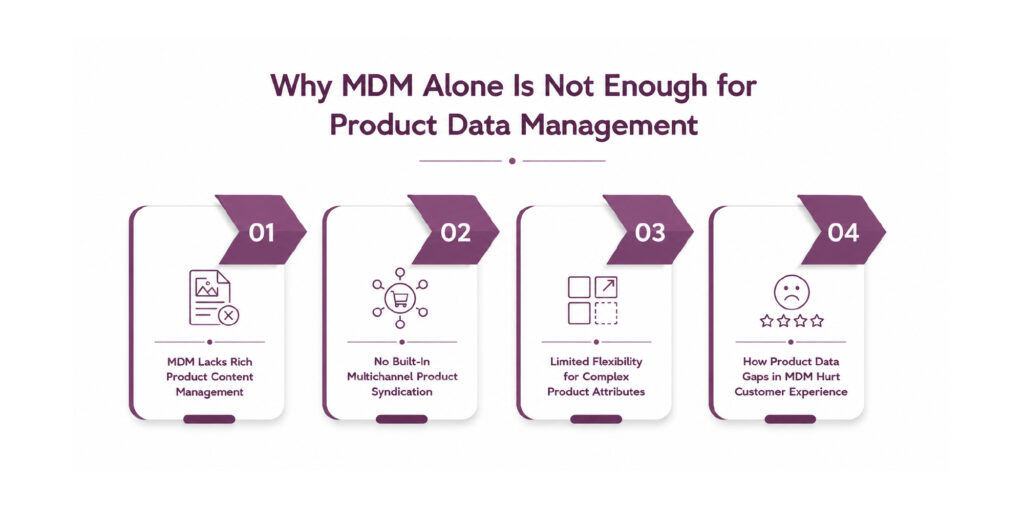
MDM Lacks Rich Product Content Management
MDM stores basic product attributes like SKU, name, and category, but cannot manage SEO descriptions, lifestyle images, or video assets. MDM vs PIM in content depth: MDM captures operational data; PIM creates customer-facing stories. Master data management vs product information management shows MDM was built for internal consistency, not marketing content. When to use PIM over MDM for rich product content is clear. MDM and PIM integration ensures operational data from MDM feeds into PIM for enrichment.
No Built-In Multichannel Product Syndication
MDM distributes clean master data to internal systems like ERP and CRM, not to external sales channels. PIM vs MDM in distribution: MDM serves internal operations; PIM syndicates to websites, marketplaces, and retailer portals. The difference between MDM and PIM in channel reach is fundamental. When to use PIM over MDM for multichannel selling. MDM and PIM integration gives you MDM’s governance and PIM’s syndication. Without PIM, your MDM product data never reaches customers effectively.
Limited Flexibility for Complex Product Attributes
MDM uses rigid schemas designed for consistency across multiple domains. Adding product-specific attributes like nested specifications or variant matrices requires heavy governance. MDM vs PIM in flexibility: PIM supports dynamic attribute families for any product type. Master data management vs product information management for complex catalogs favors PIM. When to use PIM over MDM for configurable products, compatibility matrices, or thousands of variants. MDM and PIM integration gives MDM’s governance layer with PIM’s flexible product modeling.
How Product Data Gaps in MDM Hurt Customer Experience
Customers expect rich product information. MDM-only product data means sparse descriptions, missing images, and inconsistent specifications across channels. Difference between MDM and PIM in customer impact: MDM gaps cause confusion and returns. PIM vs MDM for customer experience: PIM closes the gaps. When to use PIM over MDM when your product data touches customers directly. MDM and PIM integration ensures customers see complete, accurate, enriched product content. Without PIM, your MDM data leaves money on the table.
Do You Need Both MDM and PIM?
How MDM and PIM Work Together
MDM creates the golden record for all business domains, including product master data. PIM takes that product data and enriches it for customer-facing channels. MDM and PIM integration ensures that operational data from MDM flows seamlessly into PIM for enrichment and syndication. MDM vs PIM is not a competition, it is a partnership. When to use PIM over MDM when your focus is channel distribution. Master data management vs product information management together deliver enterprise governance plus customer-ready content.
What Data Lives in MDM vs What Lives in PIM
MDM holds the core product master data: SKU, name, description, category, weight, dimensions, and supplier information. PIM vs MDM in data division: PIM holds enriched content like SEO descriptions, lifestyle images, videos, and channel-specific copy. The difference between MDM and PIM in data ownership is clear. MDM and PIM integration ensures that core data flows from MDM to PIM, while enriched content stays in PIM. When to use PIM over MDM for channel-specific variations and rich media.
Benefits of Integrating MDM With Your PIM System
Integration eliminates double entry. Product data created in MDM appears automatically in PIM for enrichment. MDM vs PIM without integration forces manual data transfer or custom middleware. Master data management vs product information management with integration creates a single source of truth across both systems. The difference between MDM and PIM becomes invisible operationally. When to use PIM over MDM for channel syndication; use both for governance plus distribution. MDM and PIM integration delivers enterprise data quality and customer-ready content from one unified workflow.
MDM vs PIM: Which One Is Right for Your Business?
When MDM Is the Right Choice
Choose MDM when your organization needs a single trusted view of customers, suppliers, and products for internal operations. MDM vs PIM for enterprises with multiple ERPs, CRMs, and legacy systems favors MDM first. Master data management vs product information management for regulatory compliance (GDPR, SOX) requires MDM’s audit trails and governance. When to use PIM over MDM comes later. The difference between MDM and PIM means MDM handles enterprise-wide data chaos. MDM and PIM integration can follow after MDM stabilizes your core master data.
When to Invest in a Dedicated PIM System
Invest in PIM when you sell through multiple channels and need rich product content to drive sales. PIM vs MDM for ecommerce brands, manufacturers, and retailers is clear: PIM wins for product enrichment and syndication. When to use PIM over MDM when your team spends hours on SEO descriptions, images, and channel formatting. Master data management vs product information management for customer-facing content favors PIM. Difference between MDM and PIM in distribution means PIM gets products to market faster. MDM and PIM integration can wait until you need enterprise governance.
When You Need Both MDM and PIM Together
You need both when your organization has complex enterprise data governance requirements AND sells through multiple customer-facing channels. MDM vs PIM becomes irrelevant because both are essential. MDM and PIM integration delivers the complete solution: MDM for enterprise-wide master data consistency, PIM for product enrichment and channel syndication. When to use PIM over MDM for customer content; use MDM for operational governance. Master data management vs product information management together cover internal accuracy and external experience. The difference between MDM and PIM defines their roles. Integration makes them work as one.

Why Is OdooPIM the Smart Choice for Product Data Management
How Odoo PIM Goes Beyond What MDM Can Do for Products
MDM manages basic product attributes but cannot enrich content or syndicate to sales channels. OdooPIM vs MDM adds rich product descriptions, lifestyle images, SEO metadata, and channel-specific formatting. When to use PIM over MDM for customer-facing content is clear. Difference between MDM and PIM in capabilities means OdooPIM handles what MDM cannot, multichannel syndication to websites, marketplaces, and retailer portals. Master data management vs product information management with Odoo gives you product governance plus customer-ready content.
Smooth Integration of Odoo PIM With MDM and ERP Systems
OdooPIM shares the same database as Odoo ERP, eliminating the need for separate MDM for product data. MDM and PIM integration becomes automatic, not a project. For businesses using external MDM systems, OdooPIM offers API-based integration to pull master product data. PIM vs MDM in integration ease favors OdooPIM’s native architecture. The difference between MDM and PIM disappears operationally when both run on one platform. Master data management vs product information management with Odoo means one system, two capabilities.
One Centralized Platform for Product Data and Business Operations
Odoo combines ERP, PIM, CRM, and accounting in one database, no middleware, no sync delays. MDM vs PIM becomes irrelevant when both product governance and enrichment live in one platform. When to use PIM over MDM for product data is moot because Odoo gives you both. Master data management vs product information management with Odoo means your product master data flows to enrichment workflows. Difference between MDM and PIM in operational overhead: Odoo eliminates the integration complexity of separate systems. One platform. Complete product data management.
Frequently Asked Questions
1. Is PIM a Subset of MDM?
Product data is a domain within MDM’s enterprise-wide scope. However, MDM vs PIM in capabilities shows that MDM treats products like any other data domain, customers, suppliers, locations. Master data management vs product information management means MDM lacks product-specific features like variant management, rich media, and channel syndication. The difference between MDM and PIM is specialization. When to use PIM over MDM when you need product enrichment and multichannel distribution. Think of MDM as the foundation and PIM as the specialized layer on top.
2. Can MDM Replace a PIM System?
MDM vs PIM for product content shows MDM cannot manage SEO descriptions, lifestyle images, or channel-specific formatting. Master data management vs product information management in functionality: MDM handles basic product attributes; PIM handles enrichment and syndication. When to use PIM over MDM for multichannel selling, marketplaces, and rich product experiences. The difference between MDM and PIM in purpose means MDM serves internal operations, PIM serves external customers. MDM and PIM integration gives you both. MDM alone leaves your product content incomplete and your channels inconsistent.
3. Which Is Better for eCommerce: MDM or PIM?
PIM is better for ecommerce. PIM vs MDM for online selling: PIM provides product enrichment, image management, and direct syndication to your website, Amazon, and Google Shopping. MDM vs PIM in channel reach: MDM distributes to internal systems, not external sales channels. When to use PIM over MDM for ecommerce is clear, PIM was built for this. Master data management vs product information management for customer-facing content: PIM wins. Difference between MDM and PIM in ecommerce outcomes: PIM drives conversions. Use MDM for enterprise governance, but never skip PIM for ecommerce.
4. How Does PIM Integration With MDM Work?
MDM and PIM integration works through APIs or middleware. MDM holds the golden product record, SKU, name, category, weight. The PIM pulls this master data and adds enrichment: descriptions, images, SEO fields, channel mappings. Difference between MDM and PIM in integration roles: MDM is the system of record; PIM is the system of enrichment and distribution. PIM vs MDM without integration creates data drift. When to use PIM over MDM with integration means you get both governance and channel readiness. Updates flow both ways, core changes start in MDM, enrichment starts in PIM and integration keeps them in sync.