
What Is a PIM Solution?
A PIM solution is a software platform that centralizes every product attribute, technical specification, digital asset, and marketing description into a single governed repository that feeds sales channels simultaneously. Unlike fragmented spreadsheets and disconnected databases, a PIM system establishes one version of product truth that engineering, marketing, and sales teams access and trust. The product information management solution enforces data quality standards that prevent incomplete or inaccurate product records from reaching customer-facing channels. A PIM solution for B2B handles the complex product hierarchies, technical specifications, and compliance documentation that consumer-focused tools cannot accommodate. The best PIM solution transforms product data management from a perpetual operational bottleneck into a scalable capability that accelerates channel expansion and revenue growth.
Why B2B Businesses Need a PIM Solution
Growing SKU Counts and Attribute Complexity
B2B catalogs routinely span tens of thousands of SKUs, each carrying dozens or hundreds of technical attributes that spreadsheet-based management cannot govern at scale. A PIM solution for B2B handles the complex product hierarchies, variant structures, and engineering specifications that multiply data points exponentially as catalog size increases. Manual product data processes collapse when a single product change requires updating fifty attributes across thousands of related items, making a PIM system essential for operational viability. Attribute inheritance across product families automates the population of shared specifications, eliminating the manual effort that makes large-scale catalog maintenance impossible. The best PIM solution transforms growing SKU complexity from a data governance crisis into a manageable, automated workflow that scales without proportional headcount growth.
Multichannel Data Consistency
The sales channels demand product data in different formats, attribute structures, and content requirements that cause specification drift when managed through platform-specific dashboards. A product information management solution syndicates governed product truth to every channel simultaneously, ensuring identical technical specifications appear on Amazon Business, distributor portals, and your B2B website. Manual channel management inevitably produces the inconsistencies where a product carries different dimensional data or compliance certifications depending on where customers encounter it. The PIM solution enforces one master record per product, eliminating the channel-specific product data versions that confuse customers and erode purchase confidence. Multichannel consistency transforms the PIM system from a back-office tool into a frontline revenue protector that maintains brand credibility everywhere products appear.
Faster Time-to-Market for New Products
New product launches stall when teams manually compile specifications, format channel-specific listings, and verify data accuracy across multiple platforms. A PIM solution for B2B accelerates product introductions by automating the enrichment, validation, and syndication of new product records to every channel simultaneously. Category templates pre-populate standard attributes, allowing teams to focus enrichment effort on the unique specifications that differentiate new products rather than re-entering shared data. The product information management solution eliminates the sequential manual workflows where marketing waits for engineering specifications before beginning channel preparation. A PIM system compresses launch timelines from weeks to days by enabling parallel enrichment and automated distribution.
Reducing Returns and Support Tickets from Bad Product Data
Inaccurate or incomplete product specifications directly cause the returns, customer service inquiries, and negative reviews that erode margin and brand reputation. A PIM solution prevents the listing errors that occur when outdated specifications remain visible on live channels long after products change in the warehouse. Complete, accurate product data enables customers to validate purchase decisions independently, reducing the pre-sale questions that consume support team capacity. The best PIM solution catches data quality issues during the enrichment process rather than after customers discover errors on live product pages. Every support ticket avoided and return prevented through governed product data flows to the bottom line, making the PIM system a measurable ROI driver rather than an operational cost center.
Learn about best PIM software

Key Features of a PIM Solution
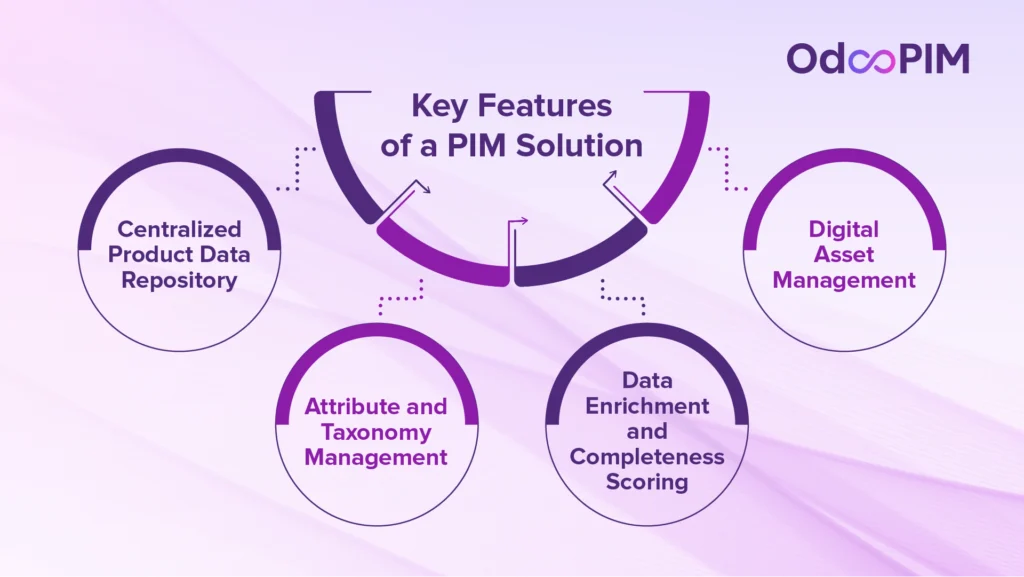
Centralized Product Data Repository
A PIM solution creates one governed location where every product attribute, specification, and digital asset lives, eliminating the version conflicts that plague spreadsheet-based management. Engineering, marketing, sales, and channel teams all access and contribute to the same product records, ensuring everyone works from identical product truth. The product information management solution establishes clear data ownership where each department controls its domain while contributing to a unified product record. Centralization prevents the dangerous scenario where marketing publishes product descriptions based on outdated engineering specifications stored in a separate system. The PIM system repository becomes the authoritative source that answers every product data question across the organization.
Attribute and Taxonomy Management
A PIM solution structures product data through defined taxonomies, category hierarchies, product families, and classification trees, that organize catalogs for internal management and customer navigation. Attribute management defines which specifications apply to which product types, ensuring relevant data appears prominently while irrelevant fields remain hidden. The product information management solution enforces controlled vocabularies where attribute values remain consistent, preventing the search failures that occur when different team members use varying terminology. Attribute inheritance across product families automates specification population, eliminating the manual effort of entering identical data across similar products. The best PIM solution makes taxonomy and attribute management the structural foundation upon which other product data capabilities depend.
Data Enrichment and Completeness Scoring
A PIM solution tracks enrichment progress across every product record, measuring completeness against defined standards before products can syndicate to customer-facing channels. Completeness scoring identifies which products require additional attributes, better descriptions, or missing digital assets, enabling teams to prioritize enrichment efforts systematically. The product information management workflow solution enforces mandatory field requirements that prevent incomplete product records from reaching marketplaces where sparse listings damage search rankings. Automated enrichment workflows route products through staged completion gates, ensuring technical validation precedes marketing enrichment. A PIM system transforms enrichment from an invisible, unmeasured activity into a trackable process with quality metrics.
Digital Asset Management
A PIM solution connects product records to their associated images, videos, specification sheets, CAD files, and compliance documentation in a searchable, governed library. Digital assets link to specific SKUs, eliminating the shared-drive chaos where teams cannot find the correct product imagery or determine which version represents the approved asset. The product information management solution ensures that channel syndication includes properly formatted assets, correct image sizes, approved document versions, and channel-compliant file types. Asset-to-product relationships enable automated syndication where the right images and documents travel with product data to every channel automatically. The best PIM solution treats digital assets as integral product components rather than separate files managed in disconnected systems.
Channel Syndication
A PIM solution pushes enriched product content to every sales channel with automated formatting that respects each platform’s specific attribute requirements, content policies, and technical specifications. Syndication eliminates the manual reformatting that consumes team hours and introduces errors when products launch across multiple marketplaces simultaneously. The product information management solution validates listings against channel requirements before publication, preventing the rejections and suppressions that damage marketplace standing. Channel-specific mapping rules translate master attributes into each platform’s required format without manual intervention. A PIM system transforms channel expansion from a data reconstruction project into a configuration exercise where new channels connect through defined syndication rules.
Workflow and Governance
A PIM solution enforces approval chains, role-based permissions, and data quality rules that govern who can create, modify, and publish product information across the organization. Workflow automation routes product content through staged reviews where engineering validates specifications before marketing adds commercial content. The product information management solution maintains audit trails tracking every change, supporting compliance requirements and providing accountability when errors occur. Governance rules prevent unauthorized modifications while allowing approved teams to enrich product data within their domains of expertise. The best PIM solution balances governance control with operational flexibility, ensuring data quality without creating approval bottlenecks that slow channel publication.
Learn about PIM vs DAM

Types of PIM Solutions
SaaS PIM
A SaaS PIM solution delivers product information management as a cloud-hosted subscription service where the vendor handles infrastructure, security, and updates. Teams access the PIM system through a browser, eliminating the server provisioning, software installation, and maintenance demands of on-premise alternatives. SaaS PIM solutions deploy, compressing implementation timelines from months to days and accelerating time-to-value for organizations needing immediate product data governance. The subscription model converts capital expenditure into predictable operational costs that scale with usage rather than capacity estimates. Cloud delivery suits organizations prioritizing speed, flexibility, and reduced IT burden over the unlimited customization potential of on-premise deployments.
Open-Source PIM
Open-source PIM solutions provide access to source code and the freedom to customize the platform extensively, appealing to organizations with development resources. The hidden cost emerges in engineering hours consumed by installation, configuration, ongoing maintenance, and security patching that commercial PIM systems handle as part of the subscription. Open-source platforms demand that internal teams become PIM infrastructure experts alongside their product data stewardship responsibilities. Organizations selecting open-source product information management solution options trade subscription costs for the operational burden of managing the application stack independently. The approach suits businesses where customization requirements justify the engineering investment required to maintain an open-source platform.
ERP-Native PIM
An ERP-native PIM solution operates within the same platform ecosystem as your enterprise resource planning system, eliminating the middleware that traditional deployments require. This emerging category serves Odoo-run businesses seeking a PIM solution for B2B that shares a data model with inventory, pricing, procurement, and sales modules. Native architecture means product data, stock levels, and pricing changes synchronize in real time without batch processing delays or integration failures. The best PIM solution for Odoo users eliminates the data mapping exercises and connector maintenance that standalone PIM deployments demand. ERP-native PIM transforms product data management from a separate initiative into an integrated business capability that teams access within their daily operational environment.

How to Choose the Best PIM Solution
Match to Your ERP and Tech Stack
The PIM solution must integrate with your existing ERP, ecommerce platform, and business systems where product data originates or flows. Native integration eliminates the middleware tax that adds cost, latency, and failure points to data synchronization between the PIM system and operational platforms. Evaluate whether the product information management solution offers pre-built connectors, robust APIs, or native architecture that makes data exchange a configuration exercise rather than a development project. Integration depth determines whether your PIM functions as a connected operational hub or an isolated data island requiring manual data transfer. The best PIM solution for your business fits seamlessly into your technology stack rather than demanding costly reconfiguration of existing systems.
Evaluate Total Cost of Ownership
PIM total cost extends beyond license fees to include implementation services, integration development, ongoing maintenance, and the internal resources required for long-term operation. SaaS PIM solutions bundle infrastructure and maintenance into predictable subscription costs while on-premise deployments demand additional hardware, IT staffing, and upgrade project expenses. Open-source PIM systems appear cheaper initially but accumulate substantial engineering costs for installation, customization, and ongoing platform maintenance. Calculate five-year total cost across PIM solution categories being evaluated, including the hidden expenses of data migration, team training, and workflow redesign. The product information management solution with the lowest subscription price carries the highest total cost when implementation complexity and operational burden enter the calculation.
Check B2B-Specific Capabilities
A PIM solution for B2B must handle complex product hierarchies, technical specification management, compliance documentation, and customer-specific catalog requirements. Evaluate whether the PIM system supports the variant structures, configurable products, and attribute inheritance patterns that industrial catalogs demand. B2B-specific features like quoting data management, bulk pricing tiers, and multi-unit packaging attributes separate general-purpose PIM solutions from those built for industrial commerce. The product information management solution should accommodate the technical buyer’s need for detailed specifications, downloadable engineering documents, and compatibility matrices. Consumer-focused PIM platforms lack the data modeling depth required for the complex product relationships and technical attributes that define B2B catalogs.
Assess Implementation Timeline
Implementation timelines for PIM solutions range from weeks for cloud-native platforms to months for complex on-premise deployments requiring infrastructure provisioning. ERP-native PIM systems accelerate deployment by leveraging existing data models and user access rather than building integrations from scratch. Evaluate whether the product information management solution vendor provides implementation support, data migration tools, and training programs that compress time-to-value. Phased rollouts starting with high-value product lines deliver measurable results while building organizational confidence in the PIM solution. The best PIM solution matches your urgency for data governance improvement with an implementation approach that delivers early wins before expanding to full catalog coverage.
How a PIM Solution Built on Odoo Simplifies Product Data Management
OdooPIM operates natively within the Odoo ecosystem, creating a PIM solution that shares its data foundation with ERP, inventory, sales, and ecommerce modules without middleware. This native architecture eliminates the integration failures and synchronization delays that plague standalone PIM solutions connected to Odoo through third-party connectors. Product data, stock levels, and pricing changes propagate instantly across the product information management solution because modules reference the same data model. The unified PIM system provides a single source of truth where engineering specifications, marketing content, and operational data coexist in one governed environment accessible to every team. Built specifically for B2B manufacturers, distributors, and wholesalers, OdooPIM handles the complex product hierarchies, technical attributes, and compliance documentation that define industrial commerce. The platform transforms product data management from a separate initiative requiring external tools into an integrated capability embedded within the daily operational systems teams already use.

FAQ’s
1. What is a PIM solution and how does it work?
A PIM solution centralizes every product attribute, technical specification, digital asset, and marketing description into one governed repository that feeds sales channels simultaneously. The PIM system ingests raw product data from ERP platforms, supplier feeds, and spreadsheets, then provides workflows where teams enrich that data with complete specifications and compelling content. Data governance rules enforce quality standards before the product information management solution syndicates enriched product records to ecommerce sites, marketplaces, distributor portals, and print catalogs. A PIM solution for B2B handles the complex hierarchies, variant structures, and technical documentation that industrial catalogs demand. The platform transforms fragmented, inconsistent product information into a single source of truth accessible to every team and every channel.
2. What is the difference between a PIM solution and an ERP?
An ERP manages business operations, inventory, purchasing, accounting, order processing, while a PIM solution governs the product information that customers use to discover, evaluate, and purchase items. The ERP holds core product identifiers, costs, and inventory counts that serve as the operational backbone; the product information management solution adds the enriched attributes, marketing descriptions, and digital assets that drive customer purchase decisions. ERPs lack the enrichment workflows, channel syndication capabilities, and content governance features that define a PIM system. A PIM solution for B2B complements ERP functionality by transforming operational product data into the complete, compelling product presentations that sales channels require. The two systems work together, with the ERP providing operational truth and the PIM providing the enriched commercial truth.
3. Do small and mid-sized B2B businesses need a PIM solution?
Small and mid-sized B2B businesses need a PIM solution the moment their product data complexity outpaces spreadsheet-based management capabilities. Growing SKU counts, expanding channel presence, and increasing customer expectations for complete technical specifications make manual product data processes unsustainable. A PIM solution for B2B prevents the operational chaos where small errors in spreadsheets multiply across channels, causing listing mistakes that damage credibility with the buyers these businesses can least afford to lose. Cloud-based PIM solutions make sophisticated product data governance accessible without the infrastructure investment that previously restricted PIM adoption to large enterprises. The best PIM solution for growing businesses delivers immediate operational relief from the data management burden that consumes team hours better spent on revenue-generating activities.
4. How much does a PIM solution cost?
PIM solutions pricing varies significantly based on deployment model, SKU volume, user count, feature tier, and integration complexity, ranging from a few hundred to several thousand dollars monthly. SaaS PIM systems convert capital expenditure into predictable operational costs with subscription pricing that scales with actual usage rather than capacity estimates. Open-source product information management solution options eliminate license fees but accumulate substantial engineering costs for installation, customization, and ongoing maintenance. A PIM solution for B2B with native ERP integration eliminates the middleware expenses that add cost and complexity to standalone deployments. The total cost of ownership for the best PIM solution must account for implementation services, data migration, team training, and ongoing operational expenses beyond the initial subscription or license price.
5. Which PIM solution works best with Odoo ERP?
OdooPIM operates as a native PIM solution within the Odoo ecosystem, sharing its data foundation with Odoo ERP, inventory, sales, and ecommerce modules without requiring middleware. This ERP-native PIM system eliminates the integration failures and synchronization delays that plague standalone PIM solutions connected to Odoo through third-party connectors. Product data, stock levels, and pricing changes propagate instantly across the product information management solution because modules reference the same underlying data model. A PIM solution for B2B built natively on Odoo provides the complex product hierarchy management, technical attribute governance, and channel syndication capabilities that industrial manufacturers and distributors require. The unified approach transforms product data management from a separate external initiative into an integrated capability embedded within the daily operational environment Odoo users navigate.