Product information management has meant manual data entry, spreadsheet cleanup, and inconsistent attribute completion. PIM AI eliminates this drudgery. Machine learning algorithms enrich product descriptions, categorize items correctly, and validate attribute completeness without human intervention. AI for PIM transforms raw supplier feeds into polished catalog content in seconds rather than days.
An AI powered PIM system detects missing specifications and suggests values based on similar products. Duplicate records merge automatically. Image tagging occurs without manual effort. AI in PIM learns from corrections, improving accuracy with each interaction. Integrating AI with PIM systems delivers data quality levels unattainable through manual processes alone. AI powered PIM solutions enable businesses to launch products faster while maintaining consistent, error-free information across sales channels.
What Is PIM AI?
Product Information Management (PIM) serves as the central repository for product data, descriptions, specifications, images, and pricing. PIM stores this information and distributes it to sales channels. Today, most PIMs rely on human input. Users manually enter attributes, correct errors, and enrich descriptions. Data quality depends on manual effort.
An AI powered PIM system transforms product information into an intelligence layer. AI for PIM automates data enrichment, classification, and validation. Machine learning algorithms detect missing information and suggests values. Duplicate records merge automatically. Images tag themselves. Integrating AI with PIM systems elevates product data management from maintenance to strategic advantage. AI PIM delivers complete catalogs without proportional increases in human effort.
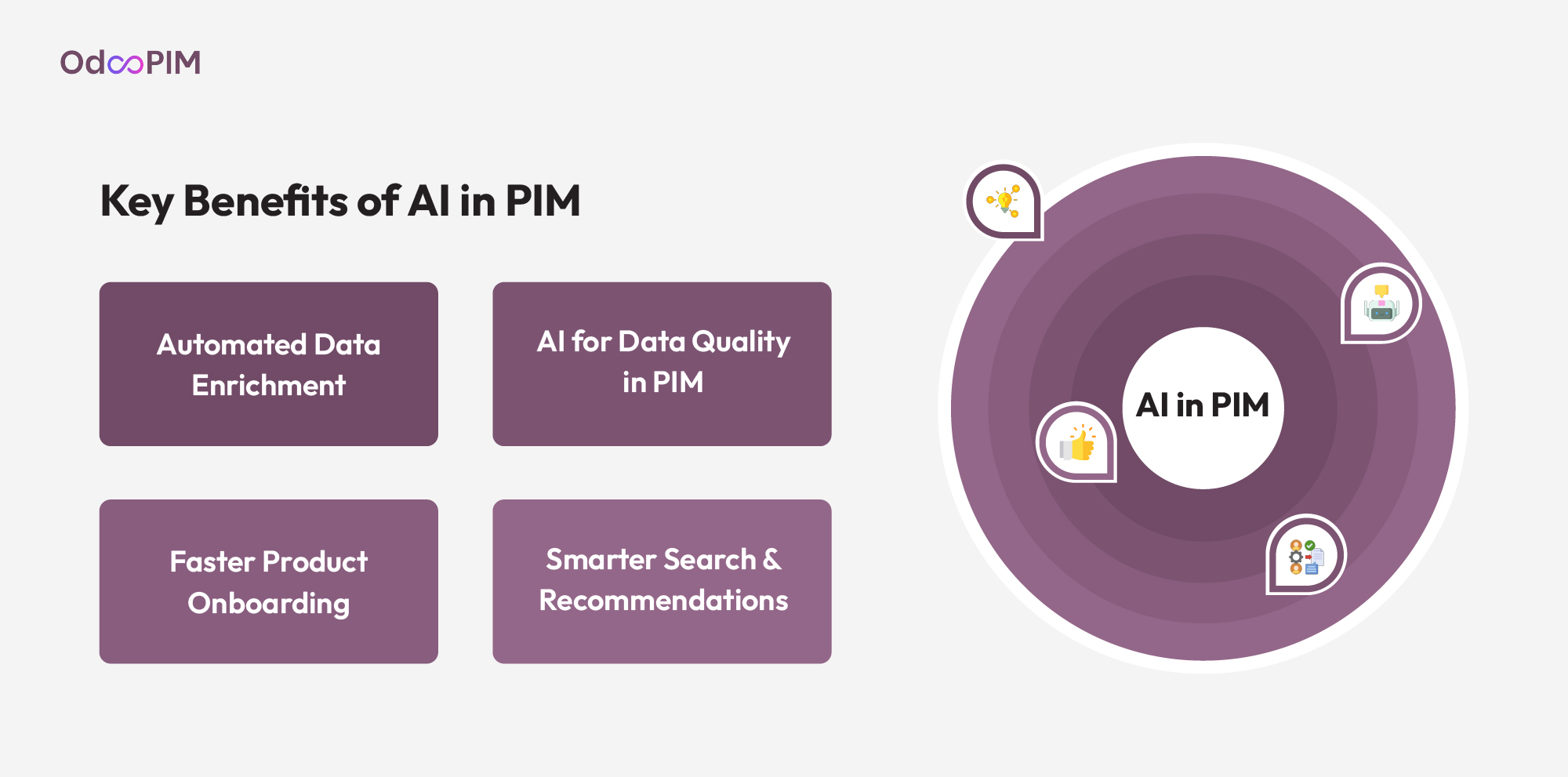
Key Benefits of AI in PIM
1. Automated Data Enrichment
AI for PIM transforms supplier data into complete product narratives. Machine learning (ML) generates descriptions, extracts specifications from documents, and assigns accurate attributes automatically. An AI powered PIM system populates missing fields by analyzing similar products, eliminating manual research.
2. AI for Data Quality in PIM
Duplicate records and inconsistent formatting plague traditional systems. AI in PIM identifies and merges duplicates, standardizes units of measure, and validates attribute completeness. Integrating AI with PIM systems ensures accurate, consistent data reaches customers.
3. Faster Product Onboarding
New product introduction cycles reduce from weeks to days. AI powered PIM classifies items correctly, maps attributes to channel requirements, and prepares content for distribution without human intervention.
4. Smarter Search & Recommendations
AI PIM enhances internal and external search. Semantic understanding delivers results even when queries lack exact keywords, improving discovery and cross-selling.
Learn about PIM best practices.

Integrating AI with PIM Systems
1. API-Based Integrations
AI for PIM connects through APIs that exchange data continuously. Supplier feeds flow into enrichment engines. Enriched content returns to PIM automatically. An AI powered PIM system processes thousands of products hourly without manual intervention.
2. Machine Learning Models for Classification
Integrating AI with a PIM system enables automatic categorization. Models trained on existing catalog data assign new products to correct categories with accuracy. AI in PIM learns from corrections, improving classification over time.
3. Real-Time Data Validation
AI for data quality in PIM validates attributes instantly. Missing specifications trigger alerts. Inconsistent units flag for review. Anomalies receive attention before reaching customers.
4. Scalability for Growing Catalogs
AI powered PIM scales with catalog expansion. Processing capacity increases as product volumes grow. AI PIM maintains data quality regardless of catalog size.
Learn about Product data management software.
AI-driven automation is transforming PIM into an intelligent, self-optimizing system.
–Gartner
Use Cases
eCommerce Businesses Managing Thousands of SKUs
Online retailers face constant data chaos. Supplier feeds arrive in inconsistent formats. Descriptions lack critical specifications. AI for PIM cleans and enriches this influx. An AI powered PIM system standardizes attributes, generates missing descriptions, and ensures product meets channel requirements before publication.
Manufacturers Distributing Across Multiple Channels
Industrial manufacturers send product data to distributors, catalogs, and sales platforms simultaneously. Each channel demands different attributes and formats. AI in PIM transforms master data into channel-specific variations without manual recreation. Integrating AI with PIM systems eliminates redundant work while maintaining consistency.
Marketplaces Requiring Structured, Clean Data
Marketplaces reject incomplete or poorly formatted submissions. AI for data quality in PIM validates every attribute against marketplace specifications before upload. AI powered PIM ensures listings activate rather than languishing in error queues. Sellers win. Marketplaces win. Customers win.
Learn about ai powered product data enrichment.

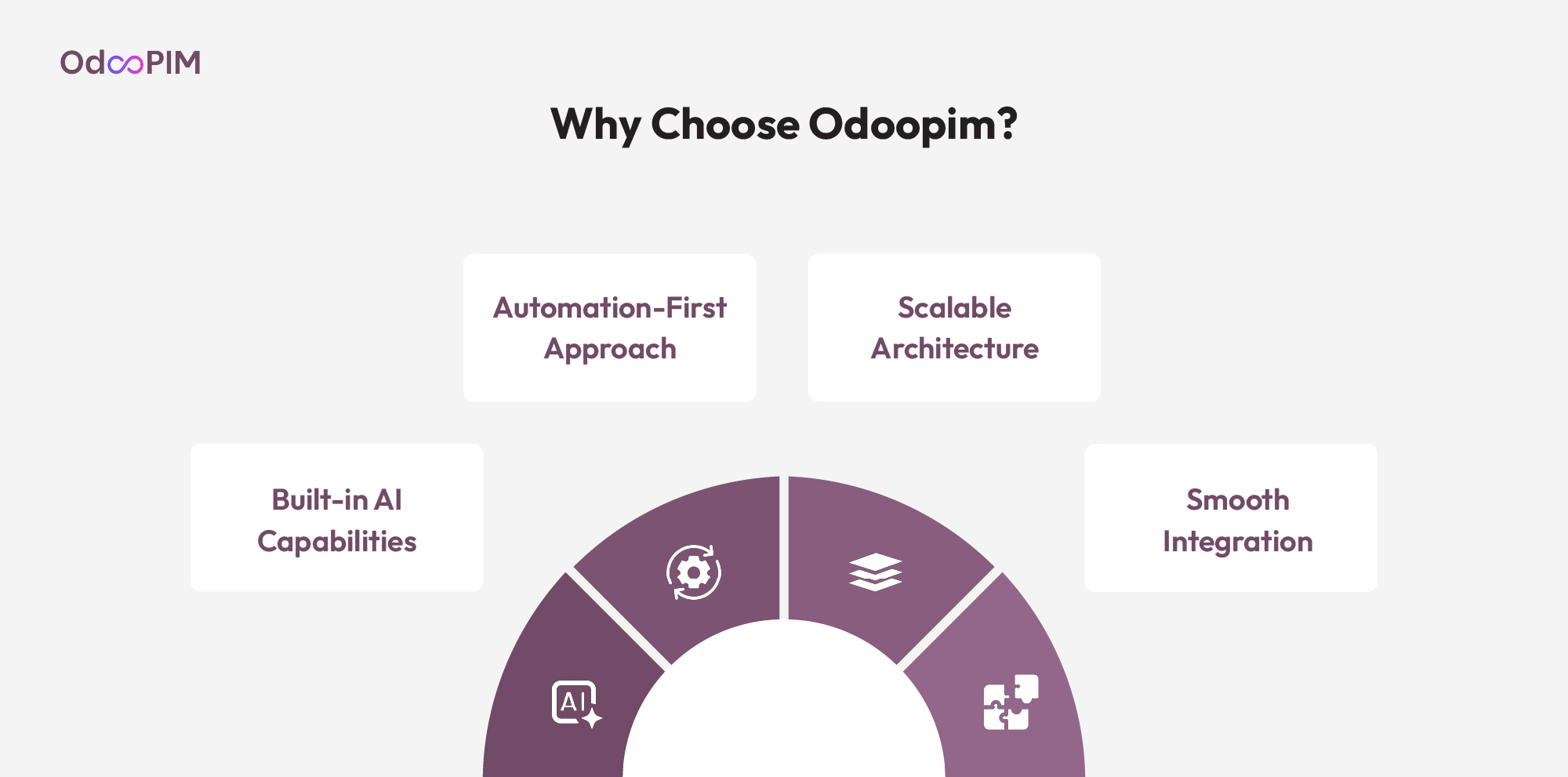
Why Choose Odoopim?
1. Built-in AI Capabilities
OdooPIM embeds AI for PIM into the platform architecture. No separate subscriptions. No complex configurations. An AI powered PIM system activates instantly, enriching product data from day one. AI in PIM works behind the scenes, improving catalog quality without manual effort.
2. Automation-First Approach
Every feature assumes automation as the default. AI for data quality in PIM validates, enriches, and classifies products automatically. Human intervention occurs for strategic decisions. Integrating AI with PIM systems through OdooPIM means data flows from supplier to customer with zero manual touches.
3. Scalable Architecture
Catalog growth never degrades performance. AI powered PIM processes thousands or millions of SKUs with equal speed. Processing capacity scales automatically with business expansion.
4. Smooth Integration
OdooPIM connects natively with ERP, eCommerce platforms, and marketplaces. AI PIM enriches data once; integrated channels consume it everywhere.
Learn about product data governance software.

To wrap up the post
Manual product data management cannot scale. Spreadsheets fail. Human review bottlenecks growth. Errors multiply with catalog expansion. PIM AI solves these problems permanently. Machine learning enriches, validates, and classifies product information at speeds humans cannot match.
AI for PIM delivers data quality across every sales channel. Integrating AI with PIM systems eliminates the trade-off between speed and accuracy. AI powered PIM solutions enable businesses to launch products faster while maintaining error-free information.
The choice is simple. Continue struggling with manual data management or deploy AI PIM. OdooPIM delivers enterprise-grade AI for data quality in PIM without complexity.
Ready to transform your product catalog? Contact us for a personalized demonstration.
Learn about best free PIM software

FAQ
1. How does AI handle multilingual product content in a PIM system?
PIM AI automates multilingual content creation through neural machine translation engines trained on product-specific terminology. An AI powered PIM system detects source language content and generates accurate translations for every target market simultaneously. AI for PIM maintains terminology across languages, ensuring brand voice remains intact globally. The system learns from corrections, improving translation quality with each interaction. Integrating AI with PIM systems eliminates manual translation bottlenecks. Product launches across multiple regions occur simultaneously rather than sequentially. AI in PIM also localizes units of measure, date formats, and cultural references automatically. An AI powered PIM delivers complete multilingual catalogs without proportional increases in translation budgets or timelines.
2. Can AI in PIM help with product taxonomy optimization across multiple sales channels?
PIM AI analyzes product attributes and automatically assigns correct categories for each sales channel. An AI powered PIM system maintains multiple taxonomies simultaneously, Amazon’s browse structure, Google’s product category taxonomy, and internal catalog organization. AI for PIM learns the categorization rules for each channel and applies them across thousands of products. Integrating AI with PIM systems eliminates manual reclassification when expanding to new marketplaces. AI in PIM detects miscategorized products and suggests corrections before they cause listing errors. An AI powered PIM adapts taxonomy mappings as channels update their structures. Businesses maintain optimal classification across platforms without dedicated taxonomy teams.
3. How secure is product data when using an AI-powered PIM system?
AI powered PIM systems implement enterprise-grade security exceeding traditional PIM protections. Data encryption occurs at rest and in transit. Access controls restrict AI model training to authorized datasets only. PIM AI operates within isolated instances, preventing cross-customer data leakage. AI for PIM processes data without storing it externally, machine learning models run within the secure environment. Integrating AI with PIM systems maintains complete audit trails showing every data access and model interaction. AI in PIM supports role-based permissions ensuring sensitive product information remains visible only to authorized personnel. An AI powered PIM system undergoes regular security certifications and penetration testing. Product data matches or exceeds traditional PIM deployments while adding intelligence capabilities.
4. Does AI require historical product data to function effectively in PIM?
PIM AI delivers value immediately with minimal historical data. Pre-trained models understand general product attributes, descriptions, and classifications out of the box. An AI powered PIM system enriches new products using patterns learned from millions of public product records. AI for PIM improves with your data over time but functions effectively from day one. Integrating AI with PIM systems enables progressive learning, the more products you process, the more tailored the recommendations become. AI in PIM adapts to industry-specific terminology within weeks, not months. An AI powered PIM provides productivity gains for startups with limited catalogs and enterprises migrating from legacy systems alike. Historical data accelerates optimization but never blocks implementation.
5. How does AI reduce manual workload for product and content teams?
Manual data entry disappears as AI for PIM extracts attributes from supplier documents automatically. Content creation shifts from writing to reviewing as AI powered PIM generates descriptions. Quality checks automate through AI for data quality in PIM, flagging only exceptions for human review. Taxonomy assignment occurs without manual categorization as AI in PIM classifies products instantly. Integrating AI with PIM systems reduces product onboarding time from hours to minutes per SKU. Teams focus on strategic work, brand voice refinement, exception handling, and new market expansion, rather than repetitive data tasks. An AI powered PIM system reduces manual product data workload by 70-80% within months.