One in three ecommerce brands deploy ecommerce AI agents to convert sales, and 76% report lower customer acquisition costs as a result. Yet while headlines focus on customer-facing chatbots, the real transformation is happening where customers never see it. AI agents for eCommerce are taking over the manual catalog work that has always consumed teams, enriching attributes, syndicating products, and quality-checking thousands of listings. eCommerce AI automation agents handle what used to require dedicated headcount. AI agents product management tools analyze images and specifications to fill missing data. AI catalog management agents monitor consistency across channels. This shift from human-driven to autonomous AI agents eCommerce 2026 operations changes everything about how product data flows.
The theory is that AI agents for product data management have moved beyond experimentation into core infrastructure. Autonomous product enrichment AI transforms raw supplier information into complete, channel-ready listings without manual intervention. PIM AI agent automation connects these agents to your product information, creating pipelines that enrich, validate, and syndicate continuously. E-commerce AI automation agents 2026 don’t just assist, they execute. For teams adopting AI catalog management agents, the result is faster time-to-market, fewer errors, and teams finally freed from spreadsheet prison. This is what ecommerce AI agents deliver, not conversation, but completion.
What Are eCommerce AI Agents?
Ecommerce AI agents are autonomous software systems that perceive their environment, make decisions, and execute actions without constant human supervision. Unlike simple automation that follows rigid rules, these agents adapt based on what they encounter. They monitor product data, identify what needs attention, and act accordingly. An AI catalog management agent doesn’t wait for instructions, it continuously scans for missing attributes, inconsistencies, or enrichment opportunities and handles them immediately. This shift from reactive tools to proactive agents changes everything.
Gen AI tools create content when you ask. eCommerce AI automation agents don’t just generate, they execute complete workflows from start to finish. An AI agents product management system doesn’t write a description and stop, it writes, validates, formats for each channel, and publishes, while logging what it did. Autonomous AI agents eCommerce 2026 represent this leap from assistance to execution.
eCommerce product data is the perfect use case because it combines volume, repetition, and complexity. AI agents for product data management handle thousands of SKUs, each requiring consistent attributes, accurate descriptions, and channel-specific formatting. Autonomous product enrichment AI transforms supplier data into complete listings. PIM AI agent automation turns catalog maintenance from a daily grind into a background process that runs itself.

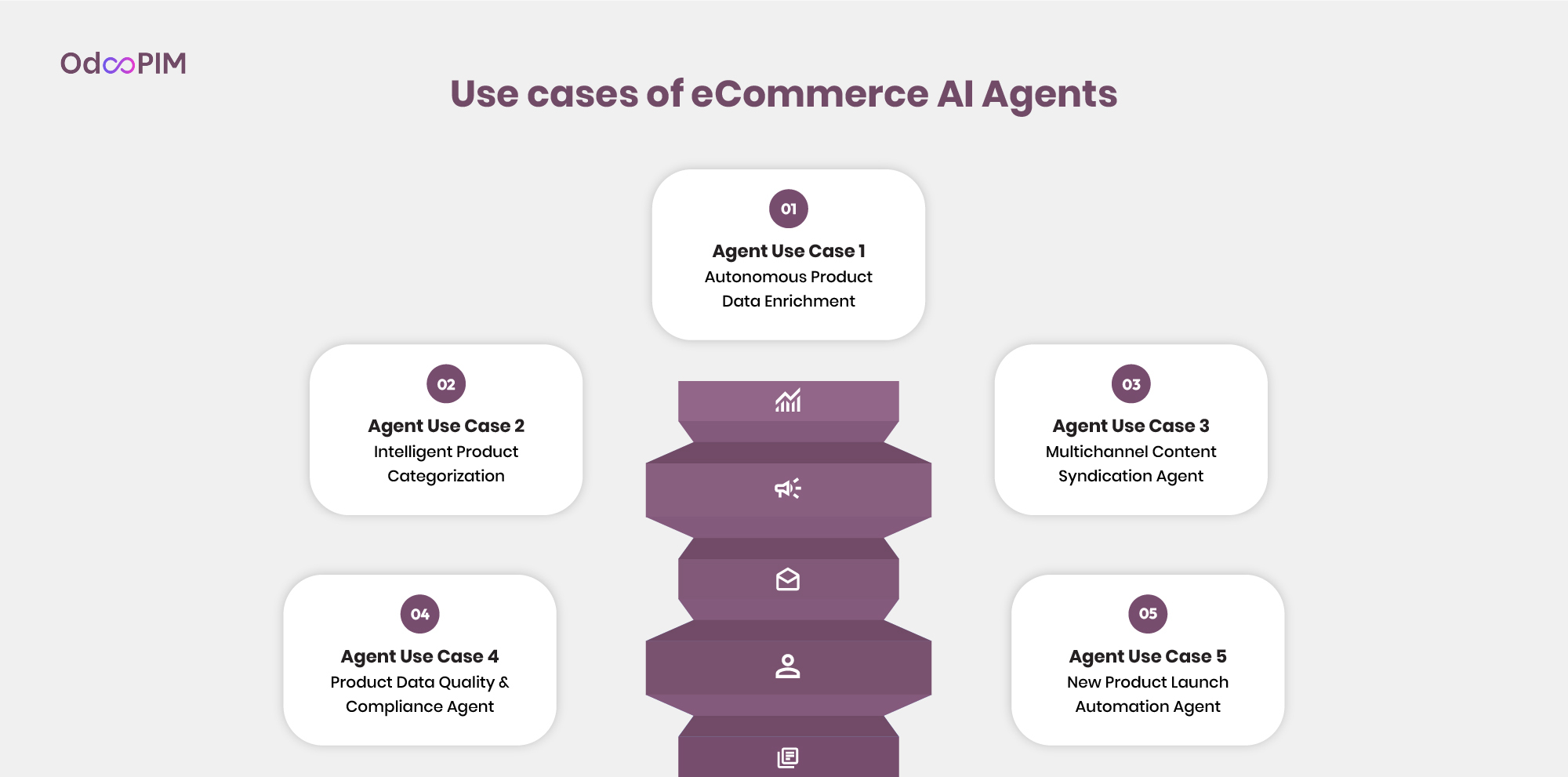
Agent Use Case 1: Autonomous Product Data Enrichment
AI agents for product data management transform how supplier information becomes complete catalog listings. When new products arrive, an autonomous product enrichment AI agent ingests supplier sheets, images, and specifications. It analyzes every data point, fills missing attributes by cross-referencing patterns, and flags gaps it cannot resolve. The agent doesn’t wait for instructions, it simply begins working the moment data appears. For teams managing thousands of SKUs, this means products move toward market-ready status without anyone touching them.
eCommerce AI automation agents handle routine enrichment without any human touchpoints. An AI catalog management agent identifies that a product lacks dimensions, checks similar items, and populates appropriate measurements based on recognized patterns. It adds material compositions extracted from images. It assigns categories based on product characteristics. Ecommerce AI agents performing these tasks eliminate the backlog that usually forms when new inventory arrives. Teams only engage when the agent flags exceptions, items requiring human judgment or missing critical information.
PIM AI agent automation within OdooPIM makes this practical. The AI agents product management agent works inside your product information system, enriching data at the moment of ingestion. No exports, no separate tools, no manual transfers. Autonomous AI agents eCommerce 2026 operate where your data lives, ensuring every product entering your catalog emerges complete, accurate, and ready for sale. The agent handles volume. Your team handles strategy.
Learn about 15 Best AI Tools for Ecommerce Business in 2026
By 2028, 15% of day-to-day business decisions will be made autonomously by AI agents.
– Reuters
Agent Use Case 2: Intelligent Product Categorization.
AI catalog management agents solve one of eCommerce’s oldest headaches, where does this product belong? When new SKUs arrive, AI agents for product data management agent analyze product images, descriptions, and attributes to map each item to your correct taxonomy automatically. A running shoe lands in footwear > athletic > running rather than general shoes. A wireless charger finds electronics > phone accessories > charging. The agent doesn’t guess, it evaluates multiple signals to make accurate placement decisions every time.
What makes these agents intelligent is continuous learning. eCommerce AI automation agents study historical categorization patterns, understanding not just where products went but why. An autonomous AI agents eCommerce 2026 agent recognizes that products with certain material compositions consistently place in specific categories. It learns that items mentioning “waterproof” follow different paths than standard products. This learning compounds over time, making each new product’s categorization faster and more accurate than the last. AI agents for eCommerce handling taxonomy eliminate the inconsistent sorting that plagues manual processes.
PIM AI agent automation within OdooPIM ensures this intelligence applies everywhere. The AI agents product management agent categorizes once, then maintains consistent categorization across every channel automatically. Your website, Amazon store, and marketplaces reflect the same taxonomy structure. Autonomous product enrichment AI that powers categorization means zero manual sorting, products flow into correct positions without anyone dragging and dropping. Your catalog organizes itself while your team focuses on growth.
Learn about AI in B2B Ecommerce

Agent Use Case 3: Multichannel Content Syndication Agent
Every channel demands something different, Amazon wants flat descriptions with specific character limits, Shopify expects structured fields and Google Shopping needs optimized titles and image requirements. AI agents for eCommerce handle this complexity by adapting product content to each channel’s specifications automatically. The agent takes your master product data and transforms it for Amazon, Shopify, Google Shopping, and every other destination without manual reformatting. No more exporting CSVs, no more channel-by-channel adjustments.
eCommerce AI automation agents don’t just reformat, they optimize for each platform’s requirements. An autonomous AI agents eCommerce 2026 agent knows that Amazon rewards certain keywords while Google prioritizes different elements. It resizes images to meet each channel’s specifications. It adjusts description length and structure accordingly. AI agents product management handling syndication ensures your products appear everywhere without your team touching each destination individually. The agent manages the variations while you manage the business.
PIM AI agent automation within OdooPIM makes it the central hub from which AI agents for product data management syndicate. Your master data lives in one place. The AI catalog management agents pull from this source, adapt for each channel, and push automatically. Autonomous product enrichment AI ensures syndicated content remains accurate and optimized. The result is a perfect product presentation across every channel with zero manual exports.
Learn about How to Boost eCommerce Sales with Generative AI Using OdooPIM
Agent Use Case 4: Product Data Quality & Compliance Agent
Your catalog never stops changing. New products arrive. Specifications update. Marketplace requirements shift. Ecommerce AI agents for product data management continuously monitor everything for errors, missing fields, and policy violations. An AI catalog management agent scans every product daily, checking that descriptions exist, attributes are complete, images meet standards, and compliance documentation is attached. It never sleeps, never misses an issue, and never waits for someone to notice a problem.
When the agent finds an issue, it acts immediately. eCommerce AI automation agents either trigger alerts for human review or apply auto-corrections based on your rules. An autonomous AI agents eCommerce 2026 agent detecting a missing safety certification flags the product and prevents publication until resolved. It spots pricing inconsistencies across channels and alerts the team. AI agents for eCommerce handling quality mean problems get addressed when they occur, not when a customer complains.
PIM AI agent automation within OdooPIM combines built-in data quality rules with an intelligent agent layer on top. AI agents product management enforce your standards continuously. Autonomous product enrichment AI that powers correction suggestions learns from how your team resolves issues. The result is a catalog that maintains quality automatically while your team handles exceptions rather than routine checks.
Learn about AI and Ecommerce

Agent Use Case 5: New Product Launch Automation Agent
Launching a new product traditionally means coordinating content creation, approvals, and channel publishing across multiple people and systems. AI agents for eCommerce now orchestrate this new product introduction workflow autonomously. The agent initiates content generation, routes drafts for required approvals, validates that everything meets standards, and publishes across every channel, without someone managing each step. What used to require spreadsheets and follow-up emails now runs itself.
eCommerce AI automation agents handling launches compress timelines dramatically. An autonomous AI agents eCommerce 2026 agent takes a product from supplier data to live on Amazon, Shopify, and Google Shopping in days rather than weeks. AI agents product management coordinates with AI catalog management agents for enrichment, with AI agents for product data management for quality checks, and with syndication agents for distribution. The process moves forward continuously, not waiting for manual handoffs.
PIM AI agent automation within OdooPIM makes this possible. OdooPIM manages the workflow structure, defining required steps, approval hierarchies, and channel destinations. The AI agents for eCommerce layer executes every step autonomously. Autonomous product enrichment AI generates content. Approval requests route automatically. Publishing happens when conditions are met. Your team defines the process; the agent runs it.
Learn about multichannel ecommerce platform
Why Your PIM Is the Brain Behind Every AI Agent
Here’s what separates AI success from expensive experiments, ecommerce AI agents are only as smart as the data they operate on. An AI agents for product data management agent fed incomplete specifications incorrectly. An AI catalog management agent working from inconsistent data misclassifies products. Autonomous product enrichment AI with poor source material produces garbage. The agent executes as designed, but garbage in, garbage out remains immutable. This is why technology alone never solves data problems.
AI agents for eCommerce connected to clean, structured, governed data deliver what you expect. eCommerce AI automation agents pulling from consistent attributes enrich accurately. Autonomous AI agents eCommerce 2026 operating on complete product information categorize correctly and syndicate properly. The PIM provides the reliable foundation that makes AI agents product management work. Without it, agents hallucinate, duplicate efforts, or push bad data to channels, automating chaos faster.
OdooPIM makes ecommerce AI agents reliable. A PIM AI agent automation built on OdooPIM ensures every agent accesses the same complete, accurate product data. Ecommerce AI agents for product data management enrich from trusted baselines. AI catalog management agents categorize based on consistent taxonomy. The result is autonomous operations you can trust, because the foundation is solid.

What to Look for in an AI-Agent-Ready PIM
Not every PIM can support AI agents for eCommerce effectively. The first requirement is API-first architecture, agents need programmatic access to your data without human intervention. If your PIM requires manual exports or screen scraping, agents cannot operate autonomously. Every eCommerce AI automation agent depends on clean API connections to read, enrich, and write product information. Without this foundation, autonomous AI agents eCommerce 2026 remain theoretical rather than practical.
Workflow automation capabilities and data governance with validation rules separate agent-ready platforms from static databases. AI agents product management need to understand your processes, approval requirements, quality standards, channel specifications. AI agents for product data management must operate within governance boundaries you define. AI catalog management agents require validation rules to check their work. The platform must enforce these standards automatically while agents execute.
Channel syndication built in completes the picture. Autonomous product enrichment AI means nothing if enriched content cannot reach your sales channels. PIM AI agent automation requires native syndication to Amazon, Shopify, Google Shopping, and every destination. OdooPIM checks these boxes, API-first, workflow automation, governance rules, built-in syndication. It’s the platform that makes AI agents for eCommerce work.
Learn about AI ecommerce personalizations

To summary this post
AI agents for eCommerce have arrived, and they’re transforming how product data flows through modern stores. From autonomous product enrichment AI to intelligent categorization, from multichannel syndication to quality monitoring, these agents handle work that once consumed teams. But here’s what every successful implementation reveals, agents only deliver when powered by clean, centralized product data. Autonomous AI agents eCommerce 2026 represent enormous potential, but potential alone doesn’t fix broken foundations.
eCommerce AI automation agents require reliable information to make reliable decisions. AI agents product management tools accessing consistent attributes enrich accurately. AI catalog management agents connected to governed data categorize correctly. AI agents for product data management without quality foundations produce automated chaos faster. PIM AI agent automation transforms this dynamic by providing the single source of truth agents need to perform.
See how OdooPIM powers AI agent workflows for eCommerce teams. Whether you’re exploring AI agents for eCommerce or ready to deploy autonomous product enrichment AI, OdooPIM provides the foundation. Book a demo to see it in action. Calculate your ROI. Explore our Gen AI use cases blog. The agents are ready. Make sure your data is too.
FAQ
1. Can small or mid-sized eCommerce businesses benefit from ecommerce AI agents or is it only for enterprise?
Small and mid-sized businesses benefit more from AI agents for eCommerce because they lack the large teams enterprises can afford to manage catalogs manually. An eCommerce AI automation agent handling enrichment and categorization replaces work that a small team cannot scale to do. Autonomous AI agents eCommerce 2026 level the playing field, a ten-person operation gains the same catalog capabilities as a hundred-person competitor. AI agents product management tools offer pricing accessible to any size business. The ROI math works better for smaller operations because the efficiency gains represent a larger percentage of their total capacity.
2. How do ecommerce AI agents handle multilingual or region-specific product data requirements?
AI agents for product data management handle multilingual requirements by accessing region-specific rules stored in your PIM. An AI catalog management agent knows that products for France require French descriptions, metric measurements, and local compliance data. It pulls the appropriate base information, applies regional formatting, and generates localized content automatically. Autonomous product enrichment AI adapts tone and terminology for each market. PIM AI agent automation ensures that when you update a product’s specifications, regional variants update simultaneously. The agent manages the complexity while you maintain a single source of truth.
3. What level of technical expertise is needed to set up and manage eCommerce AI agents?
Minimal technical expertise is required for modern eCommerce AI automation agents. These tools are designed for business users, not developers. Setup involves defining your rules, what attributes to enrich, which channels to syndicate to, what quality standards matter. AI agents for eCommerce then execute against those rules autonomously. AI agents product management platforms provide intuitive interfaces for monitoring activity and reviewing exceptions. Most teams find that the person managing product data has the skills needed to configure and supervise ecommerce AI agents. The technical complexity happens behind the scenes, invisible to daily users.
4. How do ecommerce AI agents stay updated when product data standards or channel requirements change?
AI catalog management agents stay updated through connected PIM systems that centralize standards and requirements. When Amazon changes its specification format, you update the rule once in your PIM, and all AI agents for product data management immediately apply the new standard. Autonomous AI agents eCommerce 2026 don’t need individual reprogramming, they read current requirements from the platform each time they execute. PIM AI agent automation means agents work with the latest channel specifications, compliance rules, and data standards. Your team updates the source; agents automatically follow.
5. Can multiple ecommerce AI agents work together across different parts of the eCommerce catalog workflow?
An autonomous product enrichment AI agent prepares raw product data. It passes enriched information to an AI catalog management agent for categorization. That agent triggers an eCommerce AI automation agent for quality checks. Approved products move to syndication agents for channel distribution. AI agents product management platforms, such as OdooPIM orchestrate this multi-agent workflow automatically. Each agent handles its specialty while the system ensures smooth handoffs. The result is an end-to-end autonomous pipeline requiring human intervention only for exceptions.