What Is a PIM System for Magento?
A Magento PIM centralizes product data outside your Magento store, then syndicates enriched descriptions, images, and specifications to your catalog. Magento product information management solves the pain of editing hundreds of products through Magento’s native admin panel by letting your team work in a dedicated PIM instead. PIM integration with Magento pushes updates in real time, changing a price or description once, and your Magento catalog reflects that change instantly. Magento product data management with a PIM eliminates manual entry, enforces attribute consistency, and scales your catalog from hundreds to thousands of SKUs without slowing down your store’s backend performance.
Why Magento Alone Is Not Enough for Product Data Management
Magento’s native admin panel works for entering products one at a time but crumbles under bulk operations or complex attribute hierarchies. Editing a single attribute across five hundred products requires clicking through each product individually or risky CSV imports that can break your store if formatted incorrectly. Magento catalog management becomes a bottleneck as your SKU count grows. A simple update like changing “cotton” to “100% organic cotton” across a thousand shirts takes hours of manual work.
Magento also lacks enrichment workflows, approval chains, and channel syndication beyond your own store. Your team cannot route product descriptions to marketing for review or send compliance copy to legal for approval before publishing. Magento product data management without a PIM forces you to manage everything in one system that was built for transactions, not content governance. Spreadsheet exports become your only “syndication” method to other channels. The result: slow launches, inconsistent data, and frustrated teams.

How a PIM System Works With Magento
A Magento PIM sits outside your store as the master source for all product data. Your team enriches descriptions, uploads images, and manages attributes in the PIM, not in Magento’s admin panel. PIM integration with Magento connects via API, pushing approved product data directly to your store automatically. Change a price in the PIM, and Magento reflects that change within minutes. Add a new product family, and the PIM creates all associated attributes and variants before sending to Magento.
The PIM also handles what Magento cannot. Workflow automation routes enrichment tasks to the right people. Validation rules block incomplete products from syndication. Best PIM for Magento includes bulk editing, template-based creation, and attribute families that ensure consistency across your catalog. Your Magento store becomes a publishing endpoint rather than a data entry prison. Magento product information management with a PIM means your team stops clicking through variation screens and starts focusing on catalog strategy. The store stays fast because heavy data work happens outside it.
Common Product Data Challenges Magento Stores Face
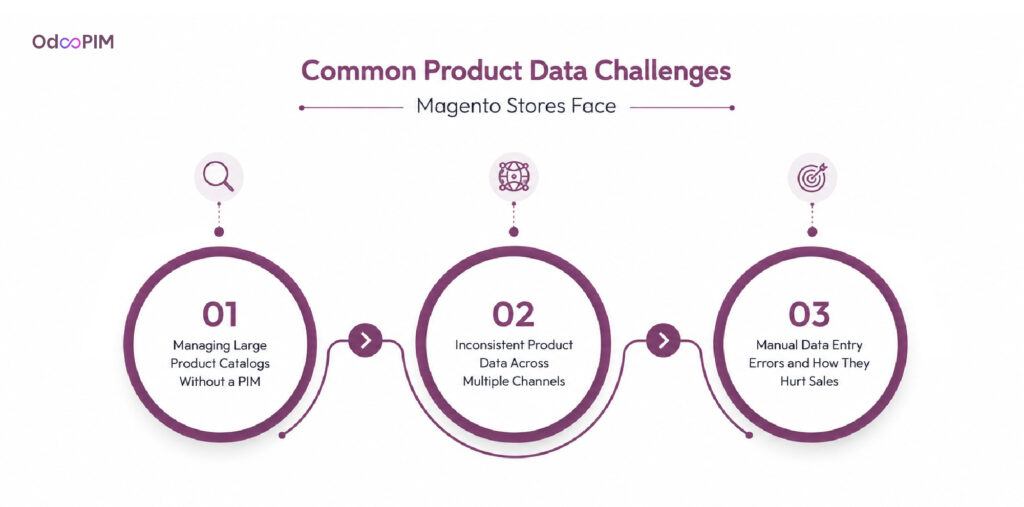
Managing Large Product Catalogs Without a PIM
A Magento store with 5,000 products becomes painfully slow to manage. Each product edit requires loading the admin page, waiting for the database to respond, and clicking through multiple tabs. Magento catalog management without a PIM means your team spends more time waiting for pages to load than actually improving product data. Bulk operations through CSV imports risk crashing your store or corrupting data if the file format is off by a single column.
The performance problem gets worse with configurable products. A jacket with ten sizes and eight colors creates eighty variant records in Magento’s database. Magento product data management platform for configurable products without a PIM means each variant must be edited separately or through risky bulk imports. Your database bloats and admin searches slow down. Your team avoids adding new products because the process is so painful. A Magento PIM offloads this work to a dedicated system, keeping your store fast and your team productive.
Inconsistent Product Data Across Multiple Channels
Most Magento stores also sell on Amazon, eBay, or Google Shopping. Each channel demands different data formats. Amazon needs bullet points and white-background images. Google Shopping needs structured feeds with GTINs. Magento product information management without a PIM forces your team to maintain separate catalogs per channel. A price change requires logging into Magento, then Amazon, then eBay. Someone forgets eBay. Customers notice the discrepancy and complain.
The alternative is exporting from Magento, reformatting manually, and uploading to each channel, a process that guarantees errors. PIM integration with Magento solves this by storing one master catalog that syndicates to the channels automatically. Update a price once in the PIM. Magento, Amazon, and eBay all reflect the change within minutes. Best PIM for Magento includes channel-specific mapping rules and validation checks. No more manual reformatting. No more channel discrepancies. No more customer complaints about mismatched pricing.
Manual Data Entry Errors and How They Hurt Sales
A single typo in Magento’s admin panel can cost your business thousands. Wrong dimensions trigger returns. Incorrect pricing erodes margin. Missing descriptions hurt SEO rankings. Magento product data management through manual entry guarantees errors because human attention spans have limits. A team member editing 200 products in a row will make mistakes. The problem is not laziness. It is biology. Spreadsheets and admin panels are error-prone by design.
Magento PIM replaces manual entry with structured workflows. Validation rules block incomplete products before they reach your store. Dropdown menus prevent typo variations like “Medium” versus “Med.” Magento catalog management with a PIM includes bulk editing with preview, so you see changes before they go live. A single error prevented per month often pays for the PIM subscription. For large catalogs, the ROI is even higher. Stop relying on human perfection. Start using systems that enforce accuracy automatically. Your sales numbers will thank you.
Learn about magento product recommendations

Key Benefits of Integrating a PIM With Magento
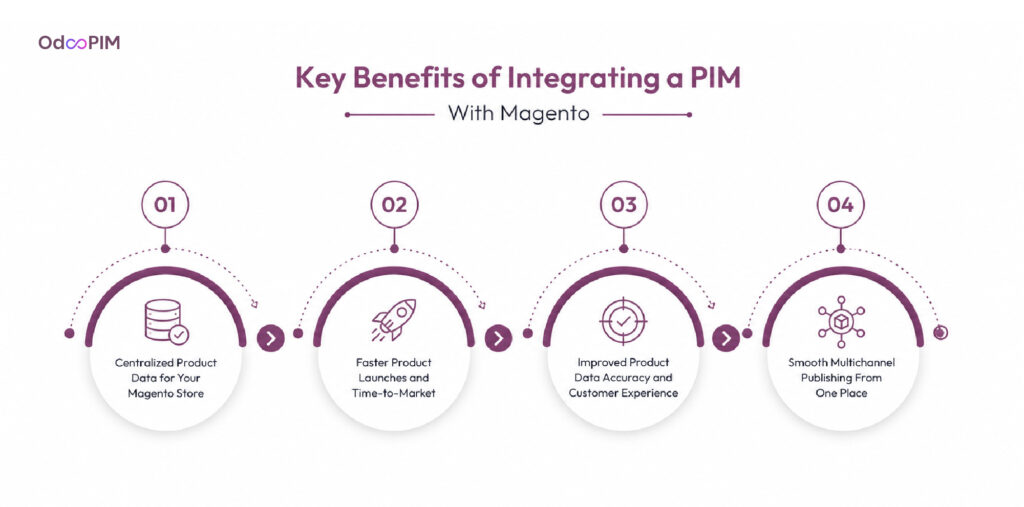
Centralized Product Data for Your Magento Store
A Magento PIM stores every product attribute, image, and specification in one database outside your store. Your team enriches data once in the PIM, not across spreadsheets or Magento’s admin panel. Magento product information management centralization eliminates the “which spreadsheet is current?” debates that waste hours weekly. PIM integration with Magento pushes that centralized data directly to your store automatically. No manual exports and no CSV imports. Just one source of truth feeding your Magento catalog.
The alternative, managing product data natively in Magento, means your store’s database holds both transactional data and enrichment content. Magento product data management becomes slower as your catalog grows. Centralization with a PIM keeps Magento fast by moving enrichment work to a dedicated system. Best PIM for Magento also maintains version history and audit trails. Your team can revert mistakes instantly. Centralization is not just about organization. It is about speed, accuracy, and accountability.
Faster Product Launches and Time-to-Market
A new product launch in Magento natively requires clicking through multiple screens, uploading images per variant, and setting attributes individually. Magento catalog management with a PIM collapses this into one workflow. Your team enters product details once in the PIM, and the system creates all variants automatically. A jacket with ten sizes and eight colors goes from two hours of data entry to two minutes. Magento product information management with bulk editing and templates cuts launch time by 70-80%.
The speed advantage multiplies with seasonal collections. A fifty-product summer launch that took two weeks of Magento admin work becomes a two-day job. PIM integration with Magento pushes ready-to-publish products to your store instantly. Your team stops chasing launch deadlines and starts launching ahead of competitors. Best PIM for Magento also includes approval workflows, so products route through marketing and legal review before reaching your store. Faster launches mean faster revenue.
Improved Product Data Accuracy and Customer Experience
Manual data entry in Magento’s admin panel guarantees errors. A wrong size option, a missing image, an incorrect price, all hurt customer trust and trigger returns. Magento PIM replaces manual entry with validation rules. The system blocks incomplete products before they reach your store. Dropdown menus prevent typo variations. Magento product data management with a PIM ensures that only complete, accurate data syndicates to your catalog. Your customers see correct specifications every time.
A shopper who finds accurate dimensions and clear images buys with confidence. A shopper who encounters missing specs or inconsistent sizing leaves. Magento product information management with a PIM also enforces attribute consistency. “Medium” appears the same way across every product. Store filters work correctly because every product uses the same attribute values. Magento catalog management without a PIM means inconsistent data that frustrates customers and kills sales. With a PIM, accuracy becomes automatic. Your customer experience improves and your return rates drop.
Smooth Multichannel Publishing From One Place
Most Magento stores also sell on Amazon, eBay, Google Shopping, and social commerce platforms. Magento PIM syndicates your master product data to channels simultaneously. Configure mapping rules once: your master description becomes Amazon bullet points, Google Shopping structured data, and eBay item specifics automatically. PIM integration with Magento includes pre-built connectors for major marketplaces. A price change in the PIM updates Magento, Amazon, and eBay within minutes. No manual per-channel updates and no version drift.
Multichannel publishing also includes validation. Before pushing to Amazon, the PIM checks that every product has a GTIN and requires safety labels. Before pushing to Google Shopping, it verifies structured data completeness. Best PIM for Magento maintains channel-specific mapping rules and validation checks. Magento product information management with multichannel syndication turns your Magento store into one of many outputs from a single master catalog. Your team enriches once. Every channel benefits. That is the multichannel promise that only a PIM delivers. Your Magento store stays consistent with Amazon, eBay, and every other sales channel. Customers trust what they see and sales follow.
By 2028, 75% of B2B organizations will complete their highest revenue deals via digital channels.
– Gartner, Magic Quadrant for Digital Commerce
How Magento PIM Integration Works
Connecting Your PIM System to Magento: Step by Step
First, install a PIM connector extension in your Magento store or use a PIM with a pre-built Magento module. PIM integration with Magento typically involves generating API credentials from your Magento admin panel and entering them into your PIM’s connection settings. The PIM authenticates with Magento’s REST API, establishing a secure channel for data exchange. Best PIM for Magento vendors provide detailed setup guides and one-click installation for their connector.
Second, configure field mapping. Tell the PIM which of your master fields correspond to which Magento attributes. Your PIM’s “product_name” maps to Magento’s “name” field. Your “short_description” maps to Magento’s “short_description.” Magento catalog management with a PIM requires defining these mappings once. Test the connection by pushing a single product from your PIM to Magento. Verify that the product appears correctly in your store before scaling to your full catalog.
Learn about PIM tools.
Syncing Product Attributes, Images, and Variants
The PIM handles attribute synchronization automatically after mapping is configured. Simple attributes like price, weight, and description sync as key-value pairs. Magento product information management with a PIM also manages complex attributes like size and color options. The PIM creates or updates Magento’s attribute options based on your master attribute families. Add a new color “Navy” to your PIM attribute family, and the system creates that option in Magento automatically.
Image and variant sync require additional configuration. The PIM sends image URLs or binary data to Magento’s media gallery, associating each image with the correct product and variant. For configurable products, the PIM generates all variant combinations from your master matrix. A jacket with three sizes and four colors creates twelve variants in Magento automatically. Magento product data management with a PIM eliminates manual variant creation. Your team manages one master product. The PIM handles the complexity. Magento PIM also syncs inventory from your ERP through the same connection.
Real-Time Product Data Updates Across All Channels
Real-time sync means changes in your PIM appear in Magento within seconds. A price correction in the PIM triggers an API call to Magento, updating the product record immediately. PIM integration with Magento with real-time sync works best for time-sensitive fields like pricing, inventory, and flash sale details. Customers see accurate information the moment your team updates it. No waiting for scheduled imports. No “last night’s data” problems.
Scheduled sync runs hourly or daily for less urgent fields like descriptions and images. Best PIM for Magento allows hybrid configuration: real-time for pricing and inventory, scheduled for enrichment content. The PIM tracks sync status for each product and each channel. A failed sync triggers an alert so your team can investigate before customers notice problems. Magento catalog management with a PIM includes retry logic for failed API calls. The system keeps trying until the sync succeeds or escalates to an administrator. Real-time or scheduled, your Magento store stays in sync with your master product data automatically. No manual exports and no CSV uploads. Just continuous, reliable data flow.
Learn about PIM vs ERP

Why OdooPIM Is the Best Choice for Magento Stores
Native ERP and PIM in One Platform
Most Magento PIM solutions require separate subscriptions for your ERP and PIM, plus middleware to connect them. Odoo combines ERP, PIM, CRM, and accounting in one database. Your inventory, pricing, and product data live together. When your warehouse updates stock in Odoo ERP, that change flows to your PIM and then to Magento automatically. Magento product information management becomes seamless because there is no integration layer to fail.
For Magento stores already using Odoo ERP, this native architecture eliminates a category of headaches. Magento product data management without Odoo means paying for a standalone PIM, paying for connector middleware, and debugging sync failures. With Odoo, your PIM and ERP share one database. PIM integration with Magento from Odoo pulls data directly from your master source. No double entry, no sync delays and no connector fees. Just one system feeding your Magento store.
Easy OdooPIM and Magento Integration
Odoo includes a native Magento connector module. Install it from Odoo’s Apps menu, enter your Magento API credentials, and map your fields. PIM integration with Magento takes minutes, not weeks. The connector handles authentication, rate limiting, and error logging automatically. Your team never touches API keys after initial setup. Magento catalog management with Odoo PIM supports real-time sync for pricing and inventory, plus scheduled sync for descriptions and images.
The connector also handles two-way sync. Orders placed in Magento flow back to Odoo for fulfillment and accounting. Inventory updates in Odoo push to Magento instantly. The best PIM for Magento for Odoo users is Odoo PIM because no other solution offers this level of native integration. Test the connector with one product before scaling. Push a simple product from Odoo to Magento. Verify attributes, images, and variants and then expand to your full catalog. Most Odoo users complete setup and sync their first products within two hours.
Scalable and Cost-Effective Magento Product Management
Enterprise Magento PIM solutions like Akeneo or Salsify cost 30,000 to 150,000 annually plus implementation. Odoo PIM adds to your existing Odoo subscription, typically 3,000 to 8,000 annually depending on user count. Magento product information management at this price includes ERP, PIM, CRM, and accounting. You are not paying for separate systems and connectors. The total cost of ownership is dramatically lower than assembling best-of-breed tools.
OdooPIM handles 500 products or 500,000 products with the same workflows. Add new Magento stores as you expand internationally. Add new channels like Amazon or eBay. Magento product data management scales without switching systems or doubling your team. PIM integration with Magento from Odoo grows with your business. Start with a single store and basic catalog. Add complexity as needed. The same platform works at every stage. That is the scalability promise only an all-in-one system delivers.
OdooPIM vs Other Magento PIM Solutions
Standalone Magento PIM solutions like Akeneo, Plytix, or Salsify require separate connectors to your ERP and Magento. You manage three systems: ERP, PIM, and middleware. Data drifts between them. Sync failures require debugging multiple layers. Magento catalog management becomes a constant integration project rather than a core competency. Odoo PIM eliminates the middleware layer because ERP and PIM share one database.
Feature comparison reveals trade-offs. Standalone best PIM for Magento options offer more advanced syndication analytics or deeper B2B workflow automation. Odoo PIM offers native ERP integration that no standalone can match. Magento product information management choice depends on your stack. Already on Odoo? Odoo PIM wins by integration alone. On SAP or NetSuite? A standalone PIM with strong connectors might suit you better. PIM integration with Magento is table stakes. The real question is how your PIM talks to your ERP. Odoo PIM answers that question with one database.
Learn about magento product export

Frequently Asked Questions
1. Do I Need a PIM If I Already Use Magento?
Magento product data management requires clicking through variation screens and risky CSV imports. A Magento PIM automates bulk edits, enforces attribute consistency, and syndicates to Amazon, eBay, and Google Shopping from one place. If your team spends more than ten hours weekly on product data entry or you dread adding seasonal collections, you need a PIM. Best PIM for Magento pays for itself through time saved and errors eliminated. Spreadsheets and Magento alone cannot scale.
2. Is Magento a PIM?
Magento is an ecommerce platform with basic product entry features, not a dedicated product information management system. Magento lacks bulk enrichment workflows, approval chains, version control, and multichannel syndication beyond your own store. Magento catalog management forces you to edit products one by one or through risky CSV imports. A Magento PIM sits outside your store as the master source, enriching data and pushing to Magento via API. Magento displays what the PIM provides. The two systems complement each other. Neither replaces the other.
3. How Long Does Magento PIM Integration Take?
Simple PIM integration with Magento using pre-built connectors takes one to two days for setup and testing. You install the connector, generate API credentials, map fields, and push a test product. Full implementation including data cleansing, attribute modeling, and workflow configuration runs two to six weeks. Magento product information management migration depends on your data quality. Clean data moves faster. Your messiest spreadsheet determines the timeline. Add 50% to vendor estimates. Rushing guarantees a broken integration your team abandons. Test with one product category before scaling.
4. Can Odoo PIM Handle Multiple Magento Stores?
Odoo PIM supports multi-store architectures because Odoo’s multi-company feature lets you manage separate Magento stores from one PIM. Each store gets its own pricing, product assortments, and channel mappings, all from the same master catalog. Magento PIM from Odoo pushes different data to your US store, EU store, and B2B store automatically. The best PIM for Magento for multi-store operations is Odoo because it eliminates managing separate PIM instances per region, one catalog and infinite storefronts. Each store sees what it should. No manual duplication across stores.