
What Is PIM Implementation?
PIM implementation drives structured product data control across ecommerce ecosystems, and in real-world case studies from retail and manufacturing teams, PIM implementation improved data accuracy by 40% and reduced catalog errors through PIM system implementation steps defined in a strong product information management implementation approach. Following a PIM implementation guide built from hands-on expertise, teams streamline onboarding, governance, and enrichment processes using PIM software implementation best practices and a structured PIM implementation checklist. In practice, PIM implementation delivers measurable ROI, as seen in enterprise examples, reinforcing repeatable PIM implementation across channels at scale across global enterprises with proven results.
Why PIM Implementation Matters for Your Business
Poor catalog structure, inconsistent product attributes, duplicate SKUs, and missing specifications create revenue loss, delayed launches, and customer dissatisfaction, making PIM implementation essential for brands managing large product catalogs management. A strong PIM implementation guide helps businesses reduce operational bottlenecks through structured PIM system implementation steps and scalable product information management implementation strategies. Companies following PIM software implementation best practices and a detailed PIM implementation checklist improve conversion rates, shorten product launch cycles, and maintain accurate omnichannel data. Real ecommerce case studies show that businesses investing in PIM implementation early achieve stronger operational efficiency, higher search visibility, reduced return rates, and long-term catalog scalability without costly rework later.

Signs Your Business Is Ready for PIM Implementation
Rapid catalog expansion, disconnected spreadsheets, ERP inconsistencies, and repetitive manual updates clearly indicate the need for PIM implementation. Businesses struggling with scattered product records across ecommerce platforms, marketplaces, supplier files, and internal databases benefit from a structured PIM implementation guide supported by proven PIM system implementation steps. Real-world product information management implementation projects show that teams lose significant operational hours correcting inaccurate descriptions, specifications, and pricing data manually. Following PIM software implementation best practices and a reliable PIM implementation checklist improves collaboration, strengthens customer trust, and maintains consistent product experiences across channels.
Key Stages of PIM Implementation
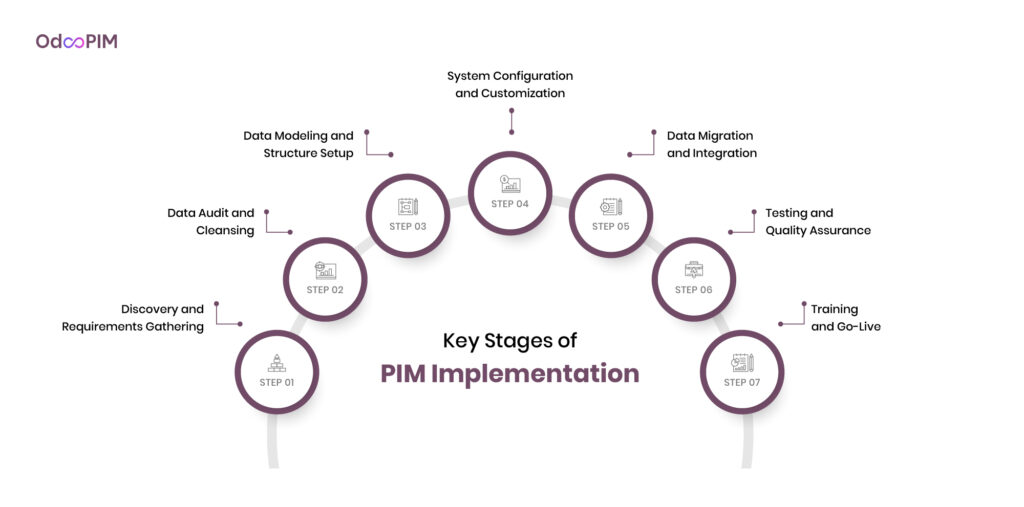
Stage 1: Discovery and Requirements Gathering
The first step in PIM implementation focuses on identifying business goals, catalog challenges, workflow gaps, and integration requirements across departments. A strong PIM implementation guide begins with stakeholder discussions, channel analysis, and operational mapping to define accurate PIM system implementation steps. Real product information management implementation projects succeed when businesses document product data sources, approval workflows, localization needs, and scalability requirements early. Following PIM software implementation best practices and a detailed PIM implementation checklist during discovery reduces delays, prevents scope confusion, and creates a structured foundation for long-term product data management success.
Stage 2: Data Audit and Cleansing
Data audit and cleansing play a critical role in PIM implementation because inaccurate, duplicate, outdated, or incomplete records directly impact operational performance and customer trust. During this phase, businesses evaluate spreadsheets, ERP systems, supplier files, ecommerce catalogs, and marketplace data to identify inconsistencies before migration. A practical PIM implementation guide recommends validating attributes, standardizing naming conventions, correcting taxonomy issues, and removing duplicate entries through structured PIM system implementation steps. Product information management implementation projects that prioritize data cleansing experience faster onboarding, smoother integrations, and stronger search performance while following proven PIM software implementation best practices and a reliable PIM implementation checklist.
Stage 3: Data Modeling and Structure Setup
Data modeling defines how product information is organized, categorized, enriched, and distributed across channels during PIM implementation. This stage involves creating attribute groups, taxonomy structures, relationships, variants, and localization frameworks that support business growth. A successful PIM implementation guide uses scalable PIM system implementation steps to ensure consistent product information management implementation across ecommerce stores, marketplaces, print catalogs, and ERP systems. Businesses applying PIM software implementation best practices build flexible data structures that simplify future expansion, improve search accuracy, and strengthen catalog governance while maintaining alignment with a complete PIM implementation checklist.
PIMs are the single source of truth for product data within modern enterprises, driving top-line growth by decreasing time to market and increasing the quality and quantity of content across digital experiences worldwide.
– Forrester
Stage 4: System Configuration and Customization
System configuration and customization align the PIM platform with operational workflows, user permissions, automation rules, approval processes, and channel distribution requirements. During PIM implementation, businesses configure dashboards, product enrichment flows, validation rules, and multilingual capabilities based on organizational needs. A structured PIM implementation guide ensures that PIM system implementation steps support existing business operations without creating unnecessary complexity. Product information management implementation projects achieve stronger adoption when customization improves usability, accelerates product onboarding, and reduces repetitive tasks. Following PIM software implementation best practices and a strategic PIM implementation checklist helps businesses create scalable and efficient product management environments.
Stage 5: Data Migration and Integration
Data migration and integration connect the PIM platform with ERP systems, ecommerce stores, supplier databases, CRM platforms, DAM solutions, and marketplaces during PIM implementation. This stage requires accurate mapping, synchronization rules, API configuration, and validation testing to maintain data consistency across systems. A reliable PIM implementation guide recommends phased migration supported by controlled PIM system implementation steps to reduce operational risks and prevent data corruption. Successful product information management implementation projects prioritize integration stability, automation efficiency, and real-time synchronization while following PIM software implementation best practices and a detailed PIM implementation checklist for long-term operational reliability.
Learn about PIM best practices.
Stage 6: Testing and Quality Assurance
Testing and quality assurance validate the accuracy, performance, security, and functionality of the PIM platform before deployment. During PIM implementation, businesses test integrations, workflows, product attributes, localization, permissions, enrichment processes, and publishing rules across every connected channel. A detailed PIM implementation guide uses structured PIM system implementation steps to identify technical issues, missing data, synchronization failures, and usability concerns before launch. Product information management implementation teams that follow PIM software implementation best practices and a complete PIM implementation checklist reduce post-launch disruptions, improve data reliability, and strengthen customer-facing product experiences across digital platforms.
Stage 7: Training and Go-Live
Training and go-live prepare teams to manage, enrich, validate, and distribute product information efficiently after PIM implementation deployment. Businesses conduct user onboarding sessions, workflow demonstrations, governance training, and role-based access education to improve platform adoption. A practical PIM implementation guide ensures employees understand operational responsibilities through clearly documented PIM system implementation steps and support procedures. Product information management implementation projects achieve smoother transitions when teams receive hands-on training before launch. Following PIM software implementation best practices and a structured PIM implementation checklist during go-live minimizes operational disruptions, improves collaboration, and strengthens long-term product data governance across departments.

PIM Implementation Checklist:
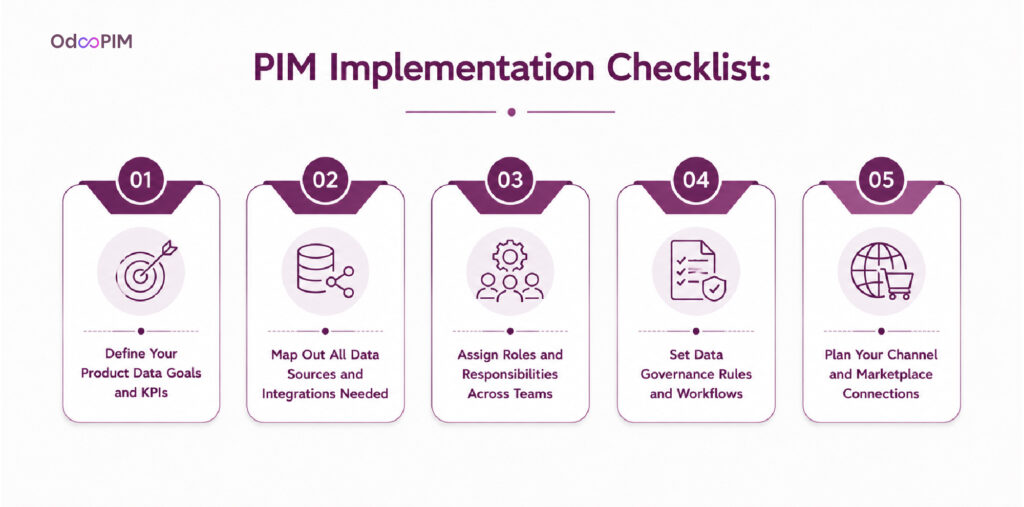
1. Define Your Product Data Goals and KPIs
A successful PIM implementation starts with clear product data goals tied to business performance, operational efficiency, and customer experience improvements. Businesses should define KPIs such as product data accuracy, catalog completion rates, faster product launches, reduced return rates, and channel consistency before execution begins. A structured PIM implementation guide helps organizations align measurable objectives with practical PIM system implementation steps and long-term product information management implementation strategies. Companies following PIM software implementation best practices and a detailed PIM implementation checklist gain stronger visibility into performance benchmarks, workflow efficiency, and scalable product data management outcomes.
2. Map Out All Data Sources and Integrations Needed
Mapping every product data source is a critical step in PIM implementation because disconnected systems create inconsistencies, duplication, and operational delays. Businesses must identify ERP platforms, ecommerce stores, supplier feeds, spreadsheets, DAM systems, CRM platforms, and marketplace connections before migration begins. A strong PIM implementation guide uses organized PIM system implementation steps to define integration flows, synchronization logic, and data ownership across departments. Product information management implementation projects that follow PIM software implementation best practices and a complete PIM implementation checklist achieve smoother integrations, stronger automation, and accurate product information distribution across all sales channels.
3. Assign Roles and Responsibilities Across Teams
Clear ownership improves accountability and operational efficiency throughout the PIM implementation process. Businesses should assign responsibilities for data enrichment, approvals, validation, governance, integration management, and channel publishing across ecommerce, marketing, IT, and product teams. A reliable PIM implementation guide ensures every department understands its role within the defined PIM system implementation steps to avoid workflow confusion and duplicated efforts. Product information management implementation projects perform better when collaboration structures are established early using PIM software implementation best practices and a structured PIM implementation checklist that supports long-term governance and consistent catalog management.
4. Set Data Governance Rules and Workflows
Strong governance rules maintain product data consistency, accuracy, compliance, and operational control during PIM implementation. Businesses should establish validation standards, naming conventions, approval hierarchies, enrichment rules, localization processes, and version control workflows before launch. A well-planned PIM implementation guide uses documented PIM system implementation steps to create repeatable processes that improve collaboration and reduce catalog errors. Product information management implementation projects following PIM software implementation best practices and a comprehensive PIM implementation checklist maintain cleaner product records, stronger compliance management, and reliable omnichannel product experiences across expanding digital ecosystems.
5. Plan Your Channel and Marketplace Connections
Planning channel and marketplace connectivity early strengthens distribution efficiency during PIM implementation. Businesses must define how product information will flow across ecommerce websites, Amazon, Flipkart, Shopify, ERP systems, social commerce platforms, dealer portals, and mobile applications. A detailed PIM implementation guide helps organizations structure PIM system implementation steps around channel requirements, attribute mapping, localization needs, and publishing automation. Product information management implementation strategies built on PIM software implementation best practices and a scalable PIM implementation checklist improve synchronization accuracy, reduce manual workload, and create consistent product experiences across every customer touchpoint.
Learn about best PIM software in India

Common PIM Implementation Challenges and How to Overcome Them:
Poor Data Quality and Inconsistent Product Information
Poor product data quality is one of the biggest obstacles during PIM implementation because duplicate entries, missing attributes, inconsistent naming conventions, and outdated records affect every connected sales channel. Businesses often discover errors spread across ERP systems, spreadsheets, supplier catalogs, and ecommerce platforms during product information management implementation projects. A strong PIM implementation guide recommends performing a detailed audit, standardizing taxonomy structures, and validating attributes through structured PIM system implementation steps before migration begins. Companies following PIM software implementation best practices and a complete PIM implementation checklist improve catalog accuracy, search performance, operational efficiency, and customer trust across digital commerce environments.
Resistance to Change From Internal Teams
Internal resistance slows PIM implementation when teams rely on outdated workflows, disconnected spreadsheets, or manual catalog processes they have used for years. Employees often hesitate because they fear operational disruption, additional responsibilities, or unfamiliar systems during product information management implementation. A practical PIM implementation guide addresses this challenge through early stakeholder involvement, workflow transparency, role clarity, and hands-on training aligned with defined PIM system implementation steps. Businesses following PIM software implementation best practices and a structured PIM implementation checklist improve collaboration, increase adoption rates, and create stronger confidence across marketing, ecommerce, product, and IT departments.
Integration Complexity with ERP and eCommerce Platforms
Integration challenges emerge during PIM implementation when businesses connect ERP systems, ecommerce platforms, supplier databases, marketplaces, DAM systems, and CRM tools with inconsistent data structures. Poor synchronization logic and incompatible APIs can create publishing errors, inventory mismatches, and operational delays during product information management implementation. A reliable PIM implementation guide recommends phased integrations, accurate attribute mapping, middleware planning, and continuous testing through organized PIM system implementation steps. Businesses applying PIM software implementation best practices and a complete PIM implementation checklist reduce technical disruptions, improve automation accuracy, and maintain stable product information flow across connected business systems.
Scope Creep and Unclear Project Goals
Scope creep creates budget overruns, delayed timelines, and operational confusion during PIM implementation when project requirements continue changing without structured planning. Many product information management implementation projects fail because businesses attempt to solve every operational issue at once instead of prioritizing critical objectives. A clear PIM implementation guide defines measurable goals, project boundaries, workflow priorities, and phased PIM system implementation steps before execution begins. Companies following PIM software implementation best practices and a disciplined PIM implementation checklist maintain stronger project control, improve team alignment, and deliver scalable product data management systems without unnecessary complexity.
Underestimating the Time Needed for Data Migration
Data migration often takes longer than expected during PIM implementation because businesses underestimate the complexity of cleaning, validating, mapping, and restructuring large product catalogs. In many product information management implementation projects, hidden inconsistencies across supplier files, ERP systems, spreadsheets, and ecommerce databases create unexpected delays. A structured PIM implementation guide recommends phased migration supported by detailed PIM system implementation steps, pilot testing, and validation checkpoints before full deployment. Businesses following PIM software implementation best practices and a reliable PIM implementation checklist reduce migration risks, improve data accuracy, and achieve smoother go-live execution across all connected sales channels.
Learn about Product catalog management software.
PIM Implementation Best Practices:
Start With a Clear Data Strategy Before Choosing a PIM
Successful PIM implementation begins with a structured data strategy that defines business goals, catalog requirements, workflows, integrations, governance policies, and channel distribution needs before platform selection. Businesses that skip this planning stage often face costly delays and operational confusion during product information management implementation. A strong PIM implementation guide recommends documenting product structures, localization requirements, enrichment processes, and future scalability goals through organized PIM system implementation steps. Companies following PIM software implementation best practices and a detailed PIM implementation checklist choose solutions that align with operational needs, improve adoption, and support long-term digital commerce growth.
Clean and Standardize Your Data Before Migration
Data migration becomes significantly smoother when businesses clean, validate, and standardize product records before PIM implementation begins. Duplicate entries, inconsistent attribute naming, incomplete specifications, and outdated product details create synchronization errors across ecommerce systems, ERP platforms, and marketplaces during product information management implementation. A reliable PIM implementation guide recommends structured data cleansing supported by clear PIM system implementation steps before importing records into the new environment. Businesses following PIM software implementation best practices and a complete PIM implementation checklist improve data consistency, reduce operational delays, and strengthen customer-facing product experiences across every sales channel.
Involve All Stakeholders From Day One
Cross-functional collaboration strengthens PIM implementation because product data management affects ecommerce, marketing, IT, operations, procurement, and sales teams. Businesses achieve better product information management implementation outcomes when stakeholders participate early in defining workflows, integrations, governance rules, and operational priorities. A practical PIM implementation guide encourages regular collaboration sessions aligned with clearly documented PIM system implementation steps to reduce communication gaps and project conflicts. Companies applying PIM software implementation best practices and a structured PIM implementation checklist improve adoption, accelerate decision-making, and build stronger accountability throughout the entire implementation lifecycle.
Choose a PIM That Scales With Your Business
Scalability is essential during PIM implementation because growing businesses require flexible catalog structures, multilingual support, marketplace integrations, automation capabilities, and expanding channel management. Selecting a limited platform creates operational bottlenecks as product volumes, geographic reach, and customer expectations increase. A strong PIM implementation guide recommends evaluating scalability, API flexibility, customization options, and integration capabilities through strategic PIM system implementation steps before finalizing a platform. Businesses following PIM software implementation best practices and a future-focused PIM implementation checklist build product information management implementation environments capable of supporting long-term expansion without expensive system replacements later.
Plan for Ongoing Maintenance and Optimization After Go-Live
PIM implementation does not end after deployment because ongoing optimization is required to maintain data quality, workflow efficiency, and integration performance over time. Businesses must continuously monitor product accuracy, taxonomy structures, automation rules, channel synchronization, and governance processes after product information management implementation goes live. A reliable PIM implementation guide includes post-launch audits, performance reviews, and process refinement through continuous PIM system implementation steps. Companies applying PIM software implementation best practices and a structured PIM implementation checklist maintain cleaner product catalogs, improve operational efficiency, and support evolving ecommerce requirements without long-term data management issues.
How to Choose the Right PIM System for Implementation:
1. Ease of Implementation and Onboarding Support
Ease of deployment directly impacts the success of PIM implementation because complex onboarding processes increase delays, training challenges, and operational disruption. Businesses should evaluate how quickly teams can configure workflows, import product data, manage integrations, and adapt to daily operations during product information management implementation. A strong PIM implementation guide recommends selecting platforms with structured onboarding support, documentation, migration assistance, and responsive technical teams aligned with practical PIM system implementation steps. Companies following PIM software implementation best practices and a reliable PIM implementation checklist achieve faster adoption, lower training effort, and smoother implementation outcomes across departments.
2. Integration Capabilities With Your Existing Systems
Strong integration capabilities are essential for successful PIM implementation because disconnected systems create data silos, manual work, and synchronization issues. Businesses should evaluate how the platform connects with ERP systems, ecommerce stores, marketplaces, CRM tools, DAM platforms, supplier databases, and analytics solutions during product information management implementation. A reliable PIM implementation guide recommends reviewing APIs, middleware compatibility, automation features, and real-time synchronization support through structured PIM system implementation steps. Organizations following PIM software implementation best practices and a complete PIM implementation checklist improve operational efficiency, maintain accurate product information, and reduce technical limitations across digital commerce ecosystems.
3. Scalability and Flexibility for Future Growth
A scalable platform supports long-term PIM implementation success by handling increasing product volumes, multilingual catalogs, regional expansions, and growing sales channels without operational limitations. Businesses should assess customization capabilities, workflow flexibility, attribute management, automation options, and cloud infrastructure before selecting a solution for product information management implementation. A strategic PIM implementation guide uses future-focused PIM system implementation steps to ensure the platform adapts to evolving business requirements and market expansion. Companies applying PIM software implementation best practices and a structured PIM implementation checklist create flexible product data environments that support continuous ecommerce growth and operational scalability.
4. Total Cost of Ownership and ROI
Evaluating total cost of ownership helps businesses understand the long-term financial impact of PIM implementation beyond initial licensing expenses. Costs related to migration, integrations, customization, support, training, maintenance, and future scalability significantly affect product information management implementation budgets. A practical PIM implementation guide recommends measuring ROI through operational efficiency, faster product launches, reduced manual workload, improved conversion rates, and stronger catalog accuracy using structured PIM system implementation steps. Businesses following PIM software implementation best practices and a comprehensive PIM implementation checklist achieve stronger financial planning, better resource allocation, and measurable long-term returns from their PIM investment.
Why OdooPIM Makes Implementation Faster and Easier:
Integrated ERP and PIM in One Platform: Less Integration Work
Odoo simplifies PIM implementation by combining ERP, inventory, ecommerce, sales, procurement, and product information management within a unified ecosystem. Businesses avoid complex third-party connectors, disconnected workflows, and synchronization issues that commonly delay product information management implementation projects. A structured PIM implementation guide becomes easier to execute because core PIM system implementation steps already align with existing operational modules. Companies following PIM software implementation best practices and a reliable PIM implementation checklist reduce integration costs, accelerate deployment timelines, and maintain consistent product information across every connected business function.
Simple Onboarding and User-Friendly Interface
User adoption improves during PIM implementation when teams work with an intuitive interface that simplifies catalog management, attribute updates, workflow approvals, and product enrichment tasks. Odoo supports faster onboarding through organized navigation, simplified workflows, and centralized product management tools that reduce training complexity during product information management implementation. A practical PIM implementation guide supported by clear PIM system implementation steps helps teams adapt quickly without operational disruption. Businesses applying PIM software implementation best practices and a structured PIM implementation checklist improve productivity, collaboration, and long-term platform adoption across departments.
Flexible Data Modeling to Match Your Business Needs
Flexible product structures are critical during PIM implementation because every business manages unique categories, variants, attributes, and channel requirements. Odoo allows businesses to configure taxonomy structures, attribute groups, product relationships, multilingual content, and workflow logic according to operational requirements during product information management implementation. A scalable PIM implementation guide supported by adaptable PIM system implementation steps helps organizations manage evolving catalogs without system limitations. Businesses following PIM software implementation best practices and a complete PIM implementation checklist build stronger product governance, efficient catalog structures, and scalable omnichannel product experiences.
Dedicated Implementation Support With OdooPIM
Expert guidance improves the success rate of PIM implementation by helping businesses manage migration, integrations, workflow setup, testing, and deployment more efficiently. Odoo implementation support teams assist organizations through every stage of product information management implementation using structured PIM system implementation steps and operational best practices. A reliable PIM implementation guide combined with technical consultation reduces deployment risks, improves data accuracy, and accelerates go-live readiness. Companies following PIM software implementation best practices and a detailed PIM implementation checklist achieve smoother execution, stronger team confidence, and long-term operational stability after deployment.

FAQs: PIM Implementation
1. How Much Does PIM Implementation Cost?
PIM implementation costs depend on catalog size, data complexity, integrations, customization requirements, migration effort, and deployment scope. Small businesses may require a basic product information management implementation with limited integrations, while enterprise environments demand advanced workflows, multilingual catalogs, marketplace synchronization, and ERP connectivity. A structured PIM implementation guide helps organizations estimate expenses more accurately by defining clear PIM system implementation steps before execution begins. Businesses following PIM software implementation best practices and a detailed PIM implementation checklist reduce unnecessary spending, improve implementation efficiency, and achieve stronger long-term ROI from centralized product data management.
2. Can I Implement a PIM System Without IT Support?
Basic PIM implementation tasks can be managed by business teams, but complex integrations, workflow automation, API configuration, migration planning, and system customization often require technical expertise. Product information management implementation projects involving ERP systems, ecommerce platforms, supplier databases, and marketplace synchronization benefit from IT involvement to maintain stability and data accuracy. A reliable PIM implementation guide outlines technical and operational PIM system implementation steps that help businesses identify where external expertise is required. Companies following PIM software implementation best practices and a complete PIM implementation checklist achieve smoother deployment, fewer technical disruptions, and stronger long-term platform performance.
3. What Is the Biggest Mistake in PIM Implementation?
The biggest mistake during PIM implementation is migrating poor-quality product data without proper cleansing, governance planning, or structured workflows. Many product information management implementation projects fail because businesses rush deployment without defining taxonomy structures, ownership responsibilities, integration priorities, or validation standards. A strong PIM implementation guide emphasizes clear objectives, organized PIM system implementation steps, and phased execution before migration begins. Businesses applying PIM software implementation best practices and a comprehensive PIM implementation checklist avoid costly rework, operational confusion, inconsistent product experiences, and long-term catalog management issues across connected sales channels.
4. How Do I Know If My PIM Implementation Was Successful?
A successful PIM implementation improves product data accuracy, reduces manual workload, accelerates product launches, strengthens channel consistency, and enhances customer experience across ecommerce ecosystems. Businesses can measure product information management implementation success through KPIs such as faster catalog updates, reduced return rates, improved search visibility, higher conversion rates, and stronger operational efficiency. A structured PIM implementation guide supported by measurable PIM system implementation steps helps organizations evaluate workflow improvements and long-term scalability. Companies following PIM software implementation best practices and a reliable PIM implementation checklist achieve cleaner product governance, stronger collaboration, and sustainable digital commerce growth.