What Are Magento Product Attributes?
Magento product attributes are the structured data fields that define, organize, and enrich product information across a catalog, making them essential for search visibility, navigation, and conversions. In Magento, attributes such as size, color, brand, material, and SKU are grouped within a magento attribute set and stored as magento 2 product attributes, enabling consistent product management at scale. Unlike magento product options, which capture customer selections during purchase, magento product attributes drive catalog organization, layered navigation, filtering, and SEO performance. Many ecommerce brands using OdooPIM Magento product attributes report faster catalog updates, improved search relevance, and cleaner magento 2 product attributes list management, while features like magento 2 export product attributes and import export product attributes magento 2 simplify data governance across channels.
How Attributes Work in Magento
Magento product attributes work as the foundation of product data management, helping merchants define, organize, and display product information consistently across the catalog. Every attribute, from color and size to brand and material, is assigned within a magento attribute set, allowing products to inherit relevant data fields automatically. Magento 2 product attributes support filtering, sorting, search indexing, pricing rules, and catalog segmentation, making them critical for large inventories. Many retailers use OdooPIM Magento product attributes to centralize enrichment and syndication, reducing manual updates while maintaining accuracy. A well-structured magento 2 product attributes list improves operational efficiency, customer experience, and overall catalog performance.

Product Attributes vs. Product Options
Magento product attributes and magento product options serve different purposes within an ecommerce store. Magento product attributes define permanent product characteristics such as brand, weight, color, and dimensions, while magento product options capture customer-selected choices like gift wrapping, engraving, or custom text. For example, a shirt’s size and color are managed through magento 2 product attributes, whereas a personalized message is handled through product options. Understanding this distinction helps businesses build cleaner catalogs, improve reporting accuracy, and optimize filtering capabilities. Properly configured magento attribute set structures ensure product data remains scalable as catalogs expand across multiple sales channels.
Why Attributes Matter for Search, Filters, and SEO
Magento product attributes directly influence search performance, navigation accuracy, and organic visibility, making them one of the most important elements of catalog optimization. Search engines and Magento’s internal search rely on well-structured magento product attributes to understand product relevance, while layered navigation uses attribute values to create effective filters. Product attributes examples such as brand, color, material, and size help shoppers narrow results quickly, reducing abandonment rates. Businesses that maintain clean magento 2 product attributes and consistent magento 2 attribute types often see stronger engagement and higher conversion rates. Tools such as magento 2 export product attributes and import export product attributes magento 2 further support scalable SEO-focused catalog management.
Data Quality Solutions, Q1 2026 states that data quality has become one of the most consequential must-have capabilities for modern enterprises, noting that as organizations scale AI initiatives, static validation approaches are becoming outdated and real-time monitoring is now non-negotiable for maintaining data integrity across systems.
– Forrester Wave, Data Quality Solutions, Q1 2026
Types of Product Attributes in Magento 2
Magento product attributes come in several categories that help merchants organize, manage, and optimize product information across large catalogs. These include system attributes, custom attributes, configurable attributes, and various Magento 2 attribute types designed for specific business needs. Magento 2 product attributes can store details such as size, color, material, brand, technical specifications, and pricing data, making catalog management more structured and scalable. A well-planned Magento attribute set ensures products contain consistent information, improving filtering, search accuracy, and merchandising. Many growing ecommerce businesses use OdooPIM Magento product attributes to standardize data governance, maintain a clean Magento 2 product attributes list, and simplify multichannel product management.
Magento 2 Attribute Input Types Explained
Magento product attributes use different input formats to control how information is entered, stored, and displayed throughout the catalog. Common Magento 2 attribute input types include text fields, text areas, dropdowns, multiselects, dates, prices, visual swatches, and boolean values. Choosing the right Magento 2 attribute types improves data consistency, simplifies catalog management, and enhances the shopping experience. For example, dropdown attributes prevent duplicate values for brands, while visual swatches make color selection easier for customers. Businesses managing thousands of SKUs often standardize Magento product attributes within a Magento attribute set to maintain accuracy and streamline product onboarding across multiple channels.

System Attributes vs. Custom Attributes
Magento product attributes are divided into system attributes and custom attributes, each serving a distinct purpose in catalog management. System attributes are built into Magento and include essential fields such as SKU, price, weight, status, and visibility, which support core platform functions. Custom attributes are created by merchants to capture unique product information such as fabric type, warranty period, compatibility, or technical specifications. Successful ecommerce brands often extend Magento product attributes with custom fields to improve filtering, merchandising, and customer decision-making. A well-designed Magento attribute set combines both attribute types to create a scalable and highly searchable product catalog.
How Attribute Scope Works in Magento
Magento product attributes support different scope levels, allowing businesses to control how product information appears across websites and store views. Attribute scope can be set as Global, Website, or Store View depending on operational requirements. Global scope applies a single value across all stores, Website scope supports region-specific information such as pricing, and Store View scope enables localized content for different languages or markets. This flexibility makes Magento product attributes particularly valuable for international ecommerce operations. Many businesses using OdooPIM Magento product attributes leverage attribute scope to maintain consistent core data while tailoring customer-facing content for specific audiences and sales channels.

What Is a Magento Attribute Set?
A Magento attribute set is a predefined collection of Magento product attributes assigned to products that share similar characteristics, ensuring consistent data management across the catalog. Instead of manually adding fields for every product, merchants can group relevant Magento 2 product attributes into a single structure for categories such as apparel, electronics, or furniture. This approach simplifies product creation, improves data quality, and reduces administrative effort. Large ecommerce businesses often manage hundreds of Magento product attributes through well-defined attribute sets to maintain catalog consistency. When combined with OdooPIM Magento product attributes, attribute sets help standardize product information across marketplaces, websites, and sales channels.
How Attribute Sets Organize Your Catalog
Magento attribute sets organize catalogs by ensuring that each product type contains only the Magento product attributes relevant to it. For example, a clothing attribute set may include size, color, and fabric, while a laptop attribute set contains processor, RAM, storage, and screen size. This structure prevents unnecessary fields from appearing during product creation and improves data accuracy. Well-organized Magento 2 product attributes also support better filtering, search functionality, and reporting. Businesses managing large inventories often use carefully designed Magento attribute sets to streamline catalog operations, improve product consistency, and create a more efficient workflow for merchandising teams.
Creating and Assigning Attribute Sets in Magento 2
Creating a Magento attribute set involves grouping related Magento product attributes and assigning them to products based on category or product type. Merchants can build a new attribute set from an existing template, add custom Magento 2 product attributes, and organize fields into logical sections for easier management. Once assigned, products automatically inherit the required attributes, reducing manual configuration and ensuring consistency across the catalog. This process becomes especially valuable for stores with thousands of SKUs and diverse product lines. Many ecommerce teams combine Magento attribute sets with OdooPIM Magento product attributes to accelerate onboarding and maintain high-quality product data across channels.
Best Practices for Structuring Attribute Sets
The most effective Magento attribute sets are built around product categories, business requirements, and long-term catalog scalability. Merchants should keep Magento product attributes relevant to each product type, avoid duplicate fields, use standardized naming conventions, and group related attributes into clear sections. Reusing common attributes across multiple attribute sets improves consistency and simplifies maintenance as catalogs grow. Regular audits of Magento 2 product attributes help remove unused fields and prevent data clutter. Successful ecommerce brands often design attribute sets with future expansion in mind, ensuring that search filters, reporting, integrations, and OdooPIM Magento product attributes continue to support evolving business needs efficiently.
Managing Magento Product Attributes at Scale
Managing Magento product attributes at scale requires a structured approach to data governance, standardization, and automation. As product catalogs grow from hundreds to thousands of SKUs, maintaining consistent Magento 2 product attributes becomes increasingly challenging without defined processes. Businesses must control attribute creation, enforce naming standards, eliminate duplicate values, and regularly audit their Magento 2 product attributes list to ensure accuracy. Well-organized Magento attribute set structures help teams onboard products faster while supporting search, filtering, and reporting requirements. Many enterprise retailers use OdooPIM Magento product attributes to centralize product information, improve collaboration across departments, and maintain data quality across multiple sales channels.
Importing and Exporting Product Attributes in Magento 2
Magento provides tools for Magento 2 export product attributes and import export product attributes Magento 2 workflows, enabling merchants to manage large volumes of product data efficiently. Instead of updating attributes manually, teams can use CSV files to create, modify, and distribute Magento product attributes across thousands of products simultaneously. This capability is essential for seasonal catalog updates, supplier data imports, and marketplace syndication projects. However, data validation remains critical, as formatting errors can create inconsistencies throughout the catalog. Many businesses integrate OdooPIM Magento product attributes with import and export processes to improve accuracy, reduce manual effort, and accelerate product data updates.
Common Attribute Management Mistakes
Many catalog performance issues stem from poor Magento product attributes management practices. Common mistakes include creating duplicate attributes, using inconsistent naming conventions, assigning incorrect Magento 2 attribute types, and building overly complex Magento attribute set structures. Businesses often collect excessive product data without a clear strategy, making filtering, reporting, and maintenance more difficult. Another frequent problem is failing to standardize product attributes examples such as color, material, or brand values, leading to fragmented search results and poor customer experiences. Regular governance, attribute audits, and centralized management help prevent these issues while keeping Magento 2 product attributes organized and scalable.
Why Native Magento Falls Short for Large Catalogs
Native Magento works well for basic catalog management, but managing Magento product attributes across large and complex product catalogs often exposes operational limitations. Teams struggle with bulk enrichment, data validation, supplier onboarding, workflow management, and maintaining consistency across multiple channels. As the number of Magento 2 product attributes grows, manual processes become slower and more error-prone, increasing the risk of incomplete or inaccurate product information. Large retailers frequently supplement Magento with dedicated PIM solutions such as OdooPIM Magento product attributes management to centralize data, automate enrichment, improve collaboration, and maintain a reliable Magento 2 product attributes list across all customer touchpoints.
Learn about magento product recommendations
How a PIM Improves Magento Attribute Management
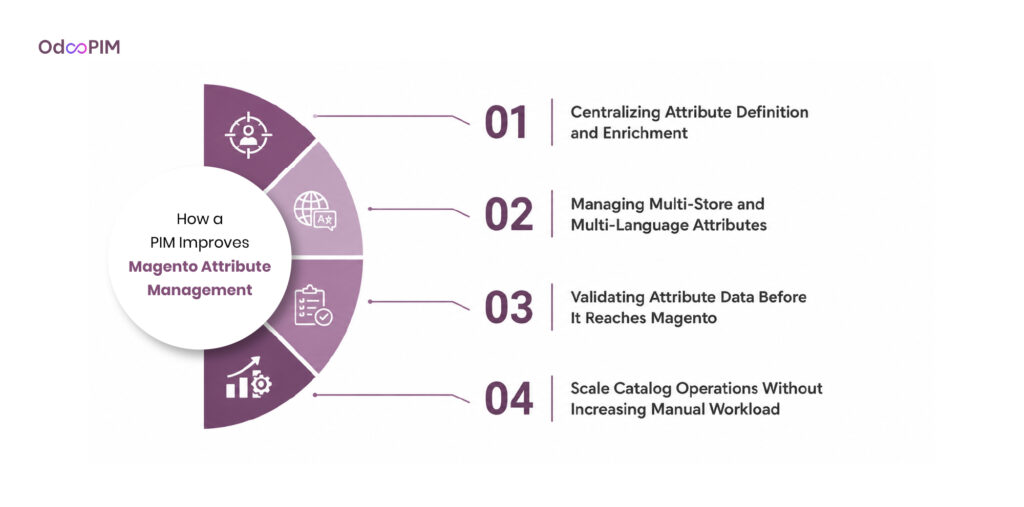
A Product Information Management (PIM) system improves Magento product attributes management by creating a single source of truth for all product data. Instead of maintaining Magento 2 product attributes across multiple spreadsheets, supplier files, and internal systems, teams can centralize attribute creation, enrichment, governance, and distribution in one platform. This approach reduces inconsistencies, accelerates product launches, and improves catalog quality across channels. As product assortments grow, a PIM helps maintain a clean Magento 2 product attributes list, standardize Magento attribute set structures, and automate data workflows. Many ecommerce brands use OdooPIM Magento product attributes to scale catalog operations without increasing manual workload.
Centralizing Attribute Definition and Enrichment
Centralizing attribute definition and enrichment ensures that Magento product attributes remain accurate, complete, and consistent throughout the product lifecycle. A PIM allows teams to define attribute standards, manage product attribute examples, and enrich information from suppliers, marketing teams, and product managers within a single environment. This eliminates duplicate data entry and reduces conflicts between departments. Instead of updating Magento 2 product attributes individually, businesses can enrich data once and distribute it everywhere automatically. Organizations using OdooPIM Magento product attributes often improve catalog completeness, reduce onboarding time, and maintain stronger control over product information across multiple sales channels.
Managing Multi-Store and Multi-Language Attributes
Managing Magento product attributes across multiple stores and languages becomes significantly easier with a PIM platform. Global ecommerce businesses often require localized descriptions, specifications, product names, and attribute values for different regions while maintaining consistent core product information. A PIM enables centralized management of Magento 2 product attributes with support for translations, regional variations, and store-specific content. This reduces duplication and prevents inconsistencies that commonly occur when updates are handled directly in Magento. By combining Magento attribute set management with localized enrichment workflows, OdooPIM Magento product attributes help businesses deliver relevant experiences across international markets while maintaining data accuracy.
Validating Attribute Data Before It Reaches Magento
Validating Magento product attributes before publishing to Magento prevents data quality issues that can negatively impact customer experience, search performance, and operational efficiency. A PIM applies validation rules to ensure required fields are completed, attribute formats are standardized, and values comply with predefined business requirements. This process helps identify errors before they affect Magento 2 product attributes, product pages, or marketplace feeds. Automated validation is especially valuable when handling large catalogs and supplier-generated data. Businesses using OdooPIM Magento product attributes can maintain a reliable Magento 2 product attributes list, reduce manual corrections, and ensure only high-quality product information reaches Magento.
CASE STUDY:
Case Study 1: Fashion Retailer Scaling 20,000+ SKUs With Structured Magento Product Attributes
A fast-growing European fashion retailer struggled with inconsistent Magento product attributes across seasonal collections. Attributes like size, color, fabric, and fit were duplicated or misaligned across Magento attribute sets, leading to poor filtering and inaccurate search results. Product onboarding took nearly 5–7 days per collection due to manual updates in Magento 2 product attributes.
After implementing a PIM solution (OdooPIM), the company centralized all Magento product attributes into a single governance model. Attribute definitions were standardized across product families, and product attributes examples such as color and material were controlled through validated dropdowns and swatches. The PIM mapped directly to Magento attribute set structures, ensuring clean synchronization.
Results:
- 70% reduction in product onboarding time
- 90% improvement in attribute consistency across catalogs
- Significant boost in filter accuracy and conversion rates
- Fully automated sync of Magento 2 product attributes across stores
Case Study 2: Electronics Brand Managing Multi-Region Magento Product Attributes at Scale
A global electronics brand operating in 12 countries faced major challenges managing Magento product attributes across regional storefronts. Each region required different specifications, languages, and compliance-based product data, resulting in fragmented Magento 2 product attributes lists and inconsistent product pages.
By adopting OdooPIM Magento product attributes management, the company centralized attribute modeling while enabling localized variations through controlled attribute scope logic. Technical attributes such as processor type, RAM, and warranty were standardized globally, while regional teams managed localized content within the same system.
The PIM ensured accurate mapping to Magento attribute sets and enabled automated Magento 2 export product attributes workflows for marketplaces and regional storefronts.
Results:
- 60% faster global product launches
- Unified Magento attribute set structure across all regions
- Eliminated duplicate and conflicting Magento product attributes
- Improved SEO performance through consistent structured data
- Scalable import export product attributes Magento 2 process for all markets
Learn about composable commerce
How OdooPIM Handles Magento Product Attributes
OdooPIM improves Magento product attributes management by acting as a centralized hub for defining, enriching, and distributing all Magento 2 product attributes across channels. Instead of handling fragmented data inside Magento, teams structure attributes once in OdooPIM and push consistent content into Magento attribute set frameworks. This reduces duplication, improves governance, and ensures every product follows standardized Magento 2 product attributes rules. Real implementations show faster catalog onboarding and fewer data errors when shifting from manual Magento workflows to OdooPIM Magento product attributes management. The result is a scalable system where product data remains clean, consistent, and ready for multichannel commerce growth.
Building Attribute Structures in OdooPIM
OdooPIM allows teams to design structured Magento product attributes models that mirror real product complexity while maintaining consistency across catalogs. Businesses can define attribute families, assign Magento 2 product attributes to categories, and standardize values for product attribute examples like size, material, or technical specifications. This structured approach replaces scattered spreadsheets with a governed data model aligned to Magento attribute set requirements. In practice, enterprises report fewer inconsistencies and faster product onboarding when attribute structures are built once in OdooPIM and reused across multiple product lines. It ensures Magento 2 product attributes remain clean, scalable, and ready for export.
Enriching and Syncing Attributes to Magento
OdooPIM streamlines enrichment and syncing of Magento product attributes by enabling teams to update product information in one place and automatically publish it to Magento. Instead of manually editing Magento 2 product attributes, businesses enrich data with marketing content, technical details, and supplier inputs inside OdooPIM. Once validated, attributes are synced directly into Magento attribute set structures, ensuring consistency across storefronts and channels. This reduces human error and speeds up product updates significantly. Companies using OdooPIM Magento product attributes workflows often achieve faster time-to-market and improved catalog accuracy across thousands of SKUs and multiple sales channels.
Managing Attribute Sets Across Product Families
OdooPIM simplifies managing Magento attribute sets by organizing Magento product attributes into reusable structures across different product families. Instead of recreating Magento 2 product attributes for each category in Magento, teams define attribute families in OdooPIM and map them directly to Magento attribute set configurations. For example, electronics, apparel, and furniture can each maintain tailored attribute structures while sharing global standards. This ensures consistency while reducing duplication across catalogs. Businesses managing complex catalogs report better governance and fewer attribute conflicts when using OdooPIM Magento product attributes to control attribute set logic centrally across all product families.
Learn about
Getting Started With OdooPIM and Magento
Getting started with OdooPIM Magento product attributes integration involves connecting Magento to OdooPIM, defining core attribute models, and mapping Magento 2 product attributes to centralized data structures. Teams typically begin by auditing existing Magento attribute set configurations, identifying gaps in the Magento 2 product attributes list, and standardizing product attributes examples before migration. Once connected, product data flows from OdooPIM into Magento automatically, ensuring consistent updates and reduced manual effort. Businesses adopting this approach often see immediate improvements in catalog accuracy, faster product launches, and stronger control over Magento product attributes across multiple sales channels and storefronts.

Frequently Asked Questions:
1. What Are the Default Product Attributes in Magento 2?
Default Magento product attributes in Magento 2 include essential system-defined fields such as SKU, name, price, quantity, weight, visibility, status, and tax class. These Magento 2 product attributes power core storefront functionality, including product display, checkout calculations, and inventory tracking. Unlike custom fields, these attributes are mandatory and tightly integrated into Magento’s architecture. Merchants often build Magento attribute sets around these defaults and extend them with additional Magento product attributes to support merchandising needs. Understanding these default Magento 2 product attributes is critical for maintaining a clean Magento 2 product attributes list and ensuring stable catalog performance across all store views and sales channels.
2. How Do I Add Custom Attributes in Magento 2?
Adding custom Magento product attributes in Magento 2 involves navigating to the admin panel, creating a new attribute under the Magento attribute set, and defining its Magento 2 attribute types such as dropdown, text field, or multiselect. These Magento 2 product attributes can then be assigned to specific attribute sets to ensure they appear only for relevant products. Businesses commonly add product attributes examples like fabric type, compatibility, or warranty period to improve filtering and search accuracy. Proper configuration of Magento product attributes ensures better catalog structure and supports scalable product data management across multiple categories and storefronts.
3. How Do I Export Product Attributes From Magento?
Exporting Magento product attributes in Magento 2 is typically done using built-in CSV export tools or data management extensions. Merchants can extract Magento 2 product attributes list data, including attribute codes, values, and assignments, to update catalogs in bulk or migrate data between systems. This process is essential for large catalogs where manual updates are inefficient. Many teams use Magento 2 export product attributes workflows to synchronize data with ERP or PIM systems. When combined with import export product attributes Magento 2 functionality, businesses can maintain accurate, up-to-date Magento product attributes across multiple sales channels and avoid data inconsistencies.
4. Can a PIM Manage Magento Attribute Sets?
Yes, a PIM can fully manage Magento attribute sets by centralizing the creation, governance, and distribution of Magento product attributes. Instead of manually configuring Magento 2 product attributes in Magento, a PIM defines structured attribute models and maps them directly into Magento attribute set configurations. This ensures consistency across product families and reduces duplication across catalogs. Businesses using OdooPIM Magento product attributes often standardize attribute logic before syncing to Magento, improving data quality and scalability. A PIM also supports validation and enrichment, making it easier to maintain a clean Magento 2 product attributes list across multiple channels.
5. How Does OdooPIM Sync Attributes to Magento?
OdooPIM syncs Magento product attributes to Magento by acting as the central source of truth for product data. Once Magento 2 product attributes are defined and enriched in OdooPIM, they are mapped to Magento attribute set structures and pushed automatically through integration workflows. This ensures consistent updates across products, reducing manual entry and errors. Businesses can control which Magento product attributes are synced, how values are formatted, and when updates are published. By using OdooPIM Magento product attributes integration, teams achieve faster synchronization, improved catalog accuracy, and a reliable Magento 2 product attributes list across all storefronts and sales channels.