What Is PIM for Manufacturing?
Definition and scope
PIM for manufacturers is a specialized software solution that centralizes, enriches, and distributes complex technical product data, specifications, CAD files, compliance documents, and compatibility matrices, across every sales and distribution channel. Unlike generic product management tools, PIM manufacturing handles attribute hierarchies where a single motor has nested voltage specifications, compatibility links to dozens of replacement parts, and multiple compliance certifications that vary by region. Product information management manufacturing covers the entire product lifecycle from engineering to sales, ensuring that technical data created in design systems reaches customers, distributors, and internal teams accurately and consistently. PIM software for manufacturers is not optional infrastructure, it is essential for scaling operations in today’s complex industrial environment.
How PIM differs from ERP and PLM
An ERP manages transactions, inventory levels, purchase orders, costs, and basic product identifiers like SKU and price, but has no concept of enriched content or channel syndication. A PLM manages product design, engineering, and development before launch, serving engineers during the creation phase. PIM software for manufacturers bridges the gap between PLM and ERP, taking technical data from engineering and turning it into customer-ready content for sales channels, distributor portals, and ecommerce sites. PIM for equipment manufacturers specifically handles the complex specifications, compatibility rules, and compliance documentation that neither ERP nor PLM can manage effectively.
Why manufacturers need a dedicated PIM
Manufacturing companies manage thousands of SKUs with dozens of attributes each, spreadsheets cannot handle the complexity, and ERPs lack enrichment and syndication capabilities. PIM meaning in manufacturing is about creating a single source of truth that every department, engineering, marketing, sales, compliance, can trust, eliminating the version conflicts and reconciliation work that drain productivity. Without dedicated product information management manufacturing, manufacturers waste hours hunting for correct specifications, reconciling spreadsheet versions, and manually updating distribution channels every time a product changes.

The Product Data Challenges Manufacturers Face
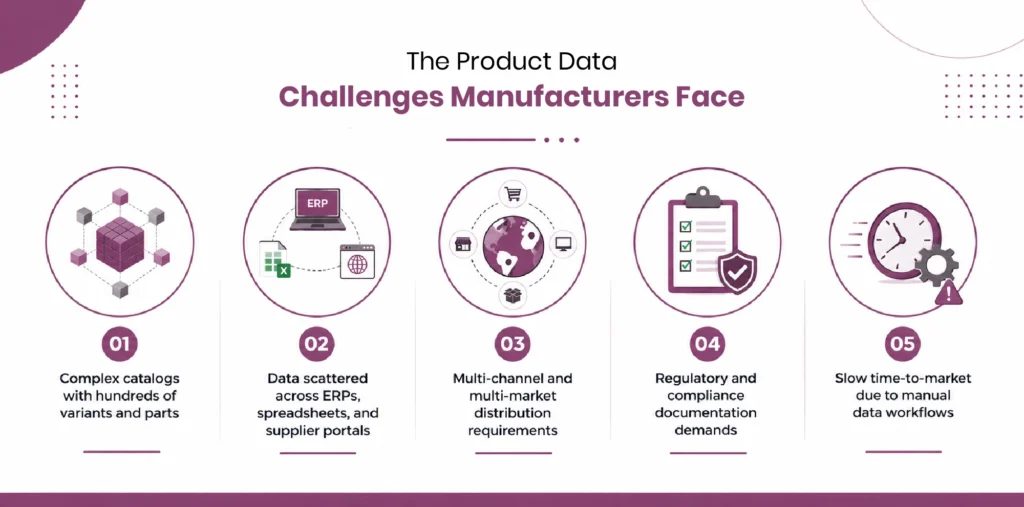
1. Complex catalogs with hundreds of variants and parts
PIM for manufacturers must handle complex product hierarchies where a single product has dozens of variants, each with unique specifications, compatibility rules, and replacement parts. A pump available in three sizes, four materials, and two voltage configurations creates 24 distinct SKUs, and each SKU requires its own set of technical attributes and compliance documentation. PIM software for manufacturers with variant generation creates all SKUs automatically from a master product record, eliminating the manual SKU creation that plagues spreadsheets and basic ERPs. PIM manufacturing also tracks compatibility matrices linking each product to compatible accessories and replacement parts, relationships that spreadsheets cannot represent cleanly.
2. Data scattered across ERPs, spreadsheets, and supplier portals
Manufacturing companies typically maintain product data in multiple disconnected systems, engineering specifications in PLM, operational data in ERP, marketing content in spreadsheets, supplier data in portals. PIM for equipment manufacturers centralizes all this fragmented data into one master database, eliminating the “which system is current?” debates that waste hours weekly. Product information management manufacturing pulls data from ERPs, supplier feeds, and spreadsheets, standardizes it, and creates a single source of truth that every department trusts. Without centralization, PIM manufacturing challenges multiply because teams cannot agree on which version of a spec sheet is correct.
3. Multi-channel and multi-market distribution requirements
Distribution channels for manufacturers include direct ecommerce, distributor portals, marketplaces, internal sales portals, and print catalogs, each requiring different data formats and product assortments. PIM for manufacturers syndicates one master catalog to every destination with channel-specific transformations, ensuring that a technical spec sheet created by engineering reaches every channel in the correct format. PIM software for manufacturers also handles localization for global markets, storing one master record with regional overlays for each region’s regulatory requirements and language preferences. Best PIM for manufacturing enables manufacturers to add new distribution channels without rebuilding their catalog, turning channel expansion from a project into a configuration change.
4. Regulatory and compliance documentation demands
Manufacturing companies face a web of compliance standards, ISO, CE, UL, RoHS, REACH, and industry-specific regulations, each requiring specific data fields, documentation, and certification tracking. PIM software for manufacturers stores compliance certificates alongside product records and enforces validation rules that block products missing required documentation from syndicating to regulated markets. PIM meaning in manufacturing includes tracking audit trails that prove what was certified and when, satisfying regulatory requirements without manual record-keeping. Without product information management manufacturing, compliance becomes a full-time manual audit job that scales poorly as product catalogs grow.
5. Slow time-to-market due to manual data workflows
A new product launch requires coordinating engineering specs, compliance docs, marketing copy, and channel distribution, a process that takes weeks of email chains and spreadsheet handoffs without a PIM. PIM for manufacturers collapses this timeline to days by centralizing every task in one system, with engineering uploading specs, marketing adding descriptions, and legal approving compliance in parallel rather than sequence. PIM manufacturing with workflow automation routes tasks automatically, tracks completion status, and escalates stalled tasks so nothing falls through the cracks. PIM software for manufacturers reduces launch time from weeks to days, giving manufacturers a competitive advantage over competitors still using manual processes.
Learn about Cloud PIM

How PIM Software for Manufacturing Solves These Challenges
PIM for manufacturers centralizes scattered product data from ERPs, spreadsheets, and supplier feeds into one master database that engineering, marketing, and sales teams all trust. PIM software for manufacturing automates variant generation, compliance validation, and channel syndication, eliminating the manual workflows that delay product launches by weeks. Product information management manufacturing with built-in approval workflows ensures that no product reaches distribution channels without complete specifications and compliance documentation. Best PIM for manufacturing reduces launch cycles from weeks to days, cuts manual data work by 80%, and ensures every channel receives accurate, consistent product information automatically.
| Challenge | Before PIM | After PIM |
| Product data scattered across systems | Engineering, marketing, and sales maintain separate spreadsheets that never align, causing constant reconciliation work | PIM for manufacturers centralizes all data into one master database that every department trusts |
| Complex variants and BOMs | Teams manually create each variant and BOM line by line in spreadsheets, spending weeks per product family | PIM software for manufacturers generates all variants from a master product matrix, creating hundreds of SKUs with one click |
| Multi-channel syndication | Manual reformatting for each distribution channel causes errors and delays, with channels often out of sync | PIM for equipment manufacturers applies channel-specific transformations automatically, pushing to every distribution channel from one master catalog |
| Compliance and regulatory tracking | Manual document management with scattered files makes it impossible to prove compliance status | PIM manufacturing stores certificates with product records and blocks non-compliant products from syndicating |
| Slow time-to-market | New product launches take weeks of email chains and spreadsheet handoffs | Product information management manufacturing with automated workflows reduces launches to days |
Centralizing product data as a single source of truth
PIM for manufacturers pulls product data from ERPs, PLMs, spreadsheets, and supplier feeds into one master database that every department trusts. PIM software for manufacturers eliminates version conflicts because everyone works from the same source, and a specification update in engineering appears instantly in sales collateral and distributor portals. PIM manufacturing with centralization means your team stops asking “which version is current?” because only one version exists. Product information management manufacturing with a single source of truth reduces reconciliation work by 80%, freeing your team for strategic work instead of fighting data chaos.
Managing product variants, BOMs, and attribute relationships
PIM for equipment manufacturers handles nested attribute hierarchies where specifications contain sub-specifications, preserving the complex relationships that spreadsheets flatten into rows and columns. A motor’s voltage rating includes min, max, and nominal values, and a pump’s compatibility matrix links to dozens of replacement parts; PIM software for manufacturers manages these relationships natively. Best PIM for manufacturing also handles BOMs (bills of materials) where a finished product comprises hundreds of components, each with its own specifications. PIM meaning in manufacturing includes understanding that a motor part A is compatible with parts B and C but not part D, relationships that generic databases cannot represent.
Accelerating channel syndication and product launches
PIM for manufacturers syndicates one master catalog to every distribution channel automatically, with channel-specific transformations that apply your mapping rules consistently. PIM manufacturing eliminates manual reformatting for each channel because your master description becomes Amazon bullet points, distributor portal technical specs, and website long-form copy automatically. PIM software for manufacturers with automated syndication reduces launch timelines from weeks to days because your team enriches data once in the PIM and pushes to every channel with one click. Product information management manufacturing with channel-specific validation ensures that each distribution channel receives formatted data, reducing errors and improving partner satisfaction.
Supporting compliance and multi-market data requirements
PIM for manufacturers stores compliance certificates alongside product records and enforces validation rules that block incomplete compliance data before it causes fines or delisting. PIM software for manufacturers with compliance tracking ensures that a product missing required CE documentation cannot syndicate to EU channels, and audit trails prove what was certified and when. Manufacturing companies using product information management manufacturing can add new compliance fields once and apply them across all affected products, adapting to regulatory changes without rebuilding their catalog. PIM meaning in manufacturing includes understanding that compliance is not optional, it is a business requirement that PIM automates instead of leaving to manual processes.
Packaged solutions that enable product, commerce and marketing teams to create and maintain an approved shareable version of rich product content — making a single, trusted source of product information available for multichannel commerce and data exchange.
–Gartner Peer Insights — PIM Market Definition
How PIM Integrates Into the Manufacturing Tech Stack
PIM and ERP integration
PIM for manufacturers connects to your ERP via pre-built connectors or APIs, pulling operational data like inventory levels, costs, and basic product identifiers. PIM software for manufacturers with ERP integration ensures that a cost update in your ERP triggers updated retail pricing in your PIM, and inventory changes in your ERP update channel availability automatically. Manufacturing companies using product information management manufacturing with ERP integration eliminate double entry because your team updates data once, not twice. PIM meaning in manufacturing includes understanding that ERP-PIM integration is non-negotiable for efficient operations.
PIM and PLM systems
PIM for equipment manufacturers connects to PLM systems to pull engineering specifications, BOMs, and CAD file references when products reach the “released” stage. PIM software for manufacturers with PLM integration ensures that a spec change in engineering flows automatically to sales catalogs, marketing content, and distributor portals. PIM manufacturing with PLM integration also flows customer feedback from the PIM back to PLM for future design revisions. Product information management manufacturing with PLM integration streamlines the handoff from development to marketing, eliminating manual data re-entry.
PIM and ecommerce platforms
PIM for manufacturers connects to ecommerce platforms like Magento, Shopify, and custom B2B storefronts via pre-built connectors or APIs. PIM software for manufacturers with ecommerce integration pushes product data, descriptions, images, pricing, inventory, to your online store automatically, eliminating manual CSV uploads. Manufacturing companies using PIM manufacturing with ecommerce integration ensure that a price change in the PIM appears on their website within minutes. Distribution channels benefit because product information management manufacturing with ecommerce integration keeps your store current without manual intervention.
PIM and digital asset management
PIM for manufacturers integrates with DAM systems to store and reference CAD files, installation manuals, compliance certificates, and product photos alongside product attributes. PIM software for manufacturers with DAM integration ensures that a motor’s CAD file never separates from its spec sheet, and an installation manual applies to the correct product family. PIM meaning in manufacturing includes asset management because technical documents are as important as product specifications. Product information management manufacturing with DAM integration creates a complete product record where assets and data live together, not in separate folders.
Key PIM Features Manufacturers Should Prioritize
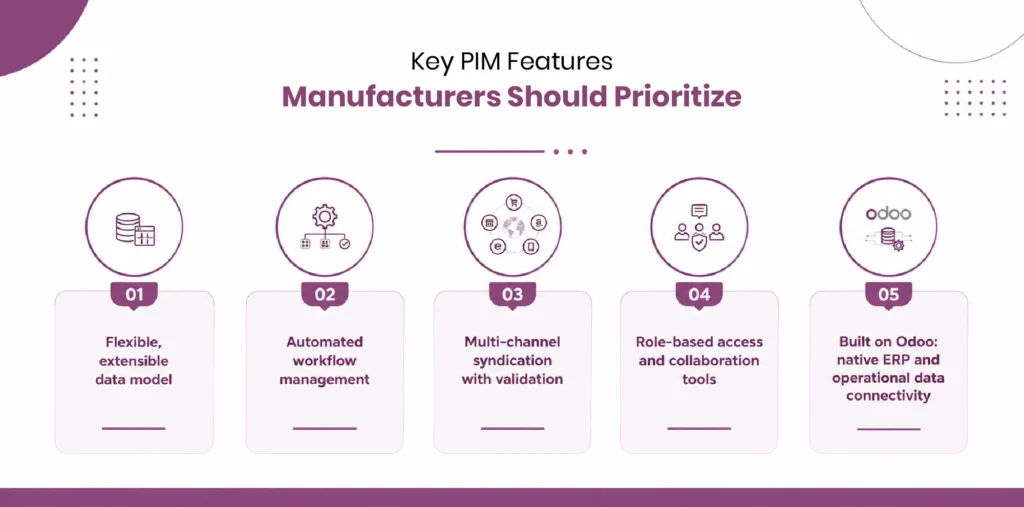
1. Flexible, extensible data model
PIM for manufacturers must support nested attributes where specifications have sub-specifications, and compatibility matrices link products to hundreds of related components. PIM software for manufacturers with flexible data modeling adapts to your catalog, not the other way around, letting you add new attributes without developer help and create attribute families for different product types. Manufacturing companies need product information management manufacturing that handles both simple catalogs and complex industrial products with nested specifications and variant relationships. PIM meaning in manufacturing includes the flexibility to represent any product type, from simple fasteners to complex machinery with thousands of components.
2. Automated workflow management
PIM for manufacturers with workflow automation routes enrichment tasks automatically, engineers verify specs, legal approved compliance, marketing adds descriptions, and sales sets channel pricing. PIM software for manufacturers tracks approval status and escalates stalled tasks, ensuring nothing falls through the cracks and no product reaches channels without proper signoff. PIM manufacturing with automation replaces email chains and spreadsheet handoffs with structured workflows that every team member follows. Product information management manufacturing with workflow automation reduces bottlenecks and ensures accountability across departments.
3. Multi-channel syndication with validation
PIM for equipment manufacturers with multi-channel syndication pushes your master catalog to every distribution channel with channel-specific transformations, ensuring that each destination receives formatted data. PIM software for manufacturers with validation checks each product against channel requirements before syndication, blocking data that would cause errors or delisting. Manufacturing companies need PIM manufacturing that validates product data against each distribution channel requirement, catching errors before they reach customers. Best PIM for manufacturing includes channel-specific validation rules that ensure every product meets each channel’s specifications before publishing.
4. Role-based access and collaboration tools
PIM for manufacturers with role-based permissions ensures that engineers edit technical fields, marketers edit descriptions, and compliance officers review legal copy, without stepping on each other’s work. PIM software for manufacturers with collaboration tools includes commenting, task assignment, and notifications that keep teams aligned without email chains. PIM meaning in manufacturing includes understanding that different teams need different views of the same product data. Product information management manufacturing with role-based access ensures that engineers see technical specs, sales sees marketing copy, and customers see approved content, all from the same master record.
5. Built on Odoo: native ERP and operational data connectivity
PIM for manufacturers built on Odoo shares the same database as Odoo ERP, eliminating the middleware and integration headaches that plague standalone PIMs. PIM software for manufacturers with Odoo’s native architecture means your inventory, pricing, and product data live in one place, not two systems fighting for truth. Manufacturing companies using Odoo PIM get ERP, PIM, CRM, and accounting in one database, reducing total cost of ownership compared to assembling best-of-breed tools. The best PIM for manufacturing for Odoo users is OdooPIM because no other solution offers this level of native integration, and your team learns one system instead of two.

What Types of Manufacturers Benefit Most from PIM?
Industrial and equipment manufacturers
PIM for equipment manufacturers handles complex specifications, CAD files, compliance certificates, and compatibility matrices for heavy machinery, pumps, motors, and industrial tools. Manufacturing companies in this sector manage massive product complexity where each product has dozens of specifications and compatibility rules with other components. PIM software for manufacturers with attribute hierarchies preserves the relationships that spreadsheets flatten, ensuring that a motor’s voltage rating, RPM, mounting pattern, and efficiency rating remain connected. PIM manufacturing for industrial equipment also tracks which replacement parts work with which equipment generations, preventing costly ordering errors.
Consumer goods and FMCG
PIM for manufacturers in consumer goods manages product variants, packaging sizes, SKUs, and channel-specific content for fast-moving consumer goods sold through retail, ecommerce, and wholesale channels. Manufacturing companies in FMCG need product information management manufacturing that handles frequent new product launches, seasonal variations, and retailer-specific requirements. PIM software for manufacturers for FMCG syndicates product data to retailers in their required formats, ensuring accurate listings across thousands of store locations. PIM meaning in manufacturing for FMCG includes managing the high velocity of product changes and retailer requirements.
Automotive parts and aftermarket
PIM for manufacturers in automotive manages YMM (Year/Make/Model) fitment data, superseded part numbers, and compatibility matrices for parts sold through OEM, aftermarket, and retail channels. Manufacturing companies in automotive need PIM software for manufacturers that handles complex fitment where one part fits dozens of vehicle configurations across multiple years and models. PIM manufacturing for automotive also tracks OE cross-references, core charges, and warranty information that general-purpose PIMs cannot handle. Best PIM for manufacturing in automotive includes fitment tables that link each part to every compatible vehicle configuration.
Electronics and medical devices
PIM for manufacturers in electronics and medical devices manages regulatory compliance, serialized inventory, and product lifecycle tracking for products with strict documentation requirements. Manufacturing companies in these sectors need product information management manufacturing that tracks ISO, FDA, CE, and other certifications alongside product specifications. PIM software for manufacturers for medical devices ensures that a device missing required compliance documentation cannot syndicate to any channel, preventing regulatory violations. PIM meaning in manufacturing for regulated industries includes audit trails that prove compliance status and support regulatory submissions.
Case Studies
Case Study 1: Master Fluid Solutions Replaces Legacy System with Centralized PIM for Industrial Data Management
Challenge
Master Fluid Solutions, a manufacturer of metalworking fluids and industrial lubricants, managed over 4,000 active SKUs across a B2B website, affiliated distributors, and a broad network of sales channels. The company relied on a custom internal database that only one developer understood, making updates slow, risky, and difficult to scale. Heavy manual data entry led to data inconsistencies across multiple systems, and product specifications, Safety Data Sheets, and cross-reference tables were often out of sync across sales channels. New product launches took 10 to 14 weeks because teams could not rely on consistent product data, and distributor data requests consumed significant team time.
Solution
Master Fluid Solutions implemented Catsy PIM and DAM with native bi-directional integration to their Epicor ERP systems, replacing the legacy database with a centralized product data hub built for data validation and structured product data management. The setup separated transactional data in the ERP from product content in the PIM, with automated sync keeping both aligned. Safety Data Sheets and technical documentation were moved into the DAM and linked to each SKU, eliminating email-on-request processes. A data validation layer enforced completeness before publishing, and distributor feeds were configured to match each channel’s requirements with automated CSV and XML outputs.
Results
- Specification and SDS update time dropped from 6–8 weeks to under 4 hours
- Distributor self-serve adoption reached 87%
- New product launch cycle shortened from 10–14 weeks to 3–4 weeks
- Manual export work reduced from three full-time roles to about 4 hours weekly
- Distributor data requests fell from 10 per month to under 3
- One person managed the full 4,000+ SKU catalog without adding headcount
Case Study 2: Dodge Industrial Achieves 97% Attribute Coverage and Faster Product Launches with PIM
Challenge
Dodge Industrial, a leading manufacturer of mechanical power transmission products, faced a critical challenge after a corporate acquisition. They needed to swiftly transition away from their old SaaS solutions and establish new PIM and DAM systems while maintaining their high standards of product information accuracy . Accurate product data was essential to preventing costly downtime for their customers, and the company needed a solution that could be deployed rapidly without disrupting operations across their engineering, sales, and distribution channels .
Solution
Dodge Industrial selected Akeneo as their PIM for manufacturers platform for its ease of use and rapid deployment capabilities, partnering with integration expert Bounteous for implementation. The company utilized Akeneo’s Family Templates and data management tools to reassess and improve data quality during implementation . The PIM became the single source of truth for all product data, allowing the engineering team to own and maintain technical data while remaining accessible to wider teams. Scheduled exports from Akeneo automated data updates, with any corrections made by engineers reflected on their eCommerce site the following day .
Results
- 97% complete attribute and asset coverage by product order volume
- 82% of US distributor partner revenue received syndicated content
- 86% reduction in development time for database updates to internal tools
- New product launches transformed from major blockers to the easiest part of the process
- Accurate data enabled successful launches like the IntelliLube automated greasing device
- Single source of truth improved decision-making across engineering, sales, and distribution
Measuring the ROI of PIM for Manufacturing Operations
Time saved on manual data tasks
PIM for manufacturers cuts manual data entry and reconciliation work by 70-80%, freeing your team for strategic work instead of fighting spreadsheet chaos. A team of five spending twenty hours weekly on product data tasks costs roughly $100,000 annually in labor, and “PIM software for manufacturers” that cuts that time by 75% saves $75,000 yearly. PIM manufacturing with automation eliminates the constant hunting for correct specifications and reconciling spreadsheet versions that drain productivity. Product information management manufacturing ROI calculations should include the time saved across engineering, marketing, sales, and compliance teams.
Faster time-to-market per product
PIM for equipment manufacturers reduces new product launch time from weeks to days by centralizing every task in one system with automated workflows and channel syndication. Each day saved in time-to-market represents revenue that would have been delayed, and PIM software for manufacturers that accelerates launches by 80% delivers significant revenue impact. Manufacturing companies launching 50 new products annually can see millions in additional revenue from faster time-to-market. Best PIM for manufacturing ROI includes both the time saved and the revenue captured from faster launches.
Reduction in channel errors and returns
PIM for manufacturers with validation rules blocks incomplete or incorrect data from reaching distribution channels, reducing returns caused by wrong specifications or missing compliance documentation. Each return costs shipping both ways, restocking labor, and a frustrated customer who may never return, and PIM software for manufacturers that reduces returns by 50% delivers significant cost savings. PIM meaning in manufacturing includes error prevention because one mis-ship per month often pays for the PIM subscription. Product information management manufacturing with channel validation ensures that wrong specifications never reach customers.
Headcount efficiency across a growing catalog
PIM for manufacturers scales with your catalog growth without requiring proportional headcount increases, so your catalog can double without doubling your team. Manufacturing companies using PIM software for manufacturers can grow from 10,000 to 50,000 SKUs without adding headcount because the PIM handles the complexity that manual processes cannot. PIM manufacturing with bulk editing and automation lets your existing team manage larger catalogs more efficiently. Product information management manufacturing ROI includes the avoided hiring costs that would be necessary without PIM, making it a cost-saving investment for growing manufacturers.
Frequently Asked Questions
1. What is PIM meaning in manufacturing?
PIM meaning in manufacturing refers to a specialized software solution that centralizes, enriches, and distributes complex technical product data across all sales and distribution channels. PIM for manufacturers manages specifications, CAD files, compliance documents, and compatibility matrices that spreadsheets and ERPs cannot handle effectively. Product information management manufacturing creates a single source of truth that engineering, marketing, and sales teams all trust, eliminating version conflicts and reconciliation work. PIM software for manufacturers also handles variant generation, automated approval workflows, and channel syndication that accelerate product launches. Without PIM manufacturing, manufacturers drown in spreadsheets and manual processes that slow growth and increase errors.
2. How is PIM different from ERP in a manufacturing environment?
An ERP manages transactions, inventory levels, purchase orders, costs, and basic product identifiers, but lacks enrichment and syndication capabilities. PIM for manufacturers manages enriched product content like descriptions, images, technical specifications, and compliance documentation that ERPs cannot handle. PIM software for manufacturing also syndicates product data to every distribution channel automatically, while ERPs only distribute to internal operational systems. Product information management manufacturing handles complex relationships like variant matrices and compatibility links that ERPs store as flat records. PIM meaning in manufacturing is about storytelling and distribution, while ERP is about transactions and operations, you need both for complete product data management.
3. How long does PIM implementation take for manufacturers?
Simple implementations with cloud-based PIM software for manufacturers take two to three months for basic catalog management and channel syndication. Complex enterprise deployments with extensive ERP integration and custom workflows run six to nine months depending on data cleanliness and catalog complexity. PIM for equipment manufacturers with deep attribute hierarchies and compliance tracking typically falls in the four to six month range for mid-size implementations. Manufacturing companies should add 50% to vendor estimates and plan for data cleansing before migration. Best PIM for manufacturing implementation timelines depend heavily on your data quality, clean data moves faster, messy data takes longer.
4. What is the best PIM software for manufacturing companies?
The best PIM for manufacturing depends on your existing systems and catalog complexity. For manufacturing companies already using Odoo ERP, OdooPIM is the strongest choice because it shares the same database as your ERP, eliminating middleware and sync delays. For standalone needs, Akeneo offers deep attribute hierarchies and workflow automation for complex industrial catalogs. InRiver excels at B2B and multichannel syndication for large distributors. PIM software for manufacturers with enterprise needs often choose Pimcore for its open-source flexibility and combined PIM-DAM-CDP capabilities. PIM manufacturing success depends on fit with your ERP, catalog complexity, and team capacity, test two finalists with your messiest product data before committing.
5. How does PIM support after-sales and spare parts management?
PIM for manufacturers supports after-sales by maintaining compatibility matrices that link each product to its replacement parts, accessories, and service documentation. PIM software for manufacturing with relationship management ensures that a customer searching for a motor part sees all compatible options and cross-references to superseded part numbers. Product information management manufacturing also stores installation manuals, warranty documents, and service guides alongside product records, making them accessible to support teams and customers. PIM for equipment manufacturers tracks supersession chains automatically, so when a part is discontinued, the system shows the current replacement. Distribution channels benefit because spare parts catalogs stay accurate without manual updates, reducing support tickets and wrong-part orders.