What Is Cloud Based PIM?
Definition
Cloud based PIM is product information management software hosted on remote servers and accessed through a web browser, eliminating the need for local installation, server hardware, or internal IT maintenance. The cloud product information management model centralizes every product attribute, digital asset, and technical specification into a governed repository that teams access from any location with internet connectivity. Unlike traditional on-premise deployments, PIM cloud platforms deliver product data management as a service where the vendor manages infrastructure, security, and software updates. This cloud PIM approach transforms product information from locally stored files into a universally accessible business capability. Cloud PIM software subscribers focus resources on enriching product content and governing data quality rather than maintaining the application stack.
How It Works
A cloud based PIM operates on multi-tenant or dedicated cloud infrastructure where the vendor provisions your environment and maintains underlying technology components. Your team logs into the cloud product information management platform through a secure browser interface, imports product data from ERP systems and spreadsheets, then enriches attributes within governed workflows. The PIM cloud architecture handles data storage, backup, security patching, and performance scaling automatically without customer intervention. Enriched product content flows from the cloud PIM to ecommerce platforms, marketplaces, distributor portals, and print catalogs through built-in syndication connectors. Cloud PIM software updates roll out continuously across customer environments, ensuring every subscriber operates on current capabilities without upgrade projects.

Cloud PIM vs On-Premise PIM
Deployment
Cloud based PIM deployment begins with account provisioning on vendor infrastructure, making the platform ready for data import and workflow configuration within hours. On-premise cloud product information management alternatives demand hardware procurement, operating system setup, database installation, and application configuration before the first product attribute enters the system. The PIM cloud model eliminates geographic constraints, letting distributed teams access identical product data without VPN configurations or remote desktop infrastructure. Cloud PIM software deployment compresses implementation timelines from months to days, accelerating the path from purchase decision to measurable business value. This speed advantage makes cloud PIM particularly attractive for organizations needing product data governance without the infrastructure delays that derail on-premise timelines.
Cost
Cloud based product information management converts capital expenditure into predictable operational spending with no upfront hardware purchases, software licenses, or implementation infrastructure costs. On-premise alternatives demand substantial initial investment in servers, database licenses, and installation services before the PIM cloud comparison even begins accounting for ongoing expenses. The cloud PIM subscription model bundles infrastructure, maintenance, updates, and support into a recurring fee that scales with actual usage rather than capacity estimates. Total cost of ownership for cloud PIM software typically undercuts on-premise alternatives over a five-year horizon when accounting for hidden infrastructure and personnel expenses. Predictable subscription pricing simplifies budgeting and eliminates the surprise capital requests that aging on-premise infrastructure inevitably generates.
Maintenance
Cloud based PIM eliminates database administration, server maintenance, security patching, and backup management from your team’s responsibilities entirely. The cloud product information management vendor operates the application stack, monitors performance, and applies updates without consuming internal IT hours or requiring scheduled maintenance windows. On-premise deployments demand dedicated staff for ongoing maintenance that diverts technical resources from strategic initiatives to routine operational tasks. PIM cloud platforms improve continuously through automatic updates that deliver new capabilities without the version-lock and upgrade projects that plague on-premise installations. This maintenance burden shift makes cloud PIM particularly valuable for mid-market organizations lacking infrastructure specialists.
Learn about Best PIM Software for Ecommerce Site in 2026

Benefits of Cloud PIM Software
1. Flexibility
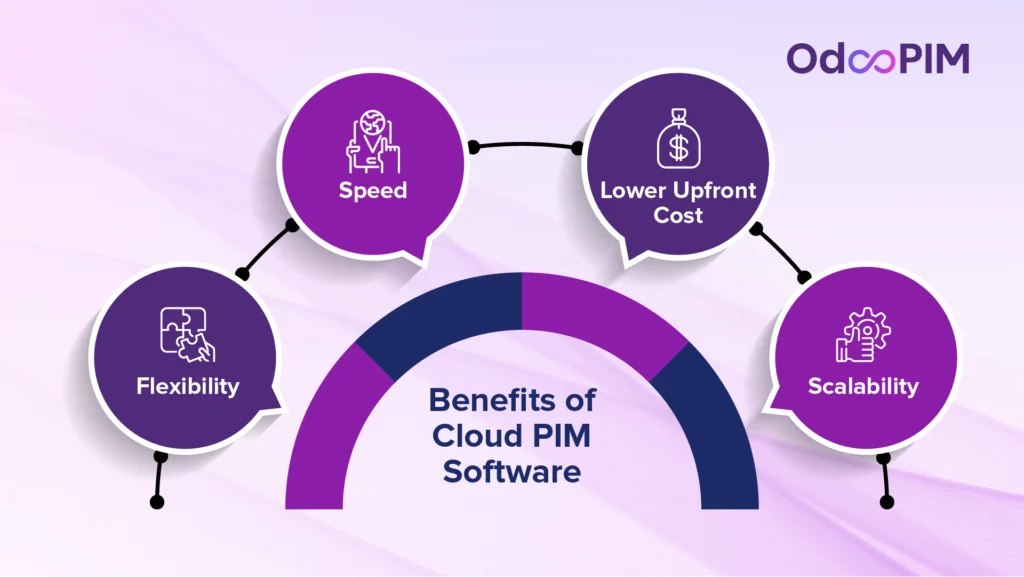
Cloud based PIM enables distributed teams to access, enrich, and govern product data from any location with internet connectivity, supporting the modern reality of remote and hybrid work. The cloud product information management model scales storage and processing resources dynamically, absorbing catalog growth without capacity planning exercises or hardware procurement cycles. PIM cloud platforms offer extensibility through APIs and marketplace connectors that integrate with ecommerce, ERP, and syndication endpoints without on-premise networking complexity. Team members across engineering, marketing, and sales collaborate on identical product records simultaneously regardless of physical location. This cloud PIM software flexibility ensures product data governance adapts to organizational changes without infrastructure reconfiguration.
2. Speed
Cloud based product information management delivers measurable business value within days of subscription activation because the platform eliminates infrastructure provisioning and software installation phases. Enrichment workflows, channel connectors, and user permissions are configured in PIM cloud environments designed for immediate productivity rather than lengthy implementation cycles. New sales channel connections activate through pre-built cloud PIM syndication connectors that require configuration rather than custom development. Product data governance initiatives that would require months of preparation in on-premise deployments launch within weeks. This deployment velocity makes cloud PIM software the default choice for organizations needing rapid product data improvements without implementation delays.
3. Lower Upfront Cost
Cloud based PIM eliminates the capital expenditure spike that traditional on-premise deployments demand for hardware, software licenses, and implementation services. The subscription model converts cloud product information management procurement from a major capital request requiring executive approval into an operational line item within departmental budgets. Organizations preserve cash for revenue-generating activities while gaining immediate access to enterprise-grade PIM cloud capabilities. The cloud PIM financial model reduces risk by letting teams prove value through subscription periods before committing to long-term contracts. Cloud PIM software makes sophisticated product data management accessible to organizations that could never justify the upfront investment of on-premise alternatives.
4. Scalability
Cloud based product information management scales compute resources, storage capacity, and user seats as catalog complexity and team size grow. Adding fifty thousand SKUs or onboarding new departments requires subscription adjustments rather than server capacity projects or database expansion initiatives. PIM cloud architecture absorbs traffic spikes during peak enrichment periods without the performance degradation that fixed on-premise infrastructure experiences under load. Geographic expansion becomes straightforward as cloud PIM vendors operate globally distributed data centers that serve international teams with low latency. This cloud PIM software scalability ensures product data management capability grows in lockstep with business ambition rather than constraining it to available hardware.
Learn about PIM for Shopify
Poor data quality costs organizations an average of $12.9 million annually, according to Gartner—making centralized, governed product data a competitive necessity rather than an IT initiative.
– Gartner
Is Cloud PIM Right for Your Business?
Small Business Fit
Cloud based PIM removes the infrastructure and IT staffing barriers that traditionally blocked small businesses from accessing sophisticated product data management. The subscription cloud product information management model aligns costs with actual usage, letting small teams start with core capabilities and expand functionality as their catalog grows. PIM cloud deployment eliminates the hardware investment that small businesses cannot justify for a single application, converting what would be impossible capital expenditure into manageable operational spending. Small teams gain enterprise-grade product data governance without hiring dedicated PIM administrators or database specialists. Cloud PIM software enables small businesses to compete on product data quality with larger competitors whose on-premise investments once created an unbridgeable capability gap.
Enterprise Fit
Large organizations benefit from cloud based product information management through reduced infrastructure complexity, automatic scaling, and elimination of the upgrade cycles that consume enterprise IT resources. The PIM cloud model lets enterprises redirect technical staff from application maintenance toward strategic data governance and channel expansion initiatives. Global enterprises leverage cloud PIM vendor data centers distributed across regions to serve international teams with low latency without building redundant infrastructure. Enterprise security requirements align with mature cloud PIM software vendors who invest in certifications, penetration testing, and compliance frameworks that individual organizations struggle to resource internally. Large-scale cloud product information management deployments handle millions of SKUs and hundreds of users with elastic resources that on-premise architecture would require massive over-provisioning to match.
Readiness Factors
Assess whether your organization’s internet connectivity, integration requirements, and security posture align with cloud based PIM adoption before committing to a vendor. Organizations with unreliable internet access or strict data sovereignty regulations requiring physical control over infrastructure may face barriers to cloud product information management deployment. Evaluate internal change management readiness because PIM cloud adoption requires teams to embrace new workflows and abandon familiar spreadsheet-based processes. Your existing ERP, ecommerce, and marketplace integrations must connect to cloud PIM endpoints through APIs or pre-built connectors rather than local network paths. Cloud PIM software readiness depends more on organizational willingness to adopt governed product data processes than on any technical prerequisite.
Learn about Magento PIM Integration

Case Studies
Case Study 1: Industrial Fastener Distributor Replaces Spreadsheets with Cloud PIM and Cuts Listing Errors to Near Zero
Challenge
A mid-sized industrial fastener distributor managed product data for thirty thousand SKUs through disconnected spreadsheets shared across purchasing, sales, and their ecommerce team. Each department maintained its own version of product specifications, creating constant conflicts where the website displayed different thread counts and material grades than the printed catalog and ERP records. The purchasing team updated supplier cost data in one spreadsheet while the ecommerce team populated Amazon and eBay listings from another, causing pricing mismatches that triggered customer complaints and marketplace policy violations. When a major contractor rejected a shipment because online specifications did not match the physical fasteners delivered, leadership recognized that spreadsheet-based cloud product information management had become an existential operational risk. The company needed a cloud based PIM solution that could centralize product truth without requiring IT infrastructure they lacked resources to support.
Solution
The distributor selected a cloud PIM software platform to eliminate infrastructure demands while governing complex industrial product data across all channels. The PIM cloud solution deployed within days, allowing the team to immediately begin importing product attributes, technical specifications, and supplier data into a single governed repository. Purchasing connected their ERP to the cloud PIM through pre-built APIs, ensuring supplier cost updates and inventory levels synchronized automatically rather than through emailed spreadsheet attachments. The ecommerce team enriched product descriptions and digital assets within the same platform, building on purchasing-validated technical data instead of duplicating it in separate files. Channel syndication pushed consistent product content to their website, Amazon, eBay, and three industry-specific marketplaces simultaneously from the governed master records. Workflow automation ensured material certifications and compliance documentation routed through approval chains before publication, eliminating the outdated specification problem that caused the contractor rejection.
Results
- Listing errors caused by specification mismatches dropped to near zero within the first quarter of cloud based product information management adoption
- Marketplace policy violations eliminated entirely as pricing updates propagated automatically across channels from a single source
- New supplier product onboarding time reduced from three weeks of manual spreadsheet coordination to same-day enrichment and syndication
- Purchasing and ecommerce teams now work from identical product data for the first time in company history
- The cloud PIM software investment delivered measurable ROI within five months through reduced returns and eliminated rework
- Channel expansion capability built into operations, with new marketplace onboarding now a configuration task rather than a data reconstruction project
Case Study 2: Consumer Electronics Brand Adopts Cloud PIM and Scales Product Launches Across Seven Channels
Challenge
A consumer electronics brand selling audio equipment and accessories managed product launches across their D2C website, Amazon, Walmart.com, Best Buy marketplace, two international distributor portals, and a B2B wholesale site. Each product release required manually updating specifications, images, compatibility information, and pricing across seven disconnected platforms, consuming three weeks of coordinated effort for every new device. The marketing team maintained product content in a shared drive while engineering stored technical specifications in a separate system, creating constant version conflicts when specifications changed during development. A product launch mishap where outdated impedance ratings appeared on Amazon while the website displayed correct specifications triggered customer confusion and negative reviews that damaged the brand’s audiophile credibility. The company needed cloud PIM that could synchronize complex technical product data across channels without multiplying their operational burden.
Solution
The brand implemented a cloud based PIM platform to serve as the central product data authority governing specifications, marketing content, and digital assets. Engineering uploaded technical specifications into the cloud product information management system where marketing could access verified data for enrichment without duplicating or altering source values. The PIM cloud syndication engine pushed enriched product content to the seven channels simultaneously, automatically formatting attributes to meet each platform’s specific requirements while maintaining data integrity. When engineering updated a driver specification during pre-production, that change propagated to every channel’s staged product listings instantly, eliminating the version conflicts that caused previous launch errors. New product launch workflows transformed from sequential manual updates across seven platforms into a single enrichment process with automated syndication handling channel-specific formatting.
Results
- New product launch time reduced from three weeks to four days as cloud PIM software automated syndication to seven channels
- Product specification consistency achieved across D2C website, Amazon, Walmart, Best Buy marketplace, and distributor portals from one governed repository
- Customer complaints about specification mismatches dropped to zero within two product launch cycles of cloud based product information management adoption
- Engineering and marketing collaboration improved as both teams accessed identical product data with clear attribute ownership boundaries
- The brand expanded into two additional international markets without adding product data management headcount
- Leadership identified PIM cloud adoption as the critical enabler behind their channel expansion strategy, noting that manual processes would have collapsed under the complexity of seven simultaneous platform updates
Learn about what is CPG
What to Look for in a Cloud PIM Solution
Security
Cloud based PIM security demands vendor investment in encryption standards, access controls, and compliance certifications that protect your product data from breaches and unauthorized access. Evaluate whether the cloud product information management vendor maintains SOC 2 certification, GDPR compliance, and industry-specific regulatory frameworks relevant to your business. Data encryption must cover both transmission and storage, with role-based access controls ensuring team members see only the product attributes their function requires. The PIM cloud vendor should provide penetration testing results, security audit reports, and uptime guarantees backed by service level agreements with financial teeth. Cloud PIM software security posture becomes your security posture, making vendor due diligence a critical step in the selection process.
Integration Support
Cloud based product information management must connect smoothly to your ERP, ecommerce platform, marketplace channels, and any legacy systems where product data originates or flows. Examine the PIM cloud vendor’s pre-built connector library, API documentation quality, and integration partner ecosystem before committing. The cloud PIM solution should offer real-time APIs for synchronous operations and batch export capabilities for bulk syndication scenarios. Integration depth determines whether your cloud PIM software functions as a connected hub or an isolated data island requiring manual data transfer. Prioritize vendors with native ERP connections that eliminate the middleware tax adding cost, latency, and failure points to product data synchronization.
Vendor Reliability
Assess cloud based PIM vendor stability through customer retention rates, financial health, product roadmap transparency, and the depth of their implementation partner network. The cloud product information management provider should demonstrate a track record of consistent uptime, responsive support, and regular feature releases that reflect customer input. Examine the PIM cloud vendor’s data backup procedures, disaster recovery capabilities, and data portability commitments that protect your product information if the relationship ends. Long-term cloud PIM success depends on selecting a vendor whose product direction and company trajectory align with your channel expansion plans. Cloud PIM software evaluations must weigh vendor viability equally with feature checklists because switching costs increase dramatically after implementation.
Challenges of Moving to the Cloud
Data Migration
Migrating product data from legacy systems into a cloud based PIM reveals the data quality problems that spreadsheets and disconnected databases concealed for years. The extraction process surfaces duplicate records, missing attributes, inconsistent formatting, and outdated specifications that accumulated across source systems without governance. Cloud product information management implementation must budget time for data cleansing, normalization, and enrichment that transforms raw source data into channel-ready product records. Migration complexity scales with the number of source systems, the consistency of existing identifiers, and the completeness of technical attributes required by target channels. PIM cloud data migration represents the largest effort component of implementation, often consuming more resources than the technical deployment itself.
Change Management
Shifting teams from spreadsheet-based product data processes to a governed cloud PIM environment triggers resistance that technology alone cannot overcome. Marketing teams accustomed to maintaining their own product descriptions resist centralized workflows, while engineering departments doubt whether the cloud product information management system will reflect their technical specifications accurately. Successful cloud based product information management adoption requires executive sponsorship, clear role definitions, and demonstrated early wins that convert skeptics into advocates. The PIM cloud transition demands communication that frames data governance as liberation from manual synchronization rather than bureaucratic restriction. Change management investment determines whether your cloud PIM adoption succeeds or whether teams revert to familiar spreadsheet workflows.
Integration with Existing Systems
Connecting a cloud based PIM to on-premise ERP systems, legacy databases, and custom applications introduces networking complexity that pure cloud deployments avoid. Firewall configurations, VPN tunnels, and data transformation mappings require collaboration between your IT team and the cloud product information management vendor’s integration specialists. Legacy systems with proprietary interfaces or outdated API capabilities extend integration timelines beyond the deployment that PIM cloud marketing promises. Test the integration architecture thoroughly before committing to a cloud PIM software vendor, ensuring data flows bidirectionally at acceptable speeds under production loads. Integration challenges represent the most common source of cloud based product information management implementation delays and should anchor your project plan’s risk assessment.
Learn about best PIM software
How a Native ERP Connection Strengthens Cloud PIM
Single Platform
A native ERP cloud based PIM operates within the same platform ecosystem as your business systems, eliminating the integration complexity that standalone PIM deployments introduce. Product data, inventory levels, pricing tiers, and customer information synchronize naturally because the cloud product information management shares a data foundation with the ERP. This architectural unity means the PIM cloud does not require separate data models, transformation mappings, or synchronization schedules to maintain consistency with business operations. Teams govern product data within the same environment they use for daily operational tasks, collapsing the learning curve that separate cloud PIM applications demand. The single platform approach transforms product data management from a siloed initiative into an integrated business capability.
Real-Time Sync
Native cloud based product information management synchronizes product changes instantly across ERP, ecommerce, and all connected channels without batch processing delays. A technical specification update in engineering propagates to customer-facing storefronts immediately because the PIM cloud and ERP operate on shared data rather than periodically synchronized copies. This real-time connection eliminates the dangerous lag where inventory systems reflect updated products while digital channels still display outdated specifications. The cloud PIM native architecture removes the integration monitoring and error handling burden that middleware-dependent deployments require. Product data consistency becomes an inherent system property rather than a fragile achievement maintained through constant synchronization vigilance.
No Middleware Overhead
Native cloud PIM software connection to ERP eliminates the middleware layer that introduces cost, latency, and failure points into product data management. Every middleware component in a traditional cloud based PIM deployment adds licensing fees, integration development, ongoing connector maintenance, and troubleshooting complexity. Native architecture removes these operational tax items from both the implementation budget and the long-term support burden. The cloud product information management implementation compresses because there is no data mapping exercise between PIM and ERP data models, they share one model by definition. This architectural simplicity eliminates the most common failure point in PIM cloud deployments: the brittle integration layer where mismatched data models corrupt product information during transfer.

FAQs
1. What is cloud based PIM?
Cloud based PIM is product information management software hosted on remote servers and accessed through a browser, eliminating the need for local installation, server hardware, or internal IT maintenance. The cloud product information management model centralizes every product attribute, digital asset, and technical specification into a governed repository that teams access from any location with internet connectivity. PIM cloud deployment transforms product data management from a capital-intensive software installation into a subscription service where the vendor handles infrastructure, security patches, and performance optimization. This cloud PIM approach lets organizations focus resources on enriching product content and governing data quality rather than maintaining application stacks. Cloud PIM software subscribers gain enterprise-grade capabilities without the infrastructure burden that on-premise alternatives demand.
2. What is the difference between cloud PIM and on-premise PIM?
The difference between cloud based PIM and on-premise centers on infrastructure ownership, deployment speed, and maintenance responsibility. On-premise deployments demand server hardware, database licenses, and dedicated IT staff for ongoing maintenance before the first product attribute enters the system. Cloud product information management shifts infrastructure, security patching, and upgrades entirely to the vendor, freeing internal teams for strategic data governance work. PIM cloud deployment completes in days while on-premise projects stretch across months consumed by hardware provisioning and software configuration. Cloud PIM subscriptions convert capital expenditure into predictable operational costs that scale with actual usage. The cloud PIM software model delivers continuous updates automatically, while on-premise installations require disruptive upgrade projects that delay access to new capabilities.
3. Is cloud PIM secure for sensitive product data?
Mature cloud based PIM vendors invest heavily in security certifications, encryption standards, and dedicated monitoring teams that often exceed what individual organizations can resource internally. Your sensitive product data in a cloud product information management platform benefits from SOC 2 compliance, data encryption in transit and at rest, and role-based access controls governing who views specific attributes. PIM cloud providers undergo regular third-party security audits and maintain dedicated threat detection teams monitoring their infrastructure continuously. The cloud PIM security question has shifted from whether the cloud is secure to whether your vendor’s security posture surpasses your internal capabilities. Cloud PIM software vendors whose business depends on data protection mostly maintain more sophisticated security operations than organizations where product data security represents one priority among many.
4. Is cloud PIM suitable for small businesses?
Cloud based PIM removes the infrastructure and IT staffing barriers that traditionally blocked small businesses from accessing sophisticated product data management. The subscription cloud product information management model aligns costs with usage, letting small teams start with core capabilities and expand functionality as their catalog grows. PIM cloud deployment eliminates the hardware investment that small businesses cannot justify for a single application, converting impossible capital expenditure into manageable operational spending. Small teams gain enterprise-grade cloud PIM governance without hiring dedicated database administrators or infrastructure specialists. Cloud PIM software enables small businesses to compete on product data quality with larger competitors whose on-premise investments once created an unbridgeable capability gap.
5. How much does cloud PIM software cost?
Cloud based PIM pricing varies significantly based on SKU volume, user count, feature tier, and integration complexity, mostly ranging from a few hundred to several thousand dollars monthly. Entry-level cloud product information management subscriptions accommodate small catalogs and basic enrichment workflows at accessible price points for growing businesses. Mid-market PIM cloud deployments handling tens of thousands of SKUs with channel syndication and workflow automation fall into moderate monthly investment ranges. Enterprise cloud PIM implementations managing millions of SKUs with complex data models and global user bases represent more substantial commitments reflecting their operational scope. Cloud PIM software vendors typically offer transparent tiered pricing while on-premise total cost calculations must account for hidden infrastructure, personnel, and upgrade expenses over the deployment lifetime.