What Is PIM for Manufacturing?
PIM for manufacturing centralizes technical product data, specifications, CAD files, compliance documents, and compatibility matrices, into one system for distribution to B2B portals, reseller networks, and ecommerce sites. Unlike retail-focused tools, product information management for manufacturers prioritizes deep attribute hierarchies, ERP integration, and role-based catalogs where engineers see technical specs while customers see approved marketing copy. PIM software for manufacturing ingests data from ERP systems like SAP or Odoo, enriches it with compliance certifications and repair manuals, and syndicates to distributors with customer-specific pricing. Manufacturing product data management solves the chaos of spreadsheets by creating a single source of truth for complex, multi-level product data across the product lifecycle.
Key Features Manufacturers Must Look For
Manufacturers need deep attribute hierarchies, not flat product lists. Your PIM must handle nested specifications, a motor has voltage, then under voltage: min, max, and nominal ranges. Best PIM for manufacturing also requires version control for technical documents (spec sheets, CAD files, compliance certificates) and automated validation rules that enforce data completeness. ERP integration is non-negotiable; your PIM must sync smoothly with SAP, Microsoft Dynamics, or Odoo so inventory and pricing flow both ways without manual double entry. Role-based catalogs matter too: engineers see technical specs, sales sees marketing copy, B2B customers see negotiated pricing, all from the same master record.
What Challenges Do Manufacturers Face Today?
Manufacturers are being squeezed from every side — customers want faster deliveries, supply chains keep fragmenting, regulations keep tightening, and skilled talent is harder to find than ever.
AI was supposed to be the answer, and investment is pouring in: 92% of executives plan to increase AI spending, and 78% of organizations already use it in at least one function. Yet nearly 70% of manufacturers admit that poor data quality and weak system integration are the biggest barriers holding AI back, per Deloitte’s 2025 Manufacturing Industry Outlook. The root cause? Product data scattered across systems, inconsistent, and impossible to act on.
1. Shorter lead times, more complex products
Buyers now expect faster delivery on increasingly customized products. KPMG reports that lead-time expectations keep shrinking while production specs grow more bespoke — so teams must deliver greater customization at higher speed without sacrificing accuracy. In response, manufacturers are digitizing everything from production cycles to procurement and sales.
2. Talent and skills gaps
Deloitte and the Manufacturing Institute estimate that up to 1.9 million manufacturing jobs could go unfilled over the next decade. And the gap isn’t just on the shop floor — four in five executives say technology is now covering knowledge gaps in data management, analytics, and digital operations that once needed dedicated staff.
3. Supply chain volatility
Geopolitical tensions, tariffs, climate disruption, rising costs, and labor shortages are straining sourcing and distribution networks simultaneously. While 78% of manufacturers are investing in supply chain planning software, those tools are only as good as the product data feeding them — inaccurate data at any node undermines the whole chain.
4. Growing regulatory and compliance demands
Every market has its own data standards, and requirements like the EU’s Digital Product Passport now demand structured sustainability and lifecycle data at the individual product level — something most legacy systems were never designed for. A single outdated or wrongly formatted data point can trigger compliance errors that are expensive to fix at scale.
5. Fragmented data across disconnected systems
When product data lives in separate ERPs, PLM tools, supplier portals, and spreadsheets, errors multiply at every stage of the product journey. It’s why three-quarters of manufacturers are increasing investment in data lifecycle management, per Deloitte. Without a unified product data foundation, teams lose speed to market — and every other technology investment underdelivers.
This is exactly the gap a PIM system fills. By centralizing product data into one master record, OdooPIM gives manufacturers the clean, connected data foundation that AI, supply chain tools, and compliance workflows all depend on.
Learn about PIM for manufacturers
How Manufacturing PIM Differs from Retail PIM
Retail PIMs prioritize beautiful product storytelling, lifestyle images, SEO descriptions, social media snippets. Best PIM software for manufacturers prioritizes technical accuracy, component relationships, and compliance data. A retail PIM cares about “fit” and “fabric feel.” A manufacturing PIM cares about “voltage tolerance” and “replacement part compatibility.” Top PIM tools for the manufacturing industry also support B2B workflows like quote-based ordering, customer-specific pricing tiers, and automated syndication to reseller portals. Retail PIMs push to Amazon and Shopify. Manufacturing PIMs push to distribution networks, repair centers, and internal procurement systems. Choose the tool that matches your data complexity, not the one with prettier product pages.

Top PIM Software for Manufacturers in 2026
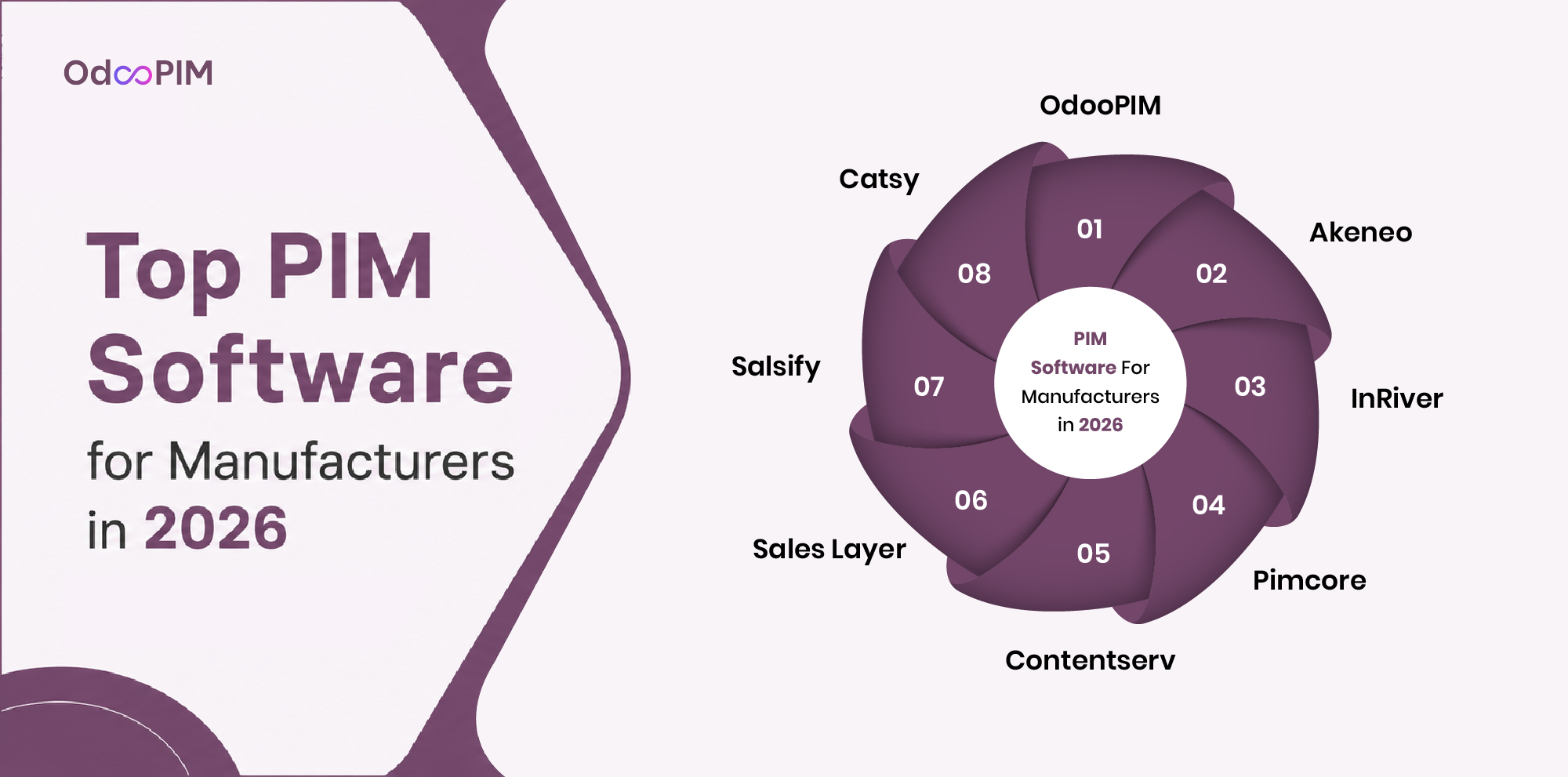
OdooPIM
Native ERP integration makes OdooPIM the best PIM for manufacturing if you already run Odoo. Your inventory, pricing, and product data share one database, eliminating sync delays and middleware costs. The PIM module adds enrichment workflows, channel syndication, and approval chains without leaving your familiar Odoo interface.
Akeneo
Best for Growing Manufacturers: Akeneo scales from mid-market to enterprise, offering open-source flexibility plus paid tiers with advanced modeling. Best PIM software for manufacturers with complex variant relationships choose Akeneo for its attribute families, reference entities, and rule-based enrichment. The learning curve is real, but the power underneath justifies the effort.
InRiver
Best for Complex Product Hierarchies: InRiver excels at nested specifications and component relationships. If your industrial product catalog has motors with multiple voltage options, each linked to compatible parts, inRiver handles it cleanly. Top rated PIM for B2B manufacturers value inRiver’s guided onboarding and role-based views for engineers versus sales teams.
Pimcore
Best Open-Source Option: Pimcore bundles PIM, DAM, CDP, and MDM into one open-source platform. Technical teams get full code access and unlimited customization. Top PIM tools for manufacturing industry for enterprises with developer headcount choose Pimcore for control. The catch: self-hosting requires serious engineering resources.
Contentserv
Best for Workflow Automation: Contentserv automates complex approval chains, supplier data ingestion, and digital asset routing. The best product information management system for manufacturers with multiple teams and compliance requirements uses Contentserv to enforce who approves which fields. Setup is heavy but the automation payoff is real for large organizations.
Sales Layer
Best for Fast Onboarding: Sales Layer gets you live in weeks, not months. Clean interface, pre-built connectors, and straightforward data modeling. Best PIM for industrial product catalog teams needing speed over depth start here. You might outgrow it, but you will launch faster than with enterprise behemoths.
Salsify
Best for Multichannel Syndication: Salsify pushes product data to Amazon, Google Shopping, distributor portals, and your website from one master record. PIM software comparison for manufacturing often puts Salsify at the high end for good reason. The price matches the power, so budget accordingly.
Catsy
Best for Catalog-Heavy Teams: Catsy specializes in turning complex technical data into print-ready catalogs, PDFs, and reseller feeds. Best PIM for complex product data management for manufacturers who still rely heavily on printed or PDF catalogs alongside digital channels. Less glamorous than Salsify, but exceptionally practical for industrial use cases.

How to Choose the Best PIM for Your Manufacturing Business
Consider Your Product Catalog Size and Complexity – A manufacturer with 500 simple SKUs needs different software than one with 50,000 complex assemblies. Best PIM for complex product data management handles nested attributes, compatibility matrices, and multi-level BOMs. Count your unique attribute families, not just your products. If each product has fifty specifications, you need enterprise-grade modeling like inRiver or Akeneo. Simple catalogs work fine with Sales Layer or OdooPIM.
Check ERP and Tech Stack Compatibility – Your PIM must talk to your ERP without expensive middleware. Best PIM for manufacturing integrates natively with SAP, Microsoft Dynamics, or Odoo. Top rated PIM for B2B manufacturers offer pre-built connectors that handle two-way sync for inventory, pricing, and product data. Test the integration before buying. A broken connector creates more work than no connector. For Odoo users, OdooPIM shares the same database, making integration automatic.
Evaluate Compliance and Data Governance Features – Manufacturers face regulatory requirements like RoHS, REACH, or ISO standards. Your best product information management system for manufacturers must track compliance fields, enforce approval workflows, and maintain audit trails. Role-based permissions ensure engineers edit specs while compliance officers approve legal copy. PIM software comparison for manufacturing should prioritize governance over flashy features. Without it, a compliance error triggers fines or delisting.
Compare Pricing and Total Cost of Ownership – The cheapest license often costs the most after implementation. Top PIM tools for the manufacturing industry require partner services for setup, budget 30-50% above license fees. Count user seats, data volume overages, API call limits, and required integrations. The best PIM for industrial product catalog for your budget might be mid-market Akeneo rather than enterprise Salsify. Request all-in quotes from three vendors. Multiply your team’s hourly rate by time saved. The PIM that pays for itself fastest wins.
Packaged solutions that enable product, commerce and marketing teams to create and maintain an approved shareable version of rich product content — making a single, trusted source of product information available for multichannel commerce and data exchange.
–Gartner Peer Insights — PIM Market Definition
Learn about catalog management.
PIM Software Comparison Table (Quick side-by-side: Features, Best For, Pricing Tier)
Stop guessing. This table cuts straight to what matters for manufacturers: complex data handling, ERP integration, compliance features, and real pricing signals.
| PIM Software | Best For | Complex Data Handling | ERP Integration | Compliance & Governance | Pricing Tier |
| OdooPIM | Odoo-native manufacturers | Good for standard BOMs and attribute families | Native (same database) | Role-based permissions, basic approval chains | $3k–$8k annually |
| Akeneo | Growing manufacturers with complex variants | Excellent (attribute families, reference entities, nested specs) | Third-party connectors (SAP, MS Dynamics, Odoo) | Advanced workflows, audit logs, enterprise governance | $10k–$30k annually |
| inRiver | B2B manufacturers with deep product hierarchies | Best-in-class (component relationships, multi-level BOMs) | Pre-built ERP connectors | Role-based catalogs, compliance tracking, guided onboarding | $30k–$80k annually |
| Pimcore | Enterprises with developer teams | Excellent (custom data models, unlimited attributes) | Open-source connectors, full API control | Full audit trails, custom workflows, open governance | Open-source free + hosting costs |
| Contentserv | Compliance-heavy manufacturers | Good (supports complex attributes) | Pre-built connectors | Best-in-class approval chains, regulatory tracking, supplier portals | $40k–$100k annually |
| Sales Layer | Teams needing fast setup | Moderate (flat attribute structures) | Basic ERP connectors | Simple role-based access | $5k–$15k annually |
| Salsify | Multichannel manufacturers selling to retailers | Good (handles variants well) | Robust ERP connectors | Syndication governance, performance tracking | $50k–$150k+ annually |
| Catsy | Catalog-heavy industrial teams | Good for print and PDF exports | Basic integrations | Role-based catalog publishing | $10k–$25k annually |
What the table won’t tell you: Your actual cost depends on implementation partners, data volume, and user count. The best PIM for manufacturing is not the one with the longest feature list, it is the one your team actually uses six months after go-live. Request tailored quotes. Test two finalists with your messiest product data. Then decide.
Common Mistakes Manufacturers Make When Choosing a PIM
Choosing a Retail-Focused PIM for Industrial Use – Retail PIMs prioritize beautiful product pages, lifestyle images, and SEO metadata. Your best PIM for manufacturing needs technical spec sheets, CAD file management, and compatibility matrices. A retail tool cannot handle nested attribute hierarchies or B2B pricing tiers. PIM software comparison for manufacturing must exclude anything built primarily for fashion or consumer goods. Test your most complex product, if the PIM chokes on voltage ranges or replacement part links, move on.
Ignoring Supplier and Distributor Collaboration Needs – Your product data comes from multiple suppliers, each with different formats and quality levels. Top rated PIM for B2B manufacturers includes supplier portals for self-service data submission and automated validation. Distributors need access to customized catalogs with their pricing and product selections. Without collaboration features, your team becomes the middleman for every supplier update and every distributor request. That manual work kills scalability. Choose a PIM that lets suppliers contribute and distributors pull their own data.
Underestimating Implementation Time – Software vendors promise eight-week rollouts. Real manufacturing implementations often take four to six months. The best product information management system for manufacturers requires data cleansing, attribute modeling, ERP integration, workflow configuration, and user training. Your team must map every field from legacy spreadsheets and supplier feeds. Compliance rules need coding into approval chains. Best PIM for industrial product catalog success depends on realistic timelines. Add 50% to vendor estimates. Test with one product family before scaling. Rushing implementation guarantees a broken system that your team abandons.
Learn about PIM Software Example.

Frequently Asked Questions
1. Which PIM is best for small manufacturers?
Sales Layer or OdooPIM are the best PIM for manufacturing at the small end. Sales Layer offers fast onboarding, clean interface, and pre-built connectors for under $15k annually. OdooPIM works perfectly if you already use Odoo ERP, with pricing starting around $3k–$8k. Top PIM tools for the manufacturing industry for small shops also include Plytix for very simple catalogs. Avoid enterprise tools like inRiver or Salsify, they will drown you in features and implementation costs. Test with your messiest product family before committing.
2. What is the difference between PIM and ERP?
ERP manages transactions: inventory levels, purchase orders, financials, and basic product identifiers like SKU and cost. Best product information management system for manufacturers manages enrichment: technical specs, CAD files, compliance documents, marketing descriptions, and channel-specific content. ERP answers “how many do we have and what did we pay?” PIM answers “what are its specifications and why should someone buy it?” Both are essential. The best PIM for complex product data management integrates tightly with your ERP so data flows both ways without double entry.
3. How long does PIM implementation take for manufacturers?
Realistic timelines run four to six months for mid-size manufacturers. PIM software comparison for manufacturing must account for data cleansing (two months), attribute modeling (one month), ERP integration (one to two months), workflow configuration (one month), and user training (two weeks). Simple deployments with Sales Layer or OdooPIM can finish in six to eight weeks. Complex implementations with inRiver or Contentserv often hit six to nine months. Add 50% to vendor estimates. Test with one product family before scaling across your entire catalog.
4. What is PIM in manufacturing?
PIM in manufacturing is software that centralizes, enriches, and distributes technical product information. A motor manufacturer uses it to manage voltage specs, CAD drawings, compliance certificates, and replacement part compatibility. Top rated PIM for B2B manufacturers also handles role-based catalogs, engineers see technical data, sales sees marketing copy, distributors see negotiated pricing. Unlike retail PIMs focused on lifestyle imagery, the best PIM for industrial product catalog prioritizes attribute hierarchies, ERP integration, and approval workflows for regulated industries. It turns chaotic spreadsheets into a single source of truth.