What Is Product Experience in Ecommerce?
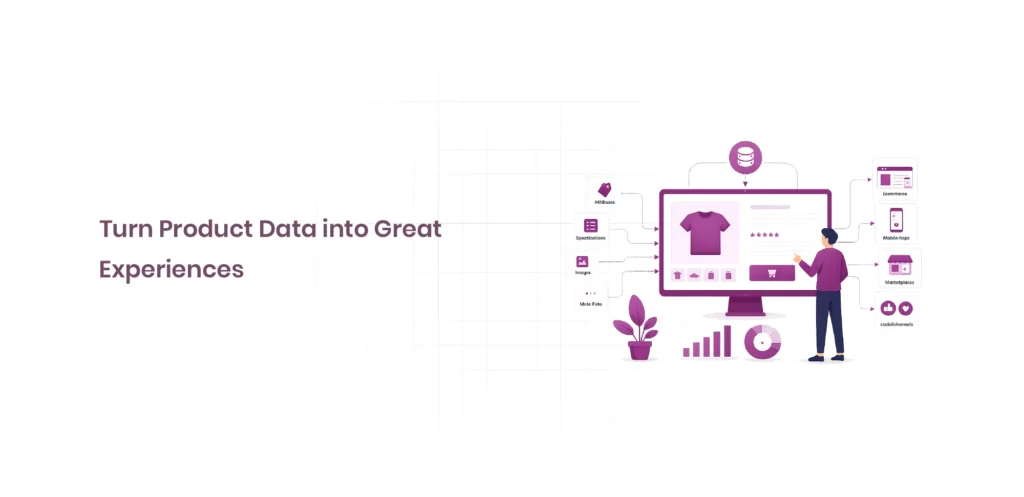
Product experience in ecommerce is the sum of every interaction a customer has with your product throughout their shopping journey, from discovery to purchase to delivery. Product experience management orchestrates product content, data, and presentation across every touchpoint to create smooth, confident purchasing decisions. Product content management ensures product descriptions, images, dimensions, and variants are complete and consistent across every channel. Product experience management software centralizes and enriches product data, validates completeness before syndication, and ensures customers see the same accurate information everywhere. PXM product experience management transforms product data from a back-end concern into a front-end competitive advantage that drives conversion, reduces returns, and builds customer trust.
Beyond product listings
Product experience in ecommerce extends far beyond a product listing, it encompasses search results, category pages, product detail pages, cart interactions, order confirmations, delivery updates, and post-purchase support. Product experience management ensures that every touchpoint in this journey delivers consistent, accurate, and complete product information that builds customer confidence and drives purchase decisions. Product content management with a PIM ensures that product data flows seamlessly from your master catalog to every customer-facing system, so a customer who discovers your product on Amazon, researches it on your website, and buys it through a retailer portal sees the same complete information at every stage. Product experience management software orchestrates this consistency across channels, devices, and customer touchpoints, eliminating the channel-specific discrepancies that destroy trust and cause confusion. PXM product experience management transforms product data from a back-end operational concern into a front-end customer experience driver that impacts conversion, loyalty, and brand perception.
Learn about Best PIM Software for Ecommerce Site
Why shoppers decide based on data quality
Shoppers decide to buy or abandon based on the quality of product information they receive, complete dimensions, accurate specifications, clear images, and consistent variant information determine whether a customer feels confident enough to purchase. Product experience ecommerce research shows that products with complete attributes and high-quality images convert at significantly higher rates than those with missing or inconsistent data, because customers who have all the information they need can make decisions quickly and confidently. Product experience management with complete product data reduces the uncertainty that causes cart abandonment, return rates, and customer hesitation because every question a shopper might have is answered before they need to ask it. Product content management with validation rules ensures that missing dimensions, incomplete variant information, or inconsistent pricing never reaches the customer, eliminating the data gaps that kill trust and drive customers to competitors. PXM product experience management turns product data quality from a back-end operational concern into a front-end revenue driver, because customers who trust your data trust your brand, and trust is what converts browsers into buyers.
Learn about E-commerce PIM Software

The Hidden Cost of Poor Product Experience
Returns and cart abandonment
Poor product experience in ecommerce drives cart abandonment and returns because customers who cannot find complete product information will not buy, and customers who receive products that do not match their expectations will return them. Product experience management with incomplete data means shoppers abandon carts at rates above 70% when dimensions, sizing, or specifications are missing or unclear. Product content management with missing variant attributes, incomplete dimensions, or inconsistent images causes customers to hesitate, leave, and buy from competitors who provide complete information. Product experience management software with completeness scoring blocks incomplete products from syndication, preventing the data gaps that drive abandonment and returns before they reach customers. PXM product experience management reduces return rates by ensuring that every product has complete, accurate information that sets proper expectations, because customers who receive what they expected do not return products.
Inconsistent data across channels
Inconsistent product data across your website, Amazon, Walmart, and retailer portals destroys product experience in ecommerce because customers who see different dimensions, different pricing, or different variant information across channels cannot trust what they read. Product experience management with channel fragmentation means customers compare your product on three channels, find three different descriptions, and abandon the purchase out of confusion. Product content management with a PIM ensures that every channel receives the same complete, validated product data, eliminating the discrepancies that drive customers away. Product experience management software with automated syndication ensures that a product description updated in the PIM updates every channel instantly, so customers never see conflicting information. PXM product experience management with consistent data across channels builds the trust that converts shoppers into buyers, because customers who see the same complete information everywhere have no reason to doubt or abandon.
Learn about Ecommerce Catalog Management
By 2028, 15% of day-to-day business decisions will be made autonomously by AI agents.
– Reuters
Key Elements of a Strong Ecommerce Product Experience
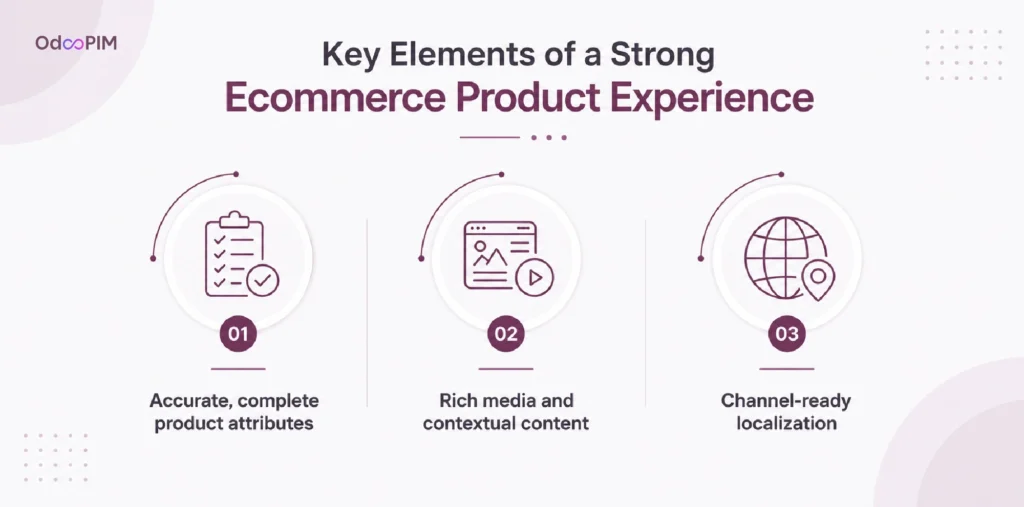
Accurate, complete product attributes
Product experience in ecommerce starts with accurate, complete product attributes, dimensions, weights, materials, specifications, and variant information, because customers make purchase decisions based on the completeness of the data they can access. Product experience management with complete attributes means every product has all the information a shopper needs to decide, from size charts to technical specifications to compatibility details. Product content management with validation rules blocks products with missing attributes from syndication, ensuring that incomplete data never reaches customers. Product experience management software with attribute templates enforces completeness across every product category, so electronics have voltage and battery life fields while apparel has size and fabric fields. PXM product experience management with complete, accurate attributes reduces return rates and increases conversion because customers who have all the information they need buy with confidence.
Rich media and contextual content
Product experience in ecommerce requires rich media, high-resolution images, videos, 360-degree views, and interactive product demonstrations, because customers cannot touch or test products online. Product experience management with rich media ensures that every product has multiple high-quality images from different angles, lifestyle shots showing products in use, and videos demonstrating key features. Product content management with asset management links media to product records, ensuring that images, videos, and documents are always attached to the correct SKU and variant. Product experience management software with rich media capabilities enables consistent, high-quality visual content across every channel, because customers who can see products from every angle are more likely to buy. PXM product experience management with compelling rich media drives higher conversion rates, reduces return rates, and builds the trust that turns browsers into buyers.
Channel-ready localization
Product experience in ecommerce requires channel-ready localization, translated content, regional measurements, and local compliance information, because customers in different markets expect product information in their language and local standards. Product experience management with localization ensures that French customers see metric measurements and local compliance labels while US customers see imperial units and regional certifications. Product content management with regional overlays stores one master record with localized versions for each market, eliminating the duplicate records that cause errors and inconsistencies. Product experience management software with automated localization applies the correct regional version to each channel automatically, ensuring that every market receives content that matches local expectations. PXM product experience management with channel-ready localization enables global expansion without duplicating data entry, because the same master product record serves every market with region-specific overlays that ensure compliance and customer confidence.
Learn about eCommerce AI Agents

What Is Product Experience Management (PXM)?
PIM vs PXM — what’s the difference
A PIM (Product Information Management) system centralizes, enriches, and validates product data, ensuring that every SKU has complete attributes, accurate dimensions, and consistent content before syndication. Product experience management (PXM) extends beyond PIM to orchestrate how that product data is presented, contextualized, and optimized across every customer touchpoint, from search results to product pages to post-purchase communications. Product content management with a PIM is the foundation, but product experience management software adds the layer of presentation, personalization, and performance optimization that turns data into a compelling customer experience. PXM product experience management focuses on how customers interact with product information, not just whether the data is complete, ensuring that product data drives conversion, loyalty, and brand perception. The product experience management distinction is simple: PIM ensures data is accurate, while PXM ensures data is presented in the most compelling way for every shopper and every channel.
Where PXM fits in the ecommerce tech stack
Product experience management sits between your PIM and your customer-facing channels, taking enriched product data from the PIM and optimizing it for presentation across your website, marketplaces, social commerce, and retailer portals. Product experience ecommerce with PXM means that product data flows from the PIM through the PXM layer, where it is contextualized with channel-specific formatting, personalized recommendations, and performance-optimized content before reaching customers. Product experience management software integrates with your PIM, CMS, analytics tools, and channel connectors to create a unified product experience ecosystem that ensures consistent, compelling content across every touchpoint. Product content management with PXM adds the ability to A/B test product descriptions, optimize images for each channel, and personalize recommendations based on customer behavior. PXM product experience management fits between data management and customer experience, transforming accurate product data into a competitive advantage that drives conversion and builds brand loyalty.
How PIM Powers Product Experience at Scale
Single source of truth for product data
Product experience in ecommerce depends on a single source of truth for product data, because customers who see different dimensions, pricing, or variant information across channels cannot trust what they read. Product experience management with a PIM centralizes every product attribute, descriptions, dimensions, images, variants, channel mappings, into one master database that every channel pulls from. Product content management with centralization ensures that a product description updated in the PIM updates your website, Amazon, and retailer portals simultaneously, eliminating channel discrepancies. Product experience management software with a single source of truth enables consistent, accurate product information across every touchpoint, building the customer trust that drives conversion and loyalty. PXM product experience management with centralization means that customers see the same complete information everywhere, and trust is the foundation of every successful product experience.
Faster time-to-market
Product experience in ecommerce requires fast time-to-market because delayed launches mean lost revenue and missed competitive opportunities. Product experience management with PIM workflow automation routes enrichment tasks, tracks approval status, and syndicates approved products to channels automatically, reducing time-to-market from weeks to days. Product content management with automated workflows eliminates the manual data preparation and per-channel listing that delays launches, ensuring that new products go live on every channel simultaneously. Product experience management software with bulk syndication pushes complete, validated product data to every channel with one click, turning channel expansion from a project into a background process. PXM product experience management with faster time-to-market captures revenue sooner, improves competitive positioning, and makes product launches a competitive advantage rather than a bottleneck.
Reducing manual errors before they reach the storefront
Product experience in ecommerce is destroyed by manual errors, wrong dimensions, missing attributes, inconsistent variant information, that confuse customers and drive returns. Product experience management with PIM validation rules blocks incomplete or inaccurate product data from ever reaching the storefront, because products missing GTINs, brand names, or dimensions cannot syndicate. Product content management with completeness scoring flags missing fields and inconsistent values before they reach customers, ensuring that every product has complete, accurate information. Product experience management software with automated validation catches errors that human reviewers would miss, preventing the data quality issues that cause cart abandonment and returns. PXM product experience management with error reduction means that customers receive accurate information every time, trust builds, return rates drop, and conversion rates increase because every product experience is built on complete, reliable data.
Learn about Omnichannel Customer Experience Management

Case Studies
Case Study 1: Aetrex Cuts New Channel Launch Time by 80% and Boosts Marketplace Revenue
Challenge
Aetrex, a global leader in foot scanning technology and premium footwear, faced a major shift in shopping behavior and needed to meet consumers where they were shopping instead of relying solely on their direct-to-consumer website. However, expanding across multiple sales channels required managing separate systems and a massive manual effort to list products on each platform. The team was spending more time managing product data than growing the business, and launching in a new marketplace took two to three months. Their product experience ecommerce was suffering because product information was trapped in disconnected systems and could not be syndicated efficiently across channels.
Solution
Aetrex implemented a product experience management software solution, Centric PXM, to manage product information and reduce the time required to set up listings on different sales channels. The solution centralized product data, syndicated enriched content to multiple marketplaces, and provided the scalability needed to support future growth. Product experience management with automated syndication eliminated the manual effort of listing products on each platform individually, and the team could now configure channel-specific content requirements once and apply them consistently across every marketplace.
Results
- New marketplace launch time reduced from 2-3 months to just 1 week
- Time to set up promotions reduced by 78%
- Daily revenue from Amazon increased by 10x
- Expanded reach across more sales channels with less manual effort
- Enhanced data accuracy and consistency across product listings
- PXM product experience management transformed product data from a bottleneck into a growth engine
Case Study 2: N Brown Group Boosts Conversions and Sell-Through with Centralized PIM
Challenge
N Brown Group, a top UK digital retailer with brands including Simply Be, Jacamo, and JD Williams, managed an extensive range of products across clothing, footwear, accessories, and lifestyle categories. The company’s product information was scattered across multiple platforms, making it difficult to create cohesive, content-rich product pages. Manual, repetitive processes for checking, entering, and enriching data consumed significant team time. Product content management was fragmented, with no single source of truth for product information across brands, leading to inconsistent customer experiences and inefficient internal workflows.
Solution
N Brown implemented Akeneo’s PIM solution across three brands, launching first on Simply Be in February 2024, followed by Jacamo in June and JD Williams in August. The PIM unified multiple data points to create cohesive product information, enriched with detailed descriptions, imagery, fabric type, garment care instructions, and critical sizing information with metric and imperial measurements. Product experience management with Akeneo also enabled the company to adjust tone of voice and content for each brand’s target audience, ensuring that product information resonated with different customer segments.
Results
- Time to make product edits and updates reduced from weeks to just one day, with changes live on the website within ten minutes
- Simply Be experienced uplifts in conversions and sell-through rates within six months of PIM implementation
- On-site search became more streamlined and precise, improving search recommendations and enhancing buying journeys
- Improved sizing information with comparative international sizing guides reduced return rates and size-sampling behaviors
- Mobile apps also benefited from enhanced PIM capabilities, providing the same improved product experience across digital touchpoints
- Product experience management in practice at N Brown meant that different customer segments received the information that mattered most to them in the right tone of voice, and product data became the keystone for future growth.
Learn about PIM Pricing
Why Odoo-Native PIM Has an Advantage
No data silos between ERP and ecommerce
Product experience in ecommerce with Odoo-native PIM means your product data flows from your ERP to your storefront without middleware, connectors, or sync delays that create data silos and inconsistencies. Product experience management with Odoo shares the same database across ERP, PIM, and ecommerce modules, so a price change in your ERP updates your product catalog and syndicates to every channel instantly. Product content management with native ERP integration eliminates the integration headaches that plague standalone PIMs, because there is only one database, not two systems fighting for truth. Product experience management software with Odoo-native architecture ensures that inventory levels, pricing, and product specifications are always aligned across your operations and customer-facing channels. PXM product experience management with no data silos means your customers see real-time availability and accurate pricing, because the data they see comes from the same source your operations team uses, not from a disconnected system that updates hours later.
Built-in workflow for catalog enrichment
Product experience in ecommerce with Odoo-native PIM includes built-in workflow automation that routes enrichment tasks to the right teams, tracks approval status, and ensures complete data before syndication. Product experience management with Odoo workflows means that a new product goes through engineering for specifications, marketing for descriptions, legal for compliance, and sales for pricing, all in one system with no email chains or spreadsheet handoffs. Product content management with native workflow automation eliminates the manual coordination that delays launches and introduces errors, because the system assigns tasks, tracks status, and escalates bottlenecks automatically. Product experience management software with Odoo’s built-in workflow means that every product launches with complete, validated data because the workflow enforces completeness before syndication. PXM product experience management with Odoo-native workflows reduces time-to-market, ensures consistency, and gives your team complete visibility into enrichment status, because everything happens in one system with no disconnected tools or manual tracking.
Learn about product information management workflow
Frequently Asked Questions
1. What is product experience management in ecommerce?
Product experience management is the discipline of orchestrating product content, data, and presentation across every customer touchpoint to create seamless, confident purchasing decisions. Product experience in ecommerce means ensuring that every shopper who discovers your product on Amazon, researches it on your website, and buys it through a retailer portal sees the same complete, accurate, and compelling information at every stage. Product content management with a PIM provides the data foundation, but product experience management software adds the layer of presentation, personalization, and performance optimization that turns data into a compelling customer experience. What is product experience management at its core is about ensuring that product data serves the customer, not just your internal operations. PXM product experience management transforms product data from a back-end operational concern into a front-end revenue driver that impacts conversion, reduces returns, and builds customer trust and loyalty.
2. How does PIM improve ecommerce product experience?
A PIM improves product experience in ecommerce by ensuring that every product has complete, accurate, and consistent data before it reaches customers, eliminating the missing dimensions, incomplete variant information, and inconsistent pricing that destroy trust and drive abandonment. Product experience management with a PIM centralizes every product attribute into one master database, so customers see the same complete information whether they shop on your website, Amazon, or a retailer portal. Product content management with validation rules blocks incomplete products from syndication, ensuring that missing GTINs, brand names, or dimensions never reach the storefront. Product experience management software with PIM enables faster time-to-market, reduced errors, and consistent data across every channel. PXM product experience management with a PIM foundation means that customers who have all the information they need buy with confidence, return rates drop, and conversion rates increase because every product experience is built on complete, reliable data.
3. What is the difference between PIM and PXM?
A PIM (Product Information Management) system centralizes, enriches, and validates product data, ensuring that every SKU has complete attributes, accurate dimensions, and consistent content before syndication. Product experience management (PXM) extends beyond PIM to orchestrate how that product data is presented, contextualized, and optimized across every customer touchpoint, from search results to product pages to post-purchase communications. Product content management with a PIM is the foundation, but product experience management software adds the layer of presentation, personalization, and performance optimization that turns data into a compelling customer experience. What product experience management distinction is simple: PIM ensures data is accurate, while PXM ensures data is presented in the most compelling way for every shopper and every channel. PXM product experience management focuses on how customers interact with product information, not just whether the data is complete, ensuring that product data drives conversion, loyalty, and brand perception.