What Makes Wholesale Product Data Different from Retail
You’re Managing Other People’s Products
Wholesale distributors do not create product data, they receive specifications, brand assets, technical documentation, and approval requirements from upstream suppliers who control the product narrative. Your marketing team cannot simply rewrite a manufacturer’s technical specifications or substitute supplier-provided imagery without risking compliance violations and customer trust. Every supplier delivers product data in their own format, their own attribute structure, and their own quality standard, creating the ingestion chaos that defines distribution operations. The best PIM for industrial distributors must normalize this fragmented supplier data into consistent, governed product records without requiring manual reformatting for each new supplier relationship. OdooPIM for wholesale business handles this supplier data diversity by automating normalization and enrichment within the same platform that manages procurement and inventory.
Your Catalogue Is Bigger and Messier
Distribution catalogs routinely span tens or hundreds of thousands of SKUs aggregated from hundreds of suppliers, each with different data formats, update frequencies, and communication preferences. Managing this scale through spreadsheets or generic PIM tools collapses under the weight of attribute diversity and the constant churn of product additions and discontinuations. B2B PIM software for distributors must handle massive catalogs without performance degradation while accommodating the chaotic data reality that supplier diversity creates. The catalog is never static, suppliers discontinue products, update specifications, change packaging, and modify pricing on their own schedules. OdooPIM for wholesale business manages this perpetual catalog churn natively by connecting product data to procurement workflows within a unified platform.
Your Buyers Are Professionals
Professional buyers in distribution markets make purchasing decisions based on technical specifications where a single incorrect attribute means a return, a project delay, or a safety incident. Unlike consumer purchases where subjective preferences drive decisions, wholesale customers validate products against engineering requirements, compliance standards, and contractual obligations. A wrong pressure rating, an outdated certification, or a missing dimensional specification does not just cost a sale, it destroys the trust that sustains long-term supplier relationships. Product data syndication errors that would be minor inconveniences in retail become contract-threatening events in distribution. OdooPIM for wholesale business enforces the data quality standards that professional buyers demand, ensuring every channel displays accurate, complete technical specifications.
The Three Problems Generic PIM Content Skips
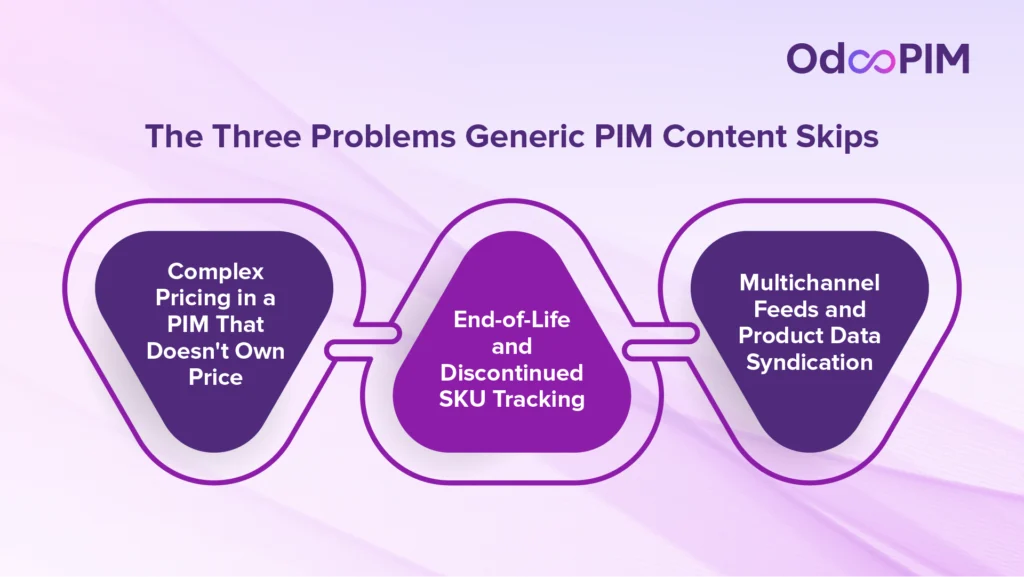
Standard PIM content addresses supplier onboarding and basic enrichment but ignores the three operational challenges that determine whether distribution catalogs succeed or fail. Customer-specific pricing at scale, product end-of-life management across channels, and multi-format product data syndication to incompatible channel endpoints receive almost no coverage in generic PIM discussions. PIM for distributors must solve these three problems simultaneously because they interact, a superseded product at the wrong price on the wrong channel creates the compound failures that damage distributor reputation. The best PIM for industrial distributors addresses pricing complexity, lifecycle tracking, and syndication diversity as integrated capabilities rather than separate concerns. OdooPIM for wholesale business delivers these distribution-specific capabilities natively within the platform that already manages customer pricing and procurement decisions.
Problem 1: Complex Pricing in a PIM That Doesn’t Own Price
The Pricing Shapes Distributors Actually Run
Wholesale pricing is never one number, it is a matrix of tiered rates, contract-specific agreements, customer-negotiated discounts, volume break thresholds, promotional pricing, regional currency variations, and rebate-adjusted net costs. A single SKU carries different prices for different customers depending on their negotiated terms, order quantities, and contractual relationships. The best PIM for industrial distributors must handle this pricing complexity without forcing distributors to maintain separate spreadsheets for customer-specific rates. PIM for distributors that only store a list price cannot serve wholesale operations where customer-specific pricing determines whether quotes are competitive. OdooPIM for wholesale business reads pricing directly from Odoo’s native pricelist engine, accessing every customer-specific rate, volume break, and contract term without duplication.
Why Standard PIM Advice Is “the PIM Never Writes Price”
The standard architecture positions the ERP as the pricing system of record, with the PIM receiving price data through periodic synchronization before forwarding it to channels. This one-way ERP to PIM to channel sync running every five to fifteen minutes creates a staleness window where customer-facing channels display outdated pricing. Stale price is treated as a critical incident because it produces visible customer-facing errors, a quote generated with last week’s pricing, a portal showing list price instead of contract rates. The industry’s response to this architectural flaw is treating pricing staleness as an incident to manage rather than a design problem to solve. OdooPIM for wholesale business eliminates the staleness window by reading pricing from the same database tables the ERP writes to.
Where It Breaks in Practice
A customer-specific price negotiated for a major account must reach a gated B2B portal, but the PIM only holds a list price and the portal only reads from the PIM. The ERP contains the negotiated rate in its pricelist engine, but that data never reaches the portal because the PIM synchronization model only handles standard pricing. The distributor deploys a workaround, maintaining customer-specific spreadsheets that portal administrators manually update, defeating the purpose of PIM investment. This B2B PIM software failure occurs silently because it only affects the customers with negotiated pricing, who are typically the highest-value accounts. OdooPIM for wholesale business reads contract pricing natively, ensuring that gated portals always display the correct customer-specific rates without manual intervention.
The Architectural Question: Does Your PIM Sync Price, or Does It Read It?
The fundamental question for distribution PIM selection is whether the platform synchronizes pricing through periodic batch processes or reads it natively from the ERP in real time. Sync-based architecture guarantees a staleness window where pricing errors can reach customer-facing channels before the next synchronization cycle catches them. Native reading eliminates the staleness window because the PIM accesses pricing from the same source the ERP uses, at the moment of channel request. PIM for distributors must answer this architectural question because customer-specific pricing complexity makes sync-based approaches operationally dangerous. OdooPIM for wholesale business reads pricing natively from Odoo’s pricelist engine, eliminating the synchronization gap that creates customer-facing pricing errors.

Problem 2: End-of-Life and Discontinued SKU Tracking
The Lifecycle States a Distributor Catalogue Actually Needs
A product does not simply exist or not exist, it moves through active, run-out, superseded, discontinued, and archived states, each requiring different channel behavior and customer communication. Active products sell normally; run-out stock requires depletion before delisting; superseded products redirect to replacements; discontinued products display final-sale messaging; archived products disappear. The best PIM for industrial distributors must model these lifecycle states natively and apply them differently across channels. Product end-of-life management in distribution requires granular state control that generic PIM platforms reduce to a single active/inactive flag. OdooPIM for wholesale business manages complete product life cycles within the same platform that controls procurement reordering decisions.
The Supersession Chain
SKU A is replaced by SKU B, which is later replaced by SKU C, and customers searching for A must land on C with clear messaging about the replacement path. This supersession chain modeling is critical for distributors because industrial buyers search by part numbers they have used for years, and losing those customers to dead search results means losing revenue permanently. Almost no PIM models supersession natively, forcing distributors to maintain manual cross-reference spreadsheets. B2B PIM software that cannot handle supersession chains creates the customer experience where searching for a known part number returns nothing. OdooPIM for wholesale business models product relationships including supersession chains, ensuring buyers always find the current replacement regardless of which legacy part number they search.
What Goes Wrong
Dead SKUs persist in marketplace feeds long after suppliers discontinue them, creating the customer experience where purchasable products never arrive. Sales representatives quote discontinued parts because their systems do not reflect the current lifecycle state, generating orders that procurement cannot fulfill. SEO equity built on legacy product URLs gets destroyed when products disappear rather than redirecting to replacements. Run-out stock never sells because the product was delisted from channels before the remaining inventory depleted. Product end-of-life management failures compound across channels, damaging marketplace metrics, customer trust, and inventory efficiency simultaneously.
Why EOL Is a Product Data Problem, Not an Inventory Problem
Inventory systems answer one question: how many units are currently in stock. When stock reaches zero, inventory says “zero”, but only the PIM can say “zero forever, and here is what to buy instead.” Product end-of-life management requires the PIM to communicate lifecycle context that inventory systems cannot provide. A product showing zero stock could be temporarily out of stock and arriving next week, or permanently discontinued with a defined replacement. PIM for distributors must own a lifecycle state because inventory data lacks the context customers need. OdooPIM for wholesale business manages lifecycle state within the same platform as inventory, ensuring both systems contribute their specific information to complete product records.
The Channel Dimension
A SKU can be end-of-life on Amazon but still active for a contract customer with guaranteed supply commitments, requiring channel-specific lifecycle state management. A product superseded for new customers may remain available to service existing installations with legacy equipment compatibility requirements. B2B PIM software must support channel-specific lifecycle states because distribution agreements create different product availability profiles across different customer segments. Generic PIM platforms apply uniform lifecycle states across all channels, breaking the nuanced availability requirements that distribution contracts demand. OdooPIM for wholesale business enables channel-specific lifecycle management, reflecting the contractual realities that define wholesale distribution.
Learn about PIM software comparision
By 2027, 80% of PIM vendors will offer at least two PXM (Product Experience Management) capabilities.
– Gartner
Problem 3: Multichannel Feeds and Product Data Syndication
What Product Data Syndication Actually Means for a Distributor
Product data syndication for distributors means taking one governed product catalog and outputting it in many different formats to serve incompatible channel requirements simultaneously. Amazon demands specific category schemas and attribute structures while an EDI partner requires ANSI X12 formatting and a print catalog needs completely different content organization. The best PIM for industrial distributors automates this multi-format output without requiring manual reformatting for each channel. PIM for distributors must handle syndication diversity because distribution businesses typically serve more channel types than any other commerce sector. OdooPIM for wholesale business provides native syndication capabilities that format governed product data for every channel from a single source.
Every Channel Has a Different Recipe
Amazon requires specific product identifiers, category templates, and image specifications that differ completely from the B2B portal’s attribute requirements. An EDI partner demands exact field positioning and standardized codes, while a print catalog needs carefully formatted specification tables and cross-reference indices. A dealer drop-ship portal requires real-time inventory availability alongside product content, adding another dimension to syndication complexity. Each channel effectively requires a different recipe prepared from the same ingredients, the governed product data in your PIM. OdooPIM for wholesale business manages these channel-specific recipes natively, automatically formatting master product data to each endpoint’s requirements.
Attribute Mapping and Classification Standards
Distributors in electrical, HVAC, plumbing, and MRO sectors cannot ignore industry classification standards like ETIM, UNSPSC, and GS1 that govern how products get categorized and described. These standards require specific attribute structures, controlled vocabularies, and classification hierarchies that generic PIM platforms do not support natively. B2B PIM software for industrial sectors must accommodate these classification frameworks or force distributors into manual workarounds. Product data syndication to industry-compliant channels demands classification standard support at the PIM data model level. OdooPIM for wholesale business provides the flexible attribute management that supports industry classification standards within governed product records.
Completeness Scoring Per Channel
Distributors must answer the operational question: which SKUs are publish-ready for Amazon specifically, versus which are ready for the B2B portal or the EDI feed? Each channel requires different mandatory attributes, and a product complete enough for one channel may lack required fields for another. PIM for distributors must provide channel-specific completeness scoring that guides enrichment teams toward the products and attributes that will unlock additional channel revenue. Generic completeness scoring that aggregates all channel requirements into a single score obscures the channel-specific readiness that distribution operations require. OdooPIM for wholesale business delivers channel-aware completeness scoring that prioritizes enrichment efforts against specific channel requirements.
Channel Rejection Rate as the KPI Nobody Tracks
Most distributors cannot quantify how many product listings get rejected by each channel or why, yet channel rejection rate directly impacts revenue by delaying product availability on high-performing platforms. Amazon suppressed listings with incomplete attributes; EDI partners reject feeds with formatting errors; B2B portals hide products missing required specifications. Product data syndication failures accumulate silently because no one owns the metric across channels. OdooPIM for wholesale business provides the validation and completeness visibility that transforms channel rejection from an invisible operational tax into a manageable metric.

Case Studies
Case Study 1: Industrial Fastener Distributor Eliminates Pricing Errors and Supersession Chaos with OdooPIM
Challenge
A Midlands-based industrial fastener distributor with twenty-five thousand SKUs sourced from over one hundred twenty suppliers faced two critical operational failures that their existing spreadsheet-based PIM for distributors approach could not solve. Customer-specific pricing lived in Odoo’s pricelist engine, but their B2B portal displayed only list prices because the manual synchronization process could not keep pace with negotiated rate changes across eight hundred active customer accounts. A major automotive client reported that their portal showed incorrect contract pricing for three weeks, forcing the distributor to issue significant credit notes. Simultaneously, the distributor struggled with product end-of-life management as suppliers discontinued fasteners without providing clear replacement paths. Sales representatives routinely quoted superseded parts because they searched an outdated spreadsheet, generating orders that procurement could not fulfill. The company needed the best PIM for industrial distributors that could handle pricing complexity and lifecycle tracking without the synchronization failures of standalone platforms.
Solution
The distributor activated OdooPIM within their existing Odoo environment, transforming their B2B PIM software architecture from fragmented spreadsheets into a governed platform sharing one database with price lists, inventory, and procurement. Contract pricing was no longer synced through periodic batch processes, the B2B portal read customer-specific rates from Odoo’s pricelist engine through OdooPIM’s native connection, eliminating the staleness window entirely. The team modeled supersession chains for every discontinued fastener, creating replacement paths that redirected buyers searching legacy part numbers to current alternatives automatically. Product data syndication pushed consistent product content with accurate pricing to the B2B portal, Amazon Business, and three industry marketplace feeds simultaneously. When a supplier discontinued a fastener and specified its replacement, the procurement team updated the lifecycle state in Odoo, and every channel reflected the change instantly.
Results
- Pricing-related credit notes eliminated as OdooPIM for wholesale business enabled the B2B portal to read customer-specific rates natively from Odoo price lists.
- Sales team quoting errors from discontinued parts dropped to zero as supersession chains redirected searches to current replacements automatically.
- Supplier product updates now reach channels instantly because lifecycle state changes happen within the same platform as procurement decisions.
- Customer trust restored with the automotive client after accurate contract pricing appeared consistently across every purchasing channel.
- The distributor identified native pricing architecture and product end-of-life management as the critical capabilities that made OdooPIM the best PIM for industrial distributors on Odoo.
Case Study 2: Electrical Components Distributor Scales Multichannel Syndication and Eliminates Channel Rejections
Challenge
An electrical components distributor with thirty thousand SKUs from over two hundred suppliers sold through six channels, their B2B website, Amazon Business, eBay, two electrical industry marketplaces, and an EDI feed serving enterprise procurement systems. Each channel demanded different attribute structures, classification standards, and content formats that a team of four product data specialists manually reformatted weekly. Product data syndication failures were constant, Amazon suppressed listings for missing category attributes, the EDI partner rejected feeds for formatting errors, and industry marketplaces required ETIM classification that the distributor’s spreadsheets could not support. Channel rejection rates ran high, with a significant portion of their catalog invisible on at least one major platform at any given time. When the distributor acquired a competitor adding twelve thousand SKUs, leadership recognized that manual syndication would collapse. The company needed B2B PIM software that could automate multi-format syndication and enforce channel-specific completeness standards.
Solution
The distributor deployed OdooPIM as their PIM for distributors, centralizing all product data within their existing Odoo ERP environment without middleware or external platforms. ETIM classification attributes were configured within OdooPIM’s flexible data model, ensuring every electrical component carried the standardized categories and specifications that industry marketplaces demanded. Channel-specific completeness scoring identified which SKUs were publish-ready for each platform, allowing the team to prioritize enrichment against the highest-revenue channels. Product data syndication automated the formatting and delivery of enriched product content to six channels simultaneously, with channel-specific mapping rules that respected Amazon’s category schemas, EDI field positioning requirements, and marketplace classification standards. When the competitor’s product line was onboarded, OdooPIM’s supplier data ingestion normalized the acquired catalog into governed product records. Product end-of-life management tracked supersession chains for discontinued electrical components, ensuring that dead SKUs were removed from marketplaces while replacement products appeared automatically.
Results
- Channel rejection rates dropped significantly as OdooPIM for wholesale business enforced channel-specific completeness requirements before syndication.
- The competitor acquisition of twelve thousand SKUs was fully integrated into six channels within two months using automated product data syndication.
- Weekly product data management hours reduced from over one hundred twenty across four specialists to under twenty as syndication automation replaced manual reformatting.
- ETIM classification compliance achieved across industry marketplace listings, improving search visibility and buyer confidence.
- The distributor identified OdooPIM as the best PIM for industrial distributors because native Odoo architecture eliminated the middleware costs that standalone B2B PIM software would have required for their complex multi-channel operations.
Learn about PIM marketing

How to Evaluate a PIM as a Distributor
1. Can It Model a Supersession Chain, or Only a Flat “Discontinued” Flag?
The evaluation of any PIM for distributors must begin with the supersession question because flat discontinued flags destroy the customer experience for buyers searching legacy part numbers. A PIM that only toggles products between active and inactive cannot redirect customers to replacement products or communicate the replacement path. Product end-of-life management requires modeling chains of successive replacements, not just terminal product states. OdooPIM for wholesale business models product relationships including supersession chains natively within the Odoo framework.
2. Does It Read Pricing from Your ERP, or Hold a Stale Copy of It?
The architectural question that determines whether your PIM creates pricing errors or prevents them: does the platform access ERP pricing natively or synchronize copies on a schedule? Sync-based approaches guarantee staleness windows where customer-facing channels display outdated pricing during the gap between synchronization cycles. B2B PIM software that reads pricing natively eliminates the staleness window entirely. OdooPIM for wholesale business reads printing directly from Odoo’s pricelist engine, accessing every customer-specific rate in real time.
3. Can Lifecycle Status Vary by Channel?
Distribution contracts create different product availability profiles across customer segments, demanding channel-specific lifecycle states that generic PIM platforms cannot accommodate. A product discontinued for new customers may remain active for existing contract holders with guaranteed supply commitments. PIM for distributors must support channel-specific lifecycle management or force distributors into manual workarounds. OdooPIM for wholesale business enables channel-specific lifecycle states that reflect contractual distribution realities.
4. Can It Ingest Supplier Files in Arbitrary Formats Without a Developer?
Distributors receive product data from hundreds of suppliers in formats ranging from structured spreadsheets to PDF specification sheets to proprietary data dumps. The best PIM for industrial distributors automates supplier data ingestion and normalization without requiring developer intervention for each new supplier format. Manual supplier onboarding consumes team capacity that should be directed toward enrichment and channel optimization. OdooPIM for wholesale business provides automated supplier data mapping that normalizes diverse formats into governed product records.
5. Does It Support Your Industry’s Classification Standard Out of the Box?
ETIM, UNSPSC, GS1, and other industry classification standards govern how products get categorized and described in major distribution channels. PIM platforms without native classification standard support force distributors into manual mapping exercises that consume ongoing operational resources. B2B PIM software for industrial sectors must accommodate these frameworks or become another source of manual work. OdooPIM for wholesale business provides flexible attribute management supporting industry classification standards within governed product records.
6. What’s the Total Cost: License, Implementation, Migration, ERP Integration, and Annual Re-Test When Your ERP Upgrades?
Distribution PIM total cost extends far beyond license fees to include implementation services, data migration from legacy systems, ERP integration development, and the recurring expense of testing and maintaining integrations through ERP upgrade cycles. Enterprise distributor PIM licensing and implementation represent substantial investments before accounting for ongoing maintenance. PIM for distributor evaluation must calculate fully loaded multi-year costs rather than comparing subscription fees alone. OdooPIM for wholesale business eliminates integration and upgrade testing costs through native Odoo architecture.
Why Pricing and EOL Break When the PIM Sits Outside the ERP
Pricing lives in the ERP price list engine, stock levels live in ERP inventory tables, and end-of-life status is determined by procurement decisions made in the ERP, but channels read from the PIM. Every one of the three distribution problems is, at root, a synchronization problem between the system that owns the data and the system that distributes it. The industry’s best-practice answer, synchronize every five to fifteen minutes and treat staleness as an incident, is not a solution but a managed failure. B2B PIM software that sits outside the ERP accepts pricing staleness, lifecycle latency, and inventory gaps as unavoidable operational costs. OdooPIM for wholesale business eliminates these synchronization problems by sharing one database with Odoo ERP, where pricing, inventory, and lifecycle states are the same records the PIM reads.
A Single-Database Approach for Wholesale Catalogues
OdooPIM delivers PIM for distributors by operating natively within the Odoo ERP ecosystem, sharing one database with price lists, inventory, procurement, and sales modules without any synchronization layer. Contract and tiered pricing are not synced copies vulnerable to staleness, they are read from the same tables the ERP writes to, eliminating the pricing gap that plagues standalone PIM architectures. Product end-of-life management is not a flag copied across a connector, it is the same procurement status record, ensuring that when a buyer discontinues reordering, every channel reflects that decision instantly. Product data syndication to Amazon, B2B portals, EDI partners, and print catalogs happens from governed product records that share real-time data with operational systems. There is no staleness window because there is no sync. OdooPIM is the best PIM for industrial distributors running Odoo ERP, while distributors on Epicor P21, SAP, Infor, or NetSuite should evaluate specialist connector-based PIM solutions like Pimberly, inRiver, or Sales Layer that offer robust integration capabilities for those platforms. For wholesale businesses on Odoo, OdooPIM for wholesale business transforms the three distribution problems from managed failures into solved architecture.

FAQ’s
1. What is a PIM for distributors?
A PIM for distributors is a product information management platform purpose-built to handle the unique challenges wholesale businesses face, aggregating product data from hundreds of suppliers, managing customer-specific pricing tiers, tracking product supersession chains, and syndicating consistent content to incompatible channel endpoints. Unlike retail-focused PIM platforms that assume a single brand controlling its own product narrative, B2B PIM software for distributors must normalize diverse supplier data formats into governed product records without manual reformatting. The best PIM for industrial distributors addresses the three operational challenges that generic PIM content ignores: complex pricing at scale, product end-of-life management across channels, and multi-format product data syndication to endpoints like Amazon, B2B portals, EDI partners, and print catalogs. OdooPIM for wholesale business delivers these distribution-specific capabilities natively within the Odoo ERP ecosystem, sharing one database with inventory, purchasing, and customer pricing without requiring external integration layers. The platform transforms product data management from a fragmented operational burden into a governed capability that scales with supplier complexity and channel expansion.
2. Can a PIM handle customer-specific and tiered pricing?
The answer depends on architecture: standalone PIM platforms synchronize pricing copies from the ERP on scheduled intervals, creating staleness windows where customer-facing channels display outdated rates, while native OdooPIM for wholesale business reads pricing directly from Odoo’s pricelist engine in real time. Wholesale pricing is never one number, it encompasses tiered rates, contract-specific agreements, volume break thresholds, promotional pricing, and customer-negotiated discounts that a simple list price cannot represent. Standard B2B PIM software advice acknowledges that the ERP owns pricing and recommends periodic synchronization, effectively treating stale price as an incident to manage rather than a design problem to solve. The architectural question every distributor must ask is whether the PIM syncs pricing copies or reads pricing natively, because sync-based approaches guarantee a gap where pricing errors reach customers. PIM for distributors on Odoo resolves this through native architecture where the PIM and ERP share the same pricing tables, eliminating the staleness window entirely.
3. How does a PIM manage end-of-life and discontinued SKUs?
Product end-of-life management in distribution requires modeling the complete product lifecycle, active, run-out, superseded, discontinued, and archived states, rather than the simple active/inactive toggle that generic PIM platforms provide. The supersession chain where SKU A is replaced by SKU B, which is later replaced by SKU C, must redirect customers searching legacy part numbers to the current replacement automatically. Generic B2B PIM software treats discontinuation as a single flag, destroying the customer experience when buyers search known part numbers and find nothing. A SKU can be end-of-life on Amazon while remaining active for contract customers with guaranteed supply commitments, demanding channel-specific lifecycle state management. OdooPIM for wholesale business manages complete product life cycles including supersession chains and channel-specific states within the same platform as procurement decisions, ensuring that when purchasing discontinues reordering, every channel reflects that change instantly.
4. What is product data syndication?
Product data syndication is the automated distribution engine that takes one governed product catalog and outputs it in many different formats to serve incompatible channel requirements simultaneously. Amazon demands specific category schemas and attribute structures while an EDI partner requires ANSI X12 formatting, a B2B portal needs customer-specific pricing visibility, and a print catalog needs completely different content organization. The best PIM for industrial distributors automates this multi-format output without requiring manual reformatting for each channel endpoint. Syndication complexity defines distribution operations because wholesale businesses typically serve more channel types than any other commerce sector. OdooPIM for wholesale business provides native syndication capabilities that format governed product data for every channel from a single source, eliminating the manual reformatting that consumes team capacity and introduces errors across incompatible endpoints.
5. Do distributors need a PIM if they already run an ERP?
ERP systems handle operational data brilliantly, inventory levels, procurement costs, order processing, but lack the enrichment workflows, channel syndication, supersession modeling, and data governance that multi-channel distribution demands. The trigger for needing PIM for distributors arrives when supplier data normalization consumes team capacity, channel-specific formatting creates listing errors, or customers encounter dead product pages when searching discontinued part numbers. B2B PIM software extends ERP capabilities by adding the enrichment layer, lifecycle management, and syndication automation that operational systems were never designed to provide. The question is not whether distributors need PIM capabilities but whether they deploy them natively within their ERP or through a standalone platform requiring middleware integration. OdooPIM for wholesale business delivers PIM functionality within the Odoo ERP environment, eliminating the integration layer that standalone PIM platforms demand while providing the distribution-specific capabilities that native ERP product fields cannot deliver.