What Is PIM Marketing?
PIM marketing is the practice of using product information management technology as the central infrastructure that governs, enriches, and distributes product content across every marketing channel from one authoritative source. Unlike generic PIM usage focused on data centralization, PIM for marketing specifically addresses the marketer’s challenge of transforming raw operational product data into compelling, consistent product stories that drive conversion. The PIM serves as the marketing content backbone where product descriptions, technical specifications, digital assets, and SEO attributes are created once and published everywhere. Product information management for marketing teams shifts the role of marketing from manual data formatters to strategic content creators who govern the product narrative. Understanding PIM digital marketing means recognizing PIM as marketing infrastructure rather than an IT-led data management initiative, the platform that makes consistent multi-channel product storytelling operationally achievable.
Learn about cloud PIM
Why Marketing Teams Struggle Without a PIM
Scattered Product Data Slows Campaign Launches
Marketing teams without a PIM waste countless hours hunting for product information scattered across ERP systems holding bare specifications, shared drives storing unorganized images, and spreadsheets containing draft copy written by multiple team members. Product launches stall because marketers must manually assemble product data from these disconnected sources before creating a single campaign asset or channel listing. Marketing product data fragmentation means the campaign launch process begins with data archaeology rather than strategic content creation. The absence of PIM for marketing infrastructure forces teams to reconcile conflicting product information before marketing activities can commence. This scattered data reality makes rapid campaign deployment impossible because every new product or promotion requires rebuilding the content foundation from disconnected fragments.
Inconsistent Product Content Across Channels
Without governed PIM marketing processes, the same product inevitably carries different descriptions, specifications, and imagery depending on which team member created which channel listing. The website describes a product as “professional grade” while Amazon lists it as “heavy duty” and the wholesale catalog describes it as “commercial quality”, creating customer confusion about which description reflects reality. Product information management for marketing teams prevents this fragmentation by establishing one governed product narrative that syndicates consistently everywhere. Manual channel management guarantees inconsistency because each platform manager applies their own interpretation to product content. PIM digital marketing governance ensures customers encounter identical product truths whether shopping on a marketplace, browsing a social commerce post, or reading an email promotion.
Manual Copy-Paste Kills Time-to-Market
Marketing teams managing product content without a PIM spend the majority of enrichment time on mechanical copy-paste work, reformatting the same product data for different channel requirements, rather than strategic content creation. A single product launch across five channels consumes days of manual formatting as marketers adapt identical information to each platform’s unique field structure. This PIM for marketing gap means skilled content creators waste expertise on data entry tasks that automation should handle. The enrichment bottleneck compounds with every new channel addition and catalog expansion, forcing marketing teams to choose between speed and accuracy. Product content syndication automation through a PIM eliminates this mechanical burden, redirecting marketing talent toward the creative and strategic work that drives brand differentiation.
Learn about best PIM software

How Does PIM Improve Marketing Performance?
Faster Time-to-Market for Product Launches
PIM marketing automation compresses product launch timelines from weeks to days by enabling parallel enrichment workflows where teams collaborate on product content simultaneously within a governed platform. Marketing teams begin creating descriptions and campaigns the moment engineering uploads technical specifications into the PIM, eliminating the sequential handoffs that delay launches. Channel-ready content is generated automatically as the PIM formats master product data to each platform’s specific requirements. PIM for marketing eliminates the post-launch scramble where marketers rush to correct listing errors discovered only after products go live. The platform transforms product launches from sequential, multi-week coordination exercises into accelerated processes where content readiness keeps pace with product availability.
Consistent Product Storytelling Across Every Channel
A PIM digital marketing platform ensures that brand voice, product positioning, and key value propositions remain identical whether customers encounter products on a marketplace, social media, email campaign, or direct website. Marketing teams define the product narrative once within the PIM, and that governed story syndicates consistently to every channel. Product information management for marketing teams eliminates the gradual brand erosion that occurs when different channel managers independently interpret how to present products. Consistent storytelling builds the brand trust that drives repeat purchases, while inconsistent product narratives fragment customer perception. The PIM acts as the brand consistency engine that maintains coherent product positioning across every marketing touchpoint.
Richer Listings That Convert
PIM marketing platforms enforce attribute completeness standards that ensure every product listing carries the detailed specifications, compelling descriptions, and rich media that customers require for purchase validation. Completeness scoring identifies which products need additional attributes, better imagery, or missing descriptions before they reach customer-facing channels. Marketing product data enrichment transforms bare operational specifications into persuasive product stories that answer every customer question before purchase. Rich, complete listings reduce return rates because customers receive products matching the detailed specifications they reviewed. The PIM for marketing completeness discipline ensures that every product detail page sells as effectively as your best-performing listings.
Localized Campaigns Without Duplicated Effort
PIM marketing platforms manage product content in multiple languages and regional variations, enabling global campaign execution without maintaining separate content libraries for each market. Localized product descriptions, measurement units, and culturally appropriate imagery coexist within the same governed product records. Product content syndication delivers the correct localized version to each regional channel automatically, eliminating the manual work of preparing market-specific campaigns. Marketing teams define localization rules once and the PIM applies them consistently across every applicable channel. This PIM digital marketing capability transforms global campaign deployment from a massive coordination exercise into an automated content delivery process.
PIM and Product Content Syndication: Getting Content to Every Channel
Product content syndication is the distribution engine of PIM marketing that pushes enriched product information to every channel where customers encounter your brand, marketplaces, retail partner platforms, social commerce, email, and storefronts. The syndication layer formats governed master product data to each channel’s specific requirements automatically, eliminating the manual reformatting that consumes marketing team capacity. PIM for marketing syndication ensures that product updates reach every channel simultaneously, preventing the dangerous lag where some platforms display outdated specifications. Channel-specific content rules allow marketers to optimize product presentations for each platform’s audience while maintaining consistent underlying product truth. Product information management for marketing teams transforms syndication from a manual coordination bottleneck into an automated capability that scales with channel expansion.
Learn about PIM requirements

PIM vs DAM vs CMS: Which One Does Marketing Actually Need?
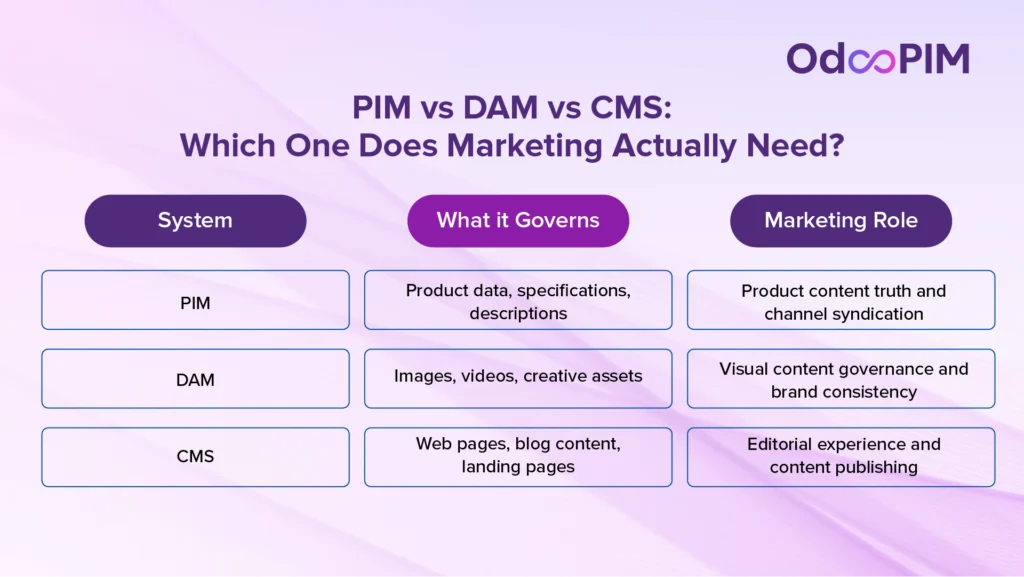
These systems complement rather than compete within the PIM marketing technology stack. A PIM serves as the product data layer providing the commercial and technical content that populates product detail pages and feeds marketing campaigns. A DAM governs the visual assets that bring product stories to life across every touchpoint. A CMS manages the editorial experiences surrounding product content. PIM digital marketing success requires the PIM as the foundational data layer, with DAM and CMS consuming governed product information to create complete customer experiences.
Case Studies
Case Study 1: Consumer Electronics Brand Reduces Product Launch Time by Seventy Percent with PIM Marketing
Challenge
A consumer electronics brand selling audio equipment and accessories managed marketing product data through disconnected spreadsheets that marketing, product, and sales teams each maintained independently. The marketing team spent twenty hours weekly hunting for current product specifications, approved imagery, and accurate pricing before creating any campaign content. Product launches consumed four weeks of manual coordination where marketers waited for engineering specifications, then manually formatted product data for their D2C website, Amazon, and three retail partner platforms. A product launch mishap where Amazon displayed outdated impedance ratings while the website showed correct specifications triggered customer confusion and negative reviews. The marketing director recognized that without PIM for marketing infrastructure, the team’s creative talent was wasted on mechanical data wrangling rather than strategic content creation.
Solution
The brand implemented a PIM platform to serve as the central PIM marketing infrastructure governing product information. Engineering uploaded technical specifications into the PIM where marketing could immediately access validated data for content creation without waiting for spreadsheet handoffs. Product information management for marketing teams provided enrichment workflows where copywriters created descriptions, SEO specialists optimized titles, and brand managers approved final content within one governed environment. Product content syndication automated the distribution of enriched product data to the D2C website, Amazon, and all three retail partner platforms simultaneously, with automatic formatting for each channel. When engineering updated a driver specification, that change propagated to every channel instantly through the PIM digital marketing syndication layer.
Results
- Product launch time reduced from four weeks to seven days as PIM marketing eliminated the manual data assembly that previously consumed marketing team capacity.
- Marketing hours spent on data wrangling dropped from twenty weekly to three, redirecting creative talent toward strategic campaign development.
- The specification mismatch problem was eliminated as product content syndication ensured all channels displayed identical, current product data.
- Customer complaints about conflicting product information dropped to zero within two launch cycles of PIM for marketing adoption.
- Marketing leadership identified product information management for marketing teams as the critical factor behind improved campaign velocity and brand consistency.
Case Study 2: Industrial Safety Equipment Manufacturer Unifies Product Storytelling Across Eight Channels
Challenge
An industrial safety equipment manufacturer with four thousand SKUs struggled with fragmented PIM digital marketing processes across their B2B website, Amazon Business, three distributor portals, eBay, Walmart Marketplace, and a government procurement platform. Each channel manager independently wrote product descriptions, creating an inconsistent brand narrative where the same safety harness was described as “industrial grade” on one platform and “professional series” on another. The marketing team spent thirty hours weekly manually reformatting marketing product data for each channel’s specific requirements. A government compliance audit flagged outdated ANSI certifications on their GSA schedule that contradicted current product data on their website. The company needed centralized PIM for marketing governance to maintain both brand consistency and regulatory compliance across every channel.
Solution
The manufacturer deployed a PIM as the central PIM marketing platform where product content received governed enrichment before syndication. Engineering maintained technical specifications and compliance certifications while marketing enriched product records with consistent brand messaging, application descriptions, and SEO content within the same platform. The product information management for marketing teams workflow enforced that compliance data received engineering approval before marketing published any product content. Product content syndication pushed governed product stories to all eight channels simultaneously, with automated formatting for each platform’s specific requirements. When compliance certifications updated, the PIM digital marketing syndication layer propagated those changes to every channel in real time.
Results
- Brand consistency achieved across eight channels as PIM marketing enforced one governed product narrative replacing eight channel-specific versions.
- Weekly marketing hours reduced from thirty to six as product content syndication eliminated manual reformatting for individual platforms.
- Government compliance violations eliminated entirely as certification updates propagated automatically through PIM for marketing syndication.
- Customer trust strengthened as buyers encountered identical product specifications and brand messaging regardless of purchasing channel.
- The marketing director credited product information management for marketing teams with transforming the department from reactive data managers into strategic brand stewards.
Learn about PIM software comparision

How to Build a PIM Marketing Workflow
1. Centralize Product Data from ERP and Suppliers
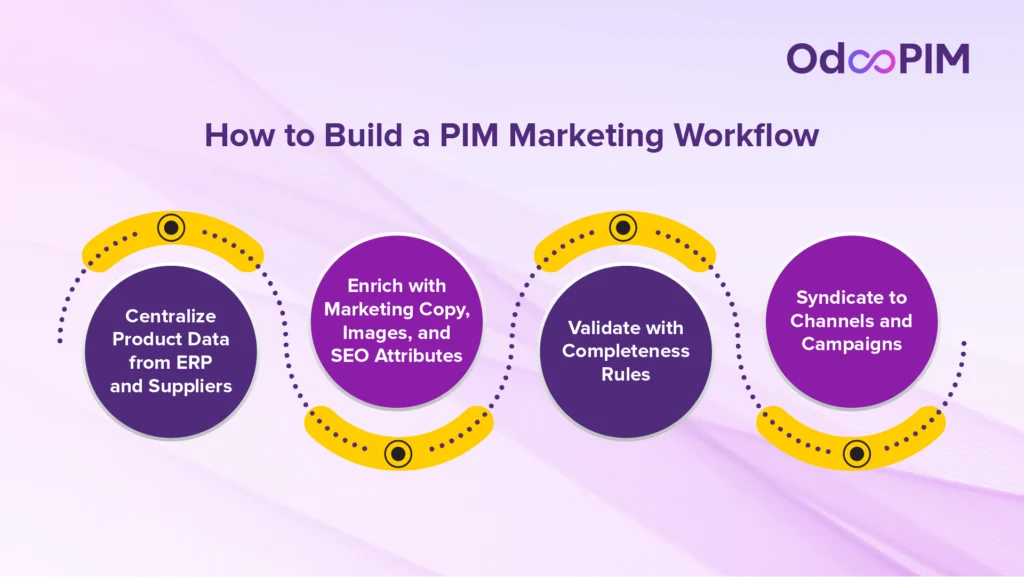
Begin the PIM for marketing workflow by ingesting raw product data from ERP systems, supplier feeds, and legacy spreadsheets into a centralized repository. This consolidation eliminates the fragmented data sources that force marketing teams to search for product information before creating content. Automated import routines transform inconsistent source formats into standardized product records ready for enrichment. Centralizing marketing product data ensures every team member works from identical product truth rather than their department’s version. The centralized foundation transforms product data from a fragmented liability into the governed asset that fuels all marketing activities.
2. Enrich with Marketing Copy, Images, and SEO Attributes
Marketing teams enhance centralized product records with persuasive descriptions, feature-benefit copy, SEO-optimized titles, and the digital assets that drive conversion. PIM marketing enrichment workflows route product content through appropriate team members, copywriters add descriptions, SEO specialists optimize titles, brand managers approve final content. The enrichment process builds on engineering-validated technical data, ensuring marketing content remains factually accurate while becoming commercially compelling. Product information management for marketing teams provides a collaborative environment where multiple specialists contribute to product records without overwriting each other’s work. This enrichment phase transforms operational product data into the complete, channel-ready content that customers require for purchase decisions.
3. Validate with Completeness Rules
Configure PIM for marketing validation rules that prevent under-enriched products from reaching customer-facing channels. Completeness scoring automatically identifies which products lack required attributes, missing digital assets, or insufficient descriptions before syndication. Marketing teams use these scores to prioritize enrichment efforts systematically rather than discovering gaps after products are published. PIM digital marketing validation catches the errors and omissions that manual review processes consistently miss across large catalogs. The validation layer ensures every product detail page meets the quality standards that drive both conversion and brand perception.
4. Syndicate to Channels and Campaigns
Activate product content syndication that pushes enriched, validated product content to every channel and campaign simultaneously. The syndication layer automatically formats master product data to each platform’s specific field requirements, image specifications, and content policies. PIM marketing syndication ensures that product launches, updates, and promotional content reach all channels at the same moment. Marketing teams configure syndication rules once, then the platform handles ongoing distribution without manual intervention. This automated distribution transforms campaign execution from a multi-day coordination effort into a routine operational process.
Learn about pim for distributors
How OdooPIM Connects Product Data to Marketing Execution
OdooPIM provides the PIM marketing infrastructure that connects governed product data directly to marketing execution within the Odoo ecosystem. Marketing teams access product information enriched by engineering, purchasing, and product management, within the same platform, eliminating the disconnected spreadsheets and shared drives that fragment campaigns. Product content syndication capabilities push consistent product content to websites, marketplaces, email platforms, and social commerce channels automatically. The native Odoo architecture ensures PIM for marketing activities operate on real-time product data, inventory levels, and pricing rather than outdated snapshots. OdooPIM transforms PIM digital marketing from a separate initiative into an integrated capability where product truth and marketing execution coexist within one operational environment. For marketing teams seeking product information management for marketing teams that connect to business operations, OdooPIM delivers the governed data foundation that makes consistent, scalable multi-channel product storytelling achievable.

FAQ’s
1. What is PIM in marketing?
PIM marketing is the practice of using product information management technology as the central infrastructure that governs, enriches, and distributes product content across every marketing channel from one authoritative source. A PIM serves as the marketing content backbone where product descriptions, technical specifications, digital assets, and SEO attributes get created once and published everywhere. PIM for marketing specifically addresses the marketer’s challenge of transforming raw operational product data into compelling, consistent product stories that drive conversion across websites, marketplaces, and campaigns. Product information management for marketing teams shifts marketing from manual data formatting to strategic content creation by automating the mechanical work of channel-specific content adaptation. The platform ensures that marketing product data remains accurate, complete, and brand-consistent regardless of how many channels display it.
2. How does PIM help digital marketing?
PIM digital marketing accelerates campaign execution by centralizing product data so marketing teams spend time creating compelling content rather than hunting for information across disconnected systems. The platform enforces brand consistency across every digital touchpoint, ensuring social media product posts, email promotions, and marketplace listings tell the same product story with identical specifications. PIM for marketing automates the channel-specific formatting that otherwise consumes hours of manual copy-paste work for each digital campaign launch. Completeness scoring ensures every product detail page carries the rich attributes, imagery, and descriptions that drive conversion and reduce return rates. Product information management for marketing teams transforms digital marketing from a constant battle against data fragmentation into a governed process where product truth reaches every channel automatically.
3. Is PIM the same as a DAM?
PIM and DAM serve fundamentally different purposes within the marketing technology stack, with PIM governing structured product data while DAM governs unstructured rich media assets. A PIM manages product attributes, technical specifications, marketing descriptions, and the commercial content that answers what a product is and why customers should buy it. A DAM manages photographs, videos, logos, and creative files, the visual content that shows what a product looks like across touchpoints. PIM marketing provides the product data layer while DAM provides the visual asset layer, making them complementary rather than interchangeable. Product information management for marketing teams requires PIM as the product truth foundation, with DAM integration ensuring approved imagery connects to governed product records.
4. What is product content syndication?
Product content syndication is the automated distribution engine that pushes enriched product information from a centralized PIM to every sales and marketing channel simultaneously. The syndication layer formats governed master product data to each platform’s specific requirements, Amazon’s category schemas, social commerce product tags, email template fields, without manual reformatting. PIM marketing depends on syndication to ensure product updates, new launches, and promotional content reach channels at the same moment. Syndication eliminates the dangerous lag where some platforms display outdated specifications while others show current product data. PIM digital marketing syndication transforms channel content management from a manual coordination exercise into an automated capability that scales effortlessly with channel expansion.
5. Do marketing teams need a PIM if they have a CMS?
A CMS governs web pages, blog content, and editorial experiences but lacks the enrichment workflows, attribute governance, and channel syndication capabilities that PIM marketing provides. Marketing teams attempting to manage marketing product data within a CMS discover that the platform cannot handle complex product hierarchies, technical specifications, or automated multi-channel distribution. The CMS excels at the editorial layer surrounding products while PIM for marketing provides the structured product information that populates product detail pages and feeds every channel. Product information management for marketing teams requires PIM as the product data foundation that integrates with CMS platforms for complete digital experiences. The two systems complement rather than replace each other, with PIM governing product truth and CMS managing the surrounding content experience.