What Are PIM Requirements?
PIM requirements are the documented functional, technical, and operational specifications that define what a product information management system must accomplish for your specific business context. These specifications span data modeling needs, integration architecture, enrichment workflows, channel syndication capabilities, and the governance controls that determine whether the platform delivers operational value. A comprehensive PIM requirements checklist translates abstract business challenges, inconsistent product data, slow product launches, channel listing errors, into concrete platform capabilities that vendors can demonstrate. Product information management requirements vary dramatically between a consumer brand managing simple catalogs and a B2B manufacturer governing complex technical specifications. Understanding how to choose a PIM system begins with documenting your unique requirements before any vendor shapes your perception of what you need.
Why Define PIM Requirements Before Contacting Vendors?
Vendors excel at demonstrating platform strengths while redirecting attention from capability gaps that your business specifically needs. Walking into product demonstrations without documented PIM requirements guarantees that the most polished presentation wins rather than the platform best suited to your operational reality. A structured PIM evaluation criteria framework transforms subjective vendor comparisons into objective assessments measured against your documented needs. Organizations that define product information management requirements before engaging vendors report faster selection cycles and fewer post-implementation regrets. The PIM RFP template you prepare before vendor contact becomes the evaluation standard that prevents sales-driven feature distraction from clouding platform selection.
The Complete PIM Requirements Checklist
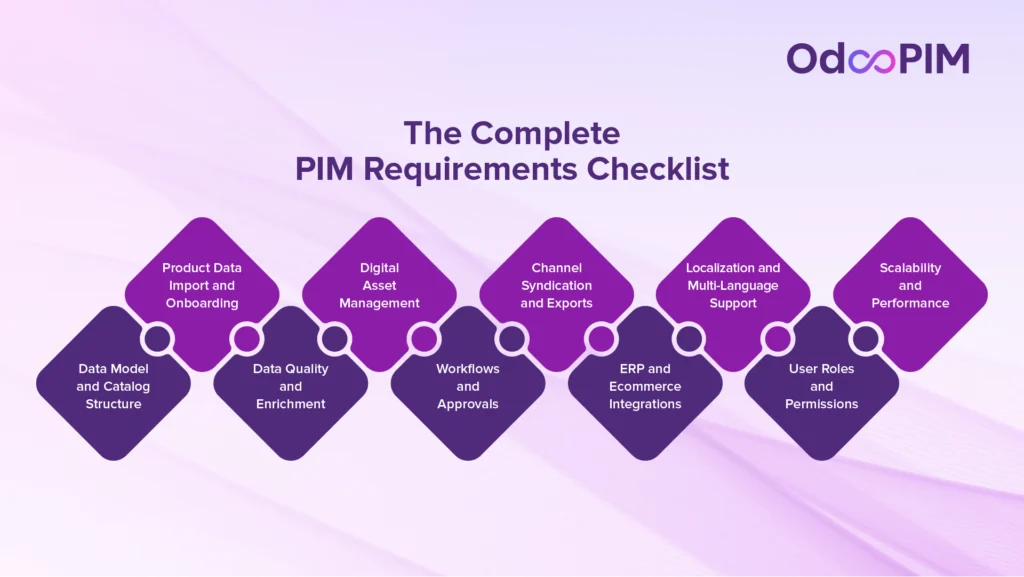
1. Data Model and Catalog Structure
Your PIM requirements must specify the product hierarchies, variant structures, attribute types, and category taxonomies the platform must support. Complex B2B catalogs demand flexible data modeling that accommodates unlimited attributes per product, configurable relationships, and inheritance across product families. The PIM requirements checklist should document whether your products require bill of materials relationships, compatibility matrices, or bundled product configurations. Category-specific attribute sets must be definable so that relevant specifications appear prominently while irrelevant fields remain hidden. Catalog structure requirements determine whether a platform’s data model can represent your products accurately or force costly workarounds.
2. Product Data Import and Onboarding
Define how the PIM system must ingest product data from ERPs, supplier feeds, spreadsheets, and legacy databases during initial migration and ongoing operations. Your product information management requirements should specify import frequency needs, real-time synchronization, scheduled batch processing, or manual upload capabilities. Data transformation requirements detail how incoming data gets mapped, validated, and standardized before entering the governed repository. Supplier onboarding automation requirements determine whether the platform can normalize diverse supplier formats without manual intervention. The PIM evaluation criteria for import capabilities impact how quickly you can consolidate product data from fragmented sources.
3. Data Quality and Enrichment
Specify the enrichment workflows, completeness scoring, and data validation rules your PIM requirements demand to maintain product data quality at scale. Completeness requirements define which attributes become mandatory at which enrichment stages before products can syndicate to channels. Data quality rules should encompass format validation, value range checking, and cross-attribute consistency verification that catches errors during enrichment. Your PIM requirements checklist must address bulk editing capabilities that enable catalog-wide updates when specifications or compliance information changes. Automated quality monitoring requirements ensure the platform flags anomalies and missing data without manual auditing.
4. Digital Asset Management
Document how the platform must handle images, videos, CAD files, specification sheets, and compliance documentation linked to product records. Your product information management requirements should specify asset-to-product relationship types, version control needs, and automated format conversion for channel-specific requirements. Asset inheritance across product variants and the ability to manage multiple image types per product must be defined clearly. The PIM evaluation criteria for digital assets should address searchability, metadata management, and integration with existing DAM systems. Channel-specific asset formatting requirements ensure the right images and documents reach each platform automatically.
5. Workflows and Approvals
Define the enrichment workflows, approval chains, and task routing that govern how product data moves from creation through publication. Your PIM requirements must specify role-based workflow steps, engineering validates technical specs, marketing enriches commercial content, compliance approves regulatory claims. Workflow automation needs include task assignment rules, notification triggers, escalation paths, and deadline management. The PIM requirements checklist should document whether workflows must support sequential approvals, parallel reviews, or conditional routing based on product categories. Audit trail requirements ensure every data change is tracked, attributed, and retrievable for compliance purposes.
6. Channel Syndication and Exports
Specify every channel where product data must flow and the formatting requirements each platform demands. Your product information management requirements must list current channels, Amazon, eBay, wholesale portals, print catalogs, plus planned channel expansion targets. Channel-specific attribute mapping requirements document how master product data translates to each platform’s unique field structure. The PIM evaluation criteria for syndication should address automated listing updates, channel validation before submission, and bulk publishing capabilities. Export format requirements ensure the platform can produce CSV, XML, JSON, and any specialized formats your channels require.
7. ERP and Ecommerce Integrations
Document every system that must connect to the PIM and the integration architecture your business requires. Your PIM requirements must specify which ERP, ecommerce platform, marketplace, and business systems need bidirectional data synchronization. Integration depth requirements define whether data must flow in real time or can operate on scheduled batch synchronization. The PIM requirements checklist should address whether you need native integration capabilities or can accommodate middleware-dependent connections. Understanding how to choose a PIM system often hinges on integration architecture because middleware introduces ongoing costs and failure points that native connections eliminate.
8. Localization and Multi-Language Support
Define requirements for managing product content across languages, regions, and market-specific regulatory frameworks. Your product information management requirements should specify how many languages the platform must support and whether translation workflows require integration with external services. Localization requirements include market-specific attribute variations, measurement unit conversions, and regionally appropriate imagery. UK-specific PIM evaluation criteria should address UKCA compliance data management, GBP pricing, and British marketplace formatting. Multi-language governance requirements ensure translated content maintains the same quality standards as source language product information.
9. User Roles and Permissions
Specify how the platform must control access to product data based on user roles, departments, and functional responsibilities. Your PIM requirements must define granular permission levels, view, edit, approve, publish, that can be assigned differently across product categories and data domains. Role-based access requirements ensure engineering controls technical specifications while marketing enriches commercial content without conflict. The PIM requirements checklist should document authentication integration needs with existing identity management systems. User experience requirements address interface simplicity for occasional users alongside power features for daily product data stewards.
10. Scalability and Performance
Define the catalog volume, user count, and transaction throughput the platform must support both currently and across your planning horizon. Your product information management requirements should specify current SKU counts, attribute volumes per product, and expected growth rates. Performance requirements address search responsiveness, bulk operation processing speed, and syndication throughput during peak catalog update periods. The PIM evaluation criteria for scalability must consider whether the platform handles your data complexity without performance degradation. Infrastructure scalability requirements ensure the platform accommodates growth without requiring migration to different deployment tiers.
Learn about best PIM software

How to Score and Prioritize Your PIM Requirements
Must-Have vs Nice-to-Have
Categorize every PIM requirement as must-have, should-have, or nice-to-have to prevent evaluation paralysis where platforms with unnecessary features distract from core capability gaps. Must-have requirements represent capabilities without which the platform cannot serve your business, typically data model flexibility, critical integrations, and essential syndication channels. Nice-to-have features should not influence platform selection because organizations often purchase sophistication they never implement. The PIM requirements checklist prioritization ensures vendors address fundamental needs before demonstrating advanced capabilities. This discipline prevents the common failure of selecting a platform based on impressive but irrelevant features while core requirements go unaddressed.
Weighted Scoring Model
Assign weighted importance scores to each requirement category so the PIM evaluation criteria reflects your business priorities rather than treating capabilities equally. Integration architecture typically warrants higher weighting than advanced features because synchronization failures impact daily operations more than missing workflow automation. Your weighted scoring model within the PIM RFP template creates an objective framework for comparing vendor responses across dozens of requirements dimensions. Weighted evaluation ensures that platforms scoring well on critical requirements rank above those excelling in less important areas. Understanding how to choose a PIM system means building a scoring methodology that reflects operational reality rather than feature checklist completeness.
Involving the Right Stakeholders
Product information management requirements must incorporate input from every team that creates, enriches, approves, or consumes product data. Engineering defines technical specification requirements, marketing specifies enrichment workflow needs, IT defines integration architecture, and sales documents channel content requirements. Cross-functional PIM requirements gathering prevents the selection of platforms that serve one department while frustrating others. The PIM requirements checklist developed in isolation inevitably misses capabilities that other stakeholders consider essential. Stakeholder involvement during requirements definition also builds the organizational buy-in that determines implementation adoption success.
What Should a PIM RFP Template Include?
Company and Project Overview
The PIM RFP template must open with context about your organization, current product data challenges, existing technology stack, and the business objectives driving PIM investment. Describe your product types, catalog complexity, channel footprint, and the specific operational problems that a PIM must solve. Document your project timeline, budget parameters, and any constraints that vendors must accommodate in their proposals. Include your decision-making process and the stakeholders who will evaluate vendor responses. This section frames the commercial and operational context that helps vendors determine whether they can serve your requirements effectively.
Functional Requirements
Translate your PIM requirements checklist into structured functional specifications that vendors can respond to with demonstrated capabilities. Organize functional requirements by category, data modeling, enrichment, syndication, asset management, with capability descriptions and priority ratings. Each product information management requirements item should be specific enough that vendors can confirm support, describe configuration approach, or acknowledge gaps honestly. Include required integrations, channel connectors, and any industry-specific capabilities that your product data demands. Well-structured functional requirements within the PIM RFP template transform vendor responses from marketing claims into verifiable capability statements.
Technical and Integration Requirements
Specify the integration architecture, API capabilities, authentication standards, hosting requirements, and technical constraints the platform must satisfy. Your PIM evaluation criteria for technical requirements should address real-time synchronization needs, data volume handling, and the security certifications relevant to your industry. Document existing system APIs, data formats, and integration patterns that the PIM must accommodate. Cloud hosting preferences, data residency requirements, and disaster recovery expectations belong in this section. Technical requirements often determine how to choose a PIM system because integration complexity impacts total cost of ownership.
Vendor Questions
Include questions about vendor viability, implementation methodology, customer support models, product roadmap, and customer references within your industry. Ask about typical implementation timelines, team composition, and the change management support vendors provide during deployment. Request customer references matching your company size, industry, and product information management requirements complexity. Vendor questions should probe financial stability, development team location, and the upgrade frequency that determines how quickly the platform evolves. The PIM RFP template vendor section surfaces the partnership quality factors that determine long-term success beyond initial platform capabilities.
Pricing and Total Cost of Ownership
Request detailed pricing that breaks out license fees, implementation costs, integration development, training expenses, and ongoing support charges. The PIM requirements for pricing transparency should compel vendors to disclose the costs that emerge after initial deployment, connector maintenance, upgrade fees, additional user licenses. Require pricing models that accommodate your growth trajectory without triggering dramatic cost increases at predictable SKU or user thresholds. Total cost of ownership comparison demands that vendors quantify the internal resources their platform requires for ongoing operation. PIM evaluation criteria for cost must normalize pricing across different deployment models and licensing structures for fair comparison.
Evaluation Timeline and Criteria
Define the selection process timeline, evaluation stages, and the criteria by which proposals will be judged. The PIM RFP template should specify when vendors will be notified of shortlisting decisions, when demonstrations occur, and when final selection completes. Document the weighting methodology applied to different requirement categories so vendors understand evaluation priorities. Include any proof-of-concept expectations or reference checks that will influence final selection. Transparent product information management requirements evaluation criteria produce better vendor responses and more defensible selection decisions.
Learn about PIM Technology

Case Studies
Case Study 1: Industrial Pump Manufacturer Uses Structured PIM Requirements to Select the Right Platform and Avoid Integration Disaster
Challenge
A British industrial pump manufacturer with seven thousand SKUs recognized that their spreadsheet-based product data management could not support planned expansion into European distributor channels. The engineering team maintained technical specifications in a legacy PLM system while marketing managed separate spreadsheets for their website and Amazon Business, creating constant specification conflicts across channels. Leadership approved PIM investment but the project team had no experience with product information management requirements definition and risked selecting a platform based on vendor demonstrations alone. A previous CRM implementation had failed because requirements were defined after vendor selection, and leadership demanded a more disciplined approach to how to choose a PIM system this time.
Solution
The manufacturer dedicated four weeks to documenting comprehensive PIM requirements before contacting any vendors, involving engineering, marketing, IT, and sales stakeholders in the process. They used a structured PIM requirements checklist covering data model flexibility for complex pump hierarchies, technical attribute management, ERP integration architecture, and channel syndication to Amazon Business and European distributor portals. The team developed a weighted PIM evaluation criteria framework that prioritized integration architecture and technical specification handling over advanced marketing features. They distributed a formal PIM RFP template to five shortlisted vendors, requiring detailed responses to functional, technical, and commercial requirements. During vendor demonstrations, the team referenced their documented product information management requirements to prevent sales presentations from diverting attention from critical integration capabilities. The disciplined approach revealed that three platforms required middleware for ERP connectivity, introducing the ongoing costs the manufacturer specifically wanted to avoid. OdooPIM emerged as the choice because native Odoo integration eliminated the middleware requirement their PIM requirements framework had identified as a critical factor.
Results
- The structured PIM requirements process prevented the integration disaster that would have occurred if the team selected a platform requiring middleware their IT team could not support.
- Vendor selection completed in ten weeks, faster than the company’s previous technology procurement where undefined requirements extended evaluation for months.
- Implementation began with complete clarity on integration architecture because the PIM requirements checklist had forced detailed technical discussions during evaluation.
- Post-deployment synchronization failures avoided because the PIM evaluation criteria prioritized native ERP connectivity over feature count.
- The manufacturer documented their how to choose a PIM system methodology for future technology procurement, institutionalizing the requirements-first approach that prevented past failures.
Case Study 2: Electrical Components Distributor Avoids Costly Platform Mismatch Through Rigorous PIM Requirements Definition
Challenge
An electrical components distributor with twelve thousand SKUs and over one hundred supplier relationships struggled with catalog inconsistency that made filtered search functionally broken for contractor customers. Leadership fast-tracked PIM procurement after a major client complained about conflicting technical specifications across their website and Amazon Business listings. The initial impulse was to invite vendors for demonstrations immediately, but the IT director insisted on documenting product information management requirements first, having learned from a previous ecommerce platform selection that prioritized features over integration fit. The company needed to manage complex electrical specifications, normalize diverse supplier data formats, and syndicate consistent product content to their website, Amazon Business, and three industry-specific marketplaces.
Solution
The distributor assembled a cross-functional team that spent three weeks building a comprehensive PIM requirements checklist spanning data modeling for electrical component hierarchies, automated supplier data normalization, and channel syndication requirements. Their PIM evaluation criteria weighted supplier data onboarding automation heavily because manual normalization of one hundred supplier formats consumed thirty hours weekly. The team documented integration requirements specifying real-time synchronization with their ERP for inventory and pricing data. They distributed a detailed PIM RFP template to six vendors, requiring explicit responses to supplier data normalization capabilities, attribute mapping automation, and the specific marketplace connectors their channel strategy demanded. Two vendors were eliminated during written evaluation because their PIM requirements responses revealed that supplier data normalization required custom development rather than platform-native capabilities. The final selection decision balanced functional fit against total cost of ownership, with the documented product information management requirements preventing the team from being swayed by advanced features they lacked organizational maturity to adopt.
Results
- The PIM requirements framework eliminated two platforms before demonstrations, saving weeks of evaluation time on vendors that could not meet core operational needs.
- Supplier onboarding automation capabilities verified during proof-of-concept against the documented PIM requirements checklist, confirming platform fit before contract signature.
- Implementation completed on schedule because the PIM RFP template had forced vendors to detail their deployment methodology and timeline commitments during evaluation.
- Post-launch, weekly product data management hours reduced from thirty to five as the selected platform’s supplier normalization matched the requirements documented during selection.
- The distributor’s IT director credited the how to choose a PIM system discipline with preventing the platform mismatch that would have occurred if vendor demonstrations had preceded requirements definition.
Learn about PIM Solution

Common Mistakes When Defining PIM Requirements
Underestimating Integration Effort
Organizations consistently underestimate the integration complexity of connecting a standalone PIM to existing ERP, ecommerce, and marketplace systems. The PIM requirements checklist often treats integration as a single line item when it represents the most resource-intensive implementation component. Integration underestimation leads to budget overruns, timeline extensions, and the synchronization failures that undermine the governance benefits PIM should deliver. Understanding how to choose a PIM system means realistically assessing whether your organization can sustain the middleware maintenance standalone platforms demand. Integration requirements should receive the most rigorous scrutiny because they determine whether the PIM functions as a connected hub or an isolated data island.
Over-Specifying Features
Organizations frequently pack PIM requirements with advanced features that teams lack the maturity, resources, or organizational alignment to implement. Purchasing sophisticated workflow automation that no team adopts creates shelfware while basic data quality problems persist unaddressed. The PIM RFP template should distinguish between capabilities needed at deployment and features that represent future-state aspirations. Over-specification extends implementation timelines and inflates costs without delivering proportional operational value. Effective product information management requirements focus on the capabilities that solve immediate data governance problems while providing headroom for incremental adoption.
Ignoring Data Migration
Data migration effort receives insufficient attention in PIM requirements documentation despite consuming substantial implementation resources. The extraction process exposes duplicate records, missing attributes, inconsistent formatting, and specification errors accumulated across years of ungoverned data management. Your PIM requirements checklist must address data cleansing expectations, migration tooling needs, and the validation processes that ensure migrated data meets quality standards. Ignoring migration requirements leads to unrealistic implementation timelines and the disappointing discovery that the PIM contains the same poor data that plagued spreadsheets. PIM evaluation criteria should include vendor migration support capabilities and the tools provided for data quality assessment during transition.
Skipping User Adoption Needs
Product information management requirements frequently neglect the user experience factors that determine whether teams embrace or abandon the new platform. Interface complexity, training requirements, and the workflow disruption during transition directly impact implementation success. The PIM RFP template should address usability for different user types, occasional contributors need simplicity while daily stewards need efficiency. Ignoring adoption requirements produces technically sound PIM deployments that teams work around rather than within. Understanding how to choose a PIM system means evaluating the user experience factors that determine whether governance processes get followed or bypassed.
Learn about Best Free PIM Software
Why Integration Requirements Decide PIM Success
Integration architecture determines whether your PIM operates as a connected operational hub or an isolated data island requiring manual data transfer. Standalone PIM platforms demand middleware connectors that introduce licensing costs, synchronization latency, and ongoing maintenance burdens that compound with each connected system. The PIM requirements for integration depth shape total cost of ownership, operational reliability, and the speed at which product changes reach customer-facing channels. Organizations evaluating how to choose a PIM system discover that native ERP integration eliminates the middleware requirement category. OdooPIM demonstrates this principle by operating on the same data model as Odoo ERP, removing the integration tax that standalone platforms impose while delivering real-time synchronization without connector maintenance. When integration complexity determines whether your product information management requirements succeed or fail, architecture choice becomes the most consequential decision in the PIM selection process.
Learn about Cloud PIM Explained

FAQ’s
1. What should a PIM requirements checklist include?
A PIM requirements checklist must cover data model flexibility for your product hierarchies and variant structures, detailing how the platform handles complex relationships and unlimited attributes per SKU. Integration requirements specifying ERP, ecommerce, and marketplace connectivity with required synchronization frequency and data flow direction form the technical backbone. Enrichment workflow specifications including completeness scoring, approval chains, and bulk editing capabilities ensure operational governance. Channel syndication requirements listing every current and planned platform with their specific formatting needs prevent distribution gaps. Your product information management requirements must also address digital asset management, user roles and permissions, localization capabilities, and the scalability thresholds your catalog growth demands.
2. What is a PIM RFP?
A PIM RFP is a structured request for proposal document that translates your PIM requirements into a formal evaluation framework vendors respond to with demonstrated capabilities, pricing, and implementation approaches. The PIM RFP template organizes functional, technical, and commercial requirements into sections that enable objective comparison across competing platforms. A comprehensive RFP includes company context, project objectives, detailed requirement specifications with priority ratings, technical constraints, vendor qualification questions, and total cost of ownership disclosure requests. The document serves as both an evaluation standard during selection and a contractual reference point during implementation. Understanding how to choose a PIM system through a structured RFP process prevents the sales-driven feature distraction that leads to costly platform mismatches.
3. How long does PIM vendor selection take?
PIM vendor selection mostly spans eight to sixteen weeks depending on requirements complexity, stakeholder availability, and the thoroughness of your PIM evaluation criteria framework. The process begins with internal PIM requirements documentation and stakeholder alignment before any vendor engagement begins. Shortlisting vendors, distributing the PIM RFP template, and evaluating written responses consumes three to five weeks of structured analysis. Vendor demonstrations, proof-of-concept exercises, and reference checks extend the timeline but surface implementation realities that written proposals conceal. Organizations that compress product information management requirements definition to accelerate selection inevitably extend implementation timelines when undocumented needs emerge post-contract.
4. What’s the most overlooked PIM requirement?
Integration architecture consistently ranks as the most overlooked PIM requirement because organizations focus on functional capabilities while underestimating the complexity of connecting platforms to existing systems. The hidden costs of middleware-dependent integration, licensing fees, connector maintenance, synchronization troubleshooting, accumulate silently after deployment. Organizations discover too late that their PIM requirements checklist treated integration as a simple checkbox rather than the resource-intensive implementation component it represents. Data migration effort receives similarly insufficient attention, with organizations underestimating the cleansing required before product data enters the governed repository. Understanding how to choose a PIM system means prioritizing integration architecture and data migration readiness alongside the enrichment features that dominate vendor demonstrations.
5. Should requirements come before or after vendor demos?
Requirements must come before vendor demonstrations because polished presentations inevitably shape your perception of what you need if you lack documented PIM evaluation criteria. Walking into demos without defined product information management requirements guarantees that the most charismatic demonstration wins rather than the platform best suited to your operational reality. Vendors excel at showcasing strengths while gracefully navigating past capability gaps that your documented PIM requirements checklist would have forced them to address. Organizations that delay requirements until after seeing platforms find themselves writing specifications that match a favorite vendor rather than their actual business needs. The discipline of defining how to choose a PIM system through pre-demo requirements documentation protects against the feature-driven selection that leads to costly implementation mismatches.