What Is Amazon Product Information Management?
Amazon product information management is the process of centralizing, enriching, and syndicating product data specifically for Amazon listings. Unlike general product management, Amazon PIM handles marketplace-specific requirements, bullet points, search terms, product identifiers (GTIN, UPC, EAN), image specifications, and category taxonomies. Product information management software for Amazon ensures that every listing includes complete, compliant data before going live. Amazon listing management software automates the manual work of creating and updating product detail pages. Without dedicated ecommerce product information management software, sellers drown in spreadsheets. Listings get suppressed. Sales disappear. PIM fixes that.
Why Product Data Quality Matters on Amazon
Amazon’s algorithm ranks listings higher when product data is complete, accurate, and enriched. Missing attributes, low-quality images, or incomplete descriptions trigger listing suppression. Amazon product information management ensures your listings never get hidden. Shoppers abandon incomplete listings. Product information management software enforces Amazon’s requirements before you publish. A missing GTIN blocks your listing entirely. A low-resolution image hurts conversion. PIM software for Amazon validates every field against marketplace rules. Quality data drives discoverability, discoverability drives sales and poor data costs you ranking and revenue.

What “Product Information” Covers: Titles, Attributes, Images, Descriptions, and More
Product titles must include brand, model, size, and key features within Amazon’s character limits. Attributes cover color, material, dimensions, weight, and category-specific fields like voltage for electronics. Amazon catalog management requires high-resolution images on white backgrounds with specific aspect ratios. Descriptions include bullet points (front-end) and long-form copy (back-end). Search terms (backend keywords) help customers find your products. Ecommerce product information management software stores all these fields in structured formats. Amazon listing management software transforms your master data into Amazon-ready content automatically. One source, infinite Amazon listings and complete compliance.
The Biggest Challenges Amazon Sellers Face with Product Data
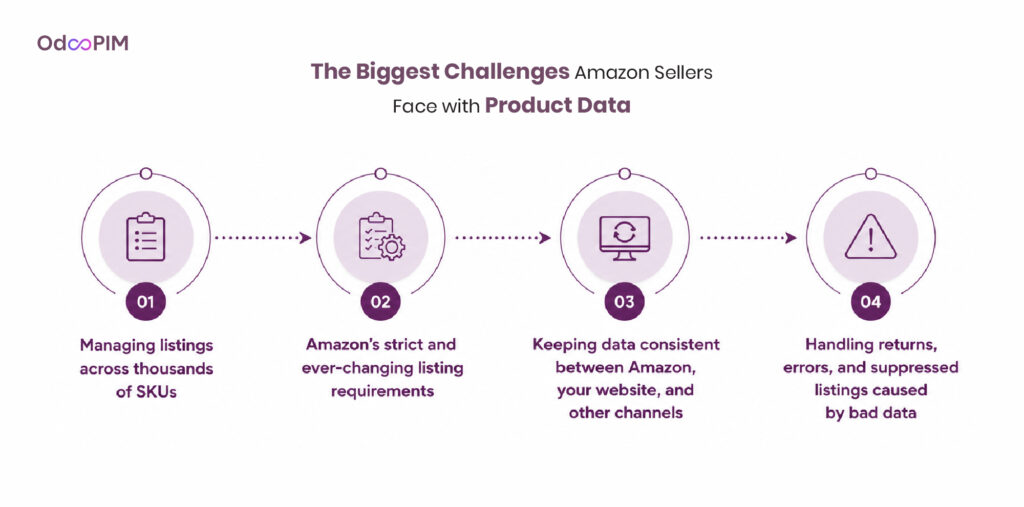
1. Managing listings across thousands of SKUs
A seller with 10,000 SKUs cannot manually update each product’s title, bullets, images, and search terms. Spreadsheets crack under this volume. Amazon product information management with bulk editing handles thousands of listings simultaneously. PIM software updates every variant of a configurable product with one click. Without amazon listing management software, your team works nights and weekends. One typo spreads across hundreds of listings. Errors multiply, sales suffer and scale demands automation.
2. Amazon’s strict and ever-changing listing requirements
Amazon updates category requirements, image specifications, and attribute rules constantly. A listing that passed validation last month may get suppressed today. Product information management software tracks Amazon’s changing requirements and flags non-compliant listings before suppression happens. Amazon catalog management without PIM means your team manually checks every listing against current rules. Miss one update, and your best seller disappears from search. Ecommerce product information management software keeps you compliant automatically.
3. Keeping data consistent between Amazon, your website, and other channels
Your website shows one price. Amazon shows another. Walmart shows a third. Customers notice. Trust erodes. Amazon product information management with multi-channel syndication ensures every channel pulls from the same master catalog. A price change in your pim software updates Amazon, your website, and marketplaces simultaneously. Amazon listing management software without channel consistency forces manual per-platform updates. One channel gets missed, discrepancies appear and complaints follow.
4. Handling returns, errors, and suppressed listings caused by bad data
A missing GTIN suppresses your listing. An incorrect size attribute triggers returns. A wrong product category confuses Amazon’s algorithm. Amazon catalog management with validation rules blocks bad data before it reaches Amazon. Product information management software checks every product against Amazon’s requirements before syndication. Missing fields get flagged. Inconsistent values get blocked. Ecommerce product information management software with pre-validation prevents suppression. Listings stay live, returns drop and revenue grows. Stop fixing problems after they happen and prevent them at the source.
Learn about Amazon SEO services in USA

What Is PIM Software and How Does It Help Amazon Sellers?
Centralized product data vs. managing listings in spreadsheets
Spreadsheets scatter product data across multiple files. One file for titles, another for bullet points and a third for images. Your team wastes hours hunting for the correct version. Amazon product information management centralizes every product attribute into one master database. Product information management software eliminates version conflicts and reconciliation work. PIM software with centralization means your team updates data once, not across ten spreadsheets. One source and complete visibility. No more “which file is current?” debates. Your team works faster and errors drop.
How PIM pushes clean, channel-ready data to Amazon automatically
PIM software transforms your master product data into Amazon’s required format automatically. Titles get truncated to Amazon’s character limits. Bullet points pull from your enriched description fields. Images resize to Amazon’s specifications. Amazon listing management software syndicates this ready-to-publish data directly to Amazon via API. No manual CSV uploads. No copy-paste errors. Product information management with automated syndication means a price change in your PIM updates Amazon within minutes. Your team stops logging into Seller Central for every update and automation replaces manual work.
Enrichment workflows: filling in missing attributes before publishing
Amazon catalog management requires complete attribute sets for every product. Missing GTIN? Listing suppressed. Missing brand name? Listing suppressed. Product information management software with enrichment workflows routes missing attributes to the right team members. A buyer fills in missing GTINs. A copywriter writes missing bullet points. Ecommerce product information management software tracks completion status. Only products with complete, validated data syndicate to Amazon. Amazon product information management with workflow automation prevents suppression before it happens. Your listings stay live, your team stays productive and quality is enforced at the source.
To win, serve, and retain customers, sellers must provide content that’s unique to a buyer’s locale, need, occasion, persona, and channel at every step of the customer journey.
– Forrester
Key Features to Look for in Amazon PIM Software
Amazon Seller Central and Vendor Central integration
Your amazon listing management software must connect to Amazon via API. No manual file uploads. No FTP drops. PIM software with native Amazon integration pushes product data to Seller Central or Vendor Central automatically. Product information management software without direct integration forces your team to export CSV files and upload manually. Manual steps introduce errors, sync delays cause listing discrepancies and native integration eliminates those risks.
Bulk listing creation and update capabilities
A price change across 5,000 SKUs should take seconds, not hours. Amazon product information management with bulk editing updates thousands of listings simultaneously. PIM software handles bulk title updates, image swaps, and description changes with one action. Amazon catalog management without bulk tools forces per-product editing. Your team clicks through thousands of listings individually. Errors multiply, time wastes and bulk editing is not optional at scale.
Variant and parent-child ASIN management
A t-shirt with three sizes and four colors creates twelve child ASINs under one parent ASIN. Product information management software generates these variants automatically from a master product matrix. Add a new color in your PIM. The system creates every size-color variant and pushes to Amazon. Amazon listing management software without variant management forces manual ASIN creation. One missing variant means lost sales and PIM handles the complexity.
Digital asset management for images and A+ content
Amazon requires white-background main images, alternate angles, and enhanced A+ content modules. Ecommerce product information management software stores these assets alongside product attributes. Amazon product information management links each image to the correct ASIN and variant. A+ content modules, comparison charts, enhanced descriptions, brand stories, sync automatically. PIM software without asset management leaves image uploads to manual processes. Images get missed and listings look incomplete.
Multi-marketplace support (Amazon US, UK, EU, etc.)
Selling in multiple Amazon marketplaces requires localized titles, translated bullet points, and region-specific pricing. Amazon catalog management with multi-marketplace support stores one master record with regional overlays. US listings show imperial measurements. EU listings show metric. Product information management software syndicates the correct version to each marketplace automatically. Amazon listing management software without multi-marketplace support forces duplicate catalogs per region. Errors multiply, launch times stretch and PIM handles global expansion.
Learn about best PIM software.

How OdooPIM Handles Amazon Product Information Management
Syncing product data from OdooPIM to Amazon Seller Central
OdooPIM connects to Amazon Seller Central via API. Configure your Amazon store credentials once. Map your OdooPIM fields to Amazon’s required attributes, title, bullet points, description, GTIN, brand, category. Amazon listing management software with native sync pushes product data automatically. No CSV exports. No manual uploads. PIM software with direct Amazon integration updates listings in real time or on a schedule. A price change in OdooPIM reflects on Amazon within minutes. Your team stops logging into Seller Central for every update.
Managing product attributes, categories, and variants in one place
OdooPIM centralizes every product attribute, titles, bullets, descriptions, search terms, images, and category-specific fields. Create attribute families for different product types. Electronics need voltage. Apparel needs size charts. Amazon product information management with structured attributes ensures consistency across your catalog. Variant management handles parent-child ASIN relationships automatically. A t-shirt with three sizes and four colors generates twelve child ASINs from one master product. Ecommerce product information management software without variant support forces manual ASIN creation.
Automating listing updates across Amazon and other sales channels
The system syndicates to Amazon, your website, eBay, Walmart, and Google Shopping simultaneously. Product information management software with multi-channel automation eliminates manual per-platform updates. A fitment correction for an auto part pushes to every channel where you sell. Amazon catalog management without automation forces your team to update each marketplace separately. One channel gets missed, data drifts and OdooPIM prevents that. One master catalog, infinite channel outputs and complete consistency. Your team focuses on strategy and automation handles distribution.
Learn about PIM for Shopify
Amazon PIM vs. Spreadsheets vs. Amazon’s Native Tools: A Comparison
Where Seller Central’s built-in tools fall short at scale
Seller Central lets you edit products one by one or via bulk uploads. No approval workflows. No version control. No validation before publishing. Amazon catalog management natively requires your team to export a flat file, edit in Excel, and re-upload. One formatting error breaks your entire feed. Amazon product information management with native tools means no audit trail. No task assignments and no role-based permissions. Seller Central works for 100 SKUs, it crumbles at 10,000 and PIM software fills these gaps.
Why spreadsheets break down beyond 500 SKUs
Spreadsheets have no data types and a merged cell breaks formulas. Two people editing the same file create version conflicts. Product information management in spreadsheets means your team spends 50% of their time hunting for the correct version. An auto part with fifty fitment rows becomes unmanageable. Variant matrices, three sizes times four colors, require twelve rows of duplicate data. Amazon listing management software with structured data modeling handles complexity that spreadsheets cannot. Spreadsheets scale negatively and more SKUs create more chaos.
What a dedicated PIM adds that neither can offer
A dedicated PIM adds attribute validation that blocks incomplete listings before syndication. Missing GTIN? Cannot push to Amazon. Missing brand name? Blocked. Ecommerce product information management software adds approval workflows. A junior editor proposes changes. A senior editor reviews and approves. Amazon product information management with PIM adds version control and audit trails. Who changed that title last week? The audit log knows. PIM software adds automated syndication. Update once and push to Amazon, eBay, Walmart, and your website simultaneously. Spreadsheets and native tools cannot match these capabilities.
Case studies
Case Study 1: Electronics Seller Cuts Listing Time by 85% and Eliminates Suppressions
Challenge
A consumer electronics seller managed 12,000 SKUs across Amazon US, UK, and EU marketplaces. The team relied on Excel spreadsheets and Amazon’s native bulk upload tools. Each new product required manual entry of titles, bullet points, descriptions, and images. Variant management for electronics, different storage capacities and colors, forced the team to create each child ASIN individually. Listing suppression rates hit 15% due to missing GTINs, incorrect category attributes, and image specification violations. The company lost $45,000 annually in lost sales from suppressed listings.
Solution
The seller implemented OdooPIM as their amazon product information management solution. Attribute families were created for each electronics subcategory, smartphones, laptops, headphones, accessories. GTINs, brand names, and category-specific attributes were validated before syndication. Product information management software with variant management generated all child ASINs automatically from master product matrices. A smartphone with three storage capacities and four colors produced twelve child ASINs with one click. Amazon listing management software with multi-marketplace support syndicated localized content, US listings showed imperial measurements, EU listings showed metric. Automated validation flagged missing attributes before data reached Amazon.
Results
- Listing suppression rate dropped from 15% to under 2%
- New product onboarding time reduced from 45 minutes to 7 minutes per SKU
- Manual data entry hours cut by 85%
- Amazon US, UK, and EU marketplaces synchronized from one master catalog
- Annual lost sales from suppressions recovered: $38,000
- Team reallocated from data entry to listing optimization and advertising
Case Study 2: Home Goods Brand Scales from 500 to 8,000 SKUs Without Headcount Increase
Challenge
A home goods brand sold on Amazon, their own Shopify store, and Wayfair. The company started with 500 SKUs managed in spreadsheets. As the catalog grew to 8,000 SKUs, spreadsheets became unmanageable. Product information was scattered across three different files, one for Amazon, one for Shopify, one for Wayfair. A price change required updating three separate spreadsheets and uploading to three different platforms. The Amazon catalog had inconsistent titles, some included “100% Cotton,” others omitted it. Bullet point formatting varied across product families. Customer returns due to incorrect product expectations reached 9%.
Solution
The brand deployed OdooPIM as unified product information management software. Amazon catalog management was centralized alongside Shopify and Wayfair feeds. Attribute families enforced consistent title structures and bullet point formats across all product categories. Ecommerce product information management software with multi-channel syndication pushed a single master catalog to Amazon, Shopify, and Wayfair simultaneously. A price change in OdooPIM updated all three channels within minutes. PIM software with validation rules blocked products missing required attributes from syndication. The team defined approval workflows, junior staff proposed changes, senior staff reviewed and approved before listings updated.
Results
- Amazon listing consistency score improved from 68% to 97%
- Customer return rate dropped from 9% to 4.5%
- Price update time across three channels reduced from 2 hours to 2 minutes
- The brand scaled from 500 to 8,000 SKUs with zero headcount increase
- New product launch time cut from 10 days to 3 days
- Annual labor savings from eliminated manual data entry: $52,000
Learn about Shopify PIM Software.

Who Benefits Most from Amazon Product Information Management Software?
Amazon third-party sellers with large or growing catalogs
A seller with 5,000 SKUs cannot manually update every title, bullet point, and search term. Amazon product information management with bulk editing updates thousands of listings simultaneously. PIM software handles variant generation automatically. A t-shirt with three sizes and four colors creates twelve child ASINs from one master product. Amazon listing management software without bulk capabilities forces per-product editing. Your team drowns in manual work and growth stalls. If your catalog exceeds 500 SKUs, you need PIM. Scale demands automation. Spreadsheets fail, native tools crack and PIM scales.
Brands selling on Amazon plus their own DTC store
Multi-channel brands need consistent product data across Amazon, Shopify, Magento, and marketplaces. Product information management software with multi-channel syndication ensures a price change in your PIM updates Amazon and your website simultaneously. Amazon catalog management without channel consistency forces manual per-platform updates. Your website shows one price, Amazon shows another, customers notice and trust erodes. Ecommerce product information management software with multi-channel support eliminates discrepancies. One master catalog, infinite channel outputs and complete consistency. DTC plus Amazon requires PIM and spreadsheets cannot handle both.
Learn about Magento PIM software.
Wholesale distributors and private label sellers
Wholesale distributors manage thousands of SKUs from dozens of suppliers, each with different data formats. Amazon product information management with bulk import maps supplier fields to your master attribute model automatically. Private label sellers need consistent branding across every listing, title formats, bullet point structures, image standards. PIM software with attribute families enforces brand consistency. A new private label product inherits the same title format as every other product in your catalog. Amazon listing management software without standardization creates inconsistent branding. Customers get confused, sales suffer and PIM fixes that.
Frequently Asked Questions
1. What is product information management for Amazon sellers?
Amazon product information management is the process of centralizing, enriching, and syndicating product data specifically for Amazon listings. It covers titles, bullet points, descriptions, search terms, images, and category-specific attributes. Product information management software for Amazon validates data against marketplace requirements before publishing, missing GTIN? Blocked. Incorrect image ratio? Flagged. PIM software also manages variants, parent-child ASIN relationships, and multi-marketplace localization. Without amazon catalog management, sellers drown in spreadsheets. Listings get suppressed. Sales disappear. PIM fixes that.
2. Does OdooPIM integrate with Amazon Seller Central?
OdooPIM connects to Amazon Seller Central via API. Configure your store credentials once. Map OdooPIM fields to Amazon’s required attributes, title, bullet points, description, GTIN, brand, category. Amazon listing management software with native API integration pushes product data automatically. No CSV exports and no manual uploads. Product information management software with direct Amazon sync updates listings in real time or on a schedule. A price change in OdooPIM reflects on Amazon within minutes. Ecommerce product information management software without native integration forces manual file transfers.
3. How is PIM software different from Amazon listing tools?
Amazon’s native listing tools let you edit products one by one or via bulk uploads. No approval workflows, no version control and no validation before publishing. PIM software adds attribute validation that blocks incomplete listings before syndication. Missing GTIN? Cannot push. Product information management with PIM adds approval workflows, audit trails, and role-based permissions. Amazon catalog management with PIM also enables multi-channel syndication, update once in your PIM, push to Amazon, eBay, Walmart, and your website simultaneously. Native tools work for 100 SKUs and PIM handles 100,000.