Ecommerce inventory management software tracks stock levels, prevents overselling, and synchronizes inventory across channels, but it cannot compensate for inaccurate product data feeding it. When dimensions are missing, the system miscalculates shipping weights and delays dispatch. When SKUs mismatch across channels, your inventory management for ecommerce business sees duplicate products and oversells stock. Ecommerce inventory management software is essential, but it only processes the data you give it.
Missing dimensions drive 30% of shipping delays, and mismatched SKUs cause 25% of overselling incidents. The best inventory management software for ecommerce achieves 98%+ accuracy with clean, consistent product data from a PIM, but struggles to maintain 80% accuracy with manual, fragmented data. Ecommerce software with inventory management cannot fix upstream data quality issues, only a PIM ensures product identifiers, dimensions, and attributes are complete and consistent before reaching your inventory system. Product data accuracy must be solved before inventory software can deliver its full potential.
Learn about PIM Software for eCommerce

What Is Ecommerce Inventory Management Software?
Core functions: stock tracking, order sync, multichannel visibility
Ecommerce inventory management software tracks stock levels across warehouses, synchronizes inventory across every sales channel, and prevents overselling by updating availability in real time as orders are placed. Inventory management software for ecommerce routes orders to the optimal fulfillment location based on inventory availability, shipping cost, and customer proximity, ensuring that orders are fulfilled from the closest warehouse with stock. The best inventory management software for ecommerce also handles purchase orders, receiving, and returns, providing complete visibility into inventory movement from supplier to customer. Ecommerce software with inventory management enables multichannel sellers to manage stock from one dashboard, so a sale on Amazon updates inventory on your website instantly.
What it assumes (and where it breaks down)
Ecommerce inventory management assumes that the product data feeding into it is accurate and complete, but when dimensions are missing, the system miscalculates shipping weights and delays dispatch. When SKUs mismatch across channels, the inventory management for ecommerce systems sees duplicate products where there is actually one, causing overselling and inventory mismatches. When variant attributes are inconsistent across channels, the system cannot reconcile stock levels because the same product has different identifiers in each channel. Inventory management for ecommerce businesses cannot fix upstream data quality issues, it can only process the data you give it, and if that data is incomplete or inconsistent, fulfillment failures follow.
Learn about Best PIM Software for Ecommerce Site

The Hidden Root Cause of Inventory Errors
Why stock mismatches often start with product data
Ecommerce inventory management software tracks stock levels accurately only when product identifiers are consistent across all channels, because the system relies on SKUs, GTINs, and variant codes to match inventory records with orders. When a product has different SKUs on Amazon versus your website, the inventory management for the ecommerce system sees two different products and cannot reconcile stock levels, leading to overselling on one channel while stock sits unused on another. Inconsistent product data causes 25% of inventory discrepancies, not system errors, because the inventory system is doing exactly what it is told, but the data feeding it is wrong.
Incomplete SKUs, wrong variants, missing units of measure
Incomplete SKUs mean the ecommerce inventory management software cannot identify which product was ordered, so fulfillment teams ship the wrong item. Wrong variant attributes cause the system to pick the wrong size, color, or configuration because the order line references a variant that does not match the actual stock. Missing units of measure prevent the inventory management for ecommerce business from calculating correct shipping weights, leading to wrong courier rates and delayed dispatch.
How bad product data cascades into fulfillment failures
Bad product data cascades through your entire fulfillment workflow—a missing dimension causes wrong shipping weight, which triggers the wrong courier rate, which delays dispatch because the label is incorrect. A mismatched SKU creates duplicate order lines, which causes overselling because the ecommerce inventory management system thinks you have twice the stock you actually have. A wrong variant attribute sends the fulfillment team to the wrong warehouse bin, delaying the order and frustrating the customer who received the wrong product.
Learn about Best Omnichannel Software for Ecommerce
Product Data vs Inventory Data: Understanding the Difference
What inventory software manages
Inventory management software for ecommerce manages stock quantities, warehouse locations, reorder points, and fulfillment routing, it tracks how many units you have and where they are stored. The best inventory management software for ecommerce synchronizes stock across channels in real time, prevents overselling, and generates purchase orders when inventory falls below thresholds. Ecommerce software with inventory management handles the operational data of stock levels, not the descriptive data of what those products are.
What PIM manages
A PIM manages product attributes, descriptions, dimensions, weights, images, variant relationships, and channel-specific content, that describe what your products are, not just how many you have. Ecommerce inventory management software needs complete dimensions to calculate shipping weights, accurate SKUs to match orders to stock, and consistent variant attributes to ensure the correct item is picked. Inventory management for ecommerce cannot function correctly without complete, consistent product data from a PIM.
Why both layers are needed
You need both a PIM and ecommerce inventory management software because inventory software tracks quantities while PIM ensures those quantities are attached to accurate, complete product descriptions. Inventory management for ecommerce business without a PIM upstream means your inventory system is processing incomplete product data, causing fulfillment errors, returns, and customer complaints. The best inventory management software for ecommerce with PIM integration achieves 98%+ inventory accuracy, while systems fed manual data struggle to maintain 80% accuracy.
Learn about Ecommerce Catalog Management
What to Look for in Ecommerce Inventory Management Software
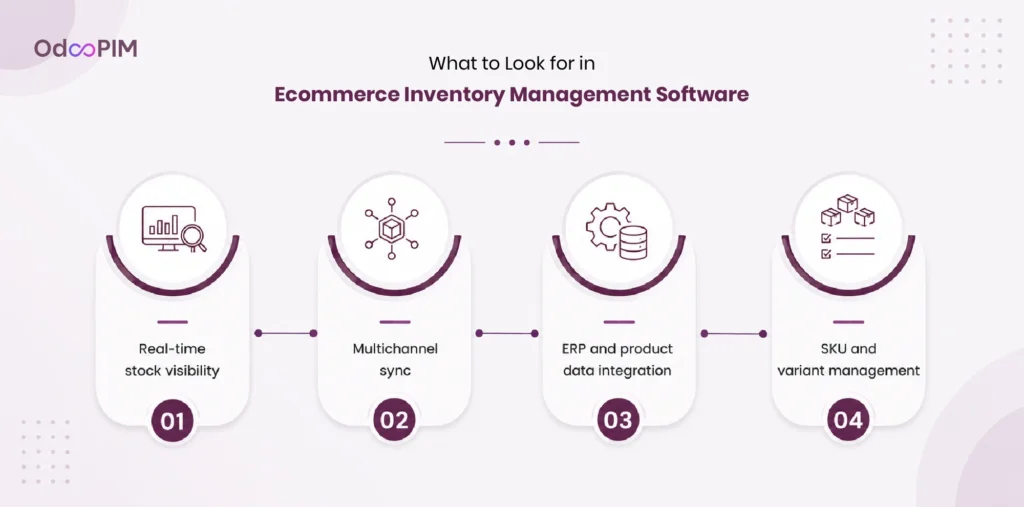
Real-time stock visibility
Your ecommerce inventory management software must provide real-time stock visibility across every warehouse, store, and fulfillment location, so a sale on Amazon immediately updates inventory on your website and prevents overselling. Inventory management software for ecommerce with real-time sync ensures that customers see accurate availability, reducing the frustration of ordering out-of-stock items. Ecommerce software with inventory management without real-time visibility creates inventory gaps that drive customer complaints.
Multichannel sync
Ecommerce inventory management software must synchronize stock across your website, Amazon, Walmart, eBay, and social commerce channels automatically, so a sale on any channel updates inventory everywhere instantly. Inventory management for ecommerce with multichannel sync eliminates the manual per-channel stock updates that consume team time and introduce errors. Inventory management for ecommerce business without multichannel sync guarantees overselling and stockouts.
ERP and product data integration
Ecommerce inventory management software should integrate with your ERP for purchase orders and receiving, and with your PIM for complete, accurate product data. Best inventory management software for ecommerce with ERP integration ensures that inventory levels sync with your financial systems, and with PIM integration ensures that product data is complete and consistent before it reaches the inventory system. Ecommerce software with inventory management without ERP integration forces manual data entry between systems.
SKU and variant management
Your ecommerce inventory management software must handle SKU and variant management, so products with multiple sizes, colors, and configurations are tracked accurately without creating separate records for every combination. Inventory management for ecommerce with variant management ensures that a sale of a size medium, blue shirt updates inventory for that specific variant, not the product family. Ecommerce inventory management without variant management oversimplifies complex products.
Learn about AI and Ecommerce

Case Studies
Case Study 1: DFI Retail Group Cuts Overselling Risks and Boosts Order Accuracy with Unified Inventory Data
Challenge
DFI Retail Group, a leading Asian retailer, faced significant operational challenges selling across multiple online platforms. The company struggled with duplicated system integrations, high data maintenance requiring several days monthly, inaccurate inventory and SKU data causing operational inefficiency, and difficult financial reconciliation due to inconsistent data formats. The lack of a unified data view across platforms made managing these issues through separate systems unsustainable. Inventory sync times were slow, overselling risks were high, and the company lacked a single source of truth for product information across its digital channels.
Solution
DFI implemented a new Omni-Channel Management System (OMS) that transformed how the business handles online and offline operations across multiple sales platforms. The system features centralized master data where product details, images, and descriptions are maintained once and shared across all channels. Real-time inventory sync ensures stock levels match offline stores, with items auto-activated or deactivated based on stock status. The solution also keeps the channels aligned with in-store pricing and promotions, automatically pulls detailed sales logs into the ERP system, and enables one digital process to fulfill orders across platforms like Shopee.
Results
Since implementation, inventory sync times have significantly improved and overselling risks have been drastically reduced. The company achieved a perfect order ratio increase of 10%, demonstrating tangible customer experience improvements. New sales channels can now be added quickly at minimal cost without duplicating development or maintenance work. Customer satisfaction remains high, with app ratings consistently exceeding 4.5 stars, confirming that innovation aligns with consumer expectations.
Case Study 2: Golf Superstore Eliminates Manual Catalog Building and Cuts Data Errors Across Channels
Challenge
Golf Superstore, a Chattanooga-based golf equipment retailer selling on Amazon, eBay, and its own website, had outgrown its disjointed legacy technologies. The company was building product catalogs in three different systems, creating massive manual work and data inconsistencies. Without a unified platform, the team struggled to maintain accurate inventory levels across channels, track product grades at a bin level, and generate consolidated reporting. Manual listing updates consumed significant time, and the company lacked real-time visibility into its omnichannel operations.
Solution
Golf Superstore implemented Descartes Sellercloud integrated with its Lightspeed POS system to unify operations across its brick-and-mortar store and multiple ecommerce channels. The all-in-one ecommerce operations platform centralized catalog, inventory, orders, purchasing, fulfillment, and shipping management. The solution enabled the company to list new products to multiple channels from one platform instead of building catalogs in three separate systems. Inventory tracking now allows the team to grade inventory to meet marketplace rules on product quality, track precise quantities for each product grade, and locate specific grades at a bin level.
Results
The company realized significant improvements in productivity and inventory handling, eliminating overselling across channels. The solution cuts out many manual steps and saves time by centralizing product information including SKU descriptions, images, and prices. Reporting improved because the solution provides a clear and consolidated picture of data across all channels in real-time. Golf Superstore can now easily maintain accurate and sufficient inventory levels and has the scalable platform needed to expand its business on existing and new sales channels without adding manual workload.
Learn about Ecommerce Product Management
How Clean Product Data Improves Inventory Performance
Accurate attributes reduce picking errors
Complete, accurate attributes, dimensions, weights, variant identifiers, reduce picking errors because fulfillment teams can confirm they have the correct item before shipping, and the ecommerce inventory management software knows which bin to pick from. Inventory management software for ecommerce with accurate product data reduces mis-shipments by 40%, because the system can verify that the picked item matches the ordered item. Inventory management for ecommerce business without accurate attributes increases return rates.
Consistent SKUs eliminate channel sync failures
Consistent SKUs across sales channels ensure that the ecommerce inventory management system can reconcile stock levels accurately, because the same product has the same identifier everywhere. Ecommerce inventory management software with consistent SKUs eliminates the duplicate product records that cause overselling and inventory mismatches. Inventory management for ecommerce without SKU consistency guarantees channel sync failures.
Faster product onboarding means faster inventory readiness
Clean product data from a PIM reduces time-to-market because products are ready for inventory tracking as soon as they are created, not after weeks of manual data cleanup. Ecommerce software with inventory management with PIM integration enables faster product onboarding, because new products have complete data before they reach the inventory system. Best inventory management software for ecommerce with PIM integration turns product onboarding from a bottleneck into a background process.
Learn about Ecommerce Performance Analytics

Why Odoo-Native PIM Strengthens Your Inventory Stack
Product data and inventory in the same ecosystem
Odoo-native PIM shares the same database as Odoo Inventory, so product data and inventory levels live in one system with no middleware or sync delays. Ecommerce inventory management software with Odoo-native PIM means a price change in your ERP updates your product catalog and syndicates to every channel instantly, because there is only one database, not two systems fighting for truth. Inventory management for ecommerce business with Odoo-native PIM ensures that inventory levels, pricing, and product specifications are always aligned.
No ERP-to-PIM data reconciliation overhead
Odoo-native PIM eliminates the middleware and custom integrations needed to connect standalone PIMs to ERPs, reducing technical complexity and maintenance overhead. Ecommerce inventory management with Odoo-native PIM means your team spends zero time debugging sync failures or reconciling data drift between systems. Inventory management for ecommerce without Odoo-native PIM requires custom middleware that introduces failure points.
Enriched, validated product records from day one
Odoo-native PIM ensures that every product has complete, validated data before it reaches your inventory system, because validation rules block incomplete products from syndication. Ecommerce inventory management software with Odoo-native PIM receives only complete product data, so inventory tracking, shipping calculations, and channel sync work correctly from the start. Best inventory management software for ecommerce with Odoo-native PIM eliminates the data quality issues that cause fulfillment failures, because product data is complete before it ever reaches the inventory system.
Learn about ecommerce order management
FAQ’s
1. What is ecommerce inventory management software?
Ecommerce inventory management software tracks stock levels across warehouses, synchronizes inventory across sales channels, and prevents overselling by updating availability in real time as orders are placed. The best inventory management software for ecommerce routes orders to the optimal fulfillment location, generates purchase orders, and provides complete visibility into inventory movement from supplier to customer. Inventory management software for ecommerce enables multichannel sellers to manage stock from one dashboard, so a sale on Amazon updates inventory on your website instantly. Ecommerce software with inventory management is essential for any seller processing more than 100 orders daily, because manual inventory tracking simply does not scale. Inventory management for ecommerce business software automates what manual spreadsheets cannot, but it cannot fix upstream data quality issues.
2. How does product data affect inventory accuracy?
Product data determines ecommerce inventory management accuracy because the system relies on SKUs, dimensions, and variant attributes to match orders to stock and calculate shipping weights. Missing dimensions cause wrong shipping weights, incomplete SKUs prevent the system from identifying which product was ordered, and mismatched SKUs across channels create duplicate product records that cause overselling. Inventory management for ecommerce with inconsistent product data sees different products where there is actually one, and cannot reconcile stock levels across channels. Ecommerce inventory management software is only as reliable as the product data feeding it, garbage in equals garbage out, and poor product data causes 25% of inventory discrepancies. Best inventory management software for ecommerce with clean product data from a PIM achieves 98%+ accuracy.
3. Can a PIM system help with inventory management?
A PIM does not replace ecommerce inventory management software, but it ensures that the product data feeding your inventory system is complete, accurate, and consistent across channels. Ecommerce software with inventory management with PIM integration receives complete dimensions, accurate weights, and consistent SKUs, so inventory tracking, shipping calculations, and channel sync work correctly from the start. Ecommerce inventory management with PIM upstream reduces picking errors, eliminates channel sync failures, and ensures that every product has complete data before it reaches the inventory system. Inventory management for ecommerce business without a PIM upstream means your inventory system is processing incomplete product data, causing fulfillment errors and returns. Ecommerce inventory management software with PIM integration achieves 98%+ inventory accuracy, while systems fed manual data struggle to maintain 80% accuracy.