What Is Multichannel Ecommerce?
How Multichannel Works
Multichannel ecommerce operates by placing your products on multiple independent sales channels, each functioning as a separate revenue stream with its own inventory counts, pricing rules, and order management workflows. A manufacturer might sell through their own website, Amazon, eBay, and wholesale distributor portals without any of these systems sharing data in real time. Each channel demands individual attention: you upload product listings separately, manage stock levels per platform, and handle orders from disconnected dashboards. This multichannel ecommerce model prioritizes presence over integration, getting your catalog in front of buyers wherever they shop without necessarily connecting the back-end operations. The approach delivers broad market coverage at the cost of fragmented management.
Advantages of Multichannel
The primary advantage of multichannel ecommerce lies in expanding your brand’s footprint across high-traffic marketplaces where buyers already congregate. Launching on Amazon, Walmart, or industry-specific distributor portals puts your catalog in front of established audiences without building traffic from scratch. This channel diversification reduces dependency on any single revenue stream, insulating your business when one marketplace shifts algorithms or fee structures. Multichannel ecommerce management allows smaller teams to start with one additional channel and expand incrementally as operational capacity grows. The model also lets you test new markets and product categories with limited upfront investment before committing to full integration.
Limitations of Multichannel
Fragmented product data becomes the Achilles’ heel of multichannel ecommerce the moment you scale beyond a handful of channels. Inconsistent descriptions, outdated pricing, and conflicting inventory counts across platforms trigger customer confusion and lost orders that compound silently. Each disconnected channel demands duplicate effort: updating a single specification means manually editing listings on five separate dashboards. When comparing omnichannel vs multichannel ecommerce, the siloed approach collapses under high SKU counts where manual synchronization becomes mathematically impossible. Inventory overselling on one platform while stock sits idle on another destroys buyer trust and margins simultaneously. The operational ceiling hits hard once channel count multiplies beyond what spreadsheets can govern.
Learn about Omnichannel Customer Experience Management

What Is Omnichannel Ecommerce?
How Omnichannel Works
Omnichannel ecommerce connects every sales touchpoint through a unified data layer where product information, inventory levels, and customer profiles synchronize across channels in real time. A buyer researching specifications on your website, then purchasing through a distributor portal, experiences consistent pricing, available stock, and identical product details regardless of where they transact. This omnichannel ecommerce strategy requires a centralized source of truth, mostly a PIM, feeding enriched content to every endpoint without manual intervention. Understanding omnichannel in ecommerce means seeing channels not as independent stores but as interconnected doorways into the same operational core. The system tracks inventory movements, customer interactions, and order status across every touchpoint, creating a smooth buyer journey.
Advantages of Omnichannel
A properly executed omnichannel ecommerce strategy eliminates the data drift that causes listing errors, overselling, and brand inconsistency across marketplaces. Buyers encounter identical product specifications whether they shop through your B2B portal, Amazon storefront, or direct sales team, reinforcing trust and accelerating purchase decisions. Real-time inventory synchronization prevents the embarrassing scenario of selling stock on one channel that another platform already depleted. The unified customer view captures buying behavior across channels, revealing insights that siloed systems never surface. While omnichannel vs multichannel ecommerce comparisons often focus on technology, the real advantage lies in operational clarity: one change propagates everywhere, one inventory truth governs every transaction.
Omnichannel vs. Multichannel: The Core Difference
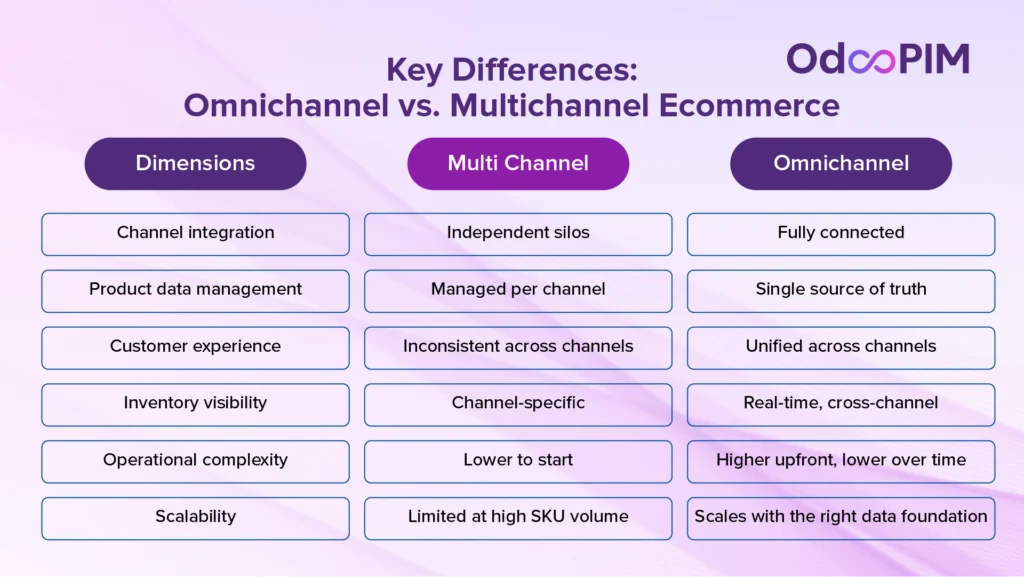
The distinction between omnichannel vs multichannel ecommerce boils down to connectivity, not channel count. Multichannel places products on multiple platforms with independent data, inventory, and customer experiences running in parallel silos. Omnichannel weaves those same platforms into a single integrated ecosystem where every channel pulls from shared product truth and real-time inventory. The multichannel ecommerce approach adds channels linearly, multiplying management effort with each new marketplace. Omnichannel adds channels exponentially while keeping operational complexity flat because the data foundation handles synchronization automatically. Choosing between them depends on whether your business can sustain fragmented operations at its current scale or needs connected systems to grow further.
Product Data in Multichannel
Product data in multichannel ecommerce lives in disconnected spreadsheets and platform-specific dashboards where a single SKU can carry five different descriptions across five channels. Updating a technical specification, compliance certificate, or pricing tier means manually editing each marketplace listing individually, inviting errors that compound with every channel addition. The multichannel ecommerce management burden grows linearly as teams duplicate enrichment work across Amazon, eBay, wholesale portals, and websites without shared attributes. This fragmentation makes consistent brand storytelling impossible when product truth scatters across siloed platforms. Without a centralized repository, data quality degrades proportionally to channel count.
Product Data in Omnichannel
Omnichannel product data flows from a single governed repository where one master record feeds enriched, channel-specific content to every sales endpoint automatically. A specification update made once propagates across your website, B2B portal, Amazon storefront, and distributor feeds without manual re-entry or copy-paste errors. This omnichannel ecommerce strategy enforces brand consistency while allowing channel-specific optimizations like marketplace-required attributes or regional compliance variations. The omnichannel vs multichannel ecommerce data gap widens as SKU counts climb, making centralized governance essential for accuracy at scale. Product data becomes an asset that accelerates channel expansion rather than a liability that constrains it.
Learn about Omnichannel Content Management
Forrester forecasts global online retail sales will grow from $4.4 trillion in 2023 to $6.8 trillion by 2028 (8.9% CAGR), making seamless omnichannel commerce a strategic priority for retailers.
– Forrester
Digital Transformation, Ecommerce, and Multichannel
Why Manufacturers Are Moving to More Channels
Manufacturers and distributors are adding sales channels at an accelerating pace to meet buyers where they research, compare, and purchase. B2B buyers now demand the same digital convenience they experience as consumers, pushing industrial brands onto marketplaces, distributor portals, and ecommerce storefronts simultaneously. This digital transformation ecommerce and multichannel momentum multiplies touchpoints while exposing the fragility of manual product data processes. Each new channel promises revenue growth but threatens operational chaos if product information lacks centralized governance. The pressure to expand channel presence without sacrificing data accuracy defines the modern manufacturing commerce challenge.
Where Digital Transformation Breaks Down Without a Data Foundation
Digital transformation initiatives collapse when manufacturers layer new sales channels on top of fragmented product data systems never designed for external syndication. Investing in a sleek B2B portal while feeding it spreadsheet-derived specifications produces a beautiful storefront displaying conflicting information that erodes buyer confidence. The omnichannel vs multichannel ecommerce dilemma intensifies as engineering teams maintain one set of specs, marketing publishes another, and distributor portals pull outdated versions from last quarter. Without a PIM anchoring the multichannel ecommerce expansion, digital transformation becomes expensive window dressing over chaotic data. The breakdown always traces back to a missing single source of truth.
The Role of Product Data in Channel Expansion
Product data quality determines whether channel expansion generates revenue or creates operational debt. Accurate, enriched, and consistent specifications accelerate listing creation across new marketplaces while preventing the errors that trigger returns and negative reviews. A centralized product record containing technical attributes, digital assets, and compliance documentation makes launching on a tenth channel as straightforward as launching on a third. The omnichannel ecommerce strategy depends entirely on product data readiness before adding touchpoints. Manufacturers who prioritize data governance during digital transformation ecommerce and multichannel rollouts scale profitably, while those who postpone it stall at the first integration hurdle.
Learn about Best Omnichannel Software for Ecommerce Brands

Omnichannel Ecommerce Strategy for Manufacturers and Distributors
Building a Channel-Ready Product Catalog
A channel-ready catalog begins with centralizing every attribute, specification, image, and compliance document into a single system designed for syndication. This master record contains enriched content above and beyond what any individual channel requires, allowing automatic extraction of channel-specific subsets without additional enrichment work. Building once and publishing everywhere transforms product data from a channel-launch bottleneck into a competitive speed advantage. The omnichannel ecommerce strategy foundation rests on complete, accurate, and governed product information that predates channel requirements. Manufacturers who invest in catalog readiness before expansion enter new markets without the typical data scramble.
Inventory and Order Management Across Channels
Real-time inventory synchronization prevents the revenue leakage that occurs when one channel sells stock already committed elsewhere. An omnichannel in ecommerce approach connects warehouse quantities to every sales endpoint, displaying accurate availability whether the buyer shops through a distributor portal or direct website. Order management consolidates across channels into a single fulfillment workflow, eliminating the dangerous practice of checking five dashboards to prevent overselling. This visibility lets manufacturers allocate inventory strategically, reserving stock for high-margin sales while servicing wholesale commitments. Connected inventory systems transform channel conflict into managed allocation.
When to Move from Multichannel to Omnichannel
The trigger for transitioning from multichannel ecommerce to an integrated omnichannel ecommerce strategy arrives when data inconsistency starts costing more than the integration investment. If your team spends hours each week manually updating listings across platforms, or overselling incidents erode marketplace metrics, the operational case for omnichannel has already materialized. Rapid SKU growth or plans to add multiple channels within a fiscal year make the shift urgent rather than optional. The omnichannel vs multichannel ecommerce calculation shifts decisively toward integration when channel count crosses the threshold where human coordination breaks down. Moving before that breaking point prevents the painful cleanup of fragmented product data scattered across disconnected platforms.
Multichannel Ecommerce Management at Scale
The Product Data Problem at High SKU Volume
High SKU volumes expose the mathematical impossibility of manual multichannel ecommerce management. A catalog of five thousand products with thirty attributes each, published across five channels, creates three-quarters of a million data points requiring synchronization every time specifications change. Spreadsheets crumble under this complexity, spawning version control nightmares where marketing, engineering, and sales teams reference different product truths. The multichannel ecommerce model that worked adequately at two hundred SKUs becomes an operational hazard at five thousand. Data fragmentation scales exponentially while human capacity to manage it remains flat.
Why Manual Management Breaks Down
Manual product data processes inject latency and error into every channel update cycle. A specification change originating in engineering might take weeks to propagate across sales channels when managed through email chains and shared drives. During that lag, customers encounter outdated technical data, discontinued items appear available, and compliance documentation references previous certifications. The omnichannel vs multichannel ecommerce comparison reveals manual management as the hidden cost center that grows with every channel addition. Human error rates multiply under high-volume, repetitive data entry, creating listing mistakes that damage marketplace standing and buyer trust.
How a Native PIM Solves Multichannel Management
A native Product Information Management system eliminates the multichannel ecommerce data burden by centralizing every attribute, asset, and specification into one governed hub. Rather than editing five platforms independently, a single master record update propagates enriched, channel-formatted content automatically to every sales endpoint. The PIM enforces completeness standards before syndication, preventing the incomplete listings that suppress marketplace visibility. For multichannel ecommerce management, native integration with existing ERP and ecommerce platforms removes the middleware tax that adds cost and complexity. The system transforms product data maintenance from a growing operational liability into an automated background function.
Learn about Omnichannel Order Management

How OdooPIM Supports Omnichannel and Multichannel Operations
Single Source of Truth for Product Data
OdooPIM centralizes every product attribute, digital asset, technical specification, and marketing description into one authoritative repository that feeds every channel. This single source of truth eliminates the version conflicts that plague multichannel ecommerce when teams maintain separate spreadsheets for different platforms. Engineering, marketing, and sales all contribute to and pull from the same governed product record, ensuring channel consistency without duplicate effort. The omnichannel ecommerce strategy depends on this centralized data foundation to synchronize every touchpoint. OdooPIM enforces validation rules that catch incomplete or conflicting data before it syndicates to marketplaces, preventing the errors manual processes inevitably introduce.
Native Odoo Integration: No Middleware Required
OdooPIM operates within the Odoo ecosystem, connecting product data to Odoo ERP, inventory, sales, and ecommerce modules without third-party middleware. This tight integration means inventory levels, order status, and customer data flow smoothly between back-office operations and sales channels. The native architecture eliminates the synchronization delays and data mapping complexities that middleware-dependent multichannel ecommerce management solutions introduce. Real-time data exchange between OdooPIM and Odoo’s native applications creates the connected infrastructure that powers omnichannel in ecommerce without adding integration tax. Manufacturers and distributors gain a unified operational core where product truth drives every function from warehouse to marketplace.
Channel Syndication Without Data Drift
OdooPIM syndicates enriched product content to every channel with automated formatting that respects platform-specific requirements while maintaining data consistency. Amazon receives optimized titles and backend search terms; distributor portals pull technical specifications; your B2B website displays complete marketing descriptions, all from the same master record. This syndication engine prevents the data drift that characterizes omnichannel vs multichannel ecommerce when disconnected systems gradually diverge. Channel-specific enrichment happens within the PIM rather than on individual platforms, preserving the single source of truth while accommodating marketplace requirements. Updates propagate universally, ensuring buyers encounter identical product information regardless of where they purchase.
Omnichannel vs. Multichannel: Which Is Right for Your Business?
Choose Multichannel If
Multichannel ecommerce fits businesses testing new markets with limited SKU counts and manageable channel complexity. Your team can handle manual listing updates across two or three platforms without data fragmentation causing customer-facing errors. The omnichannel vs multichannel ecommerce trade-off favors siloed channels when upfront integration investment outweighs the cost of current operational inefficiencies. Choose multichannel if your product catalog changes infrequently, keeping synchronization demands low enough for manual processes to sustain. This approach works as a starting point before scale forces the transition to connected systems.
Choose Omnichannel If
An omnichannel ecommerce strategy becomes essential when channel count or SKU volume makes manual data management unsustainable. You need real-time inventory visibility across platforms to prevent overselling and maintain marketplace performance metrics. The omnichannel in ecommerce investment pays for itself when listing errors, overselling incidents, and duplicate data entry consume measurable team hours weekly. Choose omnichannel if your growth trajectory includes adding channels, expanding catalogs, or entering regulated markets requiring precise compliance documentation. The model fits manufacturers who view product data as a strategic asset rather than an operational chore.
What Both Models Require
Regardless of where you sit on the omnichannel vs multichannel ecommerce spectrum, product data consistency determines whether either model succeeds. Every channel expansion, whether integrated or siloed, demands accurate specifications, complete attributes, and governed digital assets to convert browsers into buyers. Multichannel ecommerce management without data discipline collapses under its own weight as platforms multiply. An omnichannel ecommerce strategy without clean product data merely syndicates bad information faster and further. Both models depend on a centralized product truth that predates channel strategy, making PIM adoption the foundation upon which either approach stands or falls.

FAQ
1. What is the difference between omnichannel and multichannel ecommerce?
The omnichannel vs multichannel ecommerce distinction hinges on whether your sales channels communicate with each other. Multichannel ecommerce places products on multiple platforms where each operates as an independent silo with its own inventory data, pricing rules, and customer experience. Omnichannel in ecommerce connects those same platforms through a unified data layer, synchronizing product information and inventory in real time across every touchpoint. The difference lies not in how many channels you sell through but in how integrated those channels are. Multichannel expands reach through disconnected storefronts, while an omnichannel ecommerce strategy weaves them into one smooth ecosystem where every channel draws from shared product truth.
2. Which is better for manufacturers: omnichannel or multichannel ecommerce?
The answer depends on catalog complexity and growth trajectory. Multichannel ecommerce works for manufacturers testing new markets with limited SKU counts and manageable channel complexity where manual updates remain feasible. An omnichannel ecommerce strategy becomes essential when product catalogs grow beyond what spreadsheets can govern across multiple platforms. Manufacturers managing thousands of SKUs across distributor portals, direct websites, and marketplaces discover that omnichannel vs multichannel ecommerce stops being a theoretical debate and becomes an operational necessity. Connected systems prevent the overselling, listing errors, and data fragmentation that siloed channels inevitably produce at scale. The right model shifts from multichannel to omnichannel when data inconsistency starts costing more than integration investment.
3. How does product data management differ between omnichannel and multichannel ecommerce?
Product data in multichannel ecommerce lives in disconnected spreadsheets and platform-specific dashboards where a single SKU carries different descriptions across different channels. Updating a specification means manually editing each marketplace listing individually, multiplying effort and error probability with every channel addition. Multichannel ecommerce management without centralization forces teams to duplicate enrichment work endlessly. Omnichannel product data flows from a single governed repository where one master record feeds enriched content to every sales endpoint automatically. The omnichannel vs multichannel ecommerce data gap widens as SKU counts climb, making centralized governance the dividing line between scalable consistency and fragmented chaos.
4. What does digital transformation mean for multichannel ecommerce?
Digital transformation pushes manufacturers onto more sales channels simultaneously, multiplying touchpoints while exposing the fragility of manual product data processes. The digital transformation ecommerce and multichannel momentum demands that B2B brands meet buyers on distributor portals, marketplaces, and direct storefronts without sacrificing data accuracy. This transformation collapses when companies layer new channels on top of fragmented systems never designed for external syndication. Investing in sleek storefronts while feeding them spreadsheet-derived specifications produces beautiful platforms displaying conflicting information. True digital transformation ecommerce and multichannel success requires a centralized data foundation before channel expansion, turning product information from an operational liability into a growth asset that scales alongside new marketplace adoption.
5. How does a PIM system support an omnichannel ecommerce strategy?
A PIM centralizes every product attribute, digital asset, and specification into one governed hub that feeds the sales channels automatically. This single source of truth eliminates the version conflicts that plague multichannel ecommerce management when teams maintain separate spreadsheets for different platforms. A specification update made once propagates across your B2B portal, Amazon storefront, and distributor feeds without manual re-entry. The omnichannel ecommerce strategy depends entirely on this centralized data foundation to synchronize every touchpoint with consistent, enriched content. PIM enforcement rules catch incomplete or conflicting data before it syndicates outward, preventing the listing errors that erode buyer trust and marketplace standing across the omnichannel in ecommerce ecosystem.