
What Is PIM Syndication?
PIM syndication is the automated distribution of product data from your PIM system to the sales channels, your website, Amazon, Google Shopping, retailer portals, and distributor feeds. Product data syndication eliminates manual exports and reformatting by pushing updates in real time or on a schedule, with channel-specific transformations applied automatically. PIM content syndication ensures that a single change in your master catalog (a price update, a new description, a revised image) propagates everywhere simultaneously without copy-paste errors. Multichannel product syndication turns your PIM into the hub of your commerce ecosystem, feeding accurate, consistent product information to every customer touchpoint while your team focuses on strategy, not spreadsheet exports.
Simple Definition of Product Data Syndication
Product data syndication is the automated distribution of product information from one master source to multiple sales channels simultaneously. Instead of manually uploading CSV files to your website, Amazon, and Google Shopping separately, syndication pushes updates everywhere with one click. PIM syndication transforms your master data into channel-specific formats automatically. Amazon gets bullet points, your website gets long-form copy, Google Shopping gets structured feeds and all from the same source.
Without syndication, your team exports spreadsheets, reformats manually, and uploads to each channel one by one. With product information syndication software, a price change in your PIM updates every channel within minutes. Automated product data distribution eliminates manual work and the errors that come with it. PIM content syndication is not just about speed, it is about accuracy, one source, infinite outputs and zero copy-paste mistakes.
Learn about catalog management software.

How PIM Syndication Works Step by Step
First, your team enriches product data in the PIM. Add descriptions, upload images, set pricing, define variants. Product data syndication starts with a clean, complete master record. Second, you configure channel mapping rules. Tell the system how your master fields transform for each destination. Your “description” field becomes Amazon’s “bullet_points” with truncation. Your “price” field becomes Google’s “price” with currency formatting. PIM syndication applies these rules automatically during every export.
Third, you trigger syndication manually or on a schedule. Real-time for price and inventory changes. Scheduled for descriptions and images. Multichannel product syndication pushes data to your website via API, to Amazon via seller central integration, to Google via merchant center feeds. Fourth, the system validates before sending. Missing GTIN for Amazon? Blocked. Wrong image ratio for Google? Flagged. Product information syndication software checks every product against each channel’s requirements. Automated product data distribution only pushes clean data. Failed syndication log errors for your team to fix. Successes update channels automatically. Your team monitors dashboards, not upload progress bars.
What Types of Product Data Can Be Syndicated?
Base attributes syndicate first: SKU, name, price, description, weight, dimensions, and inventory levels. Product data syndication pushes these operational fields to every channel as the foundation of your product listing. Enriched content follows: SEO descriptions, lifestyle images, videos, comparison charts, and technical manuals. PIM content syndication handles rich media automatically, resizing images and converting formats per channel requirements. Amazon needs JPEGs under 10MB and your website accepts PNGs. The PIM handles both.
A single product needs Amazon bullet points, website long-form copy, Google Shopping structured data, and retailer portal specifications. PIM syndication stores one master record and applies transformation rules per destination. Relationship data completes the picture: variant matrices (a shirt in three sizes and four colors), compatibility links (which accessories work with which products), and upsell associations. Multichannel product syndication pushes these relationships too, so Amazon knows which products are frequently bought together. Product information syndication software ensures that customers see complete, connected product information wherever they shop.

Why Product Data Syndication Matters for Your Business
The Problem With Manual Product Data Distribution
Manual product data distribution means exporting spreadsheets from your ERP, reformatting for each channel, and uploading one by one. A price change requires logging into your website, Amazon, eBay, and Google Shopping separately. Product data syndication without automation guarantees errors. Someone forgets eBay, customers see the old price and complaints follow. PIM syndication eliminates this entire workflow. Update once in your PIM. All channels update automatically. Automated product data distribution turns hours of work into seconds.
A flash sale that requires price updates across ten channels becomes a nightmare of spreadsheet juggling. Multichannel product syndication with product information syndication software lets you update everything in one click. Your team stops being data entry clerks and starts focusing on strategy. The cost of manual distribution is not just labor, it is lost opportunities. Slow updates mean slow responses to market changes. Competitors with PIM content syndication move faster, manual processes cannot scale and automate before you fall behind.
How Inconsistent Product Data Hurts Sales and Returns
A product listing that shows different prices on your website versus Amazon confuses customers and erodes trust. Shoppers compare and they notice discrepancies. They buy from the competitor who got their data right. Product data syndication ensures consistency because every channel pulls from the same master source. PIM syndication eliminates the version drift that plagues manual uploads. Your website, Amazon, and Google Shopping all display the same price, same description, same specifications.
A dimension listed as 10 inches on your website but 9.5 inches on Amazon leads to customer disappointment and costly returns. Product information syndication software validates data before distribution, catching discrepancies before they reach customers. Multichannel product syndication applies the same validation rules to the channels. Automated product data distribution means one accurate master record, infinite accurate outputs. PIM content syndication reduces return rates by ensuring customers receive what they expect. Consistency is not just nice to have, but it impacts your bottom line.
Why Multichannel Selling Demands Automated Syndication
Selling on multiple channels manually is impossible at scale. Three channels might be manageable with spreadsheets. Ten channels becomes a nightmare. Multichannel product syndication automates what manual processes cannot handle. PIM syndication pushes product data to your website, Amazon, Google Shopping, eBay, Walmart, TikTok Shop, retailer portals, and distributor feeds from one interface. Add a new channel? Configure mapping rules once. The system handles distribution automatically. Product data syndication scales with your business.
Amazon needs bullet points and white-background images, Google Shopping needs structured feeds with GTINs and Walmart requires different category taxonomies. Product information syndication software manages these variations through channel-specific mapping rules. Your team defines rules once. Automated product data distribution applies them to every product. PIM content syndication transforms your master data for each destination automatically. Without automation, adding a new channel means weeks of manual setup and ongoing maintenance. With multichannel product syndication, it is a configuration change.
Learn about best PIM software in India

How PIM Syndication Works
1. Centralizing Product Data Before Syndication
PIM syndication starts with a single source of truth, one database holding every product attribute, image, and specification. Your team enriches data once in the PIM, not across spreadsheets or channel dashboards. Product data syndication without centralization fails because different channels receive different versions. Centralization ensures every channel pulls from the same master record, eliminating version drift and reconciliation work. Multichannel product syndication depends on this foundation.
2. Mapping Product Attributes for Each Channel
Channel mapping defines how your master fields transform for each destination. Your “description” field becomes Amazon’s “bullet_points” with truncation rules. The same field becomes your website’s “long_description” with no truncation. Product information syndication software stores these mapping rules in your PIM. Define once. Apply automatically to every product. PIM content syndication handles field name differences, format transformations, and value conversions. One master record and infinite channel-specific outputs.
3. Automating Product Data Distribution in Real Time
Automated product data distribution pushes changes instantly or on a schedule. Real-time sync for pricing and inventory. Scheduled sync for descriptions and images. When your team updates a price in the PIM, API calls trigger updates to your website, Amazon, and Google Shopping within seconds. Product data syndication with real-time automation means your channels never show stale data. No manual exports and no upload delays. PIM syndication turns channel updates from a daily chore into a background process.
4. Validating Data Quality Before Publishing
Validation rules block bad data before it reaches channels. Multichannel product syndication checks every product against each channel’s requirements before sending. Missing GTIN for Amazon? Blocked. Wrong image ratio for Google Shopping? Flagged. Inconsistent pricing across channels? Alert triggered. Product information syndication software displays validation errors clearly so your team knows what to fix. PIM content syndication ensures only clean, complete data is published. Automated product data distribution with validation shifts quality control from reactive cleanup to proactive prevention.
PIM solutions now support complex use cases, including product data syndication (PDS), product experience management (PXM), digital shelf analytics, and product data contextualization.
– Gartner
Key Benefits of PIM Syndication
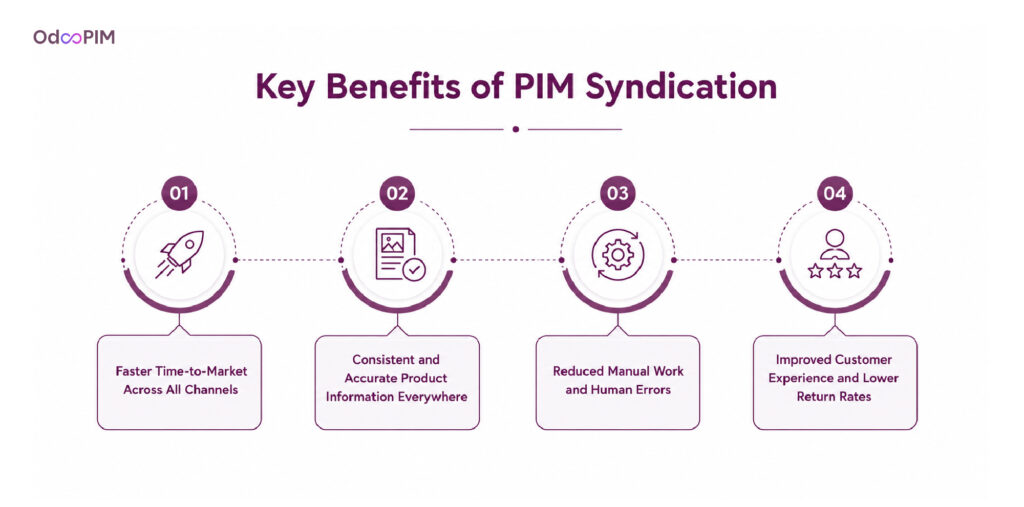
Faster Time-to-Market Across All Channels
PIM syndication collapses launch timelines from weeks to days. Your team enriches product data once in the PIM, then pushes to every channel simultaneously. Multichannel product syndication eliminates the manual per-channel uploads that delay launches. A seasonal collection that required two weeks of spreadsheet wrangling now goes live in two days. Automated product data distribution means your competitors are still reformatting CSV files while your products are already selling.
Consistent and Accurate Product Information Everywhere
Product data syndication ensures your website, Amazon, and Google Shopping all display the same price, description, and specifications. Every channel pulls from the same master source, eliminating version drift. PIM content syndication applies validation rules before distribution, catching discrepancies before they reach customers. Product information syndication software maintains consistency across dozens of channels automatically. Customers trust what they see because every touchpoint tells the same story.
Reduced Manual Work and Human Errors
Automated product data distribution replaces hours of manual CSV exports and reformatting with one click. Your team stops logging into ten different channel dashboards to update a single price. PIM syndication eliminates copy-paste errors because data flows from your PIM to channels without human intervention. Multichannel product syndication reduces manual work by 70-80%, freeing your team for strategic work. The labor savings alone often pay for the PIM subscription within months.
Improved Customer Experience and Lower Return Rates
Consistent, accurate product data means customers receive what they expect. Product data syndication ensures dimensions, colors, and specifications match across channels. PIM content syndication pushes rich descriptions and high-quality images that answer customer questions before purchase. Product information syndication software reduces return rates by eliminating the surprises caused by inconsistent or incomplete data. Automated product data distribution creates a smooth customer journey from discovery to delivery. Happy customers buy again, returns drop and trust grows.
Learn about composable commerce
Where Can You Syndicate Product Data With PIM?
eCommerce Platforms: Magento, Shopify, WooCommerce
PIM syndication pushes product data directly to your ecommerce platform via native connectors. Magento, Shopify, and WooCommerce receive real-time updates for descriptions, images, pricing, and inventory. Multichannel product syndication means a price change in your PIM reflects on your store within seconds, not days. Automated product data distribution eliminates manual CSV uploads and copy-paste errors. Your store stays accurate because every update flows automatically from your PIM.
Online Marketplaces: Amazon, eBay, Walmart
Product data syndication to marketplaces requires channel-specific formatting. Amazon needs bullet points and white-background images. eBay expects condition codes. Walmart demands different category taxonomies. PIM content syndication handles these transformations automatically. Define mapping rules once in your product information syndication software. The system applies them to every product. Automated product data distribution ensures your marketplace listings stay current without manual per-channel updates.
Retailer and Distributor Portals
Retail partners like Target, Best Buy, and Home Depot require product feeds in specific formats. PIM syndication generates these feeds automatically and pushes them via API, FTP, or retailer portals. Distributor portals need customer-specific pricing and product assortments. Multichannel product syndication creates role-based feeds where each partner sees only their approved products with their pricing. Product data syndication to portals eliminates the manual file exports that delay partner updates and cause errors.
Marketing and Social Media Channels
PIM content syndication pushes product data to Google Shopping, Facebook Catalog, Instagram Shopping, and TikTok Shop. Structured feeds require specific attributes, GTINs for Google, image ratios for Instagram. Product information syndication software handles these variations automatically. Automated product data distribution ensures your ads and social posts always reflect current pricing and availability. Multichannel product syndication extends beyond traditional ecommerce to every customer touchpoint. Your PIM becomes the engine for all product content, everywhere customers discover your brand.
PIM Syndication vs Manual Product Data Distribution
Time and Resource Cost Comparison
Manual product data distribution requires exporting from your ERP, reformatting for each channel, and uploading one by one. A single price update across five channels takes at least an hour. PIM syndication reduces that to one minute. Automated product data distribution cuts labor costs by 70-80%. A team of three spending fifteen hours weekly on manual distribution costs roughly $22,000 annually. Product information syndication software pays for itself within months through time saved.
Error Rate and Data Accuracy Comparison
A wrong formula in a spreadsheet, a forgotten channel, a typo in a description. Product data syndication with PIM content syndication applies validation rules before distribution, catching errors before they reach customers. Multichannel product syndication eliminates copy-paste mistakes because data flows from your PIM to channels without human intervention. Manual processes have error rates between 1-5% per product update. PIM syndication reduces error rates to near zero.
Scalability: Manual vs Automated Syndication
Manual syndication works at 100 products across two channels. It cracks at 1,000 products across five channels. Automated product data distribution scales linearly with your business. Add 10,000 products? The same workflows apply. Add ten new sales channels? Configure mapping rules once, and PIM syndication handles distribution automatically. Multichannel product syndication turns scaling from a hiring problem into a configuration change. Manual processes require headcount growth. Product information syndication software lets your catalog double without doubling your team.
How to Choose the Right PIM Syndication Software
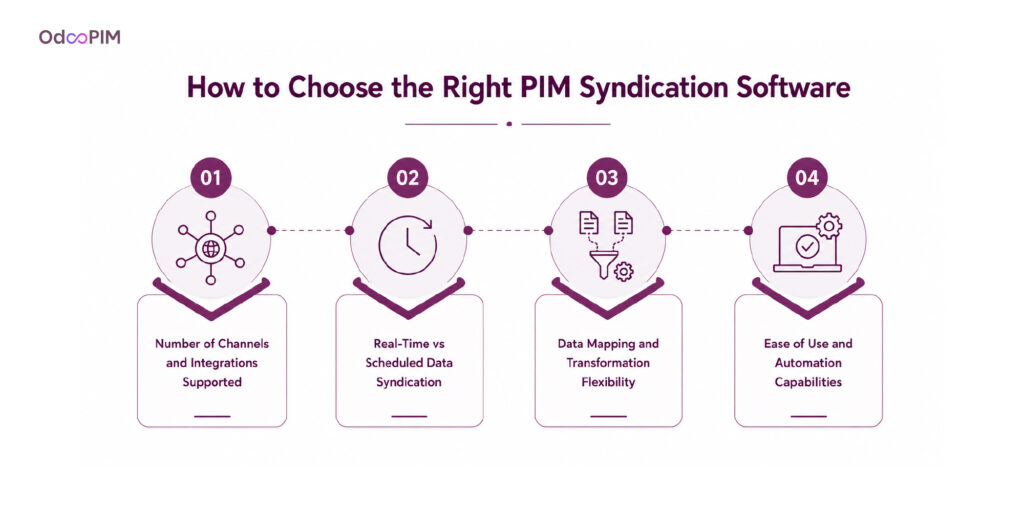
1. Number of Channels and Integrations Supported
List every channel you sell on today and plan to sell on tomorrow. Your PIM syndication software must include pre-built connectors for your ecommerce platform, marketplaces, and retailer portals. Multichannel product syndication requires native connections, not generic API access that forces your team to build and maintain custom code. Product information syndication software with rich connector libraries saves months of development work. Test each critical integration with your actual data before committing.
2. Real-Time vs Scheduled Data Syndication
Real-time product data syndication pushes changes instantly for pricing and inventory. Scheduled syndication works for descriptions and images. Your PIM syndication software should support both modes within the same platform. Automated product data distribution with real-time capabilities ensures customers see accurate availability and pricing immediately. Scheduled updates reduce API calls for less urgent content. PIM content syndication flexibility lets you balance speed and resource usage. Choose software that offers both options.
3. Data Mapping and Transformation Flexibility
Your master data format never matches every channel’s requirements perfectly. Product data syndication software must support field mapping, value transformation, and conditional logic. Map your “description” field to Amazon’s “bullet_points” with truncation rules. Convert “in_stock” from a boolean to “In Stock” text for Google Shopping. Multichannel product syndication with flexible mapping handles these variations without custom code. Product information syndication software that lacks transformation flexibility forces your team into endless manual reformatting.
4. Ease of Use and Automation Capabilities
Your marketing team needs to use PIM syndication without constant IT support. Product information syndication software should offer a clean interface for configuring channel mappings, scheduling updates, and monitoring sync status. Automated product data distribution with intuitive dashboards lets non-technical users manage syndication independently. PIM content syndication automation should include error notifications, retry logic, and validation reports. If your team needs a developer to change a channel mapping, you chose the wrong software. Ease of use determines whether syndication actually happens.
Why OdooPIM Is the Best Tool for Product Data Syndication
Built-In Multichannel Syndication With OdooPIM
PIM syndication in Odoo is not an add-on or third-party plugin, it is built directly into the platform. Your team configures channel mappings once, and multichannel product syndication pushes data to every destination automatically. Automated product data distribution from Odoo eliminates the need for separate syndication tools or middleware. Product information syndication software within Odoo handles your website, marketplaces, and retailer portals from one interface. No additional subscriptions and no connector headaches. Just built-in syndication.
Smooth Integration With eCommerce and Marketplace Platforms
Odoo includes native connectors for Magento, Shopify, WooCommerce, Amazon, eBay, and Google Shopping. Product data syndication to these platforms requires no custom code or third-party plugins. PIM content syndication from Odoo transforms your master data into channel-specific formats automatically. Amazon gets bullet points. Google gets structured feeds. Your website gets long-form copy. Multichannel product syndication with Odoo means one master record, infinite channel-specific outputs. Native integration wins over bolt-on connectors every time.
Real-Time Product Data Updates Across All Channels
PIM syndication in Odoo supports real-time updates for pricing and inventory, scheduled updates for descriptions and images. A price change in your Odoo ERP appears on your website, Amazon, and Google Shopping within seconds. Automated product data distribution with real-time sync ensures customers never see stale data. Product data syndication without real-time capabilities leaves gaps. Odoo delivers both modes. Multichannel product syndication with Odoo keeps every channel accurate, all the time. No delays and no discrepancies.
Affordable and Scalable PIM Syndication for Any Business Size
Enterprise product information syndication software costs 50,000 to 150,000 annually plus implementation. Odoo PIM adds to your existing Odoo subscription, typically 3,000 to 8,000 annually. PIM syndication at this price includes ERP, PIM, and all connectors. Automated product data distribution scales from 500 products to 500,000 products with the same workflows. Multichannel product syndication with Odoo grows with your business. Start with one channel and then add ten more. The platform handles it, enterprise power and small business pricing. That is the Odoo advantage.

Frequently Asked Questions
1. What Is the Difference Between PIM and Product Syndication?
PIM is the system that centralizes and enriches product data. Product data syndication is the process of distributing that data to sales channels. Think of PIM as your warehouse and syndication as your delivery trucks. PIM syndication without the PIM means you have nothing to distribute. A PIM without multichannel product syndication means your enriched data never reaches customers. Automated product data distribution is the final step that turns your PIM investment into channel results. You need both.
2. How Many Channels Can a PIM Syndicate To?
Most PIM syndication platforms support dozens of channels out of the box. Product information syndication software typically includes connectors for major ecommerce platforms (Shopify, Magento), marketplaces (Amazon, eBay, Walmart), comparison engines (Google Shopping), social commerce (Facebook, Instagram), and retailer portals. Multichannel product syndication scales further through APIs or custom feeds. The practical limit is determined by your product data syndication volume and update frequency, not platform constraints. PIM content syndication to twenty channels is routine. Some enterprises syndicate to hundreds. Quality of integration matters more than raw count.
3. Is PIM Syndication Only for Large Enterprises?
PIM syndication benefits businesses of any size that sell through multiple channels. A small brand selling on Shopify, Amazon, and Google Shopping needs multichannel product syndication just as much as a large enterprise. Automated product data distribution pays for itself through time saved and errors eliminated regardless of company size. Product data syndication software like Plytix or Odoo PIM offers affordable plans for small businesses. PIM content syndication scales with you. Start small. Add channels as you grow. The ROI calculation changes with channel count, not revenue. More than two channels? You need syndication. Company size does not matter.