What Is the Difference Between Pimcore, Akeneo, and OdooPIM?
OdooPIM: PIM built natively inside Odoo ERP
OdooPIM is the only PIM that runs natively on Odoo, no middleware, no API stitching, because product data, inventory, pricing, and orders share one database. No separate ERP connector to build or maintain. Built for B2B manufacturers, wholesalers, and distributors operating on Odoo.
Pimcore: open-core platform for data-heavy operations
Pimcore goes beyond PIM to cover DAM, MDM, DXP, and Commerce in one open-core platform. Highly configurable with 45+ data components, it is suited to organizations with in-house developer teams who need full control over data architecture across multiple domains, product, customer, supplier, and asset data. Community Edition is restricted to non-production use; enterprise scale requires significant developer investment.
Akeneo: PIM for omnichannel product experience
Akeneo is purpose-built for product experience management with native DAM in Product Cloud and 250+ marketplace connectors via Akeneo Activation. It is strong for marketing and merchandising teams managing large catalogs across regions and multiple languages. ERP integration requires a separate connector layer.

Key differences at a glance
| Feature | Pimcore | Akeneo | OdooPIM |
| Primary focus | PIM + DAM + MDM + DXP + Commerce | Product experience management | Native Odoo PIM + ERP |
| Deployment | Open-core (cloud, on-premise, PaaS) | SaaS + Community Edition | Native Odoo module |
| Developer dependency | High, custom config required | Medium, business-user friendly | Low (if already on Odoo) |
| ERP integration | Custom API development | Via connector | Native, zero middleware |
| DAM | Native | Native (Product Cloud) | Via Odoo Documents |
| Open source | Yes (Community Edition) | Yes (Community Edition) | Odoo open-source base |
| Best for | Dev-heavy, multi-domain data teams | Mid-market to enterprise brands | B2B Odoo users |
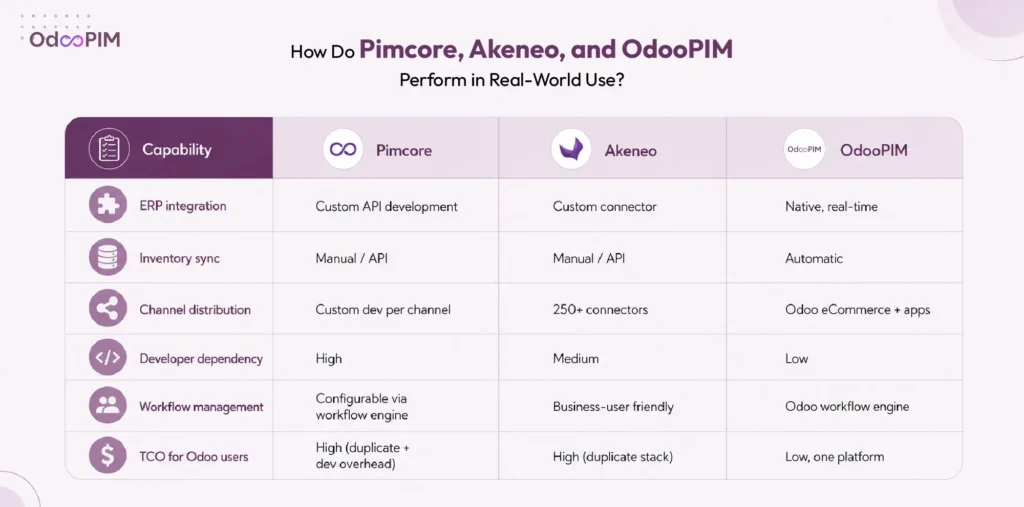
How Do Pimcore, Akeneo, and OdooPIM Perform in Real-World Use?
The operational reality of these three platforms reveals that open-source flexibility comes with hidden costs, developer time, custom maintenance, and integration upkeep that business-user-friendly solutions abstract away. Pimcore offers unlimited customization but requires serious engineering resources for hosting, security updates, and troubleshooting. Akeneo balances flexibility with business-user-friendly interfaces, but advanced features and customizations still require developer resources. OdooPIM connectors eliminates technical overhead for Odoo users, because product data, inventory, and orders share one database with no custom code required. The choice is not about which platform has the most features, it is about how much developer overhead your team can sustain.
Product data enrichment and completeness
Pimcore offers unlimited customization potential with complete control over data models, validation rules, and enrichment workflows through its platform’s underlying architecture. Akeneo provides AI-Enhanced Enrichment, rule engine automation, and business-user-friendly workflows that enable non-technical teams to manage product data independently. OdooPIM uses AI product data enrichment with validation rules and completeness checks applied before products move to syndication.
ERP and inventory sync
Pimcore requires custom API development for ERP integration, with no pre-built connectors and significant developer investment to maintain ongoing sync reliability. Akeneo syncs with ERPs through its connector marketplace but requires a separate integration layer and careful management. OdooPIM eliminates this entirely, product data, inventory, pricing, and orders share one database with zero middleware.
Developer dependency and maintenance overhead
Pimcore has high developer dependency because self-hosting requires engineering resources for server maintenance, security patches, upgrades, and troubleshooting. Akeneo has medium developer dependency, Community Edition requires self-hosting maintenance, while Enterprise Edition is managed but still requires integration work. OdooPIM has low developer dependency for Odoo users because the PIM runs as a native module on the existing Odoo instance.
Channel distribution and syndication
Pimcore requires custom development per channel because syndication must be built using its API and data modeling capabilities. Akeneo offers 250+ pre-built connectors for omnichannel distribution but each connector must be configured and maintained. OdooPIM distributes via Odoo eCommerce and native apps, with channel mapping and transformation rules defined once and applied automatically.
Implementation and onboarding effort
Pimcore implementations require significant developer investment for data modeling, custom workflows, and channel integration, with timelines often spanning months to years. Akeneo implementations with a mid-size deployment take four months with an integration partner. OdooPIM activates in minutes for existing Odoo users, install the module, configure settings, import your product base, and start enriching.
Learn about Quable vs Akeneo vs OdooPIM

Pimcore vs Akeneo vs OdooPIM: Which PIM is Right for Your Business?
Choose OdooPIM if…
- You are on Odoo ERP or actively evaluating it, and you want your PIM to share the same database as your inventory, accounting, and sales modules.
- You need PIM, inventory, and order management as one unified system with no middleware, no API stitching, and no custom connectors to maintain.
- You want to avoid the developer overhead that comes with maintaining an open-source or open-core platform, no custom API development, no connector maintenance, no security patching.
- You are a B2B manufacturer, wholesaler, or distributor with multi-SKU catalogs and complex variants that require seamless ERP-PIM integration for accurate inventory and pricing.
- You want the fastest time-to-value and lowest total cost of ownership for a PIM that activates in minutes, not months.
Choose Pimcore if…
- You need a single platform to manage product, customer, supplier, and asset data across multiple domains, extending beyond PIM into DAM, MDM, DXP, and Commerce.
- Your organization has strong in-house developer resources and wants full architectural control with unlimited customization potential.
- Deployment flexibility matters, you need the ability to run on-premise, cloud, or PaaS depending on compliance and infrastructure requirements.
- You are managing complex data governance requirements across an enterprise-scale operation with thousands of users and multiple data domains.
- You have the engineering capacity to handle custom API development, ongoing maintenance, and security updates for a self-hosted platform.
Choose Akeneo if…
- Your primary goal is product data enrichment and consistent omnichannel activation across multiple regions and sales channels.
- Marketing and merchandising teams need to manage product data independently without IT involvement, with business-user-friendly enrichment and approval workflows.
- You want a broad marketplace of 250+ ready-made connectors to reduce integration time for ecommerce and marketplace channels.
- You need both B2C and B2B product experiences with advanced product modeling across complex catalogs and multiple languages.
- You have the technical resources for an open-source Community Edition or the budget for enterprise-grade Akeneo with workflow automation.
Learn about best free PIM software

Where Your Search Ends: Why Odoo-Native PIM Wins for B2B
Pimcore is a powerful platform for organizations that need to manage product, customer, supplier, and asset data across multiple domains, but it requires significant developer investment to reach production-ready performance and maintain custom integrations. Akeneo is a strong PIM for omnichannel product experience with a large connector ecosystem, but it creates a second system that must be integrated and maintained alongside your ERP. Both platforms require ongoing developer overhead for custom API development, connector maintenance, security patching, and upgrade management.
For B2B businesses on Odoo, OdooPIM removes that entirely. Product data, inventory, pricing, and orders run on one instance, no sync lag, no duplicate maintenance, no hidden developer cost. No custom API development, no connector maintenance and no data drift between PIM and ERP because there is only one database.
Pimcore and Akeneo ask you to build and maintain integrations between your PIM and your ERP. OdooPIM asks you to enrich product data where your business already runs, inside Odoo. If you are a B2B manufacturer, wholesaler, or distributor already on Odoo or evaluating it, OdooPIM is not just a pimcore alternative or an akeneo alternative. It is the PIM that eliminates the integration overhead you would otherwise carry with any open-source or standalone solution because there is no second system to maintain. See OdooPIM in action. Book a Demo
Learn about OdooPIM vs Traditional PIM
FAQ’s
1. What is the main difference between Pimcore and Akeneo PIM?
The core difference is scope versus focus. Pimcore is an open-core platform that combines PIM, DAM, MDM, DXP/CMS, and digital commerce into a single system. It is designed for organizations with complex data requirements spanning multiple domains, product, customer, supplier, and asset data. Akeneo, by contrast, is a purpose-built PIM that focuses exclusively on product experience management, with a large connector ecosystem and a business-user-friendly interface for marketing and merchandising teams. Akeneo Community Edition is an open-source PIM, while Pimcore Community Edition has commercial restrictions for companies with revenue above €5 million. Pimcore suits developer-heavy organizations needing architectural control; Akeneo suits teams wanting a dedicated, user-friendly PIM with upgrade paths to commercial features.
2. Is Pimcore really free to use?
Pimcore Community Edition is free to download and use, but only for companies with annual revenue under €5 million. Above that threshold, you must purchase a paid Professional or Enterprise Edition. The source code is available, but the licensing model means it is not completely free for larger businesses. By contrast, Akeneo Community Edition has no revenue restrictions and is free to self-host, though advanced features (DAM, workflow automation, granular permissions) require paid tiers.
3. Which PIM is better for complex product catalogs?
For complex product catalogs, Pimcore offers a highly flexible data model with no fixed schema restrictions, making it suitable for industrial, automotive, and manufacturing use cases with thousands of attributes and compatibility rules. However, Pimcore requires significant developer resources to configure and maintain. Akeneo also handles complex catalogs well with attribute families, reference entities, and multi-language support, but its data model is less flexible than open-architecture platforms. Akeneo’s business-user-friendly interface makes it easier for merchandising teams to manage complex data without heavy developer involvement. For B2B manufacturers needing native ERP integration, OdooPIM is the strongest choice because product data, inventory, pricing, and orders share one database with zero middleware.
4. How much developer effort is required for Pimcore vs Akeneo?
Pimcore requires high developer dependency and is not an “out-of-the-box” product like Akeneo. You need experienced developers to configure, implement, and maintain the platform. Custom API development is required for ERP integration, and syndication per channel requires custom development. Akeneo has medium developer dependency. The Community Edition requires self-hosting maintenance, but the interface is business-user-friendly, with marketing teams able to manage product data without IT involvement. Enterprise SaaS tiers further reduce developer overhead. For Odoo users, OdooPIM has low developer dependency because the PIM runs as a native module on the existing Odoo instance.
5. Can Pimcore replace a dedicated DAM and CMS?
Pimcore can replace dedicated DAM and CMS because it bundles PIM, DAM, MDM, CDP, DXP/CMS, and commerce capabilities in one platform. Pimcore’s DAM module stores, organizes, and distributes digital files with previews, metadata, and version control. The DXP/CMS module manages websites, landing pages, and multi-site/multi-language setups. Akeneo offers native DAM only in paid Enterprise editions (Product Cloud), and the Community Edition has no DAM module. For organizations needing a single platform to manage product data, digital assets, and web content, Pimcore is one of the few options covering all three. However, this breadth comes with complexity: Pimcore is a platform you build on, not one you configure through a UI.