Why Odoo Users Look for a PIM Connector in the First Place
What Odoo’s Native Product Model Does Well
Odoo’s product model excels at operational data management, inventory tracking, procurement costs, SKU identifiers, bill of materials structures, and pricing rules that keep business operations running efficiently. The native product fields handle the transactional backbone that manufacturers and distributors depend on daily, providing real-time stock visibility and accurate cost calculations across warehouses and sales orders. Odoo’s product variant system manages configurable products with attributes like size and color, supporting the operational complexity of multi-SKU catalogs. The platform connects product data directly to purchasing, manufacturing, and accounting workflows within a unified environment. This operational strength makes Odoo the system of record for business transactions, but it does not address the marketing content layer that customers require.
Where It Runs Out of Road
Odoo’s native product model lacks the enrichment capabilities, marketing content workflows, and channel-specific formatting that modern commerce demands across multiple sales channels. The platform provides basic description fields but no structured enrichment workflows where marketing teams collaborate on long-form copy, localized content, or SEO-optimized product narratives. Odoo cannot automatically format product data for Amazon’s category schemas, Walmart’s item specifications, or distributor portal requirements. There is no completeness scoring to ensure every product record carries the attributes, digital assets, and descriptions required for effective selling. Odoo product information management gaps become apparent when organizations need governed enrichment workflows, channel syndication, and the data quality enforcement that prevents listing errors.
The Moment Teams Start Searching for a Connector
The trigger for seeking an OdooPIM connector or alternative OdooPIM integration mostly arrives when a business adds a second sales channel, expands into a new language, or must deliver a marketplace product feed. A manufacturer selling through their website and Amazon suddenly discovers Odoo cannot format product data for both channels simultaneously. The search for a connector begins when marketing teams exhaust their capacity to manually reformat product data for each platform. Odoo users evaluating the best PIM for Odoo realize they need governed enrichment and automated syndication when product data errors start causing marketplace warnings or customer complaints. The connector search represents the moment Odoo’s operational excellence no longer compensates for its product content limitations.
Learn about PIM Marketing

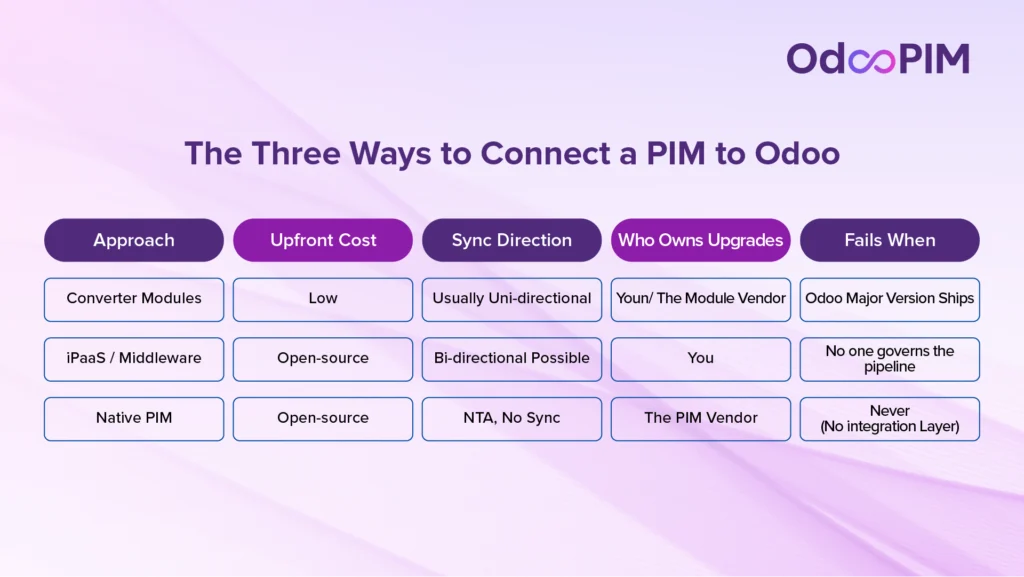
The Three Ways to Connect a PIM to Odoo
Third-Party Connector Modules
Third-party connector modules available through the Odoo Apps Store or vendors like Webkul offer the lowest upfront cost path to connecting an external PIM to Odoo. These modules provide pre-built field mappings and scheduled synchronization jobs that transfer product data between systems. The approach appears economical initially but introduces dependency on the module vendor for updates, compatibility patches, and bug fixes. When Odoo ships a major version upgrade, connector modules frequently break as underlying APIs and data models change. Organizations selecting this path must budget for ongoing module maintenance and accept that connector support may lag behind Odoo’s release cycle.
iPaaS and Middleware
iPaaS solutions like Make, Boomi, or Splash Sync provide flexible middleware that connects Akeneo or other PIM platforms to Odoo through configurable integration pipelines. This approach handles complex data flows, supports bi-directional synchronization, and accommodates non-standard product data structures. The flexibility demands governance discipline, organizations must assign ownership for testing pipelines, monitoring synchronization health, and updating mappings when either connected system changes. Without dedicated integration ownership, iPaaS pipelines degrade silently until product data inconsistencies surface in customer-facing channels. The Akeneo Odoo connector approach through middleware offers powerful capabilities but requires sustained operational commitment.
Native PIM Inside Odoo
OdooPIM delivers Odoo product information management by operating natively within the Odoo framework, sharing the same database as inventory, pricing, and sales modules without any connector or synchronization layer. There is no middleware to maintain, no field mappings to configure, and no synchronization jobs to monitor because product data governance happens within the same platform as business operations. This native architecture makes OdooPIM the best PIM for Odoo because it eliminates the integration failure points that define every connector-based approach. Product data, inventory levels, and enriched content exist in one governed environment accessible to every team. OdooPIM represents the Akeneo alternative that removes the connector conversation from product information management.
Learn about Pimcore vs Akeneo vs OdooPIM
The Akeneo-Odoo Connector: What It Actually Does (and Doesn’t)
How the Integration Works in Practice
Akeneo serves as a sophisticated PIM where teams enrich product data with marketing content, manage complex attribute structures, and govern multi-language catalogs before exporting to downstream systems. The integration with Odoo mostly involves exporting enriched attributes, product families, categories, product models, and associations from Akeneo to Odoo through manual jobs or scheduled cron processes. This export-based architecture means product data flows from Akeneo to Odoo at defined intervals rather than in real time. The Akeneo Odoo connector translates Akeneo’s data structures into Odoo-compatible formats through field mappings configured during implementation. Organizations must decide whether Odoo remains the operational system of record while Akeneo becomes the enrichment layer, a division of responsibility that requires governance.
What It Handles Well
Akeneo excels at managing large multi-language catalogs with rule-driven enrichment workflows that automate attribute population across massive product ranges. The platform provides mature workflow capabilities, completeness scoring, and channel-specific content preparation that serve enterprise-scale product data operations effectively. Teams managing complex product hierarchies and variant structures benefit from Akeneo’s flexible data modeling and attribute inheritance capabilities. The best PIM for Odoo connector discussions often acknowledge Akeneo’s strength in serving organizations with product data teams and substantial enrichment requirements. Akeneo’s ecosystem includes robust marketplace syndication and digital asset management that complement its core enrichment capabilities.
The Honest Limitations
Akeneo does not provide a vendor-maintained native Odoo connector, meaning integration depends on third-party modules, custom development, or iPaaS middleware that the PIM vendor does not own or support. Attribute type coverage during export remains partial, with some complex Odoo field types not mapping cleanly to Akeneo’s export formats. Bi-directional synchronization requires manual field ownership decisions about which system controls which attributes, a governance challenge that complicates ongoing operations. Odoo version upgrades routinely break third-party connectors, requiring re-testing and re-configuration that falls outside both Akeneo’s and Odoo’s support boundaries. Any Akeneo alternative evaluation must verify connector compatibility with the specific Odoo version currently deployed and the upgrade path planned.
Learn about Pimcore vs Akeneo vs OdooPIM

Other PIM Options Odoo Teams Should Know About
1. OdooPIM
OdooPIM is the only PIM on this list built natively inside Odoo, so there is no connector, middleware, or third-party module sitting between your product data and your ERP. Product onboarding, AI enrichment, catalog management, governance, and omnichannel publishing all run in the same system as inventory, sales, and accounting—eliminating the sync lag and upgrade risk that connector-based platforms carry. It handles complex variant hierarchies and deeply nested B2B product relationships without the strain mid-market connectors hit, and scales from thousands to millions of SKUs. Because it shares Odoo’s data model rather than mapping to it, implementation avoids the custom API development and integration governance overhead that Pimcore, Salsify, and Contentserv require. For teams already running Odoo, OdooPIM offers the shortest path to a governed source of truth—no separate login, no external dependency, no data leaving the system.
2. Sales Layer
Sales Layer offers a native Odoo connector with rapid onboarding that appeals to mid-market organizations seeking quick time-to-value. The platform provides straightforward enrichment workflows and channel syndication capabilities. Sales Layer’s connector approach reduces initial implementation complexity compared to custom integration projects. The platform can strain when handling complex variant hierarchies and deeply nested product relationships common in B2B catalogs. Organizations evaluating Odoo product information management should assess Sales Layer against their product complexity requirements.
3. Pimcore
Pimcore delivers an open-source platform combining PIM, DAM, and MDM capabilities in a unified digital experience framework. The platform provides exceptional data model flexibility for organizations with unique product structures. Pimcore demands significant engineering investment for implementation, customization, and ongoing maintenance. The open-source model appeals to technically sophisticated teams with dedicated development resources. The platform integrates with Odoo through custom API development rather than pre-built connectors, adding implementation complexity.
4. UnoPIM
UnoPIM provides open-source PIM capabilities with connectors available through the same module ecosystem that serves Akeneo integrations. The platform offers core product information management features without licensing costs. UnoPIM’s connector approach introduces the same third-party dependency and upgrade risk as Akeneo connector modules. Organizations selecting UnoPIM as their Akeneo alternative must manage the same integration governance challenges. The platform suits capable teams seeking open-source flexibility with Odoo connectivity.
5. Salsify / Contentserv
Salsify and Contentserv deliver enterprise-tier PIM platforms focused on brand manufacturers and retailer syndication. These platforms provide sophisticated digital shelf analytics and channel content optimization. The enterprise positioning typically exceeds mid-market budget and complexity requirements. Odoo integration depends on custom API development or iPaaS middleware. These platforms serve large-scale operations where syndication complexity justifies the investment level.
Building It In-House on the Odoo API
Custom-building product enrichment on Odoo’s API provides maximum flexibility for unique requirements that commercial platforms cannot accommodate. This approach demands sustained engineering investment for development, maintenance, and ongoing feature enhancement. In-house solutions rarely match the workflow sophistication, channel connectors, and governance capabilities of purpose-built PIM platforms. The approach proves defensible only when unique business processes justify the development investment. Most organizations discover that OdooPIM delivers the OdooPIM integration benefits they seek without the development burden of custom solutions.
Learn about pim for furniture retailers

The Hidden Cost Nobody Prices In: Odoo’s Upgrade Cycle
Odoo Ships a Major Version Annually and APIs Move
Odoo’s annual major version release cycle introduces API changes, data model modifications, and field-level updates that cascade through every connected system. Each upgrade potentially breaks the field mappings, attribute definitions, and authentication mechanisms that connector-based integrations depend upon. The OdooPIM connector or any third-party integration must be retested and often reworked against each new Odoo version. Organizations discover that connector maintenance becomes an annual operational expense rather than a one-time implementation cost. OdooPIM eliminates this cycle entirely because native OdooPIM integration upgrades with the Odoo platform itself.
What Breaks
Field mappings between external PIM data models and Odoo’s evolving product fields represent the most common upgrade casualty. Custom attribute types created in Odoo may not survive version migrations, breaking the data structures that connectors depend upon. Scheduled synchronization jobs and cron processes frequently fail after upgrades as authentication tokens expire or API endpoints shift. The best PIM for Odoo evaluations often overlook these recurring failure points until the first post-upgrade integration outage occurs. Organizations running connector-based PIM architectures must budget for annual re-testing and remediation cycles.
The Maintenance Question to Ask Every Connector Vendor
Every organization evaluating an OdooPIM connector must ask vendors: “Who re-tests this integration after each Odoo major version release, and is that testing included in the license or billed as a change request?” Third-party module vendors may not commit to compatibility timelines aligned with Odoo’s release schedule. iPaaS pipeline ownership questions reveal whether anyone in your organization has clear responsibility for integration health. The answer to this question determines whether connector maintenance becomes a predictable operational cost or an unpredictable source of production emergencies. OdooPIM eliminates this question because native architecture means the platform upgrades with Odoo automatically.
A Three-Year TCO Framing
The cost of connector-based PIM includes the PIM license, connector license or middleware subscription, initial integration build, annual rework for Odoo upgrades, and downtime during synchronization failures. Over three years, these accumulated costs often exceed the investment in native Odoo product information management. Organizations comparing the best PIM for Odoo must calculate fully loaded costs rather than comparing license fees alone. OdooPIM’s native architecture eliminates the recurring integration costs that dominate connector-based TCO calculations. The three-year view transforms the Akeneo alternative decision from a feature comparison into an architectural cost analysis.
How to Choose: A Decision Checklist for Odoo Teams
Do You Need Bi-Directional Sync, or Is One-Way Enrichment Enough?
Determine whether enriched product data must flow back into Odoo from the PIM or whether one-way enrichment feeding channels suffices. Bi-directional synchronization increases connector complexity, governance requirements, and failure scenarios. One-way enrichment simplifies architecture but may leave Odoo with outdated product content. OdooPIM integration eliminates this question because native architecture provides real-time access to enriched data without synchronization. Your sync requirements determine which connector approach can serve your business.
Is the Connector Maintained by the PIM Vendor or by a Third Party?
Vendor-maintained connectors carry accountability advantages that third-party modules lack, particularly when either connected platform releases major updates. Third-party connectors introduce dependency on organizations that may shift priorities or discontinue support. The OdooPIM connector ecosystem relies predominantly on third-party bridges. OdooPIM removes this question by providing PIM capabilities maintained as part of the Odoo platform. Connector maintenance ownership directly impacts long-term operational reliability.
Who Owns Each Field, Odoo or the PIM?
Define which system holds authority for each product attribute to prevent the conflicts that occur when both systems attempt to update the same fields. Field ownership ambiguity causes more integration failures than any other single factor in connector-based architectures. The best PIM for Odoo deployments establish clear data stewardship rules before implementation. OdooPIM resolves the field ownership question natively because product data exists in one governed environment. Document field ownership decisions regardless of which PIM approach you select.
Do Your Product Variants Fit the Connector’s Model?
Verify that the connector or integration approach handles your variant structures, attribute inheritance patterns, and product relationship complexity. Many connectors strain under nested BOM structures, configurable products, or complex variant hierarchies. The Odoo product information management approach must accommodate your actual product complexity rather than simplified use cases. OdooPIM handles Odoo-native variant structures directly because it operates on the same data model. Variant compatibility testing during evaluation prevents post-implementation restructuring.
What’s Your Odoo Upgrade Cadence, and Who Tests the Integration Against It?
Define your organization’s Odoo upgrade schedule and identify who bears responsibility for testing connector compatibility against each new version. Organizations following Odoo’s annual upgrade cycle face recurring integration validation requirements. The Akeneo alternative decision must account for this ongoing operational burden. OdooPIM upgrades with the Odoo platform automatically, eliminating separate integration testing. Upgrade accountability directly determines whether connector maintenance becomes routine or crisis-driven.

FAQ’s
1. Is there an official Odoo PIM connector?
Odoo does not provide an official standalone PIM connector because the platform’s native product model handles operational data rather than the enrichment, syndication, and governance capabilities that dedicated PIM platforms deliver. The Odoo Apps Store contains third-party connector modules, but these are community or vendor-maintained rather than officially supported by Odoo SA. Organizations seeking Odoo product information management without integration complexity choose OdooPIM, which operates natively within the Odoo framework rather than requiring a connector at all. The absence of an official connector reinforces the architectural advantage of native OdooPIM integration over external platforms that depend on third-party bridges. OdooPIM effectively serves as the official PIM capability within Odoo, delivering governed product data management without any connector dependency.
2. Can Akeneo integrate with Odoo?
Akeneo integrates with Odoo through third-party connector modules, custom API development, or iPaaS middleware solutions, but the integration is not maintained by Akeneo themselves as an official product feature. The Akeneo Odoo connector approach typically exports enriched product data from Akeneo to Odoo on scheduled intervals, creating synchronization latency between the two systems. Field mappings must be configured manually, and attribute type coverage remains partial during export. Organizations implementing this integration accept ongoing connector maintenance responsibility and vulnerability to breakage during Odoo version upgrades. OdooPIM eliminates these integration challenges as the Akeneo alternative that provides PIM capabilities without any connector, middleware, or synchronization layer required.
3. What are the alternatives to Akeneo for Odoo users?
OdooPIM stands as the primary Akeneo alternative for Odoo users, delivering native Odoo product information management that operates on the same database and data model as Odoo ERP without any integration layer. Other alternatives include Sales Layer with its native Odoo connector, Pimcore offering PIM combined with DAM capabilities, and UnoPIM providing PIM through the same module ecosystem as Akeneo. Salsify and Contentserv serve enterprise requirements but typically exceed mid-market budgets. iPaaS solutions like Make or Boomi can connect any PIM to Odoo but introduce governance complexity. OdooPIM represents the best PIM for Odoo because it eliminates the connector conversation while delivering the enrichment workflows, channel syndication, and data governance that growing commerce operations require.
4. What happens to my PIM connector when Odoo releases a new version?
Odoo’s annual major version releases routinely break third-party connector modules as APIs change, data models evolve, and authentication mechanisms update, requiring immediate retesting and often significant rework. Field mappings configured for one Odoo version may not survive migration, leaving synchronization pipelines silently broken until data inconsistencies surface in customer-facing channels. Third-party module vendors may not guarantee compatibility timelines aligned with Odoo’s release schedule, creating operational risk during upgrade cycles. Organizations running connector-based PIM architectures must budget for annual integration rework as a recurring operating expense. OdooPIM eliminates this vulnerability entirely because native OdooPIM integration upgrades with the Odoo platform automatically, requiring no separate connector testing or remediation after version releases.
5. Do I need a PIM if I already run Odoo?
Odoo handles operational product data efficiently, inventory, pricing, procurement, but lacks the enrichment workflows, channel syndication, completeness scoring, and marketing content governance that multi-channel commerce demands. Organizations selling through multiple channels, managing complex product catalogs, or requiring localized product content discover that Odoo’s native product fields cannot deliver the customer-ready product experiences modern buyers expect. The trigger for needing PIM arrives when marketing teams exhaust their capacity to manually format product data for different platforms or when listing errors damage marketplace standing. Odoo product information management through OdooPIM extends Odoo’s native capabilities with full PIM functionality operating on the same data model without any connector. OdooPIM provides the best PIM for Odoo by delivering governed enrichment, automated syndication, and data quality enforcement within the operational platform teams use daily.