Ecommerce brands are drowning in product data scattered across spreadsheets, ERPs, and email threads. Catalog content management is the discipline of centralizing, enriching, and distributing that fragmented product information so customers see complete, accurate listings everywhere they shop. Without it, teams waste hours reconciling spreadsheets and fixing inconsistent listings across channels.
Digital catalog management includes product data enrichment, automatically filling missing attributes and generating SEO-friendly descriptions. Multichannel product catalog capabilities then push that enriched data to Shopify, Amazon, and wholesale portals simultaneously. Catalog syndication ensures that when you update a product in your centralized product data repository, every sales channel reflects that change instantly. No manual exports, no version conflicts.
For ecommerce brands managing hundreds of SKUs across multiple channels, ecommerce catalog management isn’t optional, it’s essential infrastructure for scaling without breaking. Product catalog management transforms chaos into structure, replacing manual processes with automated workflows. The alternative is spreadsheets, errors, and lost revenue. The choice is yours.
What Is Catalog Content Management?
Catalog content management is the practice of creating, enriching, and distributing every piece of product information across your sales channels. “Content” means titles, descriptions, technical specs, attributes, images, videos, and metadata, everything a customer needs to buy. Unlike a CMS that manages blog posts, catalog content management focuses on product data. Product content management replaces manual spreadsheet work with automated product data enrichment, filling missing attributes and flagging incomplete listings before they reach customers.
OdooPIM is a purpose-built catalog content management solution for ecommerce businesses. It delivers centralized product data, multichannel product catalog capabilities, and catalog syndication to Shopify, Amazon, and wholesale portals from one interface. Ecommerce catalog management without this discipline guarantees errors, returns, and lost trust. Digital catalog management transforms chaos into structure, without adding another disconnected tool to your stack.
Catalog Content Management vs. Product Information Management (PIM): What’s the Difference?
The terms are related but not interchangeable. Catalog content management is the practice, the discipline of creating, enriching, and distributing product information across sales channels. Product content management focuses on the quality and completeness of what customers see, titles, descriptions, images, specifications. Ecommerce catalog management is what you do. A PIM (Product Information Management) is the system that enables you to do it at scale.
Think of it this way: digital catalog management without a PIM means spreadsheets, manual exports, and version conflicts. With a PIM, you automate product data enrichment, enforce governance, and syndicate to every channel from one centralized product data repository. Catalog syndication becomes systematic rather than manual. Multichannel product catalog management becomes possible without a full-time spreadsheet administrator.
Product catalog management is the outcome. PIM is the engine. When you search for catalog content management solutions, you’re looking for a PIM that handles your specific channels, catalog size, and operational complexity. For ecommerce brands, the distinction matters because choosing the right tool starts with understanding what you actually need, the practice or the system that powers it. Most growing merchants need both, and that means evaluating PIMs, not just workflows.
Learn about Catalog management software.

Why Catalog Content Management Is Critical for Ecommerce Success
Poor catalog content management damages your bottom line. Inconsistent product data across channels confuses customers and drives returns. Missing attributes force shoppers to guess, they abandon carts instead of taking chances. According to recent research, two-thirds of consumers have abandoned a significant purchase because product information was missing or inaccurate. Another study found that two-fifths of shoppers returned products because details didn’t match reality.
The business impact is measurable and severe:
- Inconsistent data across channels → customers lose trust when your Shopify listing differs from Amazon. Higher return rates follow when expectations mismatch reality.
- Missing attributes (size, material, compatibility) → shoppers cannot make confident decisions. Abandoned carts multiply when essential information is absent.
- Slow content updates → new products sit unlisted while you manually enrich spreadsheets. Delayed time to market costs revenue.
- Manual spreadsheet processes → your team wastes hours on data entry instead of strategy. Team bottlenecks become your catalog’s speed limit.
The financial stakes are high. Gartner research shows poor data quality costs organizations an average of $12.9 million annually. For ecommerce businesses, much of that loss traces to flawed product experiences.
Ecommerce catalog management done right solves these problems. Product data enrichment automates attribute completion. Digital catalog management ensures consistency across channels. Catalog syndication pushes accurate, complete listings everywhere customers shop. Centralized product data becomes your single source of truth. Product content management transforms catalog maintenance from a bottleneck into a growth engine. Without it, you’re leaving revenue on the table, and customers with your competitors.
Learn about Best PIM for Shopify in 2026
PIM makes a single, trusted source of product information available for multichannel commerce and data exchange
Gartner
The Real Cost of Poor Product Content Quality
The financial impact of poor catalog content management is staggering. According to industry research, poor data quality costs organizations an average of $12.9 million annually. In ecommerce specifically, returns driven by inaccurate product information, missing specifications, misleading images, or inconsistent descriptions, add significant reverse logistics costs, typically 5-7% of order value.
Consider a mid-sized ecommerce brand with 2,000 SKUs managing catalog content in spreadsheets. Marketing updates descriptions in one file. Operations maintain inventory in another. Sales tweaks pricing in a third. When someone changes a product attribute, no single source of truth tracks the update. The result: version conflicts, channel mismatches, and products launching with incomplete information. Product data enrichment becomes impossible at scale.
Ecommerce catalog management done poorly hits every metric that matters. Customers abandon carts when missing attributes force them to guess. Returns spike when delivered products don’t match descriptions. Time-to-market stretches as teams manually reconcile spreadsheets. Centralized product data through a multichannel product catalog eliminates these costs. Catalog syndication ensures consistent, complete information everywhere customers shop. Product content management transforms chaos into control and turns hidden costs into recovered revenue.
Learn about Best PIM software for small retail business.
Time-to-market drops from weeks to days, or even hours.

What Does Catalog Content Management Actually Include?
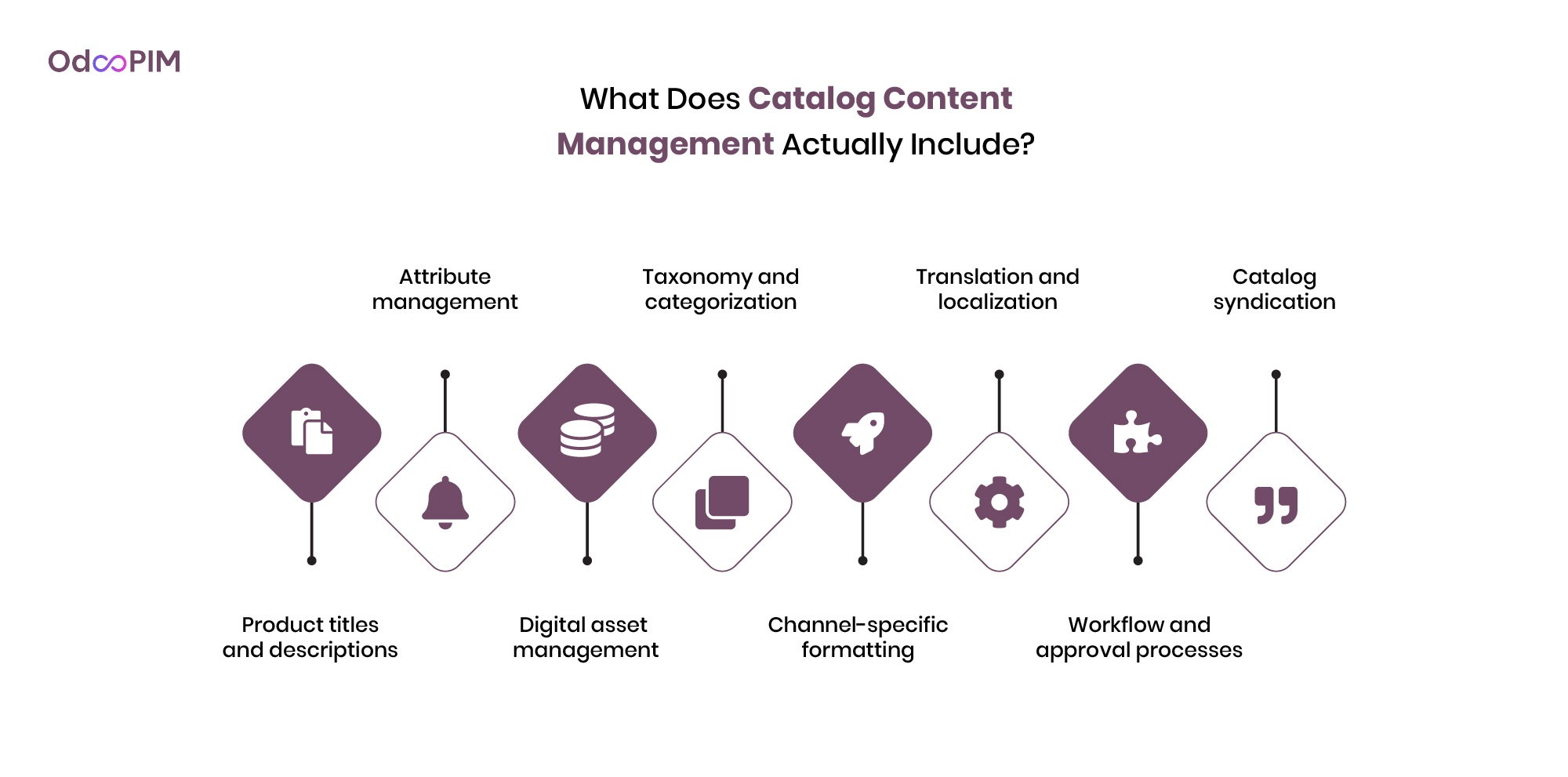
- Product titles and descriptions: Core content that drives search and conversion. Must be optimized per channel without losing brand voice.
- Attribute management: Size, color, material, dimensions, technical specs, compatibility, warranty, compliance data. Each attribute must be structured and searchable.
- Digital asset management: Images, videos, 3D models, and downloadable documents with metadata, alt text, and channel-specific formatting.
- Taxonomy and categorization: Placing products in correct browse nodes and categories so customers can find what they’re looking for.
- Channel-specific formatting: Adapting master content for Amazon, your website, wholesale portals, each with different requirements.
- Translation and localization: Adapting units, currency, cultural references, and regional compliance for global markets.
- Workflow and approval processes: Governing every change, marketing signs off, compliance verifies, pricing requires approval before publication.
- Catalog syndication: Pushing enriched, approved product data to the sales channels simultaneously from one source.
Product catalog management at this depth cannot happen in spreadsheets. Ecommerce catalog management requires centralized product data, automated product data enrichment, and multichannel product catalog capabilities. Digital catalog management done right transforms chaos into competitive advantage. Product content management without these components is just spreadsheet management with better branding.
Learn about Best Online Catalog Management Tools for Ecommerce
Structured vs. Unstructured Product Content: Why Both Matter
Structured product content is data that fits into fields: attributes, specifications, dimensions, pricing rules, and compliance codes. Computers read structured content, filters depend on it, search algorithms rank by it. Unstructured product content is everything else, marketing copy, descriptions, imagery, video, and installation guides. Humans consume unstructured content, it builds trust, answers questions, and drives conversion. When these live in separate systems, they drift. Your specifications say one thing; your marketing copy says another. Customers notice. Returns follow.
Product catalog management done right unifies both types in one centralized product data repository. Multichannel product catalog syndication pushes structured and unstructured content to every channel simultaneously. Product data enrichment applies to both. Catalog content management without this unity creates fragmentation, your product team updates attributes while marketing rewrites descriptions, with no single source of truth. Ecommerce catalog management at scale requires treating structured and unstructured content as equal partners. Most competitors skip this distinction. You shouldn’t.
Learn about best catalog management software.
Common Catalog Content Management Challenges (And How to Fix Them)
1. Inconsistent Product Data Across Channels
The classic multichannel problem. The same product shows different specifications on Shopify versus Amazon versus your own website. Your Shopify listing says “medium.” Amazon says “M.” Your wholesale portal shows different dimensions. Customers notice these inconsistencies, and they erode trust. The cause is simple: no single source of truth. Product data lives in separate spreadsheets for each channel, updated by different people at different times.
The fix is centralized product data. A PIM creates one master record for every product. Catalog syndication pushes that record to every channel simultaneously. Multichannel product catalog capabilities ensure each destination receives correctly formatted content from the same source. Product content management with a PIM eliminates channel drift, update once, publish everywhere.
2. Manual Data Entry and Version Control Nightmares
Spreadsheets break at scale. What worked for 200 SKUs becomes unmanageable at 2,000. Different team members maintain different versions. Someone overwrites your pricing file. Marketing’s description spreadsheet conflicts with operations’ attribute file. No audit trail tracks who changed what or when. The result: hours wasted reconciling versions, and products launching with conflicting information.
A catalog management system solves version control. Centralized product data means everyone works from the same source. Role-based permissions prevent unauthorized changes. Version history tracks every edit. Catalog content management with a PIM eliminates the “which file is current?” question permanently. Your team stops managing spreadsheets and starts managing products.
3. Slow Time to Market for New Products
Without a streamlined catalog workflow, launching a new product takes weeks. The product team creates specifications. Marketing writes descriptions. Operations adds shipping data. Compliance attaches certifications. Each handoff happens via email or spreadsheet attachment. Nothing moves until someone remembers to follow up. The competitive cost is real, your competitor launches faster, captures early demand, and builds market share while you’re still reconciling files.
A PIM compresses launch cycles. Workflow automation routes new products through defined approval steps automatically. Product data enrichment fills missing attributes before review. Completeness scoring shows what remains. When conditions are met, catalog syndication pushes the product to every channel instantly. Time-to-market drops from weeks to days, or even hours.

4. Scaling a Growing Product Catalog Without Scaling Headcount
The mid-market ecommerce pain point. Your catalog doubles every year, but your team doesn’t. Adding 1,000 new SKUs manually consumes 300–500 hours of data entry. The math doesn’t work. You either hire more people (expensive) or accept slower growth (costly in lost revenue). Neither option appeals.
PIM is the force multiplier. Product data enrichment automates attribute completion. Digital catalog management handles variations and relationships in bulk. One person with a PIM manages what five people with spreadsheets cannot. Product catalog management becomes scalable because the system does the repetitive work. Your team focuses on strategy, not data entry.
5. Meeting Channel-Specific Content Requirements
Every channel demands different data formats. Amazon wants flat descriptions under 2000 characters with specific keyword placement. Google Shopping requires optimized titles following strict formulas. Your website supports rich formatting and comparison charts. Wholesale portals need case quantities and spec sheets. Manual reformatting for each channel is unsustainable at scale.
This is where catalog management software earns its ROI. Multichannel product catalog capabilities store one master record but publish channel-specific versions automatically. Catalog syndication applies formatting rules per destination, Amazon gets flat descriptions, your site gets rich content, all from the same source. Product content management at scale means the system handles variation while you manage consistency. The ROI calculation is simple: hours saved, errors eliminated, products launched faster.
How a PIM System Powers Catalog Content Management
A PIM system transforms catalog content management from manual chaos into automated precision. Instead of spreadsheets scattered across teams, a PIM creates a centralized product data repository that every department trusts. Product information lives in one place, enriched, validated, and ready for distribution.
- Single source of truth: Every team accesses the same current product data. No version conflicts, no “which file is current” debates. Product data enrichment happens once and applies everywhere.
- Bulk editing and workflow automation: Update hundreds of products in minutes instead of days. Workflow rules route new products through approval steps automatically, marketing signs off, compliance verifies, pricing approves. Nothing moves until conditions are met.
- Channel-specific publishing: Catalog syndication pushes your master data to channels with formatting rules applied automatically. Amazon receives flat descriptions. Your website gets rich content. Wholesale portals receive spec sheets. Multichannel product catalog capabilities eliminate manual reformatting.
- Data validation and completeness scoring: The system flags missing attributes before products go live. Completeness scores show where gaps exist. Product content management becomes proactive rather than reactive.
OdooPIM delivers all these capabilities natively within the Odoo ecosystem. For businesses already on Odoo, it adds digital catalog management without introducing a separate platform or integration to maintain. Ecommerce catalog management becomes unified with your operations.
Key Features to Look for in Catalog Content Management Software
- Centralized data repository: One source of truth for every SKU, attribute, and digital asset. Product catalog management starts here.
- Bulk attribute editing: Update thousands of products simultaneously. Change prices, add specifications, apply categories in minutes.
- Multichannel publishing and syndication: Push product data to Shopify, Amazon, Walmart, and wholesale portals from one interface. Catalog syndication at scale.
- DAM integration: Manage images, videos, and documents alongside product data. Metadata and alt text stay attached to the right products.
- Workflow and approvals: Route new products through defined approval steps. No product goes live until all conditions are met. Audit trails track every change.
- Data quality rules: Mandatory fields, format validation, completeness scoring. Product data enrichment happens systematically, not sporadically.
- ERP and ecommerce integrations: Native connectors to Shopify, WooCommerce, Magento, and ERPs like Odoo. No middleware, no sync delays.
- Scalability: Handles hundreds of SKUs today and thousands tomorrow without platform migration. Digital catalog management that grows with you.
Catalog content management without these features is just spreadsheet management with better branding. Ecommerce catalog management at scale requires a PIM that delivers all eight. Use this list as your evaluation checklist when comparing solutions. OdooPIM checks every box for Odoo users, and eliminates integration overhead entirely. For non-Odoo merchants, match the features to your operational context. But don’t settle for less than all eight. Your catalog quality depends on it.
OdooPIM’s Approach to Catalog Content Management
OdooPIM solves catalog content management differently than standalone PIMs. Built natively on Odoo, it shares the same database as your ERP, inventory, and operations. This eliminates the integration tax, no middleware, no sync delays, no data drift between your catalog and your business systems.
Centralized product data lives alongside purchasing records, supplier information, and inventory levels. Product data enrichment draws directly from existing operational data. When procurement adds a product, the PIM already has its cost, lead time, and supplier details, no manual imports, no spreadsheet reformatting.
Catalog syndication pushes enriched data to Shopify, Amazon, and wholesale portals through native connectors. Multichannel product catalog capabilities apply channel-specific formatting automatically. Your website gets rich descriptions. Amazon receives flat text optimized for search. All from one source.
Product catalog management becomes unified with inventory, pricing, and order management. For Odoo users, OdooPIM is the PIM capability that was always available inside the platform they already own, no separate license, no new integration to maintain.
Catalog Content Management Best Practices for Ecommerce Teams
- Audit your existing product data before migrating to any new system. Run completeness reports showing missing attributes, inconsistent formatting, and duplicate entries. Catalog content management succeeds when you start with honest assessment. Product data enrichment works better when you know what gaps exist before you migrate.
- Define a consistent attribute taxonomy before you scale. Decide which attributes are required for each product family. Establish naming conventions, “color” not “colour,” “material” not “composition.” Product catalog management without consistent taxonomy creates search failures and filter gaps that frustrate customers.
- Map each channel’s content requirements upfront. Amazon needs different formatting than your website. Google Shopping has specific title formulas. Wholesale portals require case quantities. Multichannel product catalog success depends on understanding each destination’s rules before catalog syndication begins.
- Build a content completeness standard. Define minimum required fields per product family. A t-shirt needs size, color, material, and care instructions. A laptop needs a processor, RAM, storage, and OS. Product content management with clear standards ensures nothing launches incomplete.
- Establish a workflow with clear ownership. Who creates specifications? Who enriches descriptions? Who approves pricing? Who publishes? Digital catalog management without ownership creates delays and errors. Ecommerce catalog management succeeds when everyone knows their responsibility, and the system enforces the handoffs.
- Centralize before you syndicate. Centralized product data is the prerequisite for everything else. Without a single source of truth, every other best practice fails. Your product catalog management system is only as reliable as your data foundation. Build it right before you scale.

Frequently Asked Questions
1. What is catalog content management?
Catalog content management is the discipline of creating, enriching, and distributing product information across sales channels. It covers titles, descriptions, attributes, images, videos, and metadata, everything customers need to buy confidently. Product catalog management replaces manual spreadsheets with structured workflows. Ecommerce catalog management done right ensures consistent, complete product data everywhere customers shop. Without it, teams waste hours reconciling spreadsheets and fixing inconsistent listings.
2. What is the difference between catalog content management and a PIM?
Catalog content management is the practice, the discipline of managing product information across channels. A PIM (Product Information Management) is the system that enables you to do it at scale. Think of product content management as the outcome, and PIM as the engine. Digital catalog management without a PIM means spreadsheets and manual exports. With a PIM, you automate product data enrichment, enforce governance, and handle catalog syndication from one centralized product data repository.
3. Why do ecommerce brands need catalog content management software?
Ecommerce brands need catalog content management software because spreadsheets break at scale. Manual data entry consumes 20–46 minutes per SKU. Version conflicts cause listing errors. Multichannel product catalog management becomes impossible without automation. Product data enrichment software automates attribute completion, validates completeness, and syndicates to every channel. Centralized product data eliminates version chaos. Without it, your team becomes the bottleneck limiting growth. With it, catalog maintenance transforms from firefighting to background automation.
4. How does catalog content management improve conversion rates?
Catalog content management improves conversion rates by ensuring customers find complete, accurate product information when they shop. Missing attributes cause abandoned carts. Inconsistent descriptions erode trust. Product data enrichment fills specification gaps. Catalog syndication ensures consistent information across channels. When customers see all the details they need, dimensions, materials, compatibility, they buy confidently. Ecommerce catalog management done right removes the uncertainty that drives shoppers away. Complete content converts. Incomplete content kills sales.
5. Can catalog content management software integrate with Shopify, WooCommerce, or Magento?
Leading catalog content management software offers native connectors for Shopify, WooCommerce, and Magento. Multichannel product catalog capabilities push enriched product data to your store’s API, no CSV uploads, no manual exports. Catalog syndication handles products, variants, metafields, and images automatically. For Odoo users, OdooPIM provides native Shopify sync without middleware. Integration depth varies, verify metafield support, variant handling, and real-time sync before committing. The right product catalog management system makes your PIM and storefront work as one.