What Amazon SEO Tools Actually Do
Amazon SEO tools automate the manual work of keyword research, listing optimization, and performance tracking. Unlike spreadsheets, these tools connect to Amazon’s API to pull search volume, ranking data, and competitor intelligence. The best amazon SEO tools replace guesswork with data. A tool cannot fix a bad product. But it can tell you which keywords drive sales, which listings need work, and where your competitors are winning. Amazon SEO software gives you insights. You still need to execute. Tools accelerate what works. They do not fix what is broken.
Keyword Discovery and Ranking
Amazon keyword research tool functionality starts with discovering what shoppers actually type into Amazon’s search bar. Tools pull auto-suggest data, search volume, and click-through rates for millions of keywords. The best amazon keyword research tool also shows which keywords your competitors rank for and which phrases have high purchase intent. Amazon SEO tools then track your ranking for those keywords over time. A drop in ranking triggers an alert and a new high-volume keyword appears in your niche. The tool tells you, you optimize, ranking improves and data drives decisions.
Listing Audit and Scoring
Amazon listing optimization tool features include automated audits of your product listings. The tool checks title length and keyword placement, bullet point completeness, image compliance, and backend search term usage. Amazon SEO software assigns a score to each listing, 70/100, 85/100, or maybe 45/100. Low scores highlight exactly what is missing. Missing GTIN? Flagged. Title too short? Flagged. Backend terms empty? Flagged. Best amazon SEO tools prioritize fixes by estimated impact on ranking. Fix the biggest problems first, work down the list, listings improve and rankings follow.
Competitor and SERP Analysis
Amazon SEO tools analyze the search engine results page for any keyword. Which products rank in positions one through twenty? What keywords are in their titles? How many reviews do they have? What is their price? The best amazon keyword research tool also shows which backend keywords competitors might be using. You cannot see their backend terms. But the tool infers them from ranking patterns. Amazon SEO software tracks competitor ranking changes over time. A competitor drops in ranking, you see the opportunity, optimize your listing for that keyword and capture their share. Data wins and luck loses.
Learn about Amazon Product Information Management

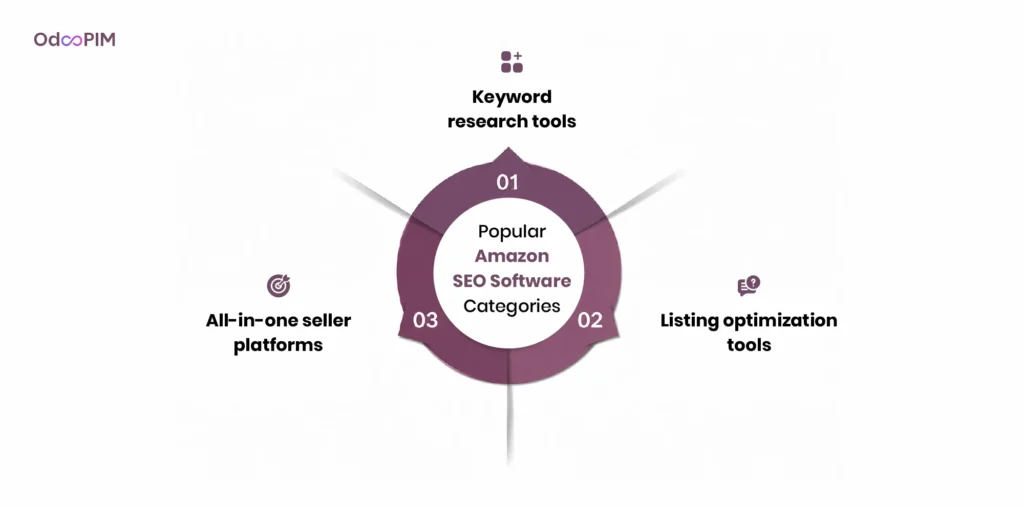
Popular Amazon SEO Software Categories
1. Keyword research tools
Amazon keyword research tool products like Helium 10 Cerebro, Jungle Scout Keyword Scout, and SellerSprite focus exclusively on discovering search terms. Enter a competitor ASIN. The tool reverse-engineers their ranking keywords. Enter a seed keyword. The tool returns search volume, trend data, and related phrases. The best amazon keyword research tool also shows estimated click and conversion rates for each keyword. These tools do not optimize your listings and they tell you what to optimize. Keyword research tools are the starting point and without them, you are guessing.
2. Listing optimization tools
Amazon listing optimization tool products like ZonGuru Listing Optimizer and DataDivas focus on improving your existing listings. Connect your Seller Central account. The tool audits every product for title quality, bullet completeness, image compliance, and backend search term usage. Amazon SEO tools in this category assign scores and prioritize fixes. Some include AI-powered titles and bullet generators. They do not discover new keywords. They help you implement keywords you already have. Listing optimization tools execute the strategy. Keyword tools inform it.
3. All-in-one seller platforms
Amazon SEO software like Helium 10, Jungle Scout, and SellerApp bundle keyword research, listing optimization, competitor tracking, and PPC management into one platform. These tools do everything the point solutions do, but rarely as deeply in any single category. The best amazon SEO tools for most sellers are all-in-one platforms. You get keyword research, listing audits, rank tracking, and competitor analysis in one subscription. The trade-off is depth. Specialist tools often go deeper in one area. All-in-one tools give you 80% of the value with 20% of the complexity. Choose based on your team size and budget.
Learn about Amazon PIM Software

Why Most Amazon SEO Tools Underperform Without Clean Product Data
Garbage in, garbage out
Amazon SEO tools analyze your product data to identify optimization opportunities. If your product data is incomplete or inconsistent, the tool’s recommendations will be wrong. A keyword research tool suggests “coffee maker thermal carafe.” Your listing does not have “thermal carafe” in any field because the attribute is missing. The tool cannot fix missing data. Amazon listing optimization tool audits your current state. It cannot invent attributes you never provided. Best amazon SEO tools are only as good as the data you feed them. Clean data first and optimize second.
Inconsistent attributes hurt discoverability
Amazon keyword research tool cannot help if your product attributes are inconsistent across variants. A shirt with “Medium” in one size and “M” in another confuses both the tool and Amazon’s algorithm. Amazon SEO software audits attribute consistency. It flags the discrepancy. But the tool cannot decide which value is correct. Your team must clean the data. Amazon listing optimization tool recommendations for backend search terms assume consistent attributes. Inconsistent data breaks discoverability, standardize your attributes and then let the tools optimize. Tools reveal problems and they do not solve data chaos.
Manual data entry creates SEO drift
A seller manually updates titles for 500 products. Six months later, competitor keywords have changed. Amazon’s algorithm priorities have shifted. But manual updates never happened. Amazon SEO tools track ranking changes over time. They show you falling rankings. They show you missed opportunities. But they cannot click the buttons for you. The best amazon keyword research tool identifies new keywords. Your team must add them to backend search terms. Amazon listing optimization tool audits your current state. Your team must implement changes. Tools without execution drift, data entry without tools drifts. So, combine both. Consistent SEO at scale requires clean data and the right tools. One without the other fails, so get both and win on Amazon.
Learn about Amazon Content Management

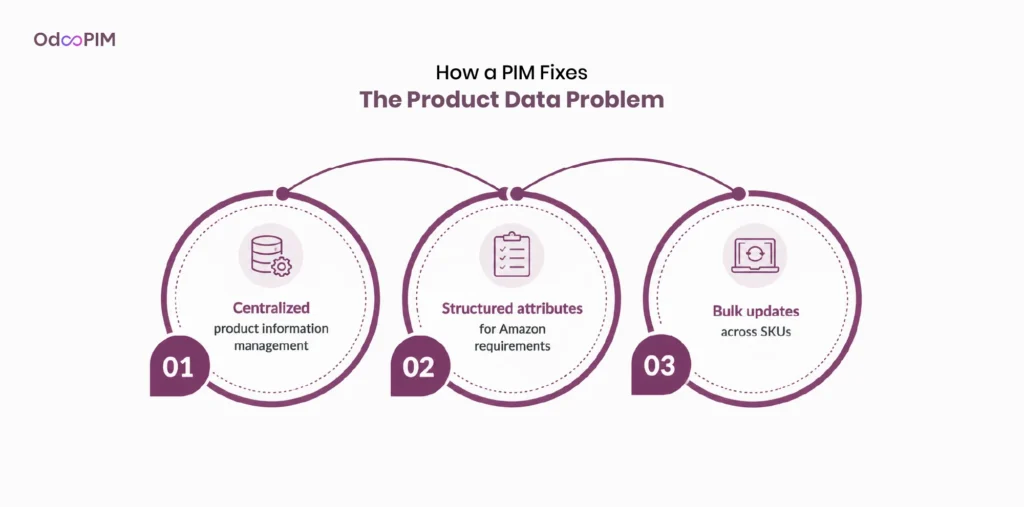
How a PIM Fixes the Product Data Problem
1. Centralized product information management
A PIM centralizes every product attribute, titles, bullets, descriptions, images, backend search terms, into one master database. Your team stops maintaining separate spreadsheets for different product categories. Amazon SEO tools then analyze clean, complete data instead of garbage. Best amazon keyword research tool recommendations become actionable because your product data actually contains those keywords. Amazon listing optimization tool audits find real problems, not data chaos artifacts. Centralization is the foundation. Without it, tools spin their wheels. With it, tools drive results.
2. Structured attributes for Amazon requirements
A PIM enforces attribute structures that match Amazon’s category requirements. Electronics get voltage and warranty fields. Apparel gets size and fabric fields. Amazon SEO software with PIM-structured data generates accurate recommendations. A keyword research tool suggests “waterproof Bluetooth speaker.” Your PIM has an IPX rating attribute. The keyword maps cleanly. Amazon listing optimization tool validates that every product has complete attributes before syndication. Missing fields get flagged. Inconsistent values get blocked. Structured data powers accurate optimization. Chaos cannot be optimized.
3. Bulk updates across SKUs
A PIM updates thousands of products with one action. A new winning keyword from your amazon keyword research tool gets added to backend search terms across your entire catalog in minutes, not weeks. Best amazon SEO tools identify opportunities. PIM executes them at scale. Amazon SEO software without PIM leaves you with a list of changes you must implement manually. One person updating 5,000 products will take weeks. Errors will multiply. Bulk updates eliminate manual work. Tools find keywords. PIM applies them. Scale your SEO without scaling your team. Execute at Amazon speed.
Forrester projects U.S. online retail sales will grow from $1.2 trillion in 2024 to $1.8 trillion in 2029, a compound annual growth rate of 8.4%, pushing ecommerce’s share of total retail sales from 23.4% to 29.3%.
– Forrester, “U.S. Online Retail Forecast, 2024 to 2029
Case Studies
Case Study 1: Electronics Seller Wasted $15,000 on SEO Tools Before Fixing Product Data
Challenge
An electronics seller with 6,000 SKUs subscribed to three amazon SEO tools, Helium 10, Jungle Scout, and DataDivas. Total monthly spend: $400. The team ran keyword research weekly. They identified high-volume keywords. They updated titles and backend search terms manually. Despite using the best amazon SEO tools, organic rankings barely moved. PPC spend remained high. The amazon listing optimization tool showed low scores, but the team could not figure out why their fixes were not working.
Solution
An audit revealed the real problem: product data quality. The seller’s amazon keyword research tool was suggesting “waterproof Bluetooth speaker.” But the seller’s product data did not include waterproof ratings as structured attributes. The team had added the keyword to titles manually, but Amazon’s algorithm could not confirm the product was actually waterproof because the attribute was missing. OdooPIM was implemented to centralize and structure product data. Attribute families were created for each product category. IPX ratings, battery life, and connectivity fields were added. Amazon SEO software recommendations were then mapped to structured attributes, not just free-text fields.
Results
- Organic rankings for targeted keywords improved within 60 days of data cleanup
- The amazon listing optimization tool score increased from 45% to 89%
- Subscription costs reduced to one best amazon keyword research tool instead of three
- Annual savings on SEO tools: $3,600
- Organic sales increased by 35% without additional PPC spend
- The lesson: tools cannot fix missing data. Fix the foundation first.
Case Study 2: Home Goods Brand Could Not Scale Keyword Execution
Challenge
A home goods brand with 8,000 SKUs used Amazon SEO software extensively. The team ran weekly keyword reports. The best amazon keyword research tool identified 1,200 new long-tail keywords monthly. But the brand’s manual process for adding keywords to backend search terms was broken. One person could update 200 SKUs per week. At that rate, 1,200 new keywords would take six weeks to implement. By the time keywords were added, competitors had already optimized. The amazon listing optimization tool showed missed opportunities piling up.
Solution
The brand deployed OdooPIM to automate keyword execution. Amazon SEO tools keyword lists were exported and imported into OdooPIM in bulk. Backend search term fields were updated across 8,000 SKUs in minutes, not weeks. Title templates were created to enforce consistent formatting, Brand + Product Type + Key Feature + Size. Bullet point structures were standardized across all product categories. The amazon keyword research tool output fed directly into OdooPIM’s bulk update workflows.
Results
- Keyword execution time reduced from six weeks to two days
- The brand captured organic rankings for 85% of targeted long-tail keywords within 90 days
- Organic traffic increased by 180%
- Amazon listing optimization tool scores improved from 58% to 94%
- Annual labor savings from eliminated manual updates: $48,000
- The team now runs weekly keyword reports and executes changes same-day
- Tools find opportunities. PIM executes them at scale.
Learn about Amazon SEO tips

OdooPIM + Amazon SEO Tools: Better Together
Feed clean data to your SEO stack
OdooPIM centralizes and cleans your product data before it reaches your amazon SEO tools. Run your best amazon keyword research tool against OdooPIM’s structured data. The tool returns relevant, actionable keywords because your product attributes are complete and consistent. Amazon listing optimization tool audits identify real optimization opportunities, not data cleanup tasks. Amazon SEO software works faster when analyzing clean data. OdooPIM eliminates the garbage. Your tools only see gold. Better data in equals better insights out.
How OdooPIM prepares listing-ready content
OdooPIM exports listing-ready content directly to Amazon Seller Central via API. Titles formatted correctly. Bullets are structured consistently. Backend search terms populated from amazon keyword research tool outputs. Best amazon SEO tools identify winning keywords. OdooPIM applies them across your catalog in bulk. Amazon listing optimization tool recommendations become executable tasks in OdooPIM workflows. Approve a title change in OdooPIM. The system pushes it to Amazon automatically. Tools find opportunities. OdooPIM executes them. No manual data entry. No copy-paste errors. Just optimized listings at scale. Better together. Faster together. Winning together.
Learn about Amazon SEO Services in USA
Frequently Asked Questions
1. What is the best Amazon SEO tool for small sellers?
For small sellers, Helium 10 offers the best balance of features and affordability. The free plan includes basic amazon keyword research tool functionality, up to 20 keyword searches daily. The Silver plan at $39 monthly unlocks Cerebro (reverse ASIN lookup), Frankenstein (keyword processor), and listing optimization features. Jungle Scout is another strong contender with a similar price point. Best amazon SEO tools for small sellers prioritize ease of use and essential features over enterprise complexity. Start with a free trial. Test both platforms. Choose the one that fits your workflow. Upgrade as you scale.
2. Is there a free Amazon keyword research tool worth using?
Amazon’s own search bar is the most underrated free amazon keyword research tool. Type a seed keyword and review auto-suggested phrases, these are real shopper queries. Helium 10’s free plan offers 20 Cerebro searches daily and basic word frequency analysis. MerchantWords offers limited free searches. Best amazon keyword research tool free tiers are sufficient for sellers with under 500 SKUs. For larger catalogs, paid tools pay for themselves quickly. Free tools give you direction. Paid tools give you data at scale.
3. How does product data quality affect Amazon SEO?
Poor product data quality destroys Amazon SEO efforts. Missing attributes leave Amazon’s algorithm with nothing to match. Inconsistent values, “Medium” versus “M”, break search filters and confuse ranking logic. Amazon listing optimization tool audits will show low scores, but the tool cannot fix your data. Clean, complete product data enables amazon SEO software to identify real optimization opportunities. A PIM enforces data quality at the source. Garbage data equals garbage rankings. Clean data equals discoverability. Fix your data before optimizing. Tools need clean fuel to run.
4. Can a PIM replace Amazon listing optimization tools?
PIM and amazon SEO tools serve different purposes. A PIM centralizes and cleans product data. Amazon listing optimization tool analyzes that data against Amazon’s ranking factors and competitor performance. Best amazon SEO tools discover keywords your PIM would never suggest. PIM executes bulk updates. Tools find opportunities. You need both. PIM without tools means you have clean data but no idea how to optimize it. Tools without PIM means you have insights but cannot execute at scale. Together, they power winning amazon SEO. One feeds the other. Both are essential.