What Is Amazon Content Management?
Amazon content management is the discipline of creating, organizing, and maintaining all product-related content across your Amazon listings. It covers everything customers see on your product detail pages, titles, bullet points, descriptions, images, videos, and A+ content, plus backend elements customers never see but Amazon’s algorithm uses for search ranking. Amazon catalog management without structured content leads to inconsistent branding and suppressed listings. PIM for Amazon sellers centralizes this content so your team manages everything from one system. Poor content kills conversions and great content drives sales.
Definition and Scope
Amazon content management spans the lifecycle of your product content from creation to publication to ongoing optimization. It includes writing SEO-friendly titles, formatting persuasive bullet points, uploading high-resolution images, building A+ content modules, and managing backend search terms. Amazon product data management also covers content localization for international marketplaces, version control for content updates, and approval workflows to ensure quality before publishing. Multichannel product content management extends beyond Amazon to your website and other marketplaces. Content management is not a one-time task as it requires continuous improvement based on performance data.

Key Content Elements: Titles, Bullets, Images, A+ Content, Backend Terms
Product titles must include brand, model, size, and key features within Amazon’s character limits. Bullet points highlight the top five selling features, benefits over specifications. Images require white backgrounds, minimum 1000 pixels, and multiple angles showing the product in use. Amazon A+ content management adds enhanced modules like comparison charts, brand stories, and high-resolution video. Backend search terms include keywords customers use to find your products but that do not fit naturally in visible content. Amazon listing optimization aligns all these elements with Amazon’s algorithm and shopper behavior. Complete content across every field ranks higher. Incomplete content gets suppressed, every element matters.
Why Amazon Content Management Matters for Sellers
Impact on search rankings and conversions
Amazon’s algorithm ranks products higher when titles include relevant keywords, bullets highlight key features, and backend search terms cover customer queries. Amazon content management directly influences where your product appears in search results. A fully optimized listing with complete attributes, high-resolution images, and A+ content converts at significantly higher rates than a sparse listing. Amazon listing optimization with structured content improves both discoverability and purchase decisions. Amazon A+ content management can increase conversion rates by 5-15%. Poor content hides your products. Great content puts them in front of ready-to-buy customers.
Risks of poor or inconsistent product data
Missing attributes trigger listing suppression. A product without a GTIN cannot sell. A title missing a brand name confuses customers and Amazon’s algorithm. Amazon catalog management without quality control guarantees errors. Inconsistent content across variants, one size uses “Medium,” another uses “M”, breaks site search. Customers cannot find what they need. PIM for Amazon sellers prevents these risks through validation before publishing. Amazon product data management with automated checks blocks incomplete listings. Multichannel product content management ensures consistency across marketplaces. Bad data costs sales, triggers returns, and damages brand reputation. Risk management starts with content quality.
Learn about amazon catalog management.
Common Amazon Content Management Challenges
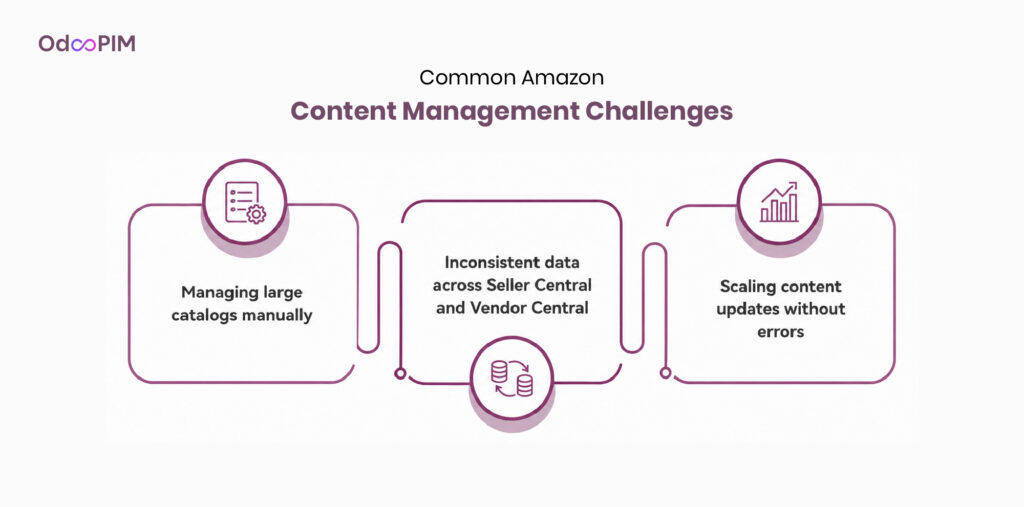
Managing large catalogs manually
A seller with 10,000 SKUs cannot manually update each product’s title, bullets, and backend search terms. Spreadsheets crack under this volume. Amazon catalog management without automation forces your team to edit products one by one or through risky bulk uploads. A single formatting error in a bulk file corrupts your feed. Amazon content management with manual processes means your team spends 50% of their time on data entry, not optimization. Manual management does not scale. Errors multiply, growth stalls and automation is not optional at scale.
Inconsistent data across Seller Central and Vendor Central
Sellers using both Seller Central and Vendor Central maintain two separate sets of product data. A title updated in Seller Central does not sync to Vendor Central. Amazon product data management without centralization guarantees inconsistency. One channel shows “100% Cotton”, the other shows “100%Cotton”, customers notice and trust erodes. PIM for Amazon sellers centralizes content once and syndicates to both Seller Central and Vendor Central automatically. Multichannel product content management eliminates the drift between platforms. One source, two channels and complete consistency.
Scaling content updates without errors
A seasonal promotion requires updating prices, titles, and images across 5,000 SKUs. Manual updates take days and guarantee errors. Amazon content management with bulk editing and automated workflows completes the same updates in minutes. Amazon listing optimization with PIM software applies changes across your catalog simultaneously. A price change in your PIM updates Amazon, your website, and other marketplaces within minutes. Amazon A+ content management with automated syndication ensures that a new comparison chart appears on every relevant ASIN instantly. Scaling without automation is impossible, manual processes break and PIM scales.

What Is a PIM and How Does It Help?
PIM as a single source of truth
PIM for Amazon sellers centralizes every product attribute, titles, bullets, descriptions, images, backend search terms, into one master database. Your team stops asking “which spreadsheet is current?” because only one version exists. Amazon product data management with a single source eliminates version conflicts and reconciliation work. Amazon content management without centralization forces your team to maintain separate files for each marketplace. One source and complete visibility. Every team member works from the same data. No more “I thought you updated that.” and no more outdated listings.
How PIM connects to Amazon listing workflows
Amazon catalog management with PIM software connects to Amazon Seller Central and Vendor Central via API. Your team enriches product data in the PIM. The system transforms that data into Amazon-ready format and pushes it to Amazon automatically. Multichannel product content management extends to your website, eBay, Walmart, and Google Shopping from the same PIM. Amazon listing optimization with automated workflows means a title change in your PIM updates Amazon within minutes. No manual CSV uploads and no copy-paste errors. Amazon A+ content management with PIM pushes enhanced modules to Amazon automatically. Update once, syndicate everywhere and automation replaces manual work.
How OdooPIM Simplifies Amazon Content Management
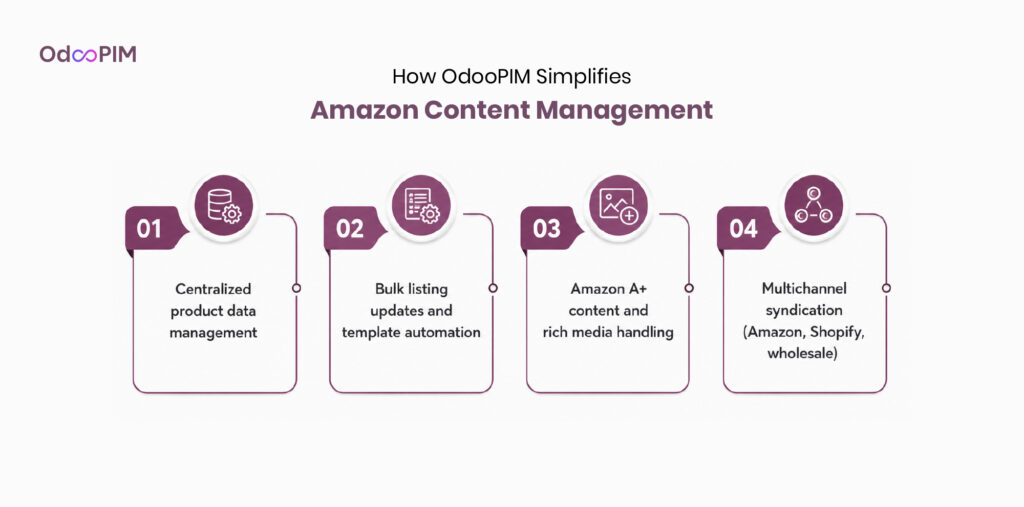
1. Centralized product data management
OdooPIM centralizes every Amazon listing component, titles, bullet points, descriptions, backend search terms, images, and A+ content, into one master database. Amazon product data management with centralization eliminates the spreadsheets and scattered files that plague manual sellers. PIM for Amazon sellers with a single source means your team updates data once, not across ten different files. Amazon content management without centralization forces reconciliation work. OdooPIM eliminates version conflicts completely. One source, complete visibility and your team trusts the data.
2. Bulk listing updates and template automation
Update 5,000 product titles with one click. OdooPIM’s bulk editing tools apply changes across your catalog simultaneously. Amazon catalog management with template automation lets you define title formats, bullet structures, and description templates once. Every new product inherits the correct format automatically. Amazon listing optimization with bulk updates means a seasonal price change propagates to every ASIN in minutes, not days. Manual per-product editing disappears. Your team focuses on strategy, not repetitive data entry and scale without drowning.
3. Amazon A+ content and rich media handling
OdooPIM stores A+ content modules, comparison charts, enhanced descriptions, brand stories, high-resolution images, and video, alongside product attributes. Amazon A+ content management with centralized asset storage ensures that every ASIN gets the correct enhanced content automatically. Upload an image once in OdooPIM. The system associates it with the right product variants and pushes to Amazon. Amazon content management without media handling forces manual image uploads per ASIN. Rich media drives conversions and OdooPIM makes rich media manageable at scale.
4. Multichannel syndication (Amazon, Shopify, wholesale)
The system syndicates to Amazon, your Shopify store, eBay, Walmart, and wholesale portals simultaneously. Multichannel product content management with OdooPIM means your team stops maintaining separate catalogs per channel. A price correction in OdooPIM fixes Amazon, your website, and marketplaces instantly. Amazon catalog management without multichannel support forces manual per-platform updates. One channel gets missed, data drifts and OdooPIM prevents that. One master catalog, infinite channel outputs and complete consistency across the sales channels. Your team works once and everywhere benefits.
Learn about what is CPG
Amazon Content Management Best Practices
Structuring your catalog before publishing
Define attribute families before importing your first product. Electronics need voltage and warranty. Apparel needs size and fabric. Amazon catalog management with structured families ensures every product has the right fields. PIM for Amazon sellers enforces these structures automatically. A new smartphone inherits the electronics attribute family. No missing fields. No inconsistent data. Amazon content management without structure creates chaos. Each product manager invents their own fields. Search breaks and filters fail. Structure first, import second and quality follows.
Keeping data accurate as your SKU count grows
Schedule weekly validation reports that flag missing attributes, inconsistent values, and incomplete listings. Amazon product data management with regular audits catches errors before they cause suppressions. Assign ownership per attribute family, one team manages electronics, another manages apparel. Amazon listing optimization with role-based permissions prevents unauthorized changes. Multichannel product content management with audit trails shows who changed what and when. Clean data is not a project, it is a discipline. Audit weekly, fix immediately and your catalog stays healthy.
Using attributes to meet Amazon category requirements
Amazon’s category requirements change constantly. A listing that passed validation last month may get suppressed today. Amazon content management with automated validation checks every product against current Amazon rules before syndication. Missing GTIN? Blocked. Incorrect image ratio? Flagged. Amazon A+ content management with compliance tracking ensures enhanced modules meet Amazon’s specifications. PIM for Amazon sellers with attribute mapping handles category-specific fields automatically. A laptop gets processor, RAM, storage attributes. A shirt gets size, color, fabric. Meet requirements or lose listings.
Learn about product content enrichment
Case Studies
Case Study 1: Electronics Brand Cuts Listing Errors by 90% and Doubles SKU Count
Challenge
An electronics brand sold 8,000 SKUs across Amazon US, UK, and EU marketplaces. The team managed product content using Excel spreadsheets and Amazon’s native bulk upload tools. Each product required separate files for titles, bullets, images, and A+ content. Listing suppression rates hit 18% due to missing GTINs, incorrect category attributes, and image specification violations. The company lost $60,000 annually in lost sales from suppressed listings. New product launches took three weeks because content had to be manually formatted for each marketplace.
Solution
The brand implemented OdooPIM as their amazon content management solution. Attribute families were created for each product category, headphones, chargers, cables, adapters. PIM for Amazon sellers with automated validation flagged missing GTINs, incorrect image ratios, and incomplete category fields before data reached Amazon. Amazon product data management with variant management generated all child ASINs automatically from master product matrices. A set of earbuds with three colors produced three child ASINs with one click. Amazon A+ content management with OdooPIM pushed enhanced comparison charts and brand modules to every relevant ASIN automatically.
Results
- Listing suppression rate dropped from 18% to under 2%
- New product launch time reduced from 3 weeks to 4 days
- The brand scaled from 8,000 to 16,000 SKUs with zero headcount increase
- Manual data entry hours cut by 85%
- Annual lost sales from suppressions recovered: $52,000
- Amazon US, UK, and EU listings synchronized from one master catalog
Case Study 2: Home Goods Seller Eliminates Inconsistent Branding Across 5,000 Listings
Challenge
A home goods seller managed 5,000 SKUs on Amazon and their own Shopify store. Product information was scattered across three different spreadsheets. One spreadsheet for Amazon titles and bullets. Another for images. A third for A+ content modules. The Amazon catalog had inconsistent formatting. Some titles included “100% Cotton.” Others omitted it. Bullet point structures varied across product families. Some used dashes. Others used asterisks. Customer reviews frequently mentioned confusion about product features due to inconsistent descriptions. Return rates reached 7%.
Solution
The seller deployed OdooPIM as unified amazon catalog management software. Title templates enforced consistent formatting, Brand + Product Type + Key Feature + Size. Bullet point templates standardized the structure across all listings. Multichannel product content management with OdooPIM syndicated a single master catalog to Amazon and Shopify simultaneously. A content update in OdooPIM updated both channels within minutes. Amazon listing optimization with approval workflows required senior review before any listing change went live. The team defined role-based permissions, junior staff proposed changes, senior staff approved.
Results
- Amazon listing consistency score improved from 62% to 96%
- Customer return rate dropped from 7% to 3.5%
- Content update time across two channels reduced from 4 hours to 5 minutes
- Annual labor savings from eliminated manual formatting: $45,000
- A+ content modules now consistently applied to 100% of eligible ASINs
- Brand perception improved as customers saw professional, consistent listings
Get Started with OdooPIM for Amazon
Key features for Amazon sellers
OdooPIM for Amazon includes bulk listing creation, variant management, automated validation against Amazon’s category requirements, and direct API sync to Seller Central and Vendor Central. Amazon A+ content management with OdooPIM pushes enhanced modules, comparison charts, and rich media to Amazon automatically. Amazon product data management with OdooPIM handles multi-marketplace localization, US listings show imperial units, EU listings show metric. PIM for Amazon sellers with OdooPIM also syndicates to your website, eBay, Walmart, and wholesale channels from the same master catalog. One tool, all channels and complete control.
Next steps and demo
Install the OdooPIM Amazon connector from the Odoo App Store. Configure your Seller Central API credentials. Map your attribute families to Amazon’s category requirements. Run an initial test sync with 25 products. Verify listing accuracy in Seller Central. Then schedule automated daily syncs for your entire catalog. Amazon listing optimization with OdooPIM reduces manual work by 80%. Amazon catalog management becomes automated, not manual. Multichannel product content management with OdooPIM scales from 100 to 100,000 SKUs without adding headcount. Book a demo, see OdooPIM in action and start scaling your Amazon business today.

Frequently Asked Questions
1. What exactly is Amazon content management?
Amazon content management is the process of creating, organizing, and maintaining all product information on your Amazon listings. This includes titles, bullet points, descriptions, images, A+ content (enhanced brand content), and backend search terms. Effective Amazon catalog management ensures your products are discoverable, rank well in search, and convert browsers into buyers by presenting complete, accurate, and compelling product stories.
2. How does PIM software help Amazon sellers?
PIM for Amazon sellers acts as a central hub for all your product data, eliminating reliance on messy spreadsheets. Instead of updating listings one by one in Seller Central, a PIM allows you to enrich and validate product information in one place, then automatically syndicate it to Amazon via API. This streamlines Amazon product data management, ensures brand consistency across listings, and drastically reduces the manual work required to launch new products or update existing catalogs.
3. What is A+ Content and how do I manage it?
Amazon A+ content management involves creating enhanced product descriptions using rich media like high-resolution images, comparison charts, and videos to improve conversion rates. A PIM simplifies this by acting as the single source of truth for your A+ modules. You can associate specific A+ content with products in the PIM, and the system automatically pushes these associations to Amazon, ensuring the right enhanced content appears on the right listings without manual re-uploads.
4. Why is my product data causing listing errors or suppressions?
Listings get suppressed or perform poorly when required product data is missing, incomplete, or formatted incorrectly. Common issues include missing GTINs (UPC, EAN), incorrect brand names, violating image requirements, or not filling out mandatory category-specific attributes. Amazon product data management best practices involve using a PIM with automated validation rules to catch these errors before data is sent to Amazon, preventing costly rejections and ensuring listing health.