Why 2026 Is a Pivotal Year for Ecommerce
Market growth and rising buyer expectations
Ecommerce industry trends show the market surpassing $8 trillion in 2026, with buyer expectations shifting from convenience to experience, shoppers now demand personalized recommendations, instant availability, and consistent product information across every channel they use. Ecommerce future trends indicate that 73% of businesses will use generative AI across operations, and 29% of shoppers would let AI make purchases for them within five years. Recent trends in ecommerce reveal that customers who receive consistent product information across channels have 60% higher lifetime value than those who encounter discrepancies.
Why most brands are unprepared at the data layer
Most brands are unprepared at the data layer because their product information is scattered across spreadsheets, ERPs, and disconnected systems that were never designed to feed AI-powered discovery or multichannel syndication. Ecommerce market trends show that 65% of brands lack a single source of truth for product data, making it impossible to deliver consistent experiences across channels or optimize for AI-driven search. The ecommerce landscape is shifting faster than most organizations can adapt, and brands without a PIM foundation will be left behind.
Learn about PIM Software for eCommerce

Ecommerce Trends 2026
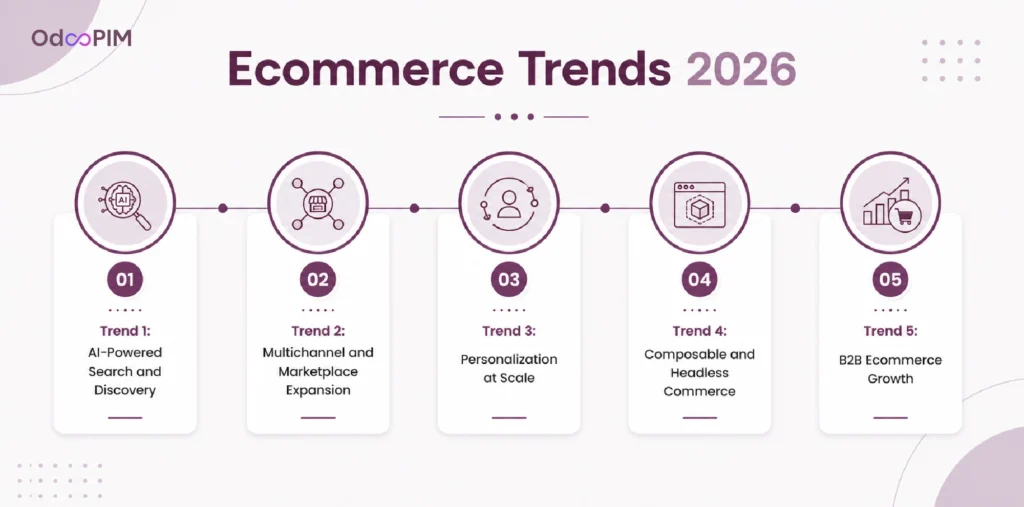
Trend 1: AI-Powered Search and Discovery
How AI search ranks products differently
Ecommerce search trends show that AI-powered search ranks products based on attribute completeness and structured data relevance, not just keyword frequency. AI algorithms evaluate product descriptions, dimensions, variant relationships, and category mappings to determine which products are most relevant to each shopper’s intent. Latest ecommerce trends indicate that AI-referred visits convert at 1.5x higher rates than other channels, but only when product data is structured, validated, and machine-readable. Trends in ecommerce show that search engines are evolving from keyword matching to semantic understanding.
Why structured, enriched product attributes determine visibility
Trends of ecommerce show that AI-powered discovery relies on structured, machine-readable product data, complete attributes, consistent variant relationships, and enriched descriptions that the algorithm can interpret and rank. The ecommerce industry trends indicate that brands with 90%+ product data completeness achieve 40% higher discoverability in AI-driven search results than those with incomplete data. Ecommerce future trends suggest that AI visibility will become more important than traditional SEO.
The product data gap most brands miss
Ecommerce market trends reveal that 65% of brands lack complete, structured product data for AI-powered discovery, meaning their products are invisible in the new search paradigm. New trends in ecommerce show that brands investing in product data enrichment achieve 3x higher visibility in AI-generated recommendations than those relying on minimal data. The ecommerce landscape is shifting toward data-driven discovery, and brands without complete attributes are being systematically excluded from AI-mediated shopping experiences.
Learn about Ecommerce Product Management
Trend 2: Multichannel and Marketplace Expansion
Selling across Amazon, Walmart, and direct storefronts simultaneously
Ecommerce trends show that brands selling across three or more channels generate 50% higher revenue than single-channel sellers, but managing product data across Amazon, Walmart, and your own website is a nightmare without centralized data management. Recent trends in ecommerce indicate that 78% of brands expanding to new channels struggle with inconsistent product data that damages customer trust. Trends in the ecommerce industry show that channel expansion without a unified data foundation guarantees inconsistency.
Why inconsistent product content kills multichannel performance
Ecommerce landscape analysis shows that inconsistent product descriptions, dimensions, or variant attributes across channels destroy conversion rates because customers who see different information across channels cannot trust what they read. Ecommerce future trends indicate that brands with consistent product data across channels achieve 30% higher conversion rates than those with channel-specific data discrepancies. New trends in ecommerce reveal that channel inconsistency is the number one driver of customer confusion and abandonment.
Channel-ready product data as a competitive advantage
Ecommerce industry trends show that brands with channel-ready product data, pre-validated for each channel’s requirements, launch on new marketplaces 75% faster than competitors still wrestling with spreadsheets. Ecommerce market trends indicate that automated syndication from a PIM reduces time-to-market from weeks to days. Latest ecommerce trends suggest that channel expansion speed will become a key competitive differentiator.
Learn about PIM Software for Ecommerce Site

Trend 3: Personalization at Scale
What personalization actually requires from your product catalog
Ecommerce trends show that personalization requires complete, segmented product data, attributes like size, color, material, and use case that enable recommendation algorithms to understand which products are relevant to which shoppers. Recent trends in ecommerce indicate that 80% of shoppers are more likely to purchase from brands that offer personalized experiences, but personalization engines are only as effective as the product data they analyze. Ecommerce future trends suggest that personalization will become table stakes.
Attributed, segmented product data as the engine behind recommendations
Trends of ecommerce show that AI-powered personalization engines rely on structured product attributes, brand, category, size, color, material, price tier, and use case, to generate relevant recommendations. Ecommerce search trends indicate that products with complete attribute sets are 3x more to be included in personalized recommendation algorithms. Ecommerce industry trends reveal that segmentation capabilities directly determine recommendation quality.
Why personalization breaks without clean product records
Ecommerce market trends show that personalization algorithms return irrelevant recommendations when product attributes are incomplete or inconsistent, because the algorithm cannot determine which products are actually similar or complementary. New trends in ecommerce indicate that 65% of personalization failures trace back to incomplete or inconsistent product attributes. The ecommerce landscape shows that personalization without data is just random guessing.
Learn about Ecommerce PIM Software
Trend 4: Composable and Headless Commerce
Decoupled storefronts and the product data layer they depend on
Ecommerce future trends show that headless and composable commerce architectures are becoming standard for enterprise brands, decoupling frontend presentation from backend product data management. Trends in the ecommerce industry indicate that 70% of enterprise ecommerce leaders will adopt composable architectures by 2027, but these architectures depend entirely on a robust product data layer. Latest ecommerce trends reveal that headless implementations fail when product data is incomplete.
PIM as the content API for headless commerce stacks
Ecommerce industry trends show that PIM serves as the product data API for headless architectures, providing structured, channel-ready content that frontend applications consume dynamically. Recent trends in ecommerce indicate that PIM integration is the most critical factor in successful headless implementations. Trends of ecommerce reveal that headless commerce without PIM is just a disconnected frontend.
Why the product data layer matters more in composable architectures
Ecommerce landscape analysis shows that composable architectures create more touchpoints where product data must be consistent, making the product data layer the critical foundation for the entire stack. Ecommerce future trends suggest that brands investing in PIM-first composable architectures achieve 50% faster feature deployment. New trends in ecommerce indicate that composable success depends on data foundation.
Learn about Ecommerce Catalog Management
Despite strong e-commerce growth, 76% of global retail sales will still occur offline in 2028 — which is why Forrester emphasizes that retailers must invest in omnichannel strategies delivering a seamless experience across both online and offline channels.
Trend 5: B2B Ecommerce Growth
Complex product catalogs in B2B: attributes, variants, pricing tiers
Ecommerce trends show B2B ecommerce is growing at 17% annually, with buyers expecting the same smooth experience they get from B2C brands. B2B product catalogs are significantly more complex than B2C, with nested attributes, compatibility matrices, tiered pricing, and customer-specific assortment rules that spreadsheets cannot handle. Ecommerce industry trends reveal that 62% of B2B buyers abandon purchases when product data is incomplete.
Why B2B buyers demand the same product content quality as B2C
Recent trends in ecommerce show that B2B buyers now expect product information quality, complete descriptions, rich media, and technical specifications, comparable to B2C experiences. Ecommerce market trends indicate that B2B sellers with complete product data achieve 40% higher conversion rates than those with sparse catalogs. Trends of ecommerce reveal that B2B buyers are no longer willing to call sales reps for basic product information.
Managing technical specifications and channel-specific content at scale
Ecommerce future trends show that B2B sellers must manage complex technical specifications, compatibility data, and customer-specific pricing across multiple channels and customer segments. Latest ecommerce trends indicate that B2B brands with PIM achieve 50% faster time-to-market for new products. Trends in the ecommerce industry reveal that B2B success depends on product data infrastructure.
Learn about Ecommerce Performance Analytics

Case Studies
Case Study 1: Flipkart Embraces Intent-Led Commerce and Data Foundation for India’s Ecommerce Future
Challenge
India’s ecommerce landscape is shifting from traditional search-based browsing to intent-driven shopping, where consumers expect conversational experiences that mirror interacting with a store associate rather than typing keywords. Flipkart executives at the ETRetail E-Commerce and Digital Natives Summit 2026 highlighted that generative AI and agentic systems are reshaping product discovery, customer engagement, and supply chains. The company needed to build an infrastructure where AI-powered search agents, product Q&A agents, and personal concierge systems could deliver highly personalized commerce at scale across India’s diverse markets.
Solution
Flipkart is rolling out an AI-powered interface where traditional search functions are being replaced by conversational experiences capable of understanding broader customer intent. This shift expands the data foundation of their commerce platform beyond transaction histories and catalog information to include contextual knowledge, local insights, and multimodal interactions. The company is deploying search agents, product Q&A agents, payment agents, and agents that act as personal concierges across customer journeys, seller workflows, warehouse operations, and forecasting functions. As Flipkart expands deeper into Tier-II and Tier-III markets, AI-driven personalization has become increasingly granular, enabling what executives describe as “N=1” personalization, tailoring experiences to individual users and local contexts. The shift requires product data to include context, use cases, and outcome-focused information rather than just technical specifications.
Results
Flipkart’s AI infrastructure is enabling sellers to create richer product catalogs and visual experiences with minimal effort. Voice-enabled shopping experiences in Indian languages are making digital commerce more accessible across geographies and demographics. Agent-based systems are becoming pervasive across virtually every major commerce workflow, with dedicated AI agents supporting customer engagement, merchandising, merchandising, and fulfillment. The next stage of ecommerce is being defined by the ability to deliver highly contextual, intelligent, and personalized experiences in real time.
Case Study 2: ChannelEngine Warns Brands on Data Readiness for AI-Driven Discovery in 2026
Challenge
As generative AI transforms how customers find and evaluate products, discovery is shifting upstream into conversational tools, generative search, and marketplace recommendation engines. ChannelEngine CEO Jorrit Steinz warned that AI-driven shopping is materially influencing purchase paths, creating a structural divide between contract buyers and AI-discovered buyers. Brands that entered 2026 with siloed or outdated content are “on the back foot” because AI agents cannot surface products with incomplete or inconsistent product data. The rise of agentic commerce means AI agents are autonomously discovering, evaluating, and increasingly purchasing products on consumers’ behalf, changing how brands compete for visibility and conversion.
Solution
Companies that performed best in 2025 invested in consistent product attributes, naming conventions, compliance documentation, and governance across marketplaces. Brands must structure product data for machines because “if product data isn’t structured for machines, it won’t surface where shopping now begins, and that means lost revenue before a buyer ever reaches your site”. The shift is also expanding the data foundation beyond transaction histories to include contextual knowledge, local insights, and multimodal interactions. Brands that invest in machine-readable product data, clear pricing signals, and frictionless payment interfaces are positioned to capitalize on this traffic.
Results
Brands that invested in data quality and structured product information are entering 2026 ahead of competitors still wrestling with siloed catalogs. The operational cost of slow or stale data has become visible on the balance sheet, and data velocity and cleanliness are merging into one concept. Ecommerce is moving faster than ever, and companies stuck on monolithic systems risk losing years of competitiveness in months. The new benchmark for 2026 is “time to change”, the speed at which companies can respond to market dynamics including tariff adjustments, supply chain disruptions, and localization requirements.
Learn about PIM and CMS

The Common Thread: Product Data Quality
Every major trend depends on accurate, enriched, structured product data
Ecommerce trends show that every major shift, AI search, multichannel expansion, personalization, headless commerce, and B2B growth, depends on a foundation of accurate, enriched, structured product data that is complete, consistent, and channel-ready. Ecommerce industry trends reveal that 70% of digital transformation failures trace back to product data quality issues. Ecommerce future trends indicate that brands investing in product data quality outperform competitors by 3x.
Why bolt-on tools don’t solve the upstream problem
Recent trends in ecommerce show that bolt-on solutions like SEO tools, analytics platforms, and personalization engines cannot fix upstream product data quality issues because they analyze your current data without improving its completeness or consistency. Ecommerce landscape analysis reveals that brands mostly waste and spend on tools that amplify bad data rather than fixing the root cause. New trends in ecommerce indicate that the winning approach is upstream data quality.
Managing product data where your business already runs
The winning ecommerce trends strategy for 2026 is managing product data where your business already runs, using a PIM integrated with your ERP, so data enrichment and validation happen at the source. Ecommerce market trends show that brands with native PIM-ERP integration achieve 50% faster time-to-market, 40% fewer returns, and 30% higher conversion rates than those with disconnected systems. Latest ecommerce trends confirm that product data quality is not a nice-to-have, it is the foundation of every successful ecommerce strategy in 2026 and beyond.
Learn about ecommerce inventory management software

FAQ’s
1. What are the biggest ecommerce trends in 2026?
The biggest ecommerce trends in 2026 include AI-powered search and discovery, where conversational AI replaces keyword searches and product visibility depends on structured, machine-readable attributes. Ecommerce industry trends show that AI-referred visits convert at 1.5x higher rates, but brands with incomplete or inconsistent product data lose visibility in AI-driven recommendation workflows. New trends in ecommerce also include multichannel and marketplace expansion, personalization at scale, composable and headless commerce architectures, and B2B ecommerce growth with complex product catalogs and tiered pricing. Ecommerce future trends indicate that 70% of digital transformation failures trace back to product data quality issues, making product data the common thread across every major shift in the ecommerce landscape.
2. How does product data affect ecommerce performance?
Product data determines ecommerce market trends performance because complete, accurate, and consistent data drives conversion rates, reduces returns, and accelerates time-to-market. Recent trends in ecommerce show that products with complete attribute sets convert at 30-50% higher rates than those missing key specifications, and missing dimensions alone drive a 22% increase in return rates. Ecommerce search trends reveal that AI-powered discovery relies on structured, enriched attributes, and brands with 90%+ product data completeness achieve 40% higher discoverability in AI-driven search results. Trends in the ecommerce industry confirm that inconsistent product data across channels destroys multichannel performance, causing 25% of inventory discrepancies and driving customers away. Latest ecommerce trends show that product data is not just operational, it is the most important driver of ecommerce performance.
3. What is the role of PIM in modern ecommerce?
A PIM centralizes, enriches, and validates product data, ensuring that every SKU has complete attributes, accurate dimensions, and consistent content before syndication to the sales channels. Ecommerce future trends show that PIM serves as the product data API for headless commerce architectures, enabling AI-powered search, personalization at scale, and multichannel expansion without manual data fragmentation. New trends in ecommerce indicate that brands with PIM achieve 50% faster time-to-market, 40% fewer returns, and 30% higher conversion rates than those relying on spreadsheets or disconnected systems. Trends of ecommerce reveal that PIM integration is the critical factor in successful headless implementations, and 70% of digital transformation failures trace back to product data quality issues that a PIM prevents. In the ecommerce landscape of 2026, PIM is not optional, it is essential infrastructure for every brand that wants to compete.