What Is PIM, and What Does It Actually Do?
Product Information Management centralizes every product attribute, specification, digital asset, and marketing description into one governed repository that feeds the sales channels simultaneously. This covers product data management for ecommerce, not Microsoft’s Privileged Identity Management, which shares the acronym but belongs to an entirely different technology category. Understanding what are the main benefits of using a PIM system begins with recognizing that PIM transforms fragmented operational data into governed, customer-ready product content.
The 12 Benefits of a PIM Solution
1. Faster Product Launches
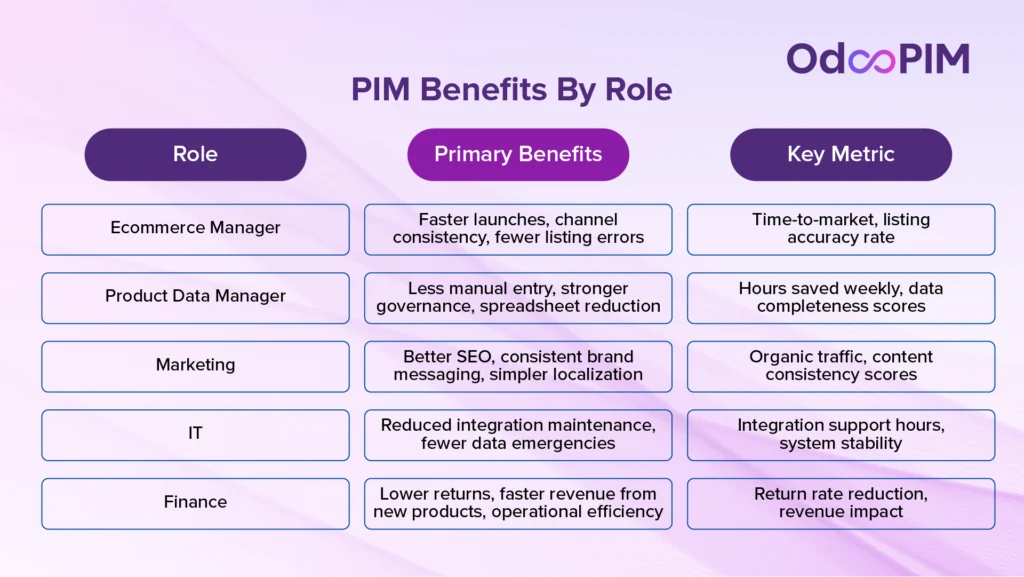
When product data lives in one governed repository instead of scattered spreadsheets, the time from product creation to channel publication compresses. Enrichment workflows run in parallel rather than sequentially, eliminating the delays when marketing waits on engineering specifications. Track this PIM benefit by measuring the days from product completion in ERP to live availability on each channel, targeting reduction through workflow automation rather than team acceleration.
2. Fewer Listing Errors
Automated validation rules catch missing attributes, incorrect formats, and incomplete specifications before products reach customer-facing channels. Every error caught during enrichment prevents a marketplace rejection or a customer encountering incorrect product information. Measure this benefit of product information management through channel rejection rates and customer-reported listing inaccuracies, watching both metrics decline as validation gates strengthen your publishing pipeline.
3. Consistent Data Across Channels
One governed product record syndicates to every channel with identical specifications, descriptions, and digital assets, eliminating the drift that occurs when teams manage each platform separately. Customers encounter the same product truth whether they shop on Amazon, your website, or a wholesale catalog. OdooPIM amplifies this benefit of a PIM solution by reading pricing and inventory from Odoo ERP, ensuring every channel displays current operational data.
4. Lower Return Rates
Returns triggered by inaccurate product descriptions, missing specifications, or misleading imagery decline when product data meets completeness and accuracy standards. Customers receive what they expected because product pages reflect reality rather than outdated or incomplete information. Track this PIM benefit by monitoring return reason codes related to product inaccuracy, measuring the percentage decline after implementing governed product content.

5. Less Manual Data Entry
Repetitive attribute population, spreadsheet copy-paste, and channel-specific reformatting disappear when automation handles the mechanical work of product data management. Teams redirect their expertise toward strategic enrichment and content quality rather than manual data transfer. Measure this benefit of product information management through weekly hours saved on data entry tasks, quantifying the capacity liberated for higher-value activities.
6. Faster Marketplace Onboarding
Pre-configured channel mapping templates and governed attribute sets make adding a new marketplace a configuration exercise rather than a data reconstruction project. Products launch on new channels in days instead of weeks because the required data exists in complete, validated form. OdooPIM supports this benefit of a PIM solution by maintaining channel-ready product data within Odoo, ready for syndication to any new platform.
7. Better Product Page SEO
Complete product attributes, keyword-rich descriptions, and structured data improve organic search visibility for product detail pages. Search engines index the comprehensive product information that PIM governance ensures, creating more discovery pathways for qualified buyers. Track this PIM benefit through organic product page traffic and search impression growth after implementing enriched, complete product content.
8. Easier Supplier Data Intake
Automated ingestion and normalization transform supplier feeds in any format into standardized product records without manual reformatting. Onboarding new suppliers accelerates because data mapping templates handle format differences automatically. OdooPIM delivers this benefit of product information management by connecting supplier data to governed product records within the Odoo framework.
9. Stronger Data Governance
Role-based permissions, approval workflows, and audit trails ensure that only authorized stakeholders can modify product data, and every change is tracked. Governance transforms product information from an uncontrolled shared resource into a managed corporate asset. Measure this benefit of a PIM solution through compliance audit readiness and the elimination of unauthorized data changes.
10. Reduced Dependency on Spreadsheets
Spreadsheet sprawl disappears when one governed platform replaces the multiple departmental files that cause version conflicts and data fragmentation. Teams stop asking “which spreadsheet is current” because the PIM provides the definitive answer. This PIM benefit manifests in reduced time spent reconciling conflicting data and increased confidence in product information accuracy.
11. Simpler Localization and Translation
Multi-language product content management centralizes translations alongside source content, enabling global channel expansion without duplicating enrichment effort. Regional variations in specifications, compliance requirements, and marketing content coexist within the same governed product records. OdooPIM supports this benefit of product information management by managing localization within the Odoo framework where multi-language capabilities operate on shared data.
12. Audit-Ready Compliance Data
Regulatory certifications, safety data, and compliance documentation link to product records with expiration tracking and automated update workflows. Audit preparation transforms from a frantic document hunt into a routine data export. Track this benefit of a PIM solution through audit preparation time and compliance
Learn about Best PIM software

How to Measure PIM ROI
PIM ROI calculation combines four measurable inputs: hours saved on manual data entry multiplied by fully loaded hourly cost, reduction in return rate multiplied by average return cost, revenue acceleration from faster product launches, and cost avoidance from eliminated listing errors. A mid-market business with ten thousand SKUs might save thirty hours weekly on data entry, reduce returns through improved data accuracy, accelerate launches to capture additional revenue, and eliminate the listing errors that previously consumed team capacity. The annualized savings from these benefits of an integrated product information management system typically recover the platform investment within the first year. OdooPIM strengthens this ROI by eliminating the middleware and integration maintenance costs that erode returns in standalone PIM deployments.
When a PIM Is Not Worth It
A PIM may exceed your needs if your catalog stays under roughly five hundred SKUs on a single sales channel with stable product data that rarely changes. The implementation and governance overhead cannot justify itself when spreadsheets still manage your catalog effectively. OdooPIM fits businesses approaching or crossing this threshold, providing the benefits of a PIM solution when your operational reality demands governed product data.
Learn about PIM Providers

Case Studies
Case Study 1: Industrial Fastener Distributor Measures PIM Benefits and Cuts Return Rate by One-Third
Challenge
An industrial fastener distributor with eighteen thousand SKUs tracked a rising return rate attributed to specification mismatches between their website product data and actual warehouse inventory. The team managed product information across five disconnected spreadsheets, with marketing, sales, and purchasing each maintaining separate files that drifted apart over time. Customers frequently received fasteners with different thread counts or material grades than the website described, triggering returns that eroded margin and customer trust. Leadership needed to understand what are the main benefits of using a PIM system before committing a budget, requiring measurable projections rather than vendor claims.
Solution
The distributor implemented OdooPIM within their existing Odoo environment, centralizing product specifications into one governed repository connected to inventory and purchasing data. Attribute validation rules enforced completeness standards before products could publish to the website, catching missing or incorrect specifications during enrichment rather than after customer purchase. Marketing and purchasing now work from identical product data because OdooPIM shares one database with Odoo ERP. The team measured four specific PIM benefits: hours saved on manual data entry, reduction in return rate, acceleration of new product launches, and elimination of listing errors on their website and Amazon Business.
Results
Return rate attributed to specification mismatches dropped by one-third within six months, delivering a measurable financial impact that contributed directly to the benefits of a PIM solution business case. Weekly data entry hours were reduced from twenty-eight to six as the benefits of product information management eliminated the manual spreadsheet reconciliation that consumed team capacity. New product launch time reduced from three weeks to five days because enrichment workflows replaced sequential email handoffs. The operations director calculated that the benefits of an integrated product information management system recovered their OdooPIM investment within seven months through return reduction and operational savings alone.
Case Study 2: Consumer Electronics Brand Quantifies PIM Benefits Across Multi-Channel Operations
Challenge
A consumer electronics brand with five thousand SKUs sold through their Shopify website, Amazon, and two retail partner platforms, managing product data through channel-specific spreadsheets that created inconsistent customer experiences. The Google Shopping feed showed different technical specifications than Amazon listings because each channel manager sourced product data from different documents. New product launches took three weeks as marketing manually formatted specifications for each platform. Leadership needed to quantify the benefits of PIM to justify the investment against competing budget priorities.
Solution
The brand deployed OdooPIM to centralize product data governance, connecting it to their Odoo ERP for real-time pricing and inventory synchronization. Channel syndication now pushes consistent product content to Shopify, Amazon, and both retail platforms simultaneously from one governed source. The team tracked multiple PIM benefits including time-to-market reduction, listing accuracy improvement, channel consistency scores, and manual data entry hours saved. Product page SEO improved as complete attributes and enriched descriptions replaced the sparse content that previously limited organic visibility.
Results
New product launch time was reduced from three weeks to four days as the benefits of a PIM solution automated the channel-specific formatting that previously consumed marketing team capacity. Listing errors dropped to near zero across four channels because validation rules catch missing attributes before syndication. The marketing director documented that the benefits of product information management included a measurable reduction in weekly data management hours from twenty-two to five. Organic product page traffic improved as complete product attributes created more search discovery pathways, validating the SEO component of the benefits of an integrated product information management system business case.
Learn about Product Information Management Workflow
Getting These Benefits Without an Integration Layer: OdooPIM
Many PIM benefits get eroded by the synchronization layer that standalone PIM systems require, stale data between sync cycles, broken connectors after platform upgrades, and the ongoing maintenance burden of middleware. OdooPIM eliminates this erosion by sharing one database with Odoo ERP, where product data, inventory, and pricing stay consistent without reconciliation because they are the same records. The benefits of an integrated product information management system materialize fully when governance and operations share one data foundation, not when they synchronize across fragile integration layers. OdooPIM delivers these benefits of product information management natively within the Odoo framework, making governed product data a natural output of your existing business systems.
Learn more about how OdooPIM brings measurable PIM benefits to your Odoo environment on our product page.
Learn about PIM syndications
FAQ’s
1. What does PIM stand for?
PIM stands for Product Information Management, the technology category that governs, enriches, and distributes product data across sales channels from one centralized source. This covers ecommerce product data governance, not Microsoft’s Privileged Identity Management, which shares the acronym but belongs to a different technology domain. OdooPIM delivers these benefits of PIM within the Odoo ERP framework, connecting product data governance to your operational systems.
2. What is PIM and how does it work?
PIM centralizes every product attribute, specification, digital asset, and marketing description into one governed repository, then provides workflows for teams to enrich and validate that content before syndicating it to every sales channel. It ingests raw product data from ERPs, supplier feeds, and spreadsheets, transforming fragmented information into customer-ready product stories. OdooPIM implements this process natively within Odoo, ensuring the benefits of product information management flow from your existing business data.
3. What are the main benefits of using a PIM system?
The benefits of a PIM solution include faster product launches, fewer listing errors, consistent product data across channels, lower return rates from inaccurate specifications, and reduced manual data entry that frees teams for strategic work. Organizations also gain stronger data governance, easier supplier onboarding, better product page SEO, and audit-ready compliance documentation. OdooPIM amplifies what are the main benefits of using a PIM system by eliminating the middleware and synchronization costs that erode ROI in standalone deployments.
4. How do you measure PIM ROI?
PIM ROI combines hours saved on manual data entry multiplied by fully loaded labor costs, reduction in return rate multiplied by average return expense, revenue acceleration from faster product launches, and cost avoidance from eliminated listing errors. A mid-market business mostly recovers their PIM investment within the first year through these four measurable inputs alone. OdooPIM strengthens the benefits of an integrated product information management system by removing middleware expenses from the cost side of the ROI equation.