
What Is the Product Data Management Process?
The product data management process is the end-to-end workflow of collecting, enriching, validating, storing, and distributing product information across your business. How product data management works involves five stages: ingestion from ERPs and suppliers, standardization of formats and attributes, enrichment with descriptions and images, validation through quality rules, and syndication to every sales channel. The product information management process requires ongoing maintenance, not just one-time cleanup, because products change and new channels emerge constantly. PIM workflow automation handles routine tasks like flagging missing attributes and routing approvals, turning reactive firefighting into proactive operations. Odoo product data workflow exemplifies this with built-in task assignment, validation rules, and automated syndication, ensuring your team focuses on selling, not spreadsheet chaos.
How the Product Data Management Process Works End to End
The product data management process starts with ingestion. The product data arrives from your ERP (SKUs, pricing, inventory), supplier feeds (specifications), and legacy spreadsheets (descriptions, images). How product data management works at this stage requires mapping varied formats to your standard attribute model. Next comes standardization: turning “M,” “Med,” and “Medium” into one consistent value. Product data collection and enrichment process then adds SEO descriptions, lifestyle images, technical manuals, and channel-specific copy.
After enrichment, the product data validation process runs automated checks. Missing GTIN? Flagged. Incorrect image ratio? Blocked. Conditional rules apply: electronics require voltage, apparel requires size charts. PIM workflow automation routes rejected items back to owners with specific fix instructions. Finally, syndication pushes validated data to every channel, your website, Amazon, Google Shopping, retailer portals. Product data lifecycle management continues after syndication. Products update, prices change and new channels launch. The cycle repeats continuously.

Why the Process Matters More Than the Software Alone
Software without a product data management process is an expensive filing cabinet. You can buy the best product information management platform, but if your team has no defined workflow for data ingestion, enrichment, or approval, the software sits unused. Product data management workflow determines success, not the feature list. A disciplined process with basic software outperforms a chaotic process with enterprise tools. Process defines who does what, when, and how.
The product data governance process is where most teams fail. They install a PIM but skip defining attribute ownership, approval chains, or quality thresholds. How product data management works effectively starts with process documentation before software selection. Map your current workflow, identify bottlenecks and define roles. Then choose tools that automate those steps. Odoo product data workflow works well for teams with clear processes because its built-in automation matches defined rules. Process first and software second. That order separates successful implementations from expensive shelfware.
Learn about PDM Software.
Who Is Involved in the Product Data Management Process?
Product data management process ownership starts with a Product Information Manager or Master Data Manager who defines standards and governs quality. Marketing owns descriptions, SEO fields, and channel-specific copy. Operations owns specifications, dimensions, weights, and supplier data. Sales owns channel pricing, customer-specific catalogs, and B2B product assortments. Product data collection and enrichment process requires input from all three.
Compliance and legal review regulated fields. Engineering provides technical specs and CAD files. Procurement manages supplier data feeds. Product data governance process assigns clear ownership per attribute type. The PIM enforces these assignments through role-based permissions. Marketing cannot edit spec fields and operations cannot change SEO metadata. PIM workflow automation routes tasks automatically: a new product goes to marketing for descriptions, then operations for specs, then legal for compliance. Product information management process success depends on every participant knowing their role. No ambiguity. No dropped tasks. No “I thought you did that.” Just accountable, repeatable execution.
Why Most Businesses Have a Broken Product Data Process
No Clear Ownership Over Product Data Tasks
Product data becomes everyone’s problem and no one’s problem. Marketing assumes operations and handles specifications. Operations assumes marketing manages descriptions. The product data governance process fails because no single person owns data quality. Tasks fall through cracks. A product launches with missing images because no one was assigned to upload them. Product data management workflow without ownership guarantees dropped tasks and finger-pointing. The fix is simple: assign one attribute owner per field type. Marketing owns SEO and operations owns specs. Compliance owns legal copy. Document ownership in a RACI matrix. Your product information management process cannot function without this foundation.
Learn about PIM data model.
Data Collected From Too Many Disconnected Sources
Your ERP holds inventory and pricing, spreadsheets contain descriptions and SEO fields, supplier feeds provide specifications and images sit in a shared drive. Product data collection and enrichment process pulls from five sources, none of which talk to each other. A dimension changes in one spreadsheet but not the others. Your website shows old data. Returns increase. How product data management works requires consolidation, not fragmentation. Without a single source of truth, your team spends hours reconciling conflicts instead of improving product data. The product data management process needs one system that ingests from sources and becomes the master record.
No Structured Review or Approval Before Publishing
Two weeks later, legal notices missing compliance language. The product gets pulled and sales lost. The product data validation process never happened because there was no approval workflow. Changes go live instantly without review and errors published before anyone catches them. PIM workflow automation solves this by routing every change through an approval chain before syndication. Senior editors review descriptions and legal reviews compliance copy. Only after all signoffs does data reach your channels. A product data management process without structured approvals is not management, it is gambling.
Updates Made Directly on Channels Instead of at the Source
Your team fixes a wrong price on Amazon. Later, they fix the same wrong price on your website directly. But the master source, your ERP or spreadsheet, still shows the old price. Next week, someone overwrites the channel fixes. How product data management works correctly requires one source of truth. Updates happen in the source, then syndicate everywhere. Product information management process breaks when teams make channel-specific edits. Those band-aids become new sources of truth. Product data management workflow must enforce a simple rule: never edit data on a channel. Edit the source. Let automation distribute.
The Real Business Cost of a Poorly Managed Data Process
Your team spends fifteen hours weekly hunting for correct data and reconciling conflicts. That is 780 hours annually, roughly $25,000 in labor. Product data lifecycle management failures add returns, compliance fines, and lost sales. A wrong dimension triggers returns at 20-30% of item value. A missing compliance field triggers retailer fines. Product data management process brokenness hits your P&L. Customers notice inconsistent information across channels, trust erodes and competitors with cleaner data win. Odoo product data workflow users avoid these costs through automation and governance. The question is not whether you can afford a PIM. The question is whether you can afford to keep your broken process.

The Product Data Management Process: Step by Step
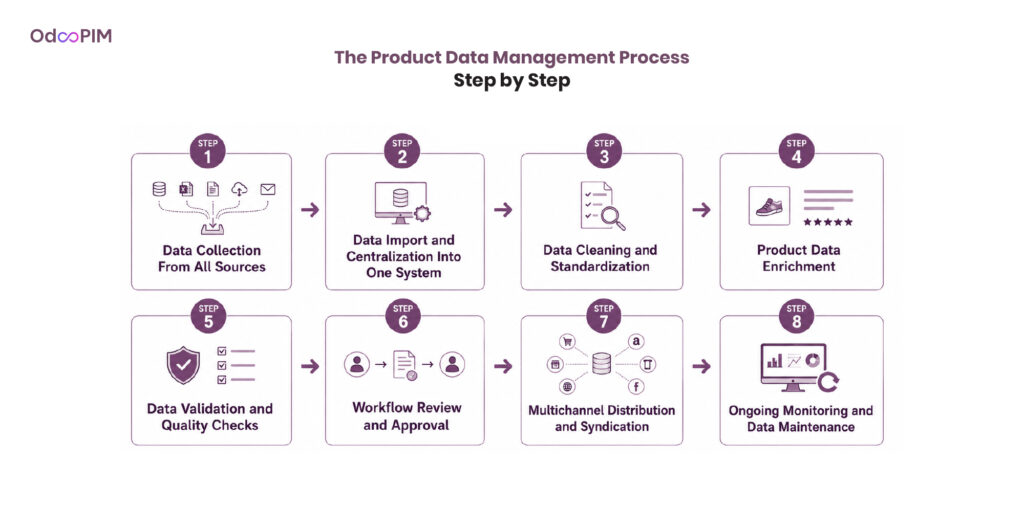
Step 1: Data Collection From All Sources
The product data collection and enrichment process starts with gathering data from every source. Your ERP provides SKUs, pricing, and inventory. Supplier feeds contribute specifications, dimensions, and compliance certificates. Spreadsheets hold descriptions, images, and SEO metadata. How product data management works at this stage requires identifying every source and data owner. Missing a source means missing data. Your team creates a source inventory before collecting anything. Document who owns each source, how often data changes, and what format it arrives in. Collection without a plan guarantees incomplete records.
Step 2: Data Import and Centralization Into One System
The data from multiple sources gets imported into a product data management process hub. The system ingests files via API, CSV upload, or direct database connections. The product information management process requires mapping each source’s fields to your master attribute model. Supplier “color_code” maps to your “color” field. ERP “list_price” maps to your “price” field. Without mapping, data lands in wrong places. Odoo product data workflow simplifies this by sharing one database with your ERP. For other setups, use ETL tools or native PIM connectors. Centralization fails if data stays in source systems.
Step 3: Data Cleaning and Standardization
Sizes appear as “M,” “Med,” and “Medium.”. Dates use different formats and prices include dollar signs in some fields, not others. Product data management workflow includes cleaning rules that transform chaos into consistency. Standardize attribute values using dropdown mappings. Convert date formats and strip currency symbols from price fields. The product data governance process defines the standard for every field. The system applies these rules automatically during import. Without cleaning, your central database just centralizes garbage. Clean data before enrichment.
Step 4: Product Data Enrichment
Enrichment adds context and selling power. Your team writes SEO descriptions, uploads lifestyle images, creates comparison charts, and adds technical manuals. Product data collection and enrichment process turns basic SKU records into complete product stories. Marketing owns description enrichment, operations own spec verification and legal owns compliance copy. PIM workflow automation assigns tasks to the right people with deadlines. A product manager enriches core data. The system notifies marketing for descriptions, then operations for specs. Enrichment without task assignment means things get forgotten.
Step 5: Data Validation and Quality Checks
Validation rules catch errors before distribution. The product data validation process checks that every product has a GTIN, at least one image, and all required attributes for its category. Conditional logic applies: electronics require voltage, apparel requires size charts. Product data management process validation also checks relationships. No duplicate SKUs, parent-child variants consistent and images meet resolution standards. The system blocks products failing validation, displaying specific error messages. Your team fixes issues in the PIM, not after customers complain. Validation shifts quality control from reactive to proactive.

Step 6: Workflow Review and Approval
Approval workflows require signoff before publishing. A junior team member enriches a product. The product information management process routes it to a senior editor for review. Marketing approves descriptions, operations verifies specs and legal signs off on compliance. PIM workflow automation tracks status: who is waiting, who is overdue, what is approved. Only after all required approvals does the product become eligible for syndication. Product data management platform workflow without approvals means any mistake anywhere published instantly. Approval chains catch what automated validation misses. Human review catches tone, brand voice, and context errors.
Step 7: Multichannel Distribution and Syndication
Syndication pushes approved product data to every sales channel. Your website, Amazon, Google Shopping, retailer portals, and B2B partner feeds all receive correctly formatted data. How product data management works at this stage includes channel-specific transformations. Master descriptions become Amazon bullet points, long-form copy goes to your website and structured data goes to comparison engines. Product data lifecycle management syndication happens automatically on schedule or in real time. A price update in your PIM propagates everywhere within minutes. No manual exports, no copy-paste errors and no version drift between channels.
Step 8: Ongoing Monitoring and Data Maintenance
The product data management process never ends, products change, specifications get updated, new channels launch and ongoing monitoring checks data health continuously. Completeness scores per category, validation failure rates per channel and aging reports showing products not updated in six months. Product data governance process schedules regular audits, monthly for fast-moving catalogs, quarterly for stable ones. Odoo product data workflow includes dashboards that flag deteriorating quality. Your team reviews reports, assigns fixes, and runs the cycle again. Maintenance separates professional operations from amateur chaos. One-time cleanup is not management and continuous improvement is.
Learn about MDM vs PIM
How the Product Data Management Process Differs by Business Type
The Process for Manufacturers Managing Technical Specifications
Manufacturers build their product data management process around engineering precision rather than marketing speed. Data originates in ERP systems like SAP or Odoo, and enrichment adds CAD files, compliance certificates, compatibility matrices, and repair manuals that require technical expertise to validate. Product data governance process assigns ownership of specifications to engineering teams, not marketers, and approval workflows involve multiple technical reviewers before any product data reaches B2B portals or distributor networks.
Validation rules for manufacturers enforce industry-specific standards such as ISO compliance, voltage tolerances, and material certifications. Product information management process includes attribute hierarchies where a single motor might have nested specifications for voltage ranges, mounting patterns, and efficiency ratings. Syndication targets reseller portals, procurement systems, and internal repair networks rather than direct-to-consumer channels. Odoo product data workflow suits manufacturers well because the PIM shares a database with manufacturing ERP, eliminating the sync delays that plague separate systems.
The Process for Retailers Managing High-Volume SKU Catalogs
Retailers prioritize speed and volume in their product data management process, ingesting thousands of new SKUs weekly from hundreds of suppliers. Product data collection and enrichment process relies on automated supplier feed mapping, template-based enrichment, and bulk editing tools because manual data entry per product is impossible at scale. Validation focuses on channel-specific requirements like GTINs for Amazon, image ratios for Google Shopping, and category taxonomies for each marketplace where the retailer sells.
PIM workflow automation routes enrichment tasks to category managers rather than individual product owners, and a single footwear buyer might manage thousands of shoe SKUs simultaneously. Product data lifecycle management for retailers includes frequent price updates, seasonal attribute changes, and automated clearance flags that trigger syndication to discount channels. The process prioritizes getting products live quickly while maintaining baseline quality, following the principle that perfect enrichment on day one is less valuable than being first to market with acceptable data that improves over time.
The Process for Brands Selling Across Multiple Channels and Regions
Brands face the most complex product data management process because they must handle channel diversity and regional localization simultaneously. One master product record might need to become Amazon bullet points, website long-form copy, retailer catalog snippets, and wholesale PDFs, with each destination requiring different field mappings and transformation rules. The product information management process also manages regional variations where French customers see metric measurements and local compliance labels while US customers see imperial units and FTC disclosures.
Validation for brands includes channel-specific and region-specific checks, such as confirming that a product has the required EU energy label before syndicating to Amazon Germany. Product data governance process assigns approval authority by channel and region, meaning a European channel manager approves content for EU marketplaces while a North American counterpart handles US retailers. Product data management workflow for brands includes continuous digital shelf monitoring, where analytics on content performance feed back into enrichment cycles to optimize descriptions and images based on conversion data rather than guesswork.
Learn about PIM database

How PIM Software Formalizes and Automates the Product Data Process
What a Manual Product Data Process Looks Like Without PIM
Without a PIM, your team manages product data across disconnected spreadsheets, emails, and ERP exports. A product launch requires exporting data from your ERP, emailing spreadsheets to marketing for descriptions, waiting for files to return, manually merging changes, then uploading to each channel separately. How product data management works manually means version conflicts, lost updates, and constant reconciliation. Teams waste hours hunting for the correct file instead of improving product content.
The approval process is nonexistent or email-based. A junior editor emails a spreadsheet to a senior reviewer. The reviewer emails back comments, edits get missed and no one knows which version is final. Product data management process without automation guarantees errors. A wrong price reaches your website because someone edited the wrong column. A missing image goes live because no validation checked for it. Manual processes scale negatively. More products create more chaos, not more efficiency.
What the Same Process Looks Like When PIM Is in Place
A PIM centralizes everything into one database. Your ERP syncs automatically, supplier feeds map to your attribute model and marketing enriches descriptions in the PIM. The product information management process eliminates spreadsheets. A product launch requires one enrichment session, one approval workflow, and one syndication click. Data reaches every channel within minutes, not weeks. Product data management workflow becomes repeatable, measurable, and fast.
The approval process lives inside the PIM, a junior editor enriches a product and the system routes it to a senior reviewer, who approves or rejects with comments. PIM workflow automation tracks every step. No emails and no version confusion. The audit log shows who approved what and when. Product data validation process runs automatically before syndication. Missing GTIN? Blocked. Incorrect image ratio? Flagged. Only clean, approved data reaches your channels. The difference is control, manual processes react to errors and PIM prevents them.
Key PIM Features That Support Each Step of the Process
Data ingestion uses pre-built connectors or flexible import templates that map supplier fields to your standard model. Product data collection and enrichment process benefits from automated attribute mapping and data type validation during import. Enrichment features include bulk editing, template-based content generation, and AI-assisted description writing. The product information management process also includes media management where images link directly to products and variants.
The product data validation process uses conditional rules, required field checks, and completeness scoring. The product data governance process relies on role-based permissions, multi-step approval chains, and audit trails. Syndication features push data to every channel with channel-specific mapping rules and format transformations. Odoo product data workflow includes all these features natively. A PIM does not just support each step. It automates steps that manual processes cannot execute reliably. That is the difference between managing product data and being managed by it.
Common Bottlenecks in the Product Data Management Process
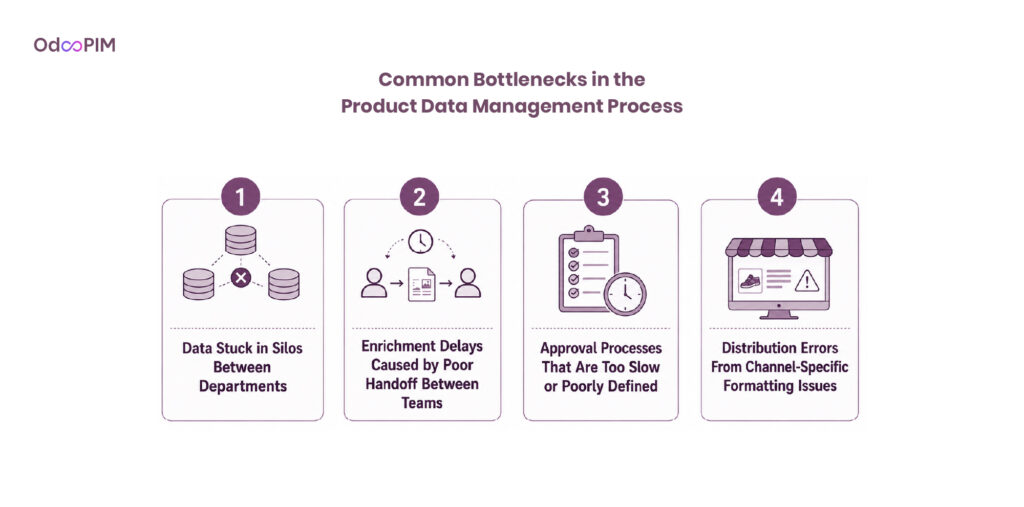
Data Stuck in Silos Between Departments
Marketing maintains descriptions in spreadsheets. Operations keep specifications in the ERP. Sales manages pricing in separate files. The product data management process fails when departments hoard data instead of sharing it. A product launch requires touching three different systems, each with its own format and update schedule. How product data management works in siloed environments means teams constantly ask “which version is current?” and waste hours reconciling conflicts.
Silos also create duplicate work, marketing enriches a product and operations enriches the same product independently. The product information management process without centralization guarantees redundant effort and inconsistent results. The same product might have two different descriptions across your website and your ERP export. The product data governance process breaks when no single system holds authority. Breaking silos requires one source of truth that every department uses. No exceptions.
Enrichment Delays Caused by Poor Handoff Between Teams
Marketing finishes writing descriptions, they email the spreadsheet to operations for spec verification and operations sets it aside for three days. Product data management workflow stalls because handoffs are manual and asynchronous. No one knows who is waiting on whom and deadlines slip. Product data collection and enrichment process becomes a game of chase, not a coordinated workflow.
Poor handoffs also create quality issues, marketing updates a description after sending the file to operations and operations verifies the old version. Product data lifecycle management suffers from version drift. The PIM would solve this by housing all enrichment tasks in one system with task assignments and notifications. PIM workflow automation routes work automatically: marketing finishes, operations gets notified immediately.
Approval Processes That Are Too Slow or Poorly Defined
An approver sits on a request for two weeks because no SLA exists. No one escalates. The product misses its launch window. The product data validation process includes approvals, but slow approvals kill speed. Poorly defined approval rules create confusion. Does pricing need legal signoff? Does every description need senior review? Product information management process without clear rules means either over-approval (everything blocked) or under-approval (errors slip through).
Defined approval workflows with SLAs fix this. A description needs review within 24 hours and after that, the request escalates to a manager. The product data governance process specifies which attributes require approval and who approves them. Routine changes skip approval and high-risk fields require signoff. How product data management works with defined approvals balances speed and safety. The bottleneck disappears when everyone knows the rules and the system enforces deadlines.
Distribution Errors From Channel-Specific Formatting Issues
Your team exports product data for Amazon. They manually reformat descriptions into bullet points. One product misses the reformatting step. The Amazon listing shows raw text instead of bullet points. Product data management process breaks during manual channel formatting. Each channel demands different structures. Amazon needs bullet points and white-background images. Google Shopping needs structured feeds. Your website needs long-form copy. Manual reformatting for every channel guarantees errors.
A PIM automates this transformation and defines mapping rules once. The system converts your master description into Amazon bullet points, website copy, and feed formats automatically. Product data validation process checks channel-specific requirements before syndication. Missing GTIN for Amazon? Blocked. Wrong image ratio for Google? Flagged. Odoo product data workflow includes channel mapping and validation. Distribution errors drop to near zero because automation replaces manual reformatting. The bottleneck is not your team’s effort. It is the absence of automated transformation rules.
How to Build and Improve Your Product Data Management Process
Start With a Product Data Audit
Run a full export of your product catalog before changing anything. Count missing values per field, identify which attributes are most frequently empty, and segment results by product category. Product data management process improvement starts with knowing your current state. A fashion category might have 95% completeness on descriptions but 60% on size charts, while electronics might struggle with voltage specifications.
Products with missing images likely indicate a broken handoff between creative and merchandising teams. Inconsistent attribute values point to missing governance. The product information management process without an audit is guesswork. Export, analyze, document findings, and prioritize fixes based on business impact. Best-selling categories first. High-error categories second.
Map Out Your Current Process Before Changing It
Document every step from data ingestion to channel syndication. Who creates new products? Who enriches descriptions? Who approves pricing? Product data management workflow mapping reveals bottlenecks and redundancies. You might discover that five people touch a product before launch but only two add value. The rest just forward emails.
Process mapping also exposes missing steps. No validation before publishing explains those customer complaints about wrong dimensions and no approval for pricing explains those margin-eroding errors. How product data management works effectively requires seeing the whole process, not just your piece. Draw the map, share it with every department and fix what is broken before automating anything.
Define Ownership and Accountability for Each Step
Assign one person per process step, marketing owns descriptions, operations owns specifications and legal owns compliance copy. Product data governance process without clear owners guarantees dropped tasks and finger-pointing. Document who does what in a RACI matrix. The PIM enforces these assignments through role-based permissions. Marketing cannot edit spec fields and operations cannot change SEO metadata.
Accountability means measuring performance. Does marketing complete descriptions within two days of product creation? Do operations verify specs within 24 hours? Product data lifecycle management requires SLAs for each step. Review performance weekly. Retrain underperformers, adjust assignments when bottlenecks emerge and ownership without accountability is just a title on a document.
Choose a PIM That Supports Your Workflow: Not the Other Way Around
Software should adapt to your process, not force you to adapt to it. List your non-negotiable workflow requirements before evaluating vendors. Do you need multi-step approvals? Role-based permissions? Channel-specific validation? PIM workflow automation features vary widely. Some platforms excel at complex approvals. Others prioritize speed over governance.
Test each candidate with your actual process, import your messiest product data, run it through your approval chain and syndicate to your most demanding channel. Product data management process success depends on fit, not features. A PIM with fifty features you do not need but lacks your required approval structure is the wrong tool. Odoo product data workflow suits Odoo users. Akeneo suits complex hierarchies. Choose based on your process, not marketing claims.
Measure Process Performance With Data Quality KPIs
Track completeness scores per category weekly. Measure validation failure rates per channel monthly. Monitor time from product creation to syndication. Product data validation process KPIs tell you whether improvements work. A completeness score that rises from 70% to 90% over six months proves progress. A validation failure rate that drops from 15% to 3% shows ROI.
A sudden drop in completeness scores signals a process breakdown. Maybe a new supplier is sending incomplete feeds. Maybe a team member skipped training. The product information management process without measurement is flying blind. Build dashboards, review metrics weekly, celebrate improvements and investigate declines. What gets measured gets managed. What gets managed gets better.
How OdooPIM Supports Every Step of the Product Data Management Process
Centralizing Data Collection and Import Inside OdooPIM
OdooPIM shares the same database as your Odoo ERP, so product data from inventory, accounting, and sales modules is already present. No separate import step or middleware required for your core product information. Product data collection and enrichment process starts with data that is already centralized, eliminating the ingestion bottlenecks that plague standalone PIMs. Supplier feeds and spreadsheets import through Odoo’s native import tools, with field mapping that applies your standard attribute model automatically.
The platform also handles external data sources through flexible CSV and API imports. Supplier A sends product specs in one format, supplier B in another. The product data management process within OdooPIM maps both to your master attribute model using configurable transformation rules. A staging area lets you review imported data before merging into your master catalog. How product data management works in Odoo means collection and centralization happen without custom middleware or third-party ETL tools.
Learn about PDM Tools.
Built-In Enrichment, Validation, and Workflow Tools
Enrichment happens on product forms that already display ERP data like cost and inventory. Your team adds descriptions, SEO fields, images, and channel-specific copy without switching applications. Product information management process benefits from bulk editing, template-based enrichment, and AI-assisted content generation for large catalogs. Attribute families ensure that products in the same category share the same field structure, reducing inconsistency.
Validation rules block incomplete or incorrect data before syndication. Required fields, data type checks, and conditional logic (if category is Electronics, voltage becomes required) run automatically. Product data validation process includes completeness scoring that shows percentage of required fields filled. PIM workflow automation routes products through approval chains: junior editors enrich, senior editors review, legal approved compliance copy. Task assignments and deadline tracking ensure nothing stalls.
How OdooPIM Connects the Process to Odoo ERP and Sales Channels
Because OdooPIM shares a database with Odoo ERP, inventory levels and pricing flow into your product records without sync delays. A warehouse update in the ERP appears in your PIM instantly, and that change can syndicate to sales channels within the same transaction. Product data lifecycle management eliminates the ERP-PIM handoff problem that forces standalone PIM users to build and maintain middleware connectors.
Channel syndication connects natively to Odoo’s ecommerce module and external platforms through pre-built connectors. Your website, Amazon, Google Shopping, and retailer portals receive product data formatted to each channel’s specifications. Product data management workflow includes channel mapping rules defined once and applied automatically. A price change in OdooPIM propagates to every connected channel within minutes, with no manual exports or reformatting.

Getting Started With OdooPIM to Streamline Your Product Data Process
For existing Odoo users, activation takes minutes. Navigate to Apps, install the PIM module, and your existing products appear immediately with fields ready for enrichment. How product data management works in Odoo means no data migration, no API connectors to build, and no learning a second interface. Your team already knows Odoo. The PIM just adds new capabilities to the product forms they already use.
For new Odoo users, subscribe to Odoo first, then add the PIM module. Implementation follows Odoo’s standard playbook: configure company settings, import your product base, set up user permissions, define attribute families, and configure approval workflows. Odoo product data workflow includes built-in training resources and documentation. Most businesses go from signup to first product syndication within two weeks. The process starts centralized, stays automated, and scales with your catalog.
Frequently Asked Questions
1. What Are the Main Steps in the Product Data Management Process?
The product data management process has eight steps: collection from ERPs and suppliers, import and centralization into one system, cleaning and standardization of formats and values, enrichment with descriptions and images, validation through quality rules, workflow review and approval, multichannel syndication, and ongoing monitoring. How product data management works effectively requires all eight steps, though some businesses combine or skip steps based on catalog complexity. Product data lifecycle management repeats these steps continuously as products update and new channels emerge.
2. How Long Does the Product Data Management Process Take?
For a single product, the product data management process takes anywhere from two hours to two weeks depending on complexity and automation. A simple SKU with pre-filled attributes and automated approval might syndicate in under an hour. A complex B2B product requiring CAD files, compliance review, and legal approval could take days. Product data management workflow without automation stretches timelines dramatically. PIM workflow automation cuts per-product time by 70-80% compared to manual spreadsheets.
3. What Is the Difference Between the PDM Process and the PIM Process?
PDM (Product Data Management) and PIM (Product Information Management) describe the same product information management process. Some vendors use “PDM” to emphasize technical specifications, while “PIM” emphasizes enrichment and syndication. How product data management works in software is identical regardless of the label. The distinction matters only when comparing against adjacent systems like ERP or PLM. Focus on features, not naming conventions.
4. How Does Automating the Process With PIM Reduce Errors?
Manual product data management process relies on humans to catch errors, which fails at scale. A PIM workflow automation applies validation rules automatically before data syndicates, checking for missing GTINs, incorrect image ratios, and inconsistent attribute values. The system blocks incomplete products and tells your team exactly what to fix. Product data validation process that runs automatically catches what human reviewers miss. Automated approval routing ensures no product launches without proper signoff. Errors drop because automation replaces manual steps.
5. Can OdooPIM Handle the Full Product Data Management Process?
Odoo product data workflow covers collection (from Odoo ERP and external sources), enrichment (descriptions, images, SEO), validation (required fields, conditional rules), approval (role-based workflows), and syndication (channels, marketplaces, portals). Because OdooPIM shares a database with Odoo ERP, the product data collection and enrichment process starts with data already centralized. Built-in product data governance process includes role-based permissions, audit trails, and version control. For Odoo users, OdooPIM delivers complete product data lifecycle management without middleware.