What Is the Difference Between Quable, Akeneo, and OdooPIM?
OdooPIM: PIM built inside Odoo
OdooPIM is the only PIM that runs natively on Odoo ERP, no middleware, no API stitching, no custom connectors because product data, inventory, pricing, and orders share one database. Built for B2B manufacturers, wholesalers, and distributors already running Odoo, OdooPIM eliminates the integration headaches that plague standalone PIMs. For Odoo users, it offers the lowest total cost of ownership and fastest time-to-value.
Quable: PIM for content-led teams
Quable is a cloud-native, marketing-first PIM with strong capabilities in rich media management, multilingual content workflows, and omnichannel syndication for brands with complex content requirements. Common in European mid-market retail, fashion, luxury, and food sectors, Quable handles product storytelling, digital catalogs, and fast integration with CMS and ecommerce platforms. Quable requires an external connector or middleware for ERP integration, making it less smooth for businesses running established ERP systems.
Akeneo: PIM for omnichannel activation
Akeneo is purpose-built for product experience management with a large connector marketplace of 250+ pre-built integrations, native DAM through Product Cloud, and advanced product modeling for complex catalogs. Akeneo scales from Community Edition (open-source, free) to enterprise-grade with workflow automation, KPI tracking, and multi-language support across global markets. Akeneo is ideal for mid-market to enterprise brands with complex catalog structures and multichannel distribution, but ERP sync requires a separate integration layer.

Key differences at a glance
| Feature | Quable | Akeneo | OdooPIM |
| Primary focus | Content & creative workflow | Product experience management | Native PIM + ERP |
| Deployment | SaaS | SaaS + Community Edition | Native Odoo module |
| ERP integration | Via connector | Via connector | Native, zero middleware |
| DAM | Native | Native (Product Cloud) | Via Odoo Documents |
| Channel syndication | Limited | Connector-based (250+) | Via Odoo eCommerce + apps |
| Best for | Marketing-led teams | Mid-market to enterprise | Odoo users, B2B operations |
How Do Quable, Akeneo, and OdooPIM Perform in Real-World Use?
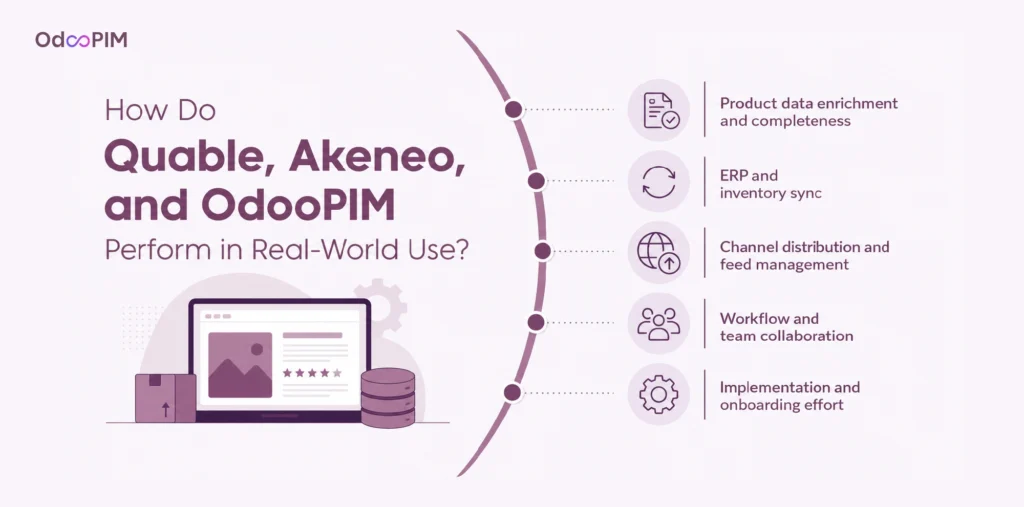
The operational reality of these three PIM platforms reveals stark differences in integration complexity, workflow design, and total cost of ownership. Quable prioritizes creative workflows and marketing-led teams, Akeneo excels at complex product modeling and omnichannel activation, and OdooPIM eliminates the middleware overhead for Odoo users by running natively on the same database. The choice is not about which platform has the most features, it is about which platform fits your existing tech stack without requiring custom connectors, duplicate data entry, or months of integration work.
Product data enrichment and completeness
Quable provides a range of enrichment tools including bulk actions, AI-generated content, and the ability to link product sheets with assets or other products for cross-selling and up-selling strategies. Akeneo offers AI-Enhanced Enrichment that leverages customer reviews and ratings to generate better textual content, with rule engine automation for applying improvements at scale. OdooPIM uses AI product data enrichment to auto-fill gaps, standardize attributes, and improve data quality at scale, with validation rules and completeness checks applied before products move to syndication. Quable also provides completeness indicators, tags, and workflows that track enrichment progress, with dashboard widgets showing data status in real-time.
ERP and inventory sync
Quable collects product information from ERPs and alerts marketing teams when enrichment can begin, but requires external connectors for ERP integration. Akeneo syncs with ERPs through its connector marketplace of 250+ pre-built integrations, but requires a separate integration layer and careful management to prevent marketing updates from overwriting operational data. OdooPIM eliminates this entirely, product data, inventory, pricing, and orders share one database with zero middleware, and ERP integration is native, real-time, and automatic.
Channel distribution and feed management
Quable publishes data to sales and distribution channels once quality reaches a predefined level, with specific adaptation for each channel’s specifications. Akeneo’s connector ecosystem supports 250+ channels for omnichannel distribution, but each connector must be configured and maintained separately. OdooPIM connectors distributes via Odoo eCommerce and native apps, with channel mapping and transformation rules defined once and applied automatically across destinations.
Workflow and team collaboration
Quable enables task assignment, notifications, and workflow automation to guide enrichment steps between purchasing, marketing, photography, and translation teams. Akeneo offers collaboration workflows with one-time initialization for new product enrichment and continuous workflows for ongoing updates, with enrichment and review steps, automated rule triggers, and task completion tracking. OdooPIM uses Odoo’s native workflow engine, with task routing, approval chains, and status tracking built into the same interface where your team manages operations.
Learn about best PIM Software
Forrester’s PIM research states that without a PIM, governing and syndicating product information across a growing omnichannel ecosystem becomes impossible, and describes PIM as the hub between content management, ecommerce, DAM, and ERP systems.
Implementation and onboarding effort
Quable claims implementation is three times faster than industry average, with cloud-native deployment and a minimalist UI designed for rapid ramp-up. Akeneo implementations vary significantly; a typical mid-size deployment with 20,000 products and 14 channels can take four months with an integration partner, including data modeling, attribute mapping, and user training. OdooPIM activates in minutes for existing Odoo users, install the module, configure your company settings, import your product base, and start enriching, with no separate implementation partner required for basic setup.
| Capability | Quable | Akeneo | OdooPIM |
| ERP integration | Custom connector | Custom connector | Native, real-time |
| Inventory sync | Manual / API | Manual / API | Automatic |
| Channel distribution | Limited native | 250+ connectors | Odoo eCommerce + apps |
| Workflow | Strong (creative) | Business-user friendly | Odoo workflow engine |
| TCO for Odoo users | High (duplicate stack) | High (duplicate stack) | Low, one platform |

Learn about Pimcore vs Akeneo vs OdooPIM
Quable vs Akeneo vs OdooPIM: Which PIM Is Right for Your Business?
Choose OdooPIM if…
- You are already on Odoo ERP or actively evaluating it, and you want your PIM to share the same database as your inventory, accounting, and sales modules.
- You need PIM, inventory, and order management as one unified system with no middleware, no API stitching, and no custom connectors to maintain.
- You want to eliminate integration overhead between PIM and ERP entirely, because product data flows from your ERP to your PIM with zero sync delays or data drift.
- You are a B2B manufacturer, wholesaler, or distributor with multi-SKU catalogs and complex variants that require smooth ERP-PIM integration for accurate inventory and pricing.
- You want the fastest time-to-value and lowest total cost of ownership for an Odoo-native PIM that activates in minutes, not months.
Choose Quable if…
- Your team is marketing-led and prioritizes content workflows, rich media management, and creative collaboration over technical integration.
- You operate in fashion, luxury, food, or retail sectors where multilingual content and brand storytelling are critical for customer experience.
- You need fast implementation and a cloud-native SaaS PIM without the overhead of enterprise platforms or open-source maintenance.
- You are willing to manage ERP integration through external connectors or middleware, accepting some sync delays and integration complexity.
- Your goal is to improve product content quality and creative workflows rather than eliminating integration overhead between systems.
Choose Akeneo if…
- You have complex product catalogs with attribute hierarchies, multiple languages, and require advanced product modeling capabilities.
- You need a mature ecosystem with 250+ connectors and a large partner network to support omnichannel distribution across multiple marketplaces.
- You have the technical resources to manage an open-source Community Edition or the budget for enterprise-grade Akeneo with workflow automation.
- You are willing to manage ERP sync through a separate integration layer, accepting some integration work to get best-of-breed product modeling.
- You need to support both B2C and B2B product experiences across multiple channels with a dedicated product experience management platform.
Learn about best free PIM software

Where Your Search Ends: Why Odoo-Native PIM Wins
Quable and Akeneo are capable platforms that solve real problems for marketing-led teams and complex omnichannel retailers. Quable excels at creative workflows and rich media management for fashion and retail brands, while Akeneo offers powerful product modeling with a vast connector ecosystem and enterprise-grade workflow automation. But both require separate ERP connectors, middleware, or custom integration work to sync with your source of truth, your ERP. Both introduce a second system to maintain, a second database to reconcile, and a second set of integration failures to debug.
One Odoo instance handles product data, inventory, pricing, and orders. No middleware and no API stitching. No custom connectors and no data drift between PIM and ERP because there is only one database. For B2B manufacturers, wholesalers, and distributors already in the Odoo ecosystem, there is no integration gap to bridge, product data flows directly from your ERP to your PIM to every channel automatically.
Quable and Akeneo ask you to connect your PIM to your ERP. OdooPIM asks you to enrich product data where your business already runs, inside Odoo. If you are already on Odoo or actively evaluating it, OdooPIM is not just another PIM alternative. It is the PIM that eliminates the integration overhead you would otherwise carry with any standalone solution.
See OdooPIM in action. Book a Demo

FAQ’s
1. What is the difference between Quable, Akeneo, and OdooPIM?
Quable is a cloud-native, marketing-first PIM with strong rich media management and multilingual content workflows, common in European mid-market retail and fashion brands. Akeneo is purpose-built for omnichannel product experience management with 250+ connectors, advanced product modeling, and an open-source Community Edition. OdooPIM is the only PIM that runs natively on Odoo ERP, no middleware, no API stitching, because product data, inventory, pricing, and orders share one database. For Odoo users, OdooPIM eliminates the integration overhead that both Quable and Akeneo require.
2. Which is the best PIM software overall?
The best PIM software depends on your ERP setup and team structure. According to G2’s Winter 2026 Grid Reports, Akeneo is top-rated for advanced product hierarchies and KPI tracking (starting at $45,000/year), while Quable is recognized for mid-market teams managing structured catalogs (starting at $17,988/year). OdooPIM is not listed as a standalone PIM because it operates as a native module within the Odoo ecosystem. For existing Odoo users, OdooPIM wins on integration and total cost of ownership; for marketing-led retail brands, Quable is a strong akeneo alternative; for complex omnichannel needs, Akeneo leads.
3. Is there a best free PIM software option?
Akeneo offers the widely adopted best free PIM software through its open-source Community Edition, which includes core product modeling, attribute management, and completeness scoring without licensing fees. Pimcore is another open-source alternative that bundles PIM with DAM and CMS capabilities. Quable and OdooPIM do not offer free versions; they are commercial SaaS or native ERP modules. However, the “free” Akeneo Community Edition requires self-hosting, maintenance, and integration work, which means the total cost of ownership often exceeds paid alternatives for non-technical teams.
4. How does Akeneo compare to Pimcore?
Pimcore vs Akeneo comparison shows different architectural approaches. Akeneo is a dedicated PIM with strong omnichannel connectors, intuitive attribute management, and a large partner network, but its data model is less flexible than open-architecture systems and it lacks native print publishing. Pimcore is a combined PIM, DAM, CDP, and MDM platform with full open-source code access and unlimited customization, making it ideal for enterprises with dedicated development teams. However, Pimcore requires serious engineering resources for hosting and maintenance, while Akeneo offers a more business-user-friendly interface and faster onboarding.
5. What are the best Akeneo alternatives for B2B manufacturers?
For B2B manufacturers, the best akeneo alternatives depend on your ERP integration needs. OdooPIM is the strongest alternative for manufacturers on Odoo ERP, because it eliminates middleware and sync delays, product data flows directly from your ERP to your PIM. inRiver specializes in complex product hierarchies, BOMs, and B2B workflows. Quable is less suited for technical manufacturing data due to its marketing-first focus. Pimcore offers complete data model flexibility for industrial catalogs with thousands of attributes. The choice is not about which PIM has the most features, it is about which fits your ERP ecosystem and data complexity without requiring months of integration work.
6. How much does PIM software mostly cost?
PIM software pricing varies significantly based on deployment model and features. Quable starts at $1,745/month (Business tier ~$17,988/year) with onboarding fees of $5,000-$15,000. Akeneo Enterprise starts at $50,000-$150,000/year plus $10,000-$50,000 onboarding. OdooPIM is not priced as a standalone PIM; it adds to your existing Odoo ERP subscription, mostly $3,000-$8,000/year depending on user count and modules. For SMBs, mid-range plans for 10 users can cost $1,000-$5,000+ monthly. Always ask about hidden costs: additional storage, API limits, extra users, premium support, and training.