What Is MDM Implementation?
Definition
MDM implementation is the process of deploying technology, governance frameworks, and data standards that create a trusted version of critical business information across disconnected systems. This MDM implementation effort consolidates fragmented product master data from ERP platforms, CRM applications, ecommerce engines, and legacy databases into governed records that every department can trust. The initiative involves selecting among MDM implementation styles, establishing data stewardship workflows, and defining the product master data model that structures how information relates across domains. Successful product master data management requires more than software installation; it demands organizational alignment around data ownership, quality standards, and ongoing governance. The MDM implementation project plan must balance technical architecture decisions with the human factors that determine whether teams adopt or abandon the new system.
Why Style Matters
Your choice among MDM styles determines where data gets authored, how conflicts resolve, and which system becomes the authoritative source when discrepancies surface. Selecting the wrong types of MDM for your organizational maturity leads to rejected data, abandoned workflows, and an expensive hub that teams route around rather than through. A registry approach suits federated organizations where business units demand local control, while centralized MDM implementation styles fit enterprises ready to enforce top-down governance. The MDM implementation steps you follow depend on whether you build a lightweight index or a heavyweight system of record. Style selection shapes every subsequent decision in your MDM implementation project plan, from integration complexity to steward training requirements.
Learn about Product data management software

What Is Product Master Data?
Definition
Product master data is the foundational information that defines what an organization manufactures, distributes, or sells, spanning identifiers, attributes, specifications, hierarchies, and relationships that every operational system consumes. Understanding what is product master data means recognizing it as the informational backbone connecting ERP inventory records, ecommerce product pages, procurement catalogs, and logistics systems. This data includes SKU codes, descriptions, dimensions, materials, compliance certifications, pricing tiers, and the parent-child relationships that organize products into categories and families. A well-designed product master data model ensures that a single product identifier carries consistent meaning whether viewed in a warehouse management system or a customer-facing website. Product master data management governs the lifecycle of this information from initial creation through enrichment, publication, and eventual retirement.
Examples
Product master data for a manufacturer includes technical specifications like torque ratings, material compositions, dimensional drawings, and safety certifications that engineering teams maintain. A distributor’s product master data model encompasses supplier information, procurement costs, warehouse bin locations, and customer-specific pricing agreements tied to each SKU. Consumer goods companies populate their product master data management systems with nutritional information, ingredient lists, packaging dimensions, and digital assets that feed retailer requirements. The “what is product master data” question answers itself through the attributes a sales team needs for quoting, a warehouse needs for picking, and a customer needs for purchasing. These product master data elements collectively form the informational infrastructure that determines whether orders ship accurately and customers receive what they expected.
Learn about PIM AI Is Transforming Product Data Management
Gartner predicts that by 2027, GenAI will accelerate time-to-value of data & analytics governance and master data management programs by 40%.
– Saul Judah, VP Analyst, Gartner
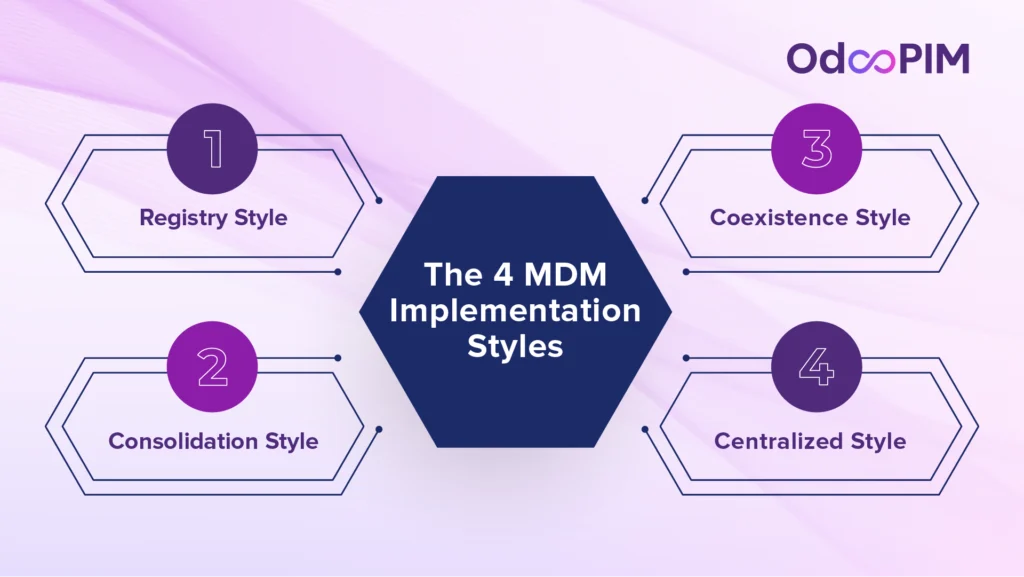
The 4 MDM Implementation Styles
1. Registry Style
The registry MDM implementation style creates a lightweight index that identifies where matching records exist across source systems without physically moving or altering the underlying data. This approach among MDM styles links customer or product records across siloed applications by flagging duplicates and establishing cross-references while leaving original entries untouched. Organizations select this type of MDM when business units resist centralized control and source systems must retain their authority over local data creation. The registry provides visibility into data fragmentation without the political battles that accompany more invasive MDM implementation styles. This style delivers the fastest time-to-value among all MDM implementation approaches but offers the least control over data quality and standardization.
2. Consolidation Style
Consolidation MDM implementation pulls master data from multiple source systems into a central hub where it gets cleansed, matched, and merged into golden records before distribution to consuming applications. This approach among MDM styles establishes a trusted product master data repository that downstream analytics, reporting, and business intelligence platforms consume without touching messy source data. Unlike registry types of MDM, consolidation physically moves data into a governed environment where stewardship teams resolve conflicts and enforce quality standards. Source systems continue operating independently, but the consolidated product master data model becomes the authoritative reference for decision-making rather than transactional processing. The consolidation MDM implementation steps typically begin with high-value domains where inconsistent data causes measurable business harm.
3. Coexistence Style
The coexistence MDM implementation style establishes a central hub where master data gets authored and enriched, then synchronizes updates back to source systems so both layers maintain consistent records. This hybrid among MDM implementation styles allows the hub to create new product master data while existing applications retain the ability to update attributes within their domains of authority. Organizations pursuing this type of MDM approach avoid the rip-and-replace disruption of full centralization while gaining more control than registry or consolidation models provide. The coexistence product master data model requires careful harmonization rules that determine which system wins when conflicts arise between hub and source application updates. This MDM implementation style balances governance ambition with organizational reality, making it the most common choice for enterprises transitioning toward mature data management.
4. Centralized Style
Centralized MDM implementation designates the master data hub as the sole system of record where all product master data gets created, enriched, and published with source systems consuming updates as subscribers. This most rigorous of MDM styles eliminates the conflict resolution complexity of coexistence by enforcing that no data enters any operational system without first passing through the central hub. Organizations adopting this type of MDM commit to complete process redesign where legacy data entry workflows get replaced by governed stewardship interfaces. The centralized product master data model delivers maximum consistency but demands the highest level of organizational maturity and executive sponsorship to overcome departmental resistance. Centralized MDM implementation steps require comprehensive change management because business units accustomed to data autonomy must surrender control to a shared service.
Learn about Product Data for Ecommerce

Choosing the Right MDM Style
Cost
MDM implementation styles carry different price tags based on integration complexity, infrastructure requirements, and the organizational change management each demands. Registry types of MDM cost the least to deploy because they leave source data untouched, requiring only matching logic and cross-reference tables rather than data migration or system reconfiguration. Centralized MDM implementation demands the heaviest investment, funding data migration from legacy systems, building new stewardship interfaces, and redesigning business processes that previously operated independently. The MDM implementation project plan must account for ongoing operational costs, stewardship headcount, data quality monitoring, and continuous synchronization maintenance that persist long after initial deployment. Choosing the cheapest MDM styles often proves most expensive when it fails to solve the data quality problems that justified the initiative.
Organizational Maturity
Your organization’s data governance maturity determines which MDM implementation styles stand any chance of successful adoption. Federated organizations where business units maintain strong autonomy find centralized types of MDM rejected outright because no division willingly surrenders data control to a central team. Companies with established data stewardship programs, executive data sponsors, and cross-functional governance councils possess the maturity to pursue coexistence or centralized MDM implementation approaches. Registry MDM styles fit organizations just beginning their data governance journey, providing immediate duplicate identification without threatening existing power structures. An honest assessment of governance readiness prevents the costly failure of selecting MDM implementation ambition that outstrips organizational willingness to change.
Use Case Priorities
Your specific business drivers determine which MDM implementation styles deliver value fastest against pressing operational problems. Analytics and reporting initiatives favor consolidation types of MDM where downstream systems need clean product master data without requiring real-time synchronization back to transactional sources. Operational use cases like order-to-cash or procure-to-pay demand coexistence or centralized MDM implementation where master data consistency prevents transaction failures. Regulatory compliance requirements often force centralized MDM styles because fragmented data across systems creates audit exposure that only an authoritative system of record can close. Match your MDM implementation project plan to the specific pain points that secured executive funding rather than pursuing architectural purity disconnected from business value.
Learn about Product Data Management Best Practices
MDM Implementation Steps
Assess Data Landscape
Begin your MDM implementation steps by cataloging every system that creates, stores, or consumes product master data across your organization. Map data flows between ERP, CRM, ecommerce, procurement, and logistics applications to identify where duplicate records originate and which source systems hold the most reliable attributes. This landscape assessment reveals the integration complexity your MDM implementation must address and surfaces the political boundaries between departments that will shape style selection. Profile actual data quality across systems, completeness percentages, standardization levels, duplication rates, to establish a measurable baseline for the MDM implementation project plan. The landscape audit prevents the common failure of designing a product master data model that ignores critical source systems or underestimates the cleansing effort ahead.
Select Style
Select your MDM styles approach based on the governance maturity assessment, use case priorities, and integration complexity uncovered during landscape analysis. Document why specific types of MDM were rejected to prevent organizational amnesia from reopening settled architectural debates when implementation challenges surface. The selection decision embedded in your MDM implementation project plan must gain explicit executive sponsorship because it determines which departments surrender data authority and which retain local control. Align the chosen MDM implementation styles with a phased rollout that delivers early wins before tackling the most politically charged data domains. Style selection converts abstract architectural theory into the concrete governance model that determines whether your product master data management succeeds or stalls.
Govern and Maintain
Establish data stewardship roles, quality metrics, and ongoing governance processes before the MDM implementation goes live because ungoverned master data decays faster than most teams anticipate. Define clear ownership for every product master data attribute, specifying which team creates it, which team validates it, and which team can modify it under what circumstances. The MDM implementation steps must include match rule tuning, duplicate resolution workflows, and exception handling procedures that prevent stewardship bottlenecks from becoming operational barriers. Schedule regular data quality audits against the baseline established during landscape assessment to prove the product master data model delivers measurable improvement. Governance transforms MDM implementation from a one-time technology project into an ongoing operational capability that compounds in value as data quality improves.
Learn about Product Data Management Platform

Challenges in MDM Implementation
Data Silos
Organizational silos create product master data fragmentation where engineering, marketing, sales, and procurement each maintain separate versions of identical product records. These departmental data islands resist integration because each team believes its version represents the truth, making the technical challenge of MDM implementation secondary to the political challenge of data ownership. Breaking silos requires executive authority that transcends departmental boundaries, mandating a single product master data model where previously autonomous teams operated independently. The most sophisticated MDM implementation styles fail when organizational silos refuse to participate, creating an expensive hub that contains only the data from willing participants. Successful mdm implementation addresses the cultural resistance to shared data ownership before addressing the technical integration patterns.
Governance Gaps
Absent or unclear data governance derails MDM implementation faster than any technology limitation because nobody knows who owns data quality decisions when conflicts surface. Organizations launching product master data management without defined stewardship roles discover that match rules go unmaintained, duplicate resolution stalls, and data quality degrades immediately after initial cleansing. Governance gaps manifest when the MDM implementation project plan assigns technology responsibility but neglects the ongoing organizational commitment required for product master data accuracy. Successful MDM implementation steps include establishing a data governance council with cross-functional authority before deploying technology. The governance framework must answer fundamental questions about who resolves conflicts, who approves attribute changes, and who monitors ongoing quality metrics.
System Sprawl
Technology proliferation multiplies the integration complexity that MDM implementation must address, with each additional source system adding data mapping, transformation, and synchronization requirements. Organizations running multiple ERP instances, acquired legacy platforms, and departmental shadow IT create a product master data landscape where identical products carry different identifiers across dozens of systems. This sprawl makes the MDM implementation project plan geometrically more complex as each new integration point requires understanding unique data models, business rules, and ownership politics. The types of MDM that work for ten source systems collapse under fifty because the matching logic and conflict resolution rules become computationally and organizationally unmanageable. System rationalization often precedes or accompanies MDM implementation styles because reducing integration complexity delivers faster time-to-value.
Learn about Product Data Management Process
How a Native ERP Data Foundation Simplifies MDM
Single Source of Truth
An ERP-native approach to product master data management creates an authoritative repository where product records originate and flow outward to consuming systems without the synchronization complexity of third-party MDM hubs. This architectural foundation treats the ERP as the natural product master data model owner, eliminating the political battles over which system holds the golden record. Native MDM implementation simplifies governance because data stewardship happens within the operational system that business teams use daily rather than a separate application requiring new logins and workflows. The product master data remains tightly coupled to the transactional processes, purchasing, inventory management, order fulfillment, that both create and consume it. This single source of truth approach reduces the MDM implementation steps required compared to standalone hubs that must integrate bidirectionally with an ERP they treat as just another source system.
Real-Time Sync
Native ERP data architecture enables real-time product master data synchronization where changes propagate instantly to every consuming system without batch processing delays or integration failures. The MDM implementation eliminates the dangerous lag between when a product attribute updates and when channels reflect that change because the ERP itself serves as the hub. Real-time sync inherent in native MDM implementation styles prevents the scenario where a compliance certification update sits in a queue while non-compliant product information remains visible to customers. This instant propagation makes the coexistence types of MDM unnecessary because there is no gap between hub and source system that requires harmonization rules to manage. The product master data model stays current across the technology stack without the middleware monitoring and error handling that standalone MDM hubs demand.
No Middleware Overhead
Native MDM implementation eliminates the middleware layer that introduces cost, latency, and failure points between an ERP and a separate MDM application. Every MDM implementation project plan relying on third-party hubs must budget for integration development, ongoing connector maintenance, and the inevitable troubleshooting when synchronization jobs fail silently. Native product master data management removes these integration tax items from the implementation budget and the operational support burden. The MDM implementation steps compress because there is no data mapping exercise between MDM and ERP data models, they are the same model by definition. This architectural simplicity reduces the most common failure point in MDM implementation styles: the brittle integration layer where mismatched data models and transformation errors corrupt master data as it flows between systems.
Learn about Product Data Management
Case Studies
Case Study 1: Automotive Parts Manufacturer Adopts Consolidation MDM to Unify Product Data Across Five ERP Instances
Challenge
A global automotive parts manufacturer operated five separate ERP instances accumulated through decades of regional growth and acquisitions, each maintaining its own version of product master data. The same brake component carried different part numbers in North America, Europe, and Asia, making global inventory visibility and consolidated procurement impossible. Engineering teams in Germany maintained technical specifications in one system while the American sales team quoted customers from outdated product records stored in another. When a major automaker demanded consistent product identifiers and compliance documentation across regions as a condition of a new contract, the fragmented product master data model became an existential revenue threat. The company needed an MDM implementation approach that could unify product records without disrupting five independently operating ERP systems that each served critical regional functions.
Solution
The manufacturer selected a consolidation MDM implementation style after evaluating four types of MDM against their federated organizational structure. A central hub pulled product master data from five ERP instances, applied matching algorithms to identify duplicate and related records, and created golden product records that cross-referenced every regional identifier. Regional ERP systems continued operating as the transactional systems of record, maintaining local autonomy while the consolidation hub served as the authoritative reference for global analytics, procurement negotiations, and customer reporting. The MDM implementation steps focused first on finished goods where customer-facing inconsistency carried the highest business risk, then expanded to raw materials and components. Stewardship teams resolved matching conflicts through governed workflows that documented decisions, building the product master data management discipline the organization previously lacked.
Results
- Global product data visibility achieved across five regional ERP instances within eight months of MDM implementation
- The major automaker contract secured after consistent part identifiers and compliance documentation became available across regions
- Procurement savings of twelve percent realized through consolidated supplier negotiations using accurate global volume data from the product master data model
- Regional autonomy preserved as consolidation MDM styles left source systems untouched while creating an authoritative cross-reference layer
- The MDM implementation project plan expanded to include supplier and customer master data after proving the consolidation approach with product records
Case Study 2: Industrial Distributor Implements Coexistence MDM and Cuts Product Returns by Thirty Percent
Challenge
An industrial equipment distributor with forty thousand SKUs managed product master data across their Odoo ERP, an acquired ecommerce platform, three marketplace integrations, and a legacy quoting system inherited from a merger. Product specifications differed between the ecommerce storefront and the ERP, creating a persistent problem where customers ordered items based on online descriptions that did not match warehouse physical inventory. Technical attributes critical to proper product selection, pressure ratings, voltage requirements, dimensional tolerances, appeared correctly in the ERP but inconsistently across customer-facing channels. Returns from specification mismatches exceeded industry averages by a wide margin, eroding margins and customer trust. The company needed MDM implementation styles that would govern product data while preserving the speed their sales teams required for catalog updates.
Solution
The distributor deployed a coexistence MDM implementation that established a central product data hub synchronized bidirectionally with Odoo ERP and all customer-facing channels. Unlike consolidation types of MDM, coexistence allowed the ecommerce team to enrich marketing descriptions and digital assets in the hub while engineering maintained technical specifications in the ERP, with harmonization rules determining which system held authority for each attribute type. The product master data model defined that technical specifications flowed from ERP through the hub to channels, while marketing content enriched in the hub could synchronize back to the ERP for complete product records. The MDM implementation steps prioritized the highest-return SKUs where specification mismatches had caused the most returns. Channel syndication from the hub ensured that when engineering updated a pressure rating in the ERP, that change propagated to the ecommerce site and marketplaces within minutes.
Results
- Product returns attributed to specification mismatches dropped by thirty percent within the first six months of MDM implementation
- Channel product data consistency achieved between Odoo ERP, ecommerce platform, and three marketplace integrations
- Engineering specification updates now reach customer-facing channels in minutes rather than the weeks required by previous manual processes
- Sales team catalog update autonomy preserved through the coexistence MDM styles approach that balanced governance with operational speed
- The MDM implementation project plan expanded to include digital asset management after proving the coexistence model with technical specifications
- Leadership identified the right types of MDM selection as the critical success factor, noting that centralized MDM implementation styles would have created governance bottlenecks their fast-moving sales operation could not tolerate.

FAQ’s
1. What are the four MDM implementation styles?
The four MDM implementation styles are registry, consolidation, coexistence, and centralized, each representing a fundamentally different architectural approach to managing master data. Registry style creates a lightweight index linking records across systems without moving data, ideal for organizations beginning their MDM implementation journey. Consolidation pulls data into a hub for cleansing and matching, serving analytics needs with trusted product master data while source systems continue operating independently. Coexistence establishes bidirectional synchronization where the hub and source systems update attributes, balancing control with departmental autonomy among MDM styles. Centralized types of MDM designate the hub as the sole system of record, demanding the highest governance maturity but delivering maximum data consistency across the enterprise.
2. Which MDM implementation style is best for a small business?
Small businesses benefit most from consolidation MDM implementation styles because this approach delivers clean, trustworthy product master data without the organizational complexity that coexistence or centralized models demand. A consolidation MDM implementation pulls product records from ecommerce, accounting, and inventory systems into a governed hub where duplicates get resolved and attributes standardized without disrupting daily operations. Registry types of MDM may suffice for very small operations needing only duplicate identification rather than full product master data management. The consolidation product master data model provides immediate value for reporting, channel syndication, and customer-facing accuracy without requiring the cross-functional governance councils larger enterprises need. Small businesses should avoid centralized MDM styles because the process redesign and political alignment required exceed what lean teams can sustain while running daily operations.
3. What is the difference between MDM and PIM?
MDM manages master data across multiple domains, products, customers, suppliers, locations, assets, while PIM focuses exclusively on product master data and the enrichment workflows that prepare it for customer-facing channels. An MDM implementation governs the core identifiers, relationships, and attributes that ensure a product record means the same thing across ERP, procurement, and logistics systems. A PIM extends that foundation with marketing descriptions, digital assets, channel-specific formatting, and the collaborative workflows that product master data management alone does not address. Think of MDM as establishing the authoritative product record at the operational level while PIM enriches it for commercial use. The product master data model in MDM emphasizes system-to-system consistency; PIM emphasizes the completeness and quality that drives customer purchase decisions across marketplaces and storefronts.
4. What is product master data?
Product master data is the foundational information defining what an organization creates, sells, or distributes, encompassing identifiers, classifications, attributes, and relationships that every business system consumes. Understanding what is product master data means recognizing the SKU codes, descriptions, dimensions, materials, and compliance certifications that must remain consistent whether viewed in a warehouse or a customer portal. This core reference data anchors the product master data model that connects ERP inventory records, procurement catalogs, ecommerce listings, and logistics workflows to a single version of product truth. Effective product master data management ensures that a part number means the same thing to engineering, purchasing, sales, and the end customer. Without governed product master data, organizations ship wrong items, quote incorrect prices, and publish conflicting specifications across channels.
5. How long does MDM implementation typically take?
MDM implementation timelines range from three months for a focused registry deployment to eighteen months or more for a full centralized rollout spanning multiple data domains. The MDM implementation steps duration depends primarily on the architectural style selected, with registry types of MDM delivering value fastest because they leave source data untouched. Consolidation MDM implementation styles mostly require six to nine months for data profiling, cleansing, match rule development, and integration with consuming analytics platforms. Coexistence and centralized MDM implementation projects extend beyond a year because they demand business process redesign, stewardship training, and the political alignment that accompanies shifting data ownership. An honest MDM implementation project plan must account for organizational readiness factors that impact timelines far more than technology installation alone.