What Is PIM Technology?
PIM technology is a software category that provides the centralized infrastructure for ingesting, governing, enriching, and distributing product information across an organization’s technology ecosystem. Unlike general-purpose databases or spreadsheets, a PIM platform is purpose-built to handle the demands of product data, complex hierarchies, variant structures, technical attributes, digital assets, and channel-specific formatting requirements. Product information management technology establishes one authoritative product record that every department and system references, eliminating the version conflicts that plague organizations managing product data in disconnected tools. Understanding “what is PIM technology” requires seeing it as the operational layer that sits between product data in ERP systems and the enriched, channel-ready content customers require. The platform transforms product information from a fragmented operational burden into a governed strategic asset that accelerates channel expansion and revenue growth.
How Does PIM Technology Work?
Data Ingestion and Onboarding
A PIM platform begins by pulling raw product data from source systems, ERPs, PLM tools, supplier feeds, spreadsheets, and legacy databases, into a centralized repository where it can be governed. The PIM technology ingests product identifiers, core attributes, procurement data, and basic specifications that serve as the foundation for all subsequent enrichment. Automated import routines map source data fields to the PIM data model, transforming inconsistent external formats into standardized internal structures. How does PIM work at this stage determines data quality downstream because inaccurate ingestion creates problems that propagate through every subsequent workflow. The product information management technology validates incoming data against defined rules, flagging missing fields and format violations before they enter the central repository.
Centralized Repository and Data Model
The PIM platform stores all product information in a single governed repository organized around a flexible data model that accommodates complex product hierarchies and relationships. This centralized architecture means engineering, marketing, sales, and channel teams access identical product records rather than maintaining separate departmental versions. The data model defines how products relate to categories, families, variants, and components, creating the structural foundation for consistent attribute management. What is PIM technology at its core, a single source of product truth where every attribute, specification, and relationship is defined once and referenced everywhere. The repository eliminates the version conflicts that occur when different teams maintain separate spreadsheets, ensuring every stakeholder works from the same governed product information.
Enrichment and Validation
PIM technology provides workflows where teams enhance raw product data with marketing descriptions, technical specifications, digital assets, and channel-specific content. Enrichment transforms bare operational data, SKU codes and basic dimensions, into complete product presentations that answer every customer question before purchase. The PIM platform enforces validation rules that prevent incomplete or substandard product records from advancing to channel publication. Completeness scoring identifies which products require additional attributes, better imagery, or missing compliance documentation before they can syndicate. How does PIM work at this stage, it ensures that every product record meets defined quality standards before customer-facing channels receive it, catching errors during enrichment rather than after publication.
Syndication to Channels
The PIM platform pushes enriched product content to every sales channel with automated formatting that respects each platform’s specific attribute requirements and content policies. Product information management technology maps master attributes to channel-specific fields, ensuring Amazon receives category-compliant listings while distributor portals pull technical specifications in their required format. Syndication eliminates the manual reformatting that consumes team hours and introduces errors when products launch across multiple channels simultaneously. The flow is straightforward: source systems feed raw data into the PIM technology, enrichment transforms it into complete product records, and syndication delivers channel-ready content everywhere products need to appear. This streamlined pipeline, source systems → PIM → channels, replaces the manual processes where each channel maintained independent, inconsistent product information.
Learn about Omnichannel vs. Multichannel Ecommerce

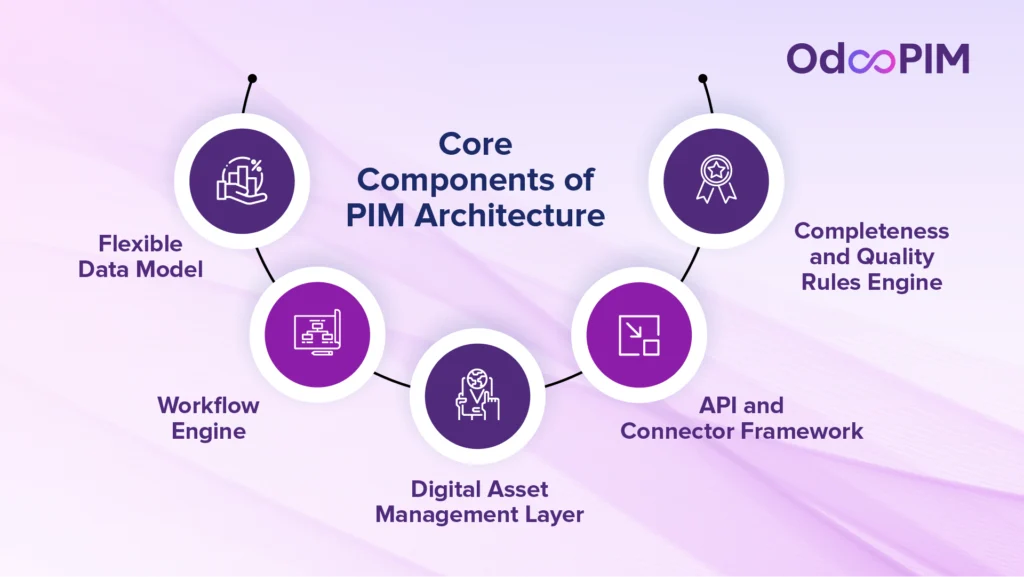
Core Components of PIM Architecture
Flexible Data Model
A PIM platform architecture begins with a data model flexible enough to handle complex product hierarchies, variant structures, and the relationships that define industrial catalogs. The model accommodates product families where attributes inherit from parent categories, reducing the manual effort of populating shared specifications across similar items. Product information management technology structures data through taxonomies, category trees, classification schemas, and relationship maps, that organize products for both internal governance and customer navigation. The data model supports unlimited attributes per product, custom attribute types for different product categories, and the complex many-to-many relationships common in B2B catalogs. This architectural flexibility distinguishes purpose-built PIM technology from the rigid data structures of ERP systems designed for transactional processing rather than product content management.
Workflow Engine
The workflow engine in PIM technology orchestrates how product data moves through enrichment, validation, approval, and publication stages across multiple teams. Workflows route content through sequential or parallel review processes where engineering validates technical specifications before marketing adds commercial descriptions. The PIM platform workflow engine enforces role-based task assignment, automated notifications, and escalation rules that prevent bottlenecks from stalling product launches. Audit trails capture every change, supporting compliance requirements while providing accountability when errors occur. How does PIM work across departments, the workflow engine coordinates the cross-functional collaboration that transforms product data into approved, channel-ready content without manual handoffs or email chains.
Digital Asset Management Layer
PIM technology includes integrated or connected digital asset management that links product records to their associated images, videos, CAD files, and documentation. This component ensures that channel syndication includes properly formatted assets, correct image resolutions, approved document versions, and channel-compliant file types. The PIM platform maintains asset-to-product relationships that enable automated syndication where the right images and documents travel with product data to every channel. Version control prevents outdated assets from reaching customer-facing channels when products update. The digital asset layer transforms product information management technology from a text-focused data tool into a comprehensive product content hub managing information types equally.
API and Connector Framework
The API layer in PIM technology exposes product data to consuming systems through standardized interfaces that enable real-time data exchange and automated synchronization. REST and GraphQL endpoints allow ecommerce platforms, marketplaces, and downstream applications to pull enriched product content programmatically. PIM integration connectors provide pre-built pathways to common platforms, ERP systems, ecommerce engines, marketplace channels, reducing the custom development required for deployment. The API framework determines how effectively the PIM platform connects to the broader technology ecosystem, making it a critical architectural component. Strong API design ensures that product data flows smoothly between systems without the manual export-import cycles that create version drift.
Completeness and Quality Rules Engine
A PIM platform includes rules engines that enforce data quality standards by validating product records against defined completeness and formatting requirements. These rules prevent products from advancing to channel publication when mandatory attributes remain empty, digital assets are missing, or data formats violate channel specifications. The quality engine computes completeness scores that enable teams to prioritize enrichment efforts systematically rather than guessing which products need attention. Product information management technology catches errors during the enrichment process rather than after customers encounter incorrect information on live listings. The rules engine transforms data quality from an abstract aspiration into enforced, measurable standards that govern every product record in the repository.
Learn about PIM Solution

Key Capabilities of Modern PIM Technology
1. Attribute Management at Scale
Modern PIM technology manages hundreds of attributes per product across tens of thousands of SKUs without performance degradation or governance breakdown. Attribute inheritance automatically populates shared specifications across product families, eliminating the manual effort that makes large-scale catalog management impossible. The PIM platform supports unlimited attribute types, text, numeric, measurement, boolean, multi-select, each with validation rules specific to the data they capture. Controlled vocabularies and attribute groups ensure consistency across categories, preventing the search failures that occur when different team members use varying terminology. Product information management technology transforms attribute management from an overwhelming manual burden into an automated, governed process that scales efficiently.
2. Multichannel Syndication
A PIM platform pushes enriched product content to every sales channel with automated formatting that respects each platform’s unique requirements. Channel-specific mapping rules translate master attributes into Amazon’s category schemas, Walmart’s item setup specifications, and distributor portal formats without manual intervention. PIM technology validates listings against channel requirements before submission, preventing the rejections and suppressions that damage marketplace standing. Syndication transforms channel expansion from a data reconstruction project into a configuration exercise where new channels connect through defined mapping rules. This capability makes product information management technology essential for any organization selling across multiple channels where manual listing management has become unsustainable.
3. Localization and Multi-Language Support
PIM technology manages product content in multiple languages and regional variations, enabling global brands to maintain consistent product information across markets. The PIM platform stores translations alongside source content, ensuring that localized descriptions maintain accuracy while adapting to regional terminology and regulatory requirements. Localization workflows route content through translation review and approval, maintaining governance across language versions. Product information management technology supports market-specific attribute requirements, measurement unit conversions, and compliance documentation variations that differ by region. Multi-language capability transforms the PIM into a global product content hub rather than a single-market tool.
4. AI-Assisted Enrichment
Modern PIM technology increasingly incorporates artificial intelligence to accelerate content creation, suggest attribute completions, and identify data quality issues. AI analyzes existing product descriptions to generate draft copy for similar items, dramatically reducing the time required for initial enrichment. Image recognition extracts product attributes from photographs, automatically populating color, shape, and material fields that previously required manual entry. The PIM platform uses machine learning to detect anomalies, flagging inconsistent attribute values and potential errors before they reach channels. AI-assisted product information management technology amplifies human enrichment efforts rather than replacing them, accelerating workflows while maintaining the governance that ensures accuracy.
5. Role-Based Governance
PIM technology enforces granular permissions that control which teams and individuals can view, edit, approve, and publish specific product data domains. Engineering retains exclusive control over technical specifications while marketing enriches commercial content, with governance rules preventing unauthorized modifications. The PIM platform maintains audit trails tracking every data change, supporting compliance requirements and providing accountability. Role-based dashboards present relevant information to each team, reducing the cognitive load of navigating complete product records. How does PIM work across large organizations, governance ensures that dozens or hundreds of users can collaborate on product data without conflicts, overwrites, or quality degradation.
Learn about best PIM software
PIM Integration: How It Connects to Your Tech Stack
PIM and ERP Integration
PIM integration with ERP systems establishes the critical connection between operational product data and the enriched content that channels require. The ERP contributes core product identifiers, inventory levels, procurement costs, and basic specifications that form the foundation for enrichment. PIM technology adds the marketing descriptions, technical specifications, digital assets, and channel-ready formatting that ERPs were never designed to maintain. Integration depth determines whether product changes flow between systems in real time or through batch processes that create dangerous synchronization gaps. The PIM platform must connect bidirectionally so that enriched content can flow back into the ERP when business processes require complete product records in the operational system.
PIM and Ecommerce Platforms
PIM integration with ecommerce platforms ensures that product detail pages display complete, accurate, and compelling product information that drives conversion. The PIM platform pushes enriched product content, descriptions, specifications, images, pricing, to the ecommerce engine, which renders customer-facing pages. Real-time PIM technology synchronization means that product updates made in the PIM appear immediately on the website without manual content deployment. Integration quality impacts site performance because slow or incomplete product data delivery degrades the customer experience. The connection between product information management technology and ecommerce platforms determines whether your digital storefront reflects current product truth or outdated snapshots.
PIM and Marketplaces
PIM integration with marketplaces like Amazon, eBay, and Walmart requires channel-specific formatting that translates master product data into each platform’s unique requirements. The PIM platform maps attributes to marketplace categories, validates listings against platform policies, and manages the ongoing synchronization that keeps listings current. Marketplace PIM technology connections handle the complexity of multiple international marketplaces, each with distinct category taxonomies and content policies. Automated syndication eliminates the manual per-platform listing management that becomes unsustainable beyond a handful of channels. Strong marketplace integration transforms the product information management technology from a content management tool into a revenue accelerator that keeps products visible and competitive everywhere they sell.
Middleware-Based vs. Native Integration
Middleware-based PIM integration connects the platform to ERP and business systems through third-party connectors that translate data between different data models and synchronize on scheduled intervals. This approach introduces integration licensing costs, configuration complexity, synchronization latency, and failure points that compound with each connected system. Native PIM technology integration operates within the same platform ecosystem as the ERP, sharing a common data model where product records synchronize in real time without translation layers. Middleware-dependent product information management technology deployments require ongoing connector maintenance and troubleshooting; native deployments eliminate this operational burden. The integration architecture decision impacts total cost of ownership, operational reliability, and the speed at which product changes reach customer-facing channels.
Learn about PIM vs DAM

How to Evaluate PIM Technology for a B2B Business
Fit with Your Existing ERP
The PIM platform must integrate smoothly with your ERP system, which serves as the operational backbone for product identifiers, inventory data, and core business processes. Evaluate whether the PIM technology offers native integration with your specific ERP, pre-built connectors, or requires custom middleware development that adds cost and complexity. Native ERP PIM integration eliminates the synchronization failures and data mapping exercises that consume team resources in middleware-dependent deployments. The depth of ERP connection determines whether your product information management technology functions as a connected operational hub or an isolated content repository requiring manual data transfer. Organizations running Odoo should prioritize PIM technology built natively on the Odoo framework to avoid the integration tax that third-party platforms impose.
Data Model Flexibility for Technical Catalogs
B2B PIM technology must accommodate complex product hierarchies, technical specification sets, variant structures, and the intricate relationships that define industrial catalogs. Evaluate whether the PIM platform data model supports unlimited attributes per product, custom attribute types, and the inheritance patterns that reduce manual enrichment effort. The product information management technology should handle configurable products, bill of materials relationships, and compatibility matrices that consumer-focused PIMs treat as edge cases. Data model rigidity forces B2B organizations to work around platform limitations, creating the spreadsheets and workarounds that PIM adoption was supposed to eliminate. The right PIM technology flexes to match product complexity rather than forcing product data into an overly simplified structure.
Total Cost of Ownership
B2B PIM technology evaluation must account for total cost beyond license fees, implementation services, integration development, data migration, team training, and ongoing operational expenses. SaaS PIM platforms bundle infrastructure and maintenance into subscription costs; on-premise deployments add hardware, IT staffing, and upgrade project expenses. Middleware-dependent product information management technology carries hidden integration costs that compound with each connected system and every synchronization failure. Calculate five-year total cost across deployment models being considered, including the operational burden of maintaining integrations over time. The PIM platform with the lowest subscription price often carries the highest total cost when implementation complexity and ongoing maintenance enter the calculation.
Implementation and Maintenance Effort
PIM technology implementation timelines range from weeks for cloud-native, ERP-integrated platforms to many months for complex deployments requiring extensive customization and integration development. Evaluate the implementation support, data migration tooling, and training resources the PIM platform vendor provides to accelerate time-to-value. Ongoing maintenance burden differs dramatically between middleware-heavy deployments requiring connector updates and native product information management technology where upgrades happen within the platform ecosystem. Phased implementations starting with high-value product lines deliver measurable results quickly while building organizational confidence. The right PIM technology matches your urgency for data governance improvement with an implementation approach that delivers early wins before expanding to full catalog coverage.
Learn about PIM vs PCM
Case Studies
Case Study 1: Industrial Valve Manufacturer Deploys PIM Technology and Cuts Product Launch Time by Seventy Percent
Challenge
An industrial valve manufacturer with nine thousand SKUs managed product data through a fragmented combination of engineering PLM files, marketing spreadsheets, and manual channel updates. Technical specifications lived in the PLM system while marketing maintained separate spreadsheets for Amazon Business, their B2B website, and three distributor portals, creating constant conflicts where product listings showed outdated pressure ratings and incorrect material specifications. Each new product launch required six weeks of manual data coordination, engineering extracted specifications from the PLM, marketing reformatted them for each channel, and sales teams entered data separately into distributor systems. A critical compliance audit revealed that fifty-three product listings across various channels displayed certification dates that had expired, threatening their ISO certification status. The company needed PIM technology that could centralize complex technical product data and automate channel distribution without disrupting their existing engineering workflows.
Solution
The manufacturer implemented a PIM platform designed for industrial product complexity, beginning with a comprehensive data model that accommodated their valve hierarchies, variant structures, and technical attribute sets. PIM integration connected the platform to their PLM system through APIs, automatically ingesting engineering-validated specifications, pressure ratings, material grades, and compliance certifications into governed product records. The product information management technology established enrichment workflows where marketing teams added application descriptions, selection guides, and digital assets to the engineering foundation without duplicating or altering technical data. Channel syndication pushed complete, validated product content to their B2B website, Amazon Business, and three distributor portals simultaneously, with automated formatting that respected each channel’s specific requirements. Understanding what is PIM technology in practice meant that when engineering updated a valve specification in the PLM, the change propagated through the PIM to every channel within minutes, eliminating the compliance certification lag that caused the audit failure.
Results
- New product launch time reduced from six weeks to eight days as PIM technology automated the enrichment and syndication that previously required manual coordination
- Compliance certification violations eliminated because specification updates now propagate to channels in real time
- Listing errors caused by specification mismatches between engineering and marketing dropped to near zero
- Distributor satisfaction scores improved significantly as partners received accurate, enriched product feeds instead of outdated spreadsheets
- The PIM platform architecture demonstrated how does PIM work at scale, the centralized data model handled complex valve hierarchies while flexible APIs connected to both legacy PLM systems and modern ecommerce channels
- Channel expansion capability built into operations, with new marketplace onboarding now a configuration exercise rather than a data reconstruction project
Case Study 2: Electrical Components Distributor Replaces Manual Processes with PIM Technology and Scales to Eight Channels
Challenge
An electrical components distributor with fifteen thousand SKUs aggregated product data from over one hundred suppliers, each delivering specifications in different formats, attribute naming conventions, and quality levels. The resulting catalog suffered from severe inconsistency, some products carried complete technical specifications while others listed only a part number, making filtered search and product comparison functionally broken for customers. Product data management consumed thirty hours weekly as a team manually reformatted supplier data for their website, Amazon, eBay, and two electrical industry marketplaces. When leadership planned expansion into three additional channels, they recognized that manual processes would require hiring five additional content specialists. The company needed PIM technology that could automate supplier data normalization and channel syndication without multiplying operational headcount.
Solution
The distributor deployed a cloud-based PIM platform with automated data ingestion capabilities that transformed supplier feeds into standardized, enriched product records. Attribute mapping rules in the product information management technology converted each supplier’s unique terminology into a controlled vocabulary, ensuring that “rated current,” “amp rating,” and “current capacity” mapped to a single attribute for consistent filtered search. PIM integration connected the platform to their ERP for real-time inventory synchronization and to their ecommerce engine for automated product page generation. The system enforced completeness standards, automatically flagging supplier submissions that lacked mandatory technical attributes and triggering automated requests for missing data. Channel syndication pushed consistent, enriched product content to their website, Amazon, eBay, and both industry marketplaces, with the architecture designed to add new channels through configuration rather than development. When the distributor expanded into the three additional channels, the PIM technology simply applied new syndication rules without additional content development.
Results
- Weekly product data management hours reduced from thirty hours to five hours as PIM technology automated supplier data normalization and channel syndication
- Channel expansion from five to eight sales channels completed within three months without adding product data management headcount
- Filtered search accuracy improved by sixty-five percent as standardized attribute structures ensured consistent filtering across product categories
- Supplier onboarding time reduced from three weeks to two days as automated PIM integration mapped new supplier formats to the distributor’s standard data model
- The PIM platform investment delivered measurable ROI within eight months through headcount cost avoidance and increased conversion from improved search functionality
- The distributor identified product information management technology as the critical enabler behind their supplier aggregation strategy, noting that understanding how does PIM work with automated supplier data normalization was the difference between scalable growth and operational collapse
Learn about best PIM software in India

How ERP-Native PIM Technology Built on Odoo Removes the Integration Burden
OdooPIM operates as native PIM technology within the Odoo framework, sharing the same database and data model as Odoo ERP, inventory, sales, and ecommerce modules. This unified architecture eliminates the middleware layer that introduces integration costs, synchronization latency, and failure points into traditional PIM platform deployments. Product data, stock levels, and pricing changes propagate instantly across modules because every component references the same underlying data foundation rather than exchanging information through periodic API calls. The product information management technology connects natively to Odoo ecommerce, Odoo inventory, and Odoo sales, ensuring that enriched product records serve both operational processes and customer-facing channels simultaneously. Built specifically for B2B manufacturers, distributors, and wholesalers, the platform handles the complex product hierarchies, technical attributes, and compliance documentation that define industrial commerce. OdooPIM transforms PIM integration from a costly, fragile engineering challenge into an inherent property of the platform, no middleware, no sync jobs, no data mapping exercises required.
FAQs
1. What is PIM technology and what does it do?
PIM technology is the software infrastructure that centralizes product data from multiple source systems, governs its quality through enrichment workflows, and distributes consistent product information to every sales channel and customer touchpoint. Understanding “what is PIM technology” means recognizing it as the operational layer that transforms fragmented spreadsheets and disconnected databases into one authoritative product record accessible across the organization. A PIM platform ingests data from ERPs, supplier feeds, and legacy systems, then provides tools for teams to enrich attributes, manage digital assets, and validate completeness before syndication. Product information management technology enforces governance rules that prevent incomplete or inaccurate product data from reaching customer-facing channels. How does PIM work in practice, it creates a single source of product truth from which every system and channel draws consistent, complete information.
2. How does PIM technology work with an ERP system?
PIM integration with ERP systems establishes a bidirectional connection where the ERP contributes core operational data while the PIM returns enriched product content. The ERP supplies product identifiers, inventory levels, procurement costs, and basic specifications that serve as the foundation for enrichment within the PIM platform. Product information management technology adds the marketing descriptions, technical specifications, digital assets, and channel-ready formatting that ERPs were never designed to manage. Integration depth determines whether “how does PIM work” involves real-time synchronization or periodic batch transfers vulnerable to data drift. Native PIM technology integration eliminates middleware, sharing a common data model with the ERP so product changes propagate instantly without translation layers or sync failures.
3. What is the difference between a PIM platform and a PIM solution?
A PIM platform refers to the core software technology that provides product data management capabilities, the data model, workflow engine, API framework, and syndication tools. A PIM solution encompasses the PIM technology plus the implementation configuration, integration connections, governance policies, and operational processes tailored to a specific organization’s requirements. The PIM platform delivers the technical capabilities; the solution represents how those capabilities are deployed, configured, and adopted within a business context. Understanding “what is PIM technology” means recognizing the platform as the foundation upon which a complete product data management solution gets built. The distinction matters because selecting powerful product information management technology without proper implementation and governance design produces an underutilized platform that fails to deliver expected value.
4. What integrations does PIM technology support?
PIM technology supports integrations with ERP systems for operational data, ecommerce platforms for customer-facing product pages, marketplaces like Amazon and Walmart for channel syndication, and supplier portals for inbound data feeds. PIM integration with digital asset management systems connects product records to images, videos, and technical documentation, while CRM integrations enable sales teams to access enriched product information. Product information management technology connects to print publishing tools for catalog production and translation management systems for multi-language content. The PIM platform typically offers pre-built connectors for common platforms alongside REST and GraphQL APIs for custom integrations. The breadth and depth of “how does PIM work” with existing systems determines whether it functions as a connected operational hub or an isolated data island.
5. Is PIM technology worth it for mid-sized B2B businesses?
PIM technology delivers measurable value for mid-sized B2B businesses the moment product data complexity outpaces spreadsheet-based management capabilities. Growing SKU counts, expanding channel presence, and increasing buyer expectations for complete technical specifications make manual product data processes unsustainable and error-prone. A PIM platform prevents the operational chaos where specification errors multiply across channels, causing the listing mistakes that damage credibility with the buyers mid-sized businesses can least afford to lose. Cloud-based product information management technology makes sophisticated data governance accessible without the infrastructure investment previously required. The return on PIM integration materializes through reduced returns, faster product launches, fewer support tickets, and the channel expansion capability that drives revenue growth without proportionally scaling operational headcount.