What Is Amazon SEO?
Amazon SEO is the practice of optimizing product listings to rank higher in Amazon’s internal search results. Unlike Google, where users search for information, Amazon shoppers search for products to buy immediately. Amazon listing optimization focuses on conversion-driven keywords, terms that indicate purchase intent. Amazon SEO for sellers requires optimizing titles, bullet points, descriptions, backend search terms, and images. The goal is not just visibility, it is sales, rank higher, get more clicks and convert more customers. Amazon’s algorithm rewards listings that sell.
How It Differs from Google SEO
Google SEO targets informational queries, “How to fix a leaky faucet” brings up videos and articles. Amazon SEO targets transactional queries, “Faucet washer size 5/8” brings up products. Amazon keyword research focuses on purchase intent terms. Google ranks pages based on backlinks and domain authority. Amazon ranks products based on sales velocity, conversion rate, and relevance. Amazon product ranking depends on how well your listing converts browsers into buyers. Google rewards authority, Amazon rewards sales. Different platforms have different strategies.
How the A10 Algorithm Ranks Products
Amazon’s A10 algorithm prioritizes products that convert well for specific search terms. Sales velocity, how many units you sell per hour, is the strongest ranking factor. Amazon backend search terms must include relevant keywords without repetition or prohibited characters. Amazon A+ content optimization improves conversion rates, which signals the algorithm to rank you higher. PIM for Amazon SEO ensures your product data, titles, bullets, images, backend terms, is complete and optimized before listing goes live. The algorithm favors products with complete, accurate data. Missing attributes hurt rankings. Rich content helps, sell well and rank well. That is A10.

Key Elements of Amazon SEO
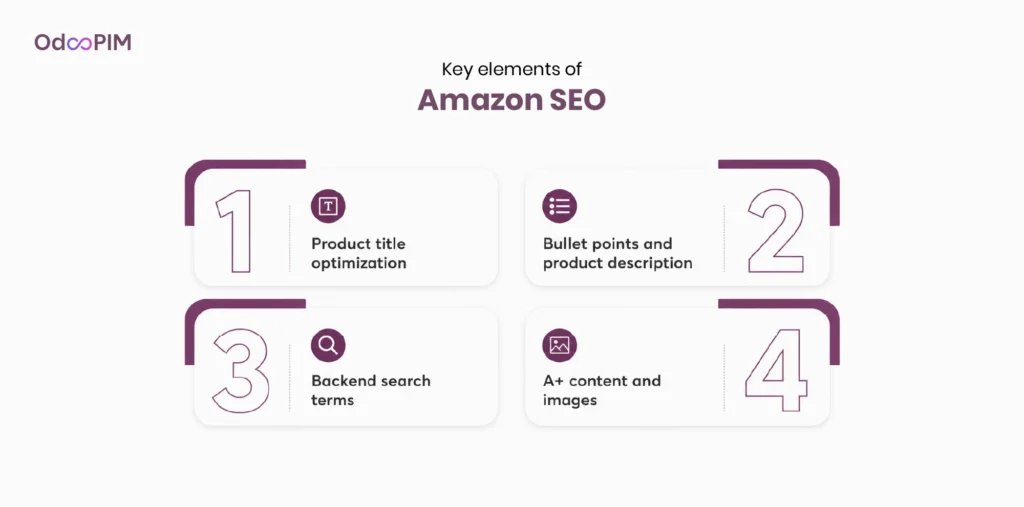
1. Product title optimization
Your title is the most important ranking factor on Amazon. Include your primary keyword, brand, model, size, color, and key feature within Amazon’s character limits. Amazon listing optimization requires titles that read naturally for shoppers while including search terms. Amazon keyword research should identify the one or two phrases driving most conversions for your product. Front-load the most important keyword and avoid keyword stuffing. A title that says “Coffee Maker 12-Cup Programmable Drip Machine” ranks better than “Coffee Maker Coffee Machine Brewer.” Titles drive discovery so get them right.
2. Bullet points and product description
Bullet points should highlight the top five selling features, benefits over specifications. Use backend search terms for extra keywords, not bullet points. Amazon SEO for sellers means bullets must answer customer questions before they ask them. The product description allows 2,000 characters for longer-form content. Use it for brand storytelling, technical specifications, and use-case scenarios. Amazon product ranking improves when bullets and descriptions improve conversion rates. Write for humans first, optimize for search second and bullets that convert rank higher. It is that simple.
3. Backend search terms
Backend search terms are invisible to shoppers but critical for Amazon’s algorithm. Include misspellings, synonyms, and related phrases that did not fit in your title or bullets. Amazon backend search terms have character limits, 1,250 bytes for generic keywords, plus 500 for specific product types. No repetition across fields. No prohibited phrases like “best” or “cheap.” Amazon keyword research for backend terms should focus on long-tail phrases with lower competition. Use plurals naturally, avoid commas and separate terms with spaces as backend terms fill the gaps, so use every character wisely.
4. A+ content and images
A+ content modules, comparison charts, enhanced descriptions, brand stories, can increase conversion rates by 5-15%. Amazon A+ content optimization requires high-resolution images, clear benefit statements, and mobile-friendly formatting. Images must have white backgrounds for main images, minimum 1000 pixels, and multiple angles showing product in use. PIM for Amazon SEO centralizes A+ modules and images, ensuring every ASIN gets the right enhanced content automatically. Rich content signals Amazon that you are a serious seller and better conversion rates trigger better rankings as A+ content is not optional for brand owners, it is essential.
Learn about amazon PIM software.
Amazon Keyword Research Basics
Primary vs. secondary vs. long-tail keywords
Primary keywords are the main search terms for your product, “coffee maker” for a coffee maker listing. Secondary keywords add modifiers, “12-cup coffee maker” or “programmable coffee maker.” Long-tail keywords are highly specific phrases with lower search volume but higher conversion rates, “stainless steel programmable coffee maker with thermal carafe.” Amazon keyword research should focus on long-tail terms for new products with limited sales history. Amazon SEO for sellers uses primary keywords in titles, secondary in bullets, and long-tail in backend search terms.
Where to place keywords in your listing
Primary keywords belong in the first 50-80 characters of your product title and secondary keywords fit in bullet points and product descriptions. Amazon backend search terms should include long-tail keywords, misspellings, and synonyms that did not fit elsewhere. Amazon listing optimization requires keyword placement that reads naturally for shoppers. Stuffing keywords into your title makes listings unreadable and hurts conversion rates. Amazon product ranking improves when keywords drive purchases, not just impressions. Place keywords where they make sense and write for humans first. Amazon’s algorithm rewards conversions as clear, readable listings convert better.

Factors That Affect Amazon Rankings
Sales velocity and conversion rate
Sales velocity measures how many units you sell per hour or day. The higher your sales velocity for a specific keyword, the higher Amazon ranks you for that term. Amazon product ranking depends on conversion rate, the percentage of shoppers who buy after clicking your listing. A product that converts at 15% will outrank one that converts at 5%, even with fewer total sales. Amazon SEO for sellers requires optimizing your listing to convert browsers into buyers. Better conversion rates signal Amazon that customers want your product. Higher rankings follow, sell more and rank higher.
Click-through rate and buyer intent
Click-through rate (CTR) measures how shoppers click your listing after seeing it in search results. Your main image is the biggest CTR driver. A poor image kills CTR regardless of ranking. Amazon listing optimization for CTR includes clear, high-contrast main images, competitive pricing, and visible review stars. Buyer intent varies by keyword. “Running shoes for women” has a different intent than “Nike Air Zoom Pegasus size 8.” Amazon keyword research should match keywords to shopper intent. High-intent keywords convert better. Better conversion improves rankings.
Product data completeness and accuracy
Amazon’s algorithm favors listings with complete product data. Missing GTIN? Lower ranking, missing brand name? Lower ranking and missing category attributes? Lower ranking. Amazon A+ content optimization with complete enhanced modules signals Amazon that you are a professional seller. Amazon backend search terms with all fields filled helps the algorithm understand your product. PIM for Amazon SEO ensures every product has complete attributes before listing goes live. Incomplete data hurts rankings and complete data helps. Amazon wants to show customers the best possible listings. Complete listings win, partial listings lose and fill every field.
Learn about Amazon content management.
Common Amazon SEO Mistakes Sellers Make
Keyword stuffing in titles
“Coffee Maker Coffee Machine Brewer Espresso Machine 12-Cup Programmable Drip Coffee Maker” is unreadable and hurts conversion. Amazon SEO for sellers with keyword stuffing makes your listing look spammy. Shoppers click away and conversion rates drop. Amazon product ranking suffers because Amazon’s algorithm detects poor user experience. Titles should read naturally while including primary keywords once. Front-load the most important keyword. Add brand, size, and key features. Stop there, stuffing titles kills CTR and CTR kills rankings. Write for humans first.
Inconsistent product data across ASINs
One variant uses “Medium”, another variant uses “M”, and the third uses “Med.” Amazon’s algorithm treats these as different attributes. Amazon listing optimization requires consistent attribute values across the variants of a configurable product. PIM for Amazon SEO enforces attribute standardization through dropdown menus and validation rules. A shirt with three sizes and four colors must use the same size values for every variant. Inconsistent data confuses Amazon’s algorithm and breaks site filters. Consistency is not optional, standardize your attributes and your rankings depend on it.
Ignoring backend search terms
Backend search fields are not visible to shoppers, but Amazon’s algorithm uses them for ranking. Leaving them empty leaves discoverability on the table. Amazon backend search terms allow up to 1,250 bytes for generic keywords plus 500 for specific product types. Use every character. Include misspellings, synonyms, and related phrases that did not fit in your title or bullets. Avoid repetition across fields. Amazon keyword research for backend terms should focus on long-tail phrases. No commas, separate terms with spaces and backend terms are free real estate. Use them or lose ranking opportunities.
Learn about Amazon SEO tips

Case Studies
Case Study 1: Electronics Brand Increases Organic Traffic by 240% with Structured SEO Workflows
Challenge
An electronics brand sold 7,500 SKUs across Amazon US and EU marketplaces. The team managed amazon SEO using spreadsheets. Titles had inconsistent formatting, some included brand at the front, others at the back. Bullet points used different structures across product categories. Amazon backend search terms were either empty or filled with repetitive keywords. Amazon product ranking for primary keywords was stuck on page two or three. The brand spent $40,000 monthly on PPC just to drive traffic. Organic sales were stagnant.
Solution
The brand implemented OdooPIM as their PIM for Amazon SEO. Title templates were created for each product category, Brand + Model + Key Feature + Size for electronics. Bullet point templates enforced a consistent structure: feature first, benefit second, specification third. Amazon keyword research identified 500+ long-tail keywords with high purchase intent. These were mapped to amazon backend search terms fields using bulk update. Amazon A+ content optimization added comparison charts and enhanced brand modules to all eligible ASINs. The team scheduled weekly keyword refreshes and monthly SEO audits.
Results
- Organic search traffic increased by 240% within six months
- Average organic amazon product ranking moved from page three to top of page one for 18 primary keywords
- PPC spend reduced by 35% while maintaining same sales volume
- Amazon listing optimization consistency score improved from 54% to 94%
- Annual organic sales increased by $1.2 million
- Backend search term usage went from 35% of available space to 92%
Case Study 2: Home Goods Seller Fixes Inconsistent Rankings Across 4,000 Variants
Challenge
catalog included configurable products, sheets with multiple sizes and colors, towels with multiple sizes. Amazon SEO for sellers was inconsistent across variants. One size used “Queen” as the size attribute. Another variant used “Queen Size.” A third used “Queen (60×80).” Amazon’s algorithm treated these as different products. Amazon product ranking varied wildly across variants of the same base product. The Queen size ranked on page one. The King size ranked on page four. Customer returns due to size confusion reached 8%.
Solution
The seller deployed OdooPIM to centralize amazon listing optimization. Attribute families enforced consistent size values across all variants, “Queen” not “Queen Size” or “Queen (60×80).” PIM for Amazon SEO with variant management ensured that all child ASINs inherited the same title structure and bullet format. Amazon backend search terms were standardized across variants. A queen sheet set and king sheet set shared the same backend keyword strategy. Amazon A+ content optimization added size comparison charts to every configurable product, helping customers choose correctly before purchase.
Results
- Amazon product ranking became consistent across variants, all sizes now rank within page two for primary keywords
- Customer return rate dropped from 8% to 3.2%
- Organic sales across all variants increased by 55%
- Variant attribute consistency improved from 62% to 98%
- Manual SEO update time reduced by 80%
- Size-related customer service tickets dropped by 65%
Learn about Amazon SEO services in USA
How PIM Supports Amazon SEO at Scale
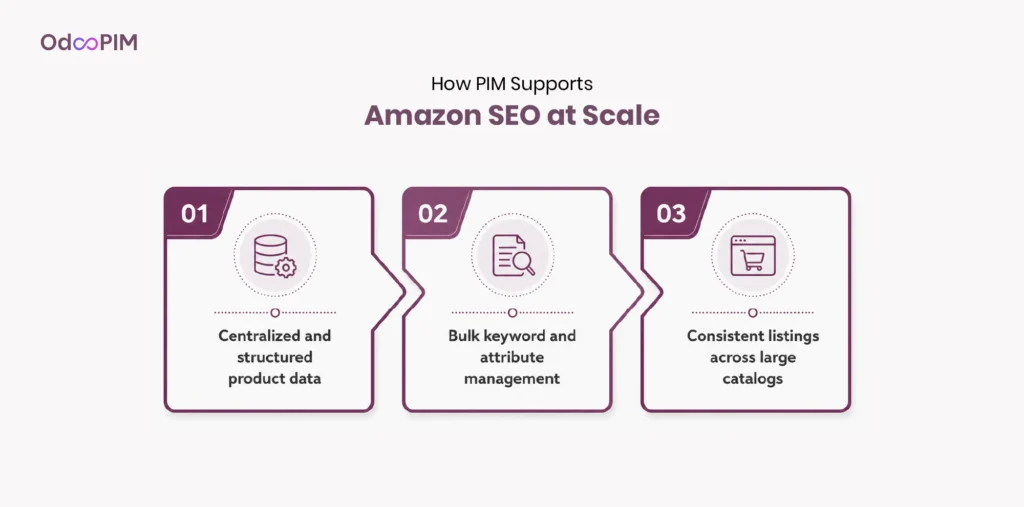
Centralized and structured product data
PIM for Amazon SEO centralizes every SEO element, titles, bullets, descriptions, backend search terms, and A+ content, into one master database. Your team stops juggling spreadsheets for different product categories. Amazon SEO for sellers with structured data ensures that every product has the same optimized fields. A new coffee maker inherits the same title format, bullet structure, and backend term strategy as every other coffee maker. Amazon listing optimization becomes repeatable, not guesswork. Centralization enables consistency and consistency drives rankings. One source of truth, one SEO strategy and infinite products.
Bulk keyword and attribute management
Update backend search terms across 5,000 products with one click. PIM for Amazon SEO with bulk editing applies keyword changes to your entire catalog simultaneously. Add a new winning keyword to your PIM. The system pushes it to every relevant ASIN’s backend search fields. Amazon keyword research becomes actionable at scale. No more per-product keyword entry. Amazon product ranking improves when every product has optimized, consistent keywords. Bulk management is not a luxury at scale, it is a necessity. Manual per-product keyword updates fail and the PIM bulk updates scale.
Consistent listings across large catalogs
Amazon A+ content optimization with PIM ensures every eligible ASIN receives the correct enhanced content modules. A brand story applies to all products. A comparison chart applies to related product families. Amazon backend search terms stay consistent across variants of configurable products. One size uses the same backend keywords as all other sizes. Amazon SEO for sellers with PIM eliminates the inconsistency that plagues manual management. A seller with 10,000 SKUs cannot manually ensure every listing is optimized. PIM does it automatically. Consistency at scale wins on Amazon and inconsistent listings lose. So, choose consistency, choose PIM, rank higher and sell more.

How OdooPIM Helps You Rank Better on Amazon
Key features for Amazon SEO workflows
OdooPIM includes title template engines that enforce consistent formatting across your entire catalog. Define a title structure once, Brand + Product Type + Key Feature + Size. Every new product inherits the correct format automatically. Amazon backend search terms are managed in bulk. Update keywords across thousands of ASINs with one click. Amazon A+ content optimization with OdooPIM pushes enhanced modules to Amazon automatically. PIM for Amazon SEO with variant management ensures consistent attribute values across child ASINs. One system, all SEO elements and complete control. No spreadsheets, no guesswork and just optimized listings at scale.
Learn about amazon catalog management.
Getting started with OdooPIM
Install the OdooPIM Amazon connector from the Odoo App Store. Configure your Seller Central API credentials, map your attribute families to Amazon’s category requirements and define your title templates and bullet point structures. Amazon keyword research results can be imported into backend search term fields. Run an initial test sync with 25 products, verify SEO elements in Seller Central and then schedule automated daily syncs for your catalog. Amazon listing optimization with OdooPIM reduces manual SEO work by 80%. Amazon SEO for sellers becomes scalable. Book a demo, see OdooPIM in action and start ranking higher today.
Frequently Asked Questions
1. What is Amazon SEO and how does it work?
Amazon SEO is the process of optimizing product listings to rank higher in Amazon’s internal search results. Unlike Google, Amazon’s A10 algorithm prioritizes sales velocity and conversion rate over backlinks. Amazon product ranking depends on how well your listing converts browsers into buyers for specific search terms. Optimized titles, bullet points, backend search terms, and A+ content all signal relevance to the algorithm. Higher conversion rates lead to higher rankings and higher rankings lead to more sales. It is a virtuous cycle.
2. How do I research keywords for Amazon product listings?
Amazon keyword research starts with Amazon’s own search bar. Type a seed keyword and review the auto-suggested phrases, these are high-volume search terms. Use tools like Helium 10, Jungle Scout, or Amazon Brand Analytics to find search volume and competitor keywords. Focus on long-tail phrases with purchase intent. “Stainless steel coffee maker 12-cup” converts better than “coffee maker.” Amazon listing optimization requires placing primary keywords in titles, secondary in bullets, and long-tail in backend search terms. Research thoroughly and update regularly.
3. What are Amazon backend search terms and why do they matter?
Amazon backend search terms are invisible keywords that shoppers never see but Amazon’s algorithm uses for ranking. They allow up to 1,250 bytes for generic keywords plus 500 bytes for specific product types. Include misspellings, synonyms, and related phrases that did not fit in your title or bullets. Avoid repetition, commas, and prohibited phrases like “best” or “cheap.” Amazon SEO for sellers requires filling every backend field. Leaving them empty means leaving discoverability on the table, so use every character wisely.
4. How do I optimize my Amazon product title for SEO?
Your product title is the most important ranking factor on Amazon. Front-load your primary keyword within the first 50-80 characters. Include brand, model, size, color, and key feature within Amazon’s character limits. Amazon listing optimization requires titles that read naturally for shoppers while including search terms. Avoid keyword stuffing, “Coffee Maker Coffee Machine Brewer” looks spammy and hurts conversion. Amazon A+ content optimization complements strong titles with enhanced modules. Write for humans first. Amazon’s algorithm rewards conversions as clear, readable titles convert better.
5. What is A+ content and how does it affect Amazon SEO?
Amazon A+ content optimization involves enhanced product descriptions using rich media, comparison charts, brand stories, high-resolution images, and video. A+ content can increase conversion rates by 5-15%. Higher conversion rates signal Amazon’s algorithm that your product is relevant and trustworthy. Amazon product ranking improves when A+ content helps convert browsers into buyers. PIM for Amazon SEO centralizes A+ modules, ensuring every eligible ASIN receives the correct enhanced content. A+ content is not optional for brand owners. It impacts your bottom line.
6. Can PIM software help with Amazon SEO at scale?
PIM for Amazon SEO centralizes the SEO element, titles, bullets, descriptions, backend search terms, and A+ content, into one master database. Instead of updating thousands of listings manually, you make changes once in your PIM and push to Amazon via API. Amazon SEO for sellers with PIM enables bulk keyword updates, consistent attribute values across variants, and automated validation against Amazon’s requirements. A seller with 10,000 SKUs cannot manually optimize every listing, PIM does it automatically. Scale your SEO and scale your sales.